Wang Di, Senior Vice President of Xingxing Charging: Empowering the New Energy Sector with AI to Build an Intelligent Ecosystem for Charging, Microgrids, and Power Trading | 36Kr Future Industry Conference 2025
On September 10th, the 2025 36Kr Industry Future Conference, hosted by 36Kr, grandly kicked off in Xiamen, China. This conference has joined hands with the "China International Fair for Investment and Trade" hosted by the Ministry of Commerce. With the core theme of "The Era of Intensive Cultivation, the Surging Tides of Jiahe", it has dedicatedly created a high - standard, high - value, and high - influence industrial event that combines national vision, industrial depth, and market enthusiasm.
The conference closely aligns with national strategic directions and the forefront of industrial development. It focuses on five core sectors: artificial intelligence, low - altitude economy, advanced manufacturing, new energy, and mass consumption. It brings together the top forces in the industry to discuss development paths and envision the future of the industry. During the two - day agenda, with the "industrial cooperation chain" as the logical main line, the conference focuses on the collaborative mechanism among the government, capital, and industry. It delves into how to break down barriers, integrate resources, and precisely solve the pain points, bottlenecks, and constraints in industrial development.
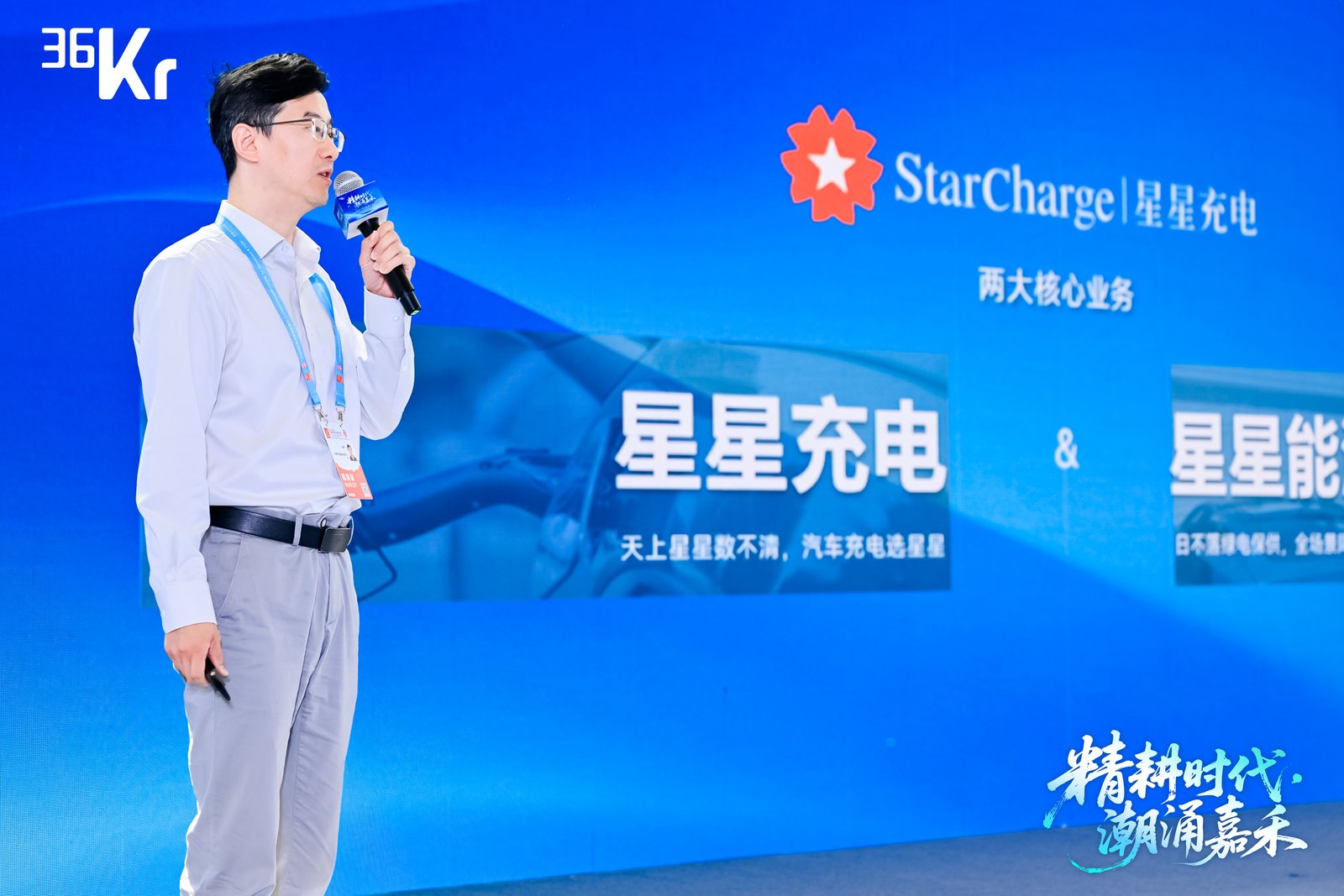
On that day, Wang Di, the senior vice - president of Star Charge and the dean of the Digital Energy Research Institute, delivered a keynote speech titled "The Development Path of Star Charge's AI - Driven New Energy Three - Network Integration".
The following is the content of the speech, edited by 36Kr:
Good morning, everyone! Today, I'd like to focus on the application of AI technology in the new energy field.
Before I start, let me briefly introduce Star Charge. C - end users mostly know us for our charging piles and charging stations, but we also have a layout in the energy business. Now, our charging network and intelligent micro - grid cover multiple scenarios. Let me give you some data: Since 2014, we have independently developed and produced charging piles, invested in and built charging stations, developed a franchise network, and provided solutions. Over the past 11 years, our business has covered 261 prefecture - level cities and more than 2,800 counties across the country. The number of charging piles connected to our platform exceeds 2 million, accounting for about 1/6 of the country's public charging infrastructure. It can be said that now it's no longer a problem for people to charge their electric cars when traveling across the country.
To support such a large - scale business, the core is to achieve: safety, efficiency, and long service life. The emergence of artificial intelligence technology has provided crucial support for this goal. All our hardware products are implanted with intelligent algorithms and a combination of software and hardware. Our business covers the charging network, the user - side intelligent micro - grid, and the operation of virtual power plants built on the basis of the two. Next, I'll share the practical applications of AI through specific cases. Although some of the content is quite professional, I hope it can provide references for friends from different industries on how to think about and plan when they want to integrate AI into their industries.
The first case is the layout planning and site selection of the charging network. Whether it's planning a city's charging network for the next five years or a small - and - medium - sized operator investing in a single charging station, "site selection" is the core issue. It may seem simple, but in fact, it requires multi - dimensional considerations from aspects such as investment and the market. In the process of building charging stations over the past decade, Star Charge has accumulated a large amount of experience, both successful and unsuccessful. We have extracted these experiences and best practices and built an automated recommendation and verification platform through AI. Now, this system is a "must - pass" for our internal investment decisions and proposals to customers. Although it can't guarantee 100% success, it can accurately identify risk points and help avoid potential problems.
The second case is the AI intelligent assistant "Station Doctor" for charging station operation. It's quite common for AI to solve knowledge - based problems, but its in - depth integration in vertical fields still needs exploration. For example, charging station operators may ask, "How was the operation of the station yesterday and last week? What are the suggestions for cost reduction, efficiency improvement, and revenue increase?" These are the core concerns of investors and operators. However, in the traditional model, the whole process from data collection, research to staff training is cumbersome and inefficient. It's already difficult to manage a single station, let alone operate on a national scale. "Station Doctor" can not only generate analysis reports with more than 100 indicators but also generate task lists and assign them to operators. After the tasks are completed, it will review the results to form an online closed - loop, enabling AI - empowered large - scale operation.
In asset management, intelligent pricing is the key to increasing revenue. Take a charging station near a venue in Xiamen as an example. Determining "how much to charge for one kilowatt - hour of electricity" requires considering multiple factors such as local electricity prices, vehicle demand, surrounding competition, and seasonal changes. Moreover, C - end charging fees include variables such as electricity prices, service fees, and promotions. It's difficult for traditional operation teams to achieve refined pricing. Now, we use AI and large - scale models to achieve full - scale automatic pricing. Operators only need to make one - click configurations in the background, and AI will recalculate and update the station prices every day with an accuracy of up to four decimal places, which is beyond the reach of manual work.
The fourth case is the safety and unmanned management of charging stations. Most charging stations in China are unmanned and are located in areas such as communities and office buildings. Problems such as vehicle parking occupation, equipment damage, and fire hazards are likely to occur. Although the thermal runaway of new energy vehicle charging is a low - probability event, it's still a high - frequency scenario that national operators need to deal with. Therefore, we have developed an AI device integrating cameras, voice interaction, and intelligent ground - lock control, which can replace manual management 24/7 to solve the above pain points.
In terms of equipment maintenance, most charging piles are installed outdoors and need to withstand extreme environments such as temperatures as low as minus 40 - 50 degrees Celsius in Northeast China, high temperatures in Xinjiang, high humidity in Hainan, and high - altitude conditions in Tibet. Improving availability is the core challenge. In the past, it was difficult to detect outdoor IoT device failures in a timely manner, and the maintenance cost was high. Now, through full - scale proactive maintenance and preventive detection, we transmit the equipment operating condition data to the cloud platform in real - time. We use an automatic diagnostic model to predict and analyze failures. Most problems can be self - healed through remote upgrades, significantly improving equipment availability. Currently, the equipment availability and charging success rate of the Star Charge network are leading in the industry, and the number of required maintenance personnel has decreased significantly.
Customer service is one of the most mature fields for AI application. Our core approach is to integrate the industry knowledge base and business characteristics into the online robot and intelligent voice system through large - scale model plug - ins, focusing on improving the self - service resolution rate and closed - loop rate. After years of refinement, currently 75% of user problems can be independently solved by AI and robots.
In the field of intelligent micro - grids, the core is to solve the coordination problem among photovoltaics, energy storage, and charging. This is imperceptible to C - end users, but it directly affects the operator's electricity price cost, green energy consumption, and coordination efficiency with the power grid. Take the Changzhou Olympic Sports Center as an example. On weekends, a football game attracts 40,000 - 50,000 people, and a large number of out - of - town vehicles need to be charged. The venue is equipped with photovoltaic and energy - storage facilities. Problems such as "when to charge, what price to set, and how to balance the grid load" were previously manually scheduled, but now they are all optimized by AI algorithms in the background. The extension of this model is vehicle - to - grid interaction (V2G). The year 2025 is known as the first year of vehicle - to - grid interaction. In the future, new energy vehicles will not only be energy consumers but also participate in grid regulation through discharging. For example, when the power supply is tight during large - scale events, vehicles around the charging station can discharge collectively to support the local power grid. Currently, the National Energy Administration has launched pilot projects in 9 cities, and only Shanghai and Changzhou in the Yangtze River Delta region have been selected. We completed the "Discharge for Love" experiment during the Suzhou Super League games in Changzhou, which is a milestone breakthrough in the relationship between automobiles and energy. The implementation of vehicle - to - grid interaction depends on the support of AI in aspects such as grid load prediction and green energy consumption optimization. At the same time, we also use digital twin technology to monitor the safety of energy - storage batteries.
In the production and manufacturing process, we apply AI to prediction, production scheduling, production planning, and logistics scheduling. Take visual inspection as an example. The cameras at the charging pile production and packaging stations can automatically identify the contents and sequence of packing, detect omissions and misplacements, significantly improving the quality control efficiency.
Overall, Star Charge is building an AI - intelligent foundation to empower ten business fields. Through the development and implementation of applications, we aim to improve efficiency, reduce costs, and develop new - quality productivity. This is also the core of the enterprise's top - level AI layout design.
Finally, I'd like to show you the latest scenario integrating the above capabilities: the Three - Network Integration Platform and the Taiyi Power Trading System. In the application of independent energy storage on the grid side combined with virtual power plants, AI can assist in energy - storage trading decisions, helping enterprises buy low - cost electricity in the power market and profit from discharging during peak electricity consumption. The scale of China's power trading market reaches 10 trillion kilowatt - hours, covering medium - and long - term wholesale and spot trading, similar to commodity trading. In the past, it relied on professional talents in the power market. Now, we have built an intelligent auxiliary platform through large - scale models, integrating functions such as power policy interpretation, weather prediction, new energy power generation prediction, and quotation strategy analysis to form an "intelligent agent", which provides efficient assistance to the trading team. In the future, full - scale automated trading will be gradually realized.
That's all for my sharing. Thank you!