What signals does Baidu's bond issuance send?
On September 8th, Baidu announced its plan to issue RMB-denominated senior unsecured notes through an offshore transaction outside the United States. The net proceeds from the note issuance will be used for general corporate purposes, including repaying certain existing debts, paying interest, and other general corporate uses.
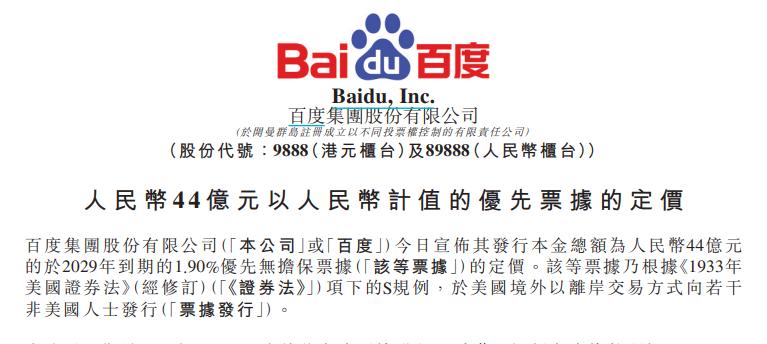
Screenshot of the announcement
The market also responded optimistically. The intraday maximum increase of Baidu's Hong Kong stocks reached 12.7%, and the final closing increase was 9.48%.
Why does cash-rich Baidu issue bonds?
According to the second-quarter financial report for 2025, Baidu still has a cash reserve of $4.1 billion. At the earnings conference, Baidu's management also stated that as of June 2025, Baidu held a total of $32 billion in cash and cash equivalents, with a net cash of $21.7 billion, indicating that its cash reserve remains abundant.
However, looking at the due amount of Baidu's short-term borrowings, the mid-year report for 2025 showed a significant increase. It rose from $1.466 billion in the first-quarter report to $3.3 billion, reaching a new high in nearly two decades since 2017. From this perspective, Baidu has the motivation to optimize its debt structure.
More importantly, Baidu is rapidly increasing its investment in AI infrastructure such as cloud, data centers, and large models. The capital expenditure in the second quarter increased from $2.1 billion last year to $3.8 billion, a year-on-year increase of over 80%. It needs to reserve strength for the next stage of investment.
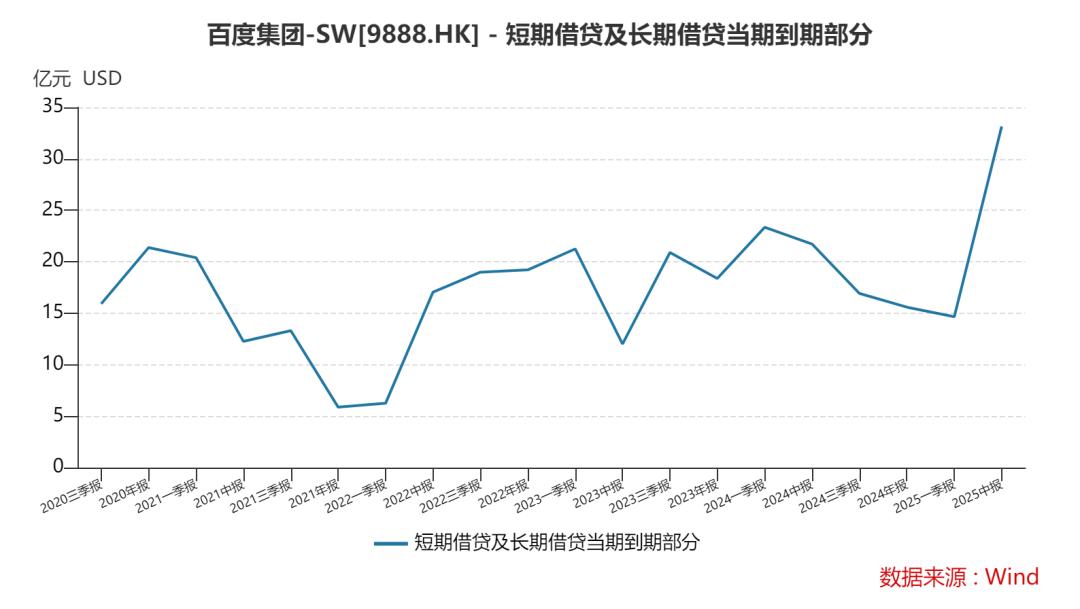
Baidu's short-term borrowings and the current due portion of long-term borrowings
Currently, the RMB interest rate is at a historical low. The pricing of the 1.90% senior unsecured notes due in 2029 issued this time can effectively reduce the company's interest burden.
In 2024, the company's interest expense was $397 million. The average interest-bearing liabilities (long-term borrowings + short-term borrowings) were $9.389 billion, corresponding to an interest burden level of 4.2%, significantly higher than the interest rate of this bond issuance.
Actually, in March this year, Baidu began to optimize its debt structure. It issued dim sum bonds for the first time to raise 10 billion RMB, setting the coupon rates of the 5-year and 10-year bonds at 2.7% and 3% respectively. By taking advantage of the low-interest-rate cycle, it actively issued 5-year and 10-year bonds to lock in lower capital costs. Through debt optimization, the company can effectively reduce its interest expenses.
From international experience, actively issuing bonds during low-interest-rate periods to lock in low-cost funds is a common practice among overseas peers. As a cash cow, Apple actively issued long-term bonds to lock in low-interest funds during the low-interest-rate period in the United States from 2015 to 2017 and during the COVID-19 pandemic in the United States from 2020 to 2021 to improve its capital operation efficiency.
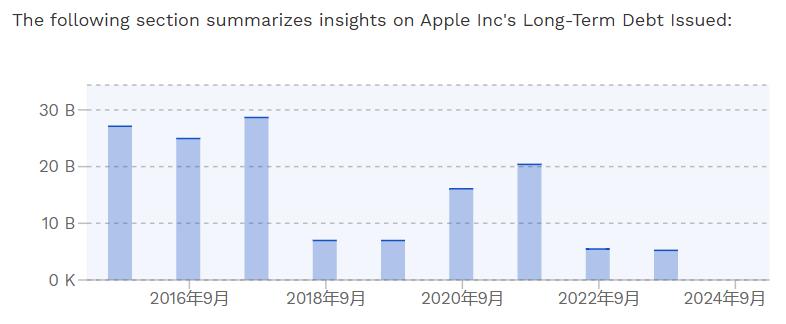
Summary of Apple's long-term debt issuance
Doubling down on AI, can Baidu's search business make a comeback?
Baidu's traditional search-related business is currently accelerating its AI transformation. It is facing certain challenges, but we can also see Baidu's determination to transform into an AI company.
In July, the proportion of AI-generated content on the mobile search results page rapidly increased from 35% in April to 64%. On the Baidu APP, over 60% of the search results pages present rich media content at the top. However, compared with web search, AI search makes it more difficult to embed advertisements due to the characteristics of single-text output.
However, this also shows Baidu's determination to actively embrace long-term transformation in the face of industry changes. The recent bond issuance also provides more sufficient financial support for Baidu's long-term AI investment.
Looking at the capital markets in China and the United States, there are three specific benchmarking areas for AI.
E-commerce: Alibaba vs. Amazon
Social media: Tencent vs. Meta
Search: Baidu vs. Google
Alibaba has data advantages in e-commerce, and Tencent has resources in social media. Then, with the support of a large amount of historical search data, can the undervalued Baidu catch up?
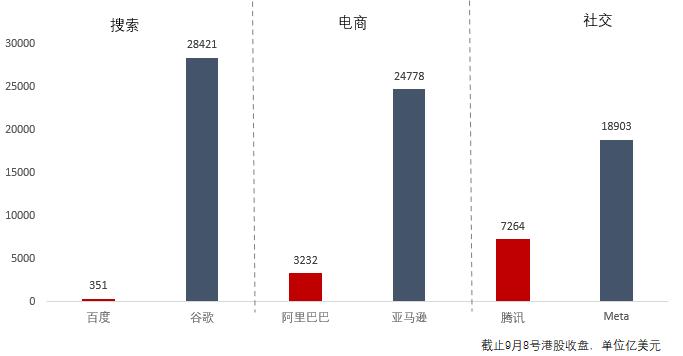
Comparison of the three specific benchmarking areas for AI in China and the United States