How can human-AI teams achieve mutual understanding?
Imagine this: your project team is in the final sprint for a crucial product launch. The team consists of an experienced project manager, a creative designer, a highly skilled programmer, and a new member - an AI Agent.
It analyzes market data and predicts user responses with you. This is a well - rounded and dedicated AI colleague. As AI integrates into work teams with unprecedented depth, this scenario will gradually shift from science fiction to reality.
Questions then arise: how can we collaborate efficiently with such a "non - human colleague"? Can humans and AI achieve the same level of synergy and understanding as human colleagues?
To answer this question, let's first examine how synergy is generated in human teams.
Two Explanations for Synergy in Human Teams
In traditional human teams, we often use the term "synergy" to describe a highly efficient collaborative state. But what exactly is "synergy"? There are two mainstream academic explanations: the "Shared Mental Models" (SMM), centered around knowledge structure, and the "Interactive Team Cognition" (ITC), centered around the interaction process. We can simply understand them as the "Script School" and the "Improvisation School".
1. The "Script School": Everyone Holds the Same Script
The "Script School" believes that a highly efficient team owes its efficiency to the team members' highly consistent understanding of "how the work should be done". Just like a well - established film crew, the director, actors, cameramen, and lighting technicians all have a thorough understanding of the script, storyboard, and blocking. Everyone has the same "script" in mind, knowing what they should do and what others will do in different scenarios.
This "script" is called the "Shared Mental Model" in management. It encompasses the team's common understanding of the task itself (such as the project's goals, processes, and technical difficulties) and of the team members (such as who is good at what and who is responsible for what). If a team has a highly unified "script", the communication cost will be extremely low, and collaboration will be very smooth. For example, with a simple hint from the project manager, the programmer knows which bug to fix urgently; with a single statement from the designer, the marketing specialist understands which selling point to highlight. This "script - based" collaboration based on consensus is stable, reliable, and efficient.
2. The "Improvisation School": On - the - Spot Interaction Matters
However, real - world work is often much more complex than following a script, full of unexpected events. Sudden market changes, last - minute client requirement changes, new technological bottlenecks... In such situations, even the most perfect "script" may become ineffective.
Thus, there is a second explanation, the "Improvisation School". It argues that the real strength of a team lies not in reaching a perfect pre - consensus but in the ability to adapt and coordinate during dynamic interactions. Just like a top - notch jazz band, the musicians may only have a simple melodic framework, but through listening, responding, and improvising with each other, they can create amazing music. This fluid and real - time collective wisdom generated during interactions is called "Interactive Team Cognition".
A team of the "Improvisation School" may not have a perfect script, but they have strong communication and adaptability skills. When unexpected events occur, they can quickly exchange information, adjust strategies, and re - allocate tasks, finding new order in chaos. This improvisational collaboration is flexible, resilient, and creative.
In summary, the "Script School" emphasizes that "team members think alike", aiming for stability and efficiency; the "Improvisation School" emphasizes that "we interact well", aiming for flexibility and innovation. In a traditional team, the ideal situation is that the two complement each other. With a "script" as a foundation and "improvisation" as a supplement, the team can handle complex and ever - changing work.
Two New Challenges Brought by AI
Now, let's introduce AI, this "new colleague", into the team. You'll find that both the theories of the "Script School" and the "Improvisation School" face unprecedented challenges.
Challenge 1: Can AI Understand Our "Script"?
The core of the "Script School" is sharing, meaning that everyone has the same model in mind. However, the "mind" of AI is completely different from that of humans. Its "mentality" is composed of algorithms, data, and models. For the following reasons, it's difficult to ensure that AI can understand the unique "script" of humans.
(1) Understanding Deviation: When you tell AI that "this plan needs to be more impactful", you may be thinking about visual shock and emotional resonance, but AI may interpret it as "increasing contrast" or "using more aggressive words". It cannot understand the rich subtext, emotions, and cultural background behind human language.
(2) Information Asymmetry: AI has access to a vast amount of data, but it doesn't know who in the team is in a bad mood today, who has a conflict with whom, or who is under great pressure recently. These "tacit information" are crucial in human collaboration, but no database can list all the implicit facts we know. Conversely, humans also cannot fully understand how AI reaches a certain conclusion. Many advanced AI models (such as deep learning) are like "black boxes".
(3) Role Fixation: Roles in human teams are flexible. One may be the main attacker today and the assistant tomorrow. However, the roles of AI are often preset. Whether it's a "data analyst" or a "copywriter optimizer", it's difficult for AI to switch roles flexibly according to the situation like humans.
Therefore, it's quite difficult for humans to establish a "Shared Mental Model" with AI, just like asking an alien actor to understand an Earth script. If forced to share, the result may be that humans constantly adapt to AI's logic, or AI misinterprets human instructions, ultimately leading to low - efficiency collaboration or even errors.
Challenge 2: Can AI "Improvise" with Us?
The core of the "Improvisation School" is high - quality interaction. However, AI currently has difficulty in real - sense improvisational interaction for the following reasons:
(1) Lack of Initiative and Empathy in AI: Improvisation requires active listening, emotion perception, and creative responses. AI can passively answer questions, but it's hard for it to actively detect changes in the team atmosphere, let alone use encouraging words to boost morale. It has no empathy and cannot conduct emotional communication.
(2) Breakage of the Emotional Feedback Loop: In human team improvisation, when a member proposes an idea, others will immediately give feedback through language, facial expressions, and body language, forming a rapidly iterative feedback loop. AI's feedback is often data - based, logical, and delayed. It cannot integrate into this real - time interactive flow full of emotions and intuitions.
(3) Dilemma in Trust - Building: Improvisational collaboration is based on deep trust. You are willing to improvise with your teammates because you trust their professional abilities and character. However, our trust in AI often only lies in "it can calculate accurately", rather than "it is reliable". When AI gives a counter - intuitive suggestion, should we trust it or our own experience? This lack of trust makes improvisation extremely difficult.
Therefore, it's still too early to expect AI to spark ideas with humans in interactions like human teammates.
AI is more like a powerful "instrument", but not yet a "musician" who can "improvise and play together" with humans.
A New Approach: From "Shared Mentality" to "Human - AI Mutual Recognition and Synergistic Efficiency"
Since single theories don't work, can we change our thinking? There's no need to force AI to have the same "mentality" as humans, nor to expect it to "interact" like humans. This article attempts to construct a new model more suitable for human - AI collaboration, which consists of three levels:
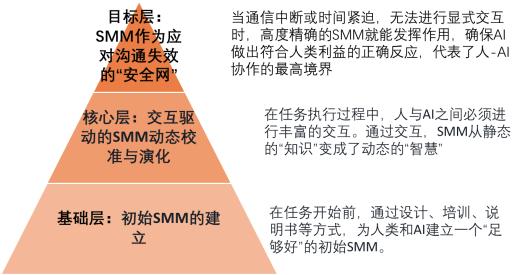
Three - level Synergy Model for Human - AI Teams
Foundation Level: Establish a "Mutual Recognition Contract" - Create an "Operation Manual" for Human - AI Collaboration
The foundation level borrows from the idea of the "Script School", but its goal is not "shared mentality" but "mutual recognition of abilities". We don't need AI to understand human complex emotions, nor do we need humans to understand AI's complex algorithms. We only need both sides to have a clear and unified agreement on each other's "ability boundaries" and "communication methods". Just like writing an "operation manual" for a complex machine, the manual will state:
(1) AI Ability List. It explains what AI can and cannot do. AI can be assigned one (or several) relatively stable roles, such as a marketing analyst: "I can analyze the sales data of the past five years and predict the trend of the next quarter, but I cannot predict the sudden marketing activities of competitors."
(2) AI Instruction Set. It shows how humans should give instructions to AI. Don't forget to train its polite language: "Please ask me questions with structured instructions like 'the target users are women aged 25 - 30', 'the style should be fresh and natural', 'the budget should not exceed 10,000 yuan', and I will provide a more accurate plan. Thank you!"
(3) Output Standards and Styles. It details how AI should present results to humans. Here is an example of a rigorous scientific research style: "My conclusion is based on three data points, A, B, and C, with a confidence level of 90%. Among them, data point A has the greatest impact."
This operation manual is the "mutual recognition contract" between humans and AI. It doesn't pursue deep spiritual resonance but efficient interoperability. With it, humans know how to "use" AI as a colleague, and AI knows how to "serve" the human team. This is the foundation for human - AI collaboration.
Core Level: Promote "Synergistic Efficiency" - Make Human - AI Interaction Produce a 1 + 1>2 Effect
This level borrows from the idea of the "Improvisation School", but the protagonist is humans, and AI is the "super assistant". The core of the interaction is still the human team, but the addition of AI greatly enhances the quality and efficiency of human interaction.
Here, AI's role is not a passive executor but an active "empowerer":
(1) Information Empowerment: During team discussions, AI can act like an all - knowing "information officer", providing relevant data, cases, and background knowledge in real - time, enabling human discussions to be based on facts rather than experience and speculation.
(2) Option Generation: When the team gets stuck in a mental dead - end, AI can quickly generate dozens of alternative plans for humans to discuss and select. It doesn't make decisions but broadens human decision - making horizons.
(3) Process Optimization: AI can act like an indefatigable "coordinator", automatically tracking project progress, reminding of risks, and assigning tasks, freeing humans from tedious administrative work and allowing them to focus on more creative interactions.
At this level, the interaction between AI and humans is indirect and non - social but powerful. By empowering the human interaction process, it makes the team's "improvisation" more fluent, exciting, and inspiring. The human team remains the protagonist of "improvisation", but AI provides them with top - notch "stage" and "sound equipment".
Goal Level: Achieve "Synergistic Cooperation" - SMM as a "Safety Net" for Communication Failure
Through continuous interaction at the core level, the shared mental model is calibrated more and more accurately, and humans and AI become more and more "in sync". Even when communication is interrupted or time is tight and explicit interaction and communication are impossible, this highly accurate shared mental model can still function, ensuring that AI can still make correct responses in the best interests of humans based on the previous in - depth understanding of each other.
The goal level is the ultimate standard to measure whether a team is "excellent". It describes the "bottom - line value" and "ideal state" of the shared mental model, ensuring the team's survival and basic functions in the worst - case scenario. It represents the real evolution of human - AI collaboration from a "tool - user" relationship to a symbiotic relationship of mutual understanding.
Four Operational Suggestions for Human - AI Team Building
The addition of AI is not a simple enhancement of the human team but a profound reshaping.
AI forces us to rethink the essence of "collaboration". Perhaps we should no longer cling to the traditional concept of "shared mentality" and fantasize about becoming soulmates with AI. Instead, we should establish a new type of partnership with AI with a practical and open - minded attitude.
We propose the following four operational suggestions for human - AI team building:
First, write a clear job description for AI and establish a mutual recognition contract. At the beginning of introducing AI tools, organize a team workshop to form a written document with consensus on AI's job responsibilities, ability boundaries, communication language, and reporting format. This "job description" is the team's "mutual recognition contract", which can unify the team's understanding of AI, reduce misunderstandings and ineffective attempts, and let everyone know how to interact with this "new colleague".
Second, consider setting up the role of "human - AI translator" to promote synergistic efficiency. In the team, designate 1 - 2 members who are sensitive to technology and have strong business capabilities to serve as "human - AI translators". Their responsibility is not to become technical experts but to translate the complex and professional results output by AI into plain language that all team members can understand and explain the business implications behind them. At the same time, translate the vague and divergent needs of team members into "structured instructions" that AI can accurately understand; collect problems and good experiences encountered by the team in using AI and update AI's "job description" regularly.
Third, conduct pre - training on "human - AI collaboration" scenario simulations to strengthen the interaction process. Just like fire drills, regularly organize the team to conduct simulation exercises on "human - AI collaboration". For example, in new product development, a new product concept meeting can be simulated. Team members put forward preliminary ideas, and AI is responsible for quickly searching for relevant patents, conducting competitor analysis, and collecting user comments, and generating several product concept sketches. The team then conducts brainstorming and in - depth discussions on this basis. Through actual combat exercises, let team members personally experience how to cooperate with AI in a dynamic process, get familiar with the rhythm and process of "human - AI interaction", cultivate a collaborative habit of "consulting AI when encountering problems", and enhance the team's adaptability.
Finally, establish a review and iteration mechanism for "human - AI collaboration" to achieve continuous optimization. After each project cycle, in addition to the regular business review, add a special "human - AI collaboration review" session. Topics for discussion include: in this project, in which aspects did AI greatly assist us? In which aspects did AI underperform? What are the reasons? What updates are needed for AI's "job description"? What good skills do team members have to share when collaborating with AI? Through regular reviews, the team can continuously optimize the "mutual recognition contract" and "synergistic efficiency" process with AI, making this mixed - team smarter and more efficient.
Human - AI collaboration will become the norm in organizations. The relationship between humans and AI begins with a clear "mutual recognition contract" that defines each other's boundaries and language, and is realized through an efficient "synergistic efficiency" process, making AI a "super amplifier" of the team's wisdom and creativity.
The future excellent teams will be those that are best at collaborating with AI. Human members will not be replaced by AI. Instead, by mastering AI, they will unleash unprecedented and amazing collective potential.