In the new round of urban competition, cities with a trillion - yuan GDP are taking the lead.
Recently, Wenzhou held a city-wide conference on the innovative development of artificial intelligence, at which the Wenzhou Artificial Intelligence Bureau was inaugurated. This is the first artificial intelligence bureau in Zhejiang and the first municipal-level artificial intelligence bureau in the country.
That's not all. On the same day, Wenzhou also released several documents, including the Implementation Plan for Accelerating the Construction of an Innovative and Developed Pilot City for Artificial Intelligence in Wenzhou (2025 - 2027), clearly stating that it aims to promote the in-depth integration and practical application of AI in fields such as manufacturing and healthcare, so that artificial intelligence can truly serve industrial upgrading and improve people's livelihoods.
The artificial intelligence industry is regarded as an important driving force for Wenzhou to reach a GDP of one trillion yuan. However, Wenzhou's significant moves in this industry are not an isolated case.
In May this year, Longgang District in Shenzhen held a conference on the development of artificial intelligence and robotics, and unveiled the Longgang District Artificial Intelligence (Robotics) Bureau, which is mainly responsible for overall planning and promotion of the development plans, ecological construction, investment promotion, service for enterprises, scenario promotion, and safety management of artificial intelligence and robotics.
It can be seen that both trillion-yuan cities and cities on the verge of reaching this milestone are actively seizing the national opportunities in artificial intelligence development. Through measures such as establishing specialized institutions and introducing supporting plans, they are promoting the extensive and in-depth integration of artificial intelligence with various sectors and industries in the economy and society.
In recent years, China's artificial intelligence industry has witnessed rapid growth. In 2024, the industry's scale exceeded 700 billion yuan, maintaining a growth rate of over 20% for several consecutive years. The industrial chain covers aspects such as data, algorithms, platforms, chips, and applications.
As the industrial strength continues to rise, the national-level policy layout is also being continuously deepened.
The 2024 Government Work Report emphasized, "Deepen the R & D and application of big data, artificial intelligence, etc., and launch the 'Artificial Intelligence +' initiative." This was the first time the "Artificial Intelligence +" concept appeared in China's Government Work Report. In December 2024, the Central Economic Work Conference mentioned the "Artificial Intelligence +" initiative again. The 2025 Government Work Report also emphasized the need to "continuously promote the 'Artificial Intelligence +' initiative."
Against this backdrop, local governments have successively issued special policies or relevant documents on artificial intelligence, actively exploring different paths for AI implementation - some focus on the intelligent transformation of the manufacturing industry, some strive for AI-assisted diagnosis in healthcare, and others promote AI-based personalized teaching in the education sector.
Experts interviewed by Times Weekly reporters said that from the national policy orientation to local governments' issuance of special documents and active implementation, the intention of this series of actions is clear: to inject new vitality into key areas with AI, break through the growth bottlenecks of traditional industries, and achieve high-quality economic development and modernization of the industrial system.
01
Trillion-yuan Cities Accelerate Their Layout
As important driving forces for regional economic development, many of China's GDP trillion-yuan cities have actively laid out in the field of artificial intelligence and intensively issued policy documents related to "Artificial Intelligence +".
According to the incomplete statistics of Times Weekly reporters, since the beginning of this year, among the 27 trillion-yuan cities, 20 cities, including Beijing, Tianjin, and Chongqing, have released implementation plans, action plans, and other documents related to the development of artificial intelligence, with a total of 32 documents. Cities such as Jinan, Nanjing, and Foshan had already issued similar policies as early as 2024.
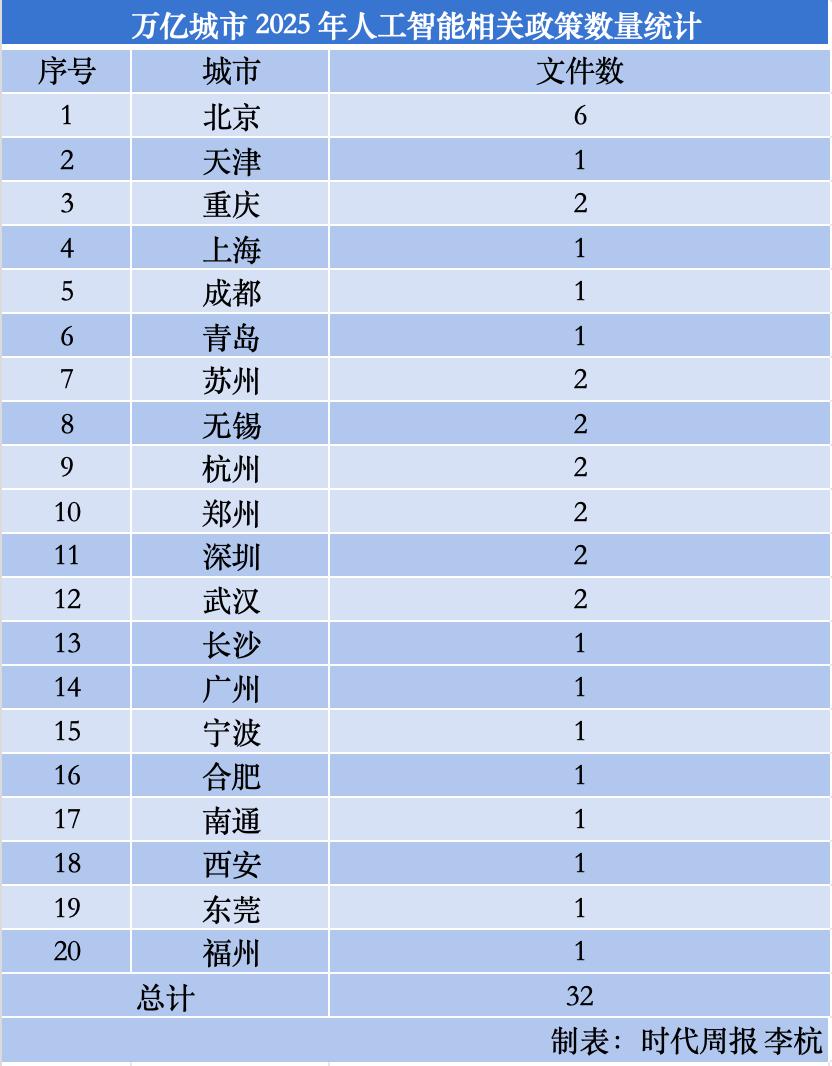
Further analysis reveals that among the aforementioned 32 documents, there are not only comprehensive plans for the development of the artificial intelligence industry and the overall promotion of "Artificial Intelligence +", but also special plans for the in-depth integration of artificial intelligence with specific fields such as manufacturing, healthcare, and education.
Among them, Beijing's performance is particularly outstanding. In 2025, Beijing issued the largest number of artificial intelligence-related policies among trillion-yuan cities, covering multiple fields such as healthcare, embodied intelligence, new materials, primary and secondary education, and industrialization. This not only reflects the breadth of the policy layout but also the leading development trend of Beijing in the field of artificial intelligence.
In the comprehensive plans, many places have laid out around the three basic elements for the development of artificial intelligence: computing power, data, and algorithms.
For example, the Several Policy Measures for Promoting the Development of the Artificial Intelligence Industry in Wuhan, released in February this year, mentioned that it is necessary to strengthen the supply of inclusive computing power, enhance the model innovation ability, promote the development and utilization of data, and provide financial subsidies ranging from 2 million to 5 million yuan for relevant projects.
Nantong released the Notice on the Action Plan for Promoting the Innovative Development of the General Artificial Intelligence Industry at the beginning of this year, proposing to strengthen the construction of computing power infrastructure and deploy intelligent computing centers in advance. Relying on the industrial foundation, it aims to strengthen the R & D of advanced large models in vertical fields and the local access, training, commercial deployment, and application of excellent industry-specific large models, and create a number of typical application scenarios for "Artificial Intelligence +".
Judging from these policy orientations, when promoting the development of the artificial intelligence industry, local governments are still strengthening the underlying foundation to pave the way for the subsequent integration and application of "Artificial Intelligence +".
Now that artificial intelligence technology is becoming increasingly mature, many cities have jumped out of the framework of basic layout and directly focused on key fields such as manufacturing, healthcare, and education, issuing more targeted special plans.
Among these special plans, the number of documents related to "Artificial Intelligence + Manufacturing" is the largest. Major industrial cities such as Shanghai, Guangzhou, and Dongguan are promoting AI empowerment in the manufacturing industry, while cities such as Qingdao, Suzhou, Wuxi, and Shenzhen are focusing on embodied robots.
Taking Shanghai as an example, its plan focuses on industries such as integrated circuits, automobiles, and high-end equipment, stating that it will promote enterprises to innovatively apply artificial intelligence technology, create industry models in niche fields, develop specialized small models for specific scenarios, and accelerate the implementation and application in industrial scenarios.
Guangzhou has proposed to encourage leading artificial intelligence platform enterprises to focus on key fields such as automobiles, electronics, and equipment, cooperate with industry leaders in R & D, tackle key technologies for large industrial vertical models, and accelerate the cultivation and incubation of large industrial models.
Education and healthcare related to people's livelihood are also key areas for policy implementation.
Beijing released an action plan for "Artificial Intelligence + Medical and Health", proposing to leverage Beijing's outstanding advantages in the origin of artificial intelligence technology, the concentration of leading medical resources, and the high enrichment of health data. By 2027, it aims to produce more than 30 core technologies and innovative products, introduce and cultivate no less than 100 high-level professionals, and form 2 - 3 competitive industrial clusters.
In the field of education, both Chengdu and Xi'an plan to empower basic education with AI to improve teaching quality and offer general courses on artificial intelligence.
For example, from 2025 to 2027, Chengdu will cultivate and promote about 80 application scenarios of artificial intelligence in basic education schools each year, and promote the overall application of artificial intelligence education in 3 - 5 districts (counties) within three years. Xi'an has proposed that by 2027, the coverage rate of artificial intelligence education courses in primary and secondary schools in the city will reach over 70%, and a number of replicable and promotable excellent cases of artificial intelligence education will be discovered.
02
Searching for New Economic Support Points
It is not difficult to see from the intensive policy layout mentioned above that the planning of artificial intelligence development in trillion-yuan cities is always closely linked to their core needs for economic transformation and industrial upgrading.
"Local governments are actively seizing the high ground of the development of new productive forces and launching a new round of industrial competition," Lin Xianping, an associate professor at Zhejiang University City College and the executive deputy secretary-general of the China Urban Expert Think Tank Committee, told Times Weekly reporters. Currently, local governments have realized that artificial intelligence is the core engine for forming new productive forces. "Whoever can make the first breakthrough in AI - empowered industries will take the lead in the future economic landscape."
Lin Xianping further analyzed that combining artificial intelligence with the manufacturing industry as the main direction of attack is the optimal choice based on China's national conditions and development stage. "China has the world's most complete and largest industrial system, and the added value of the manufacturing industry accounts for about 30% of the global total. This is the largest and richest 'application field' and 'experimental field' for China's development of AI. Empowering the manufacturing industry can maximize the value of AI and directly strengthen the country's economic foundation."
Meanwhile, this is also an urgent need to solve the traditional pain points of the manufacturing industry and enhance international competitiveness.
Currently, China's manufacturing industry is facing challenges such as the fading demographic dividend, rising production costs, and intensified global industrial chain competition. Empowering the manufacturing industry with artificial intelligence can precisely address these issues - for example, using automated production to reduce labor dependence and relying on intelligent scheduling to optimize resource allocation, ultimately achieving cost reduction and efficiency improvement.
More importantly, the development of "Artificial Intelligence + Manufacturing" is in line with strategic deployments such as building a manufacturing powerhouse and a digital China, and is the most specific and direct path to promote new - type industrialization and develop new productive forces.
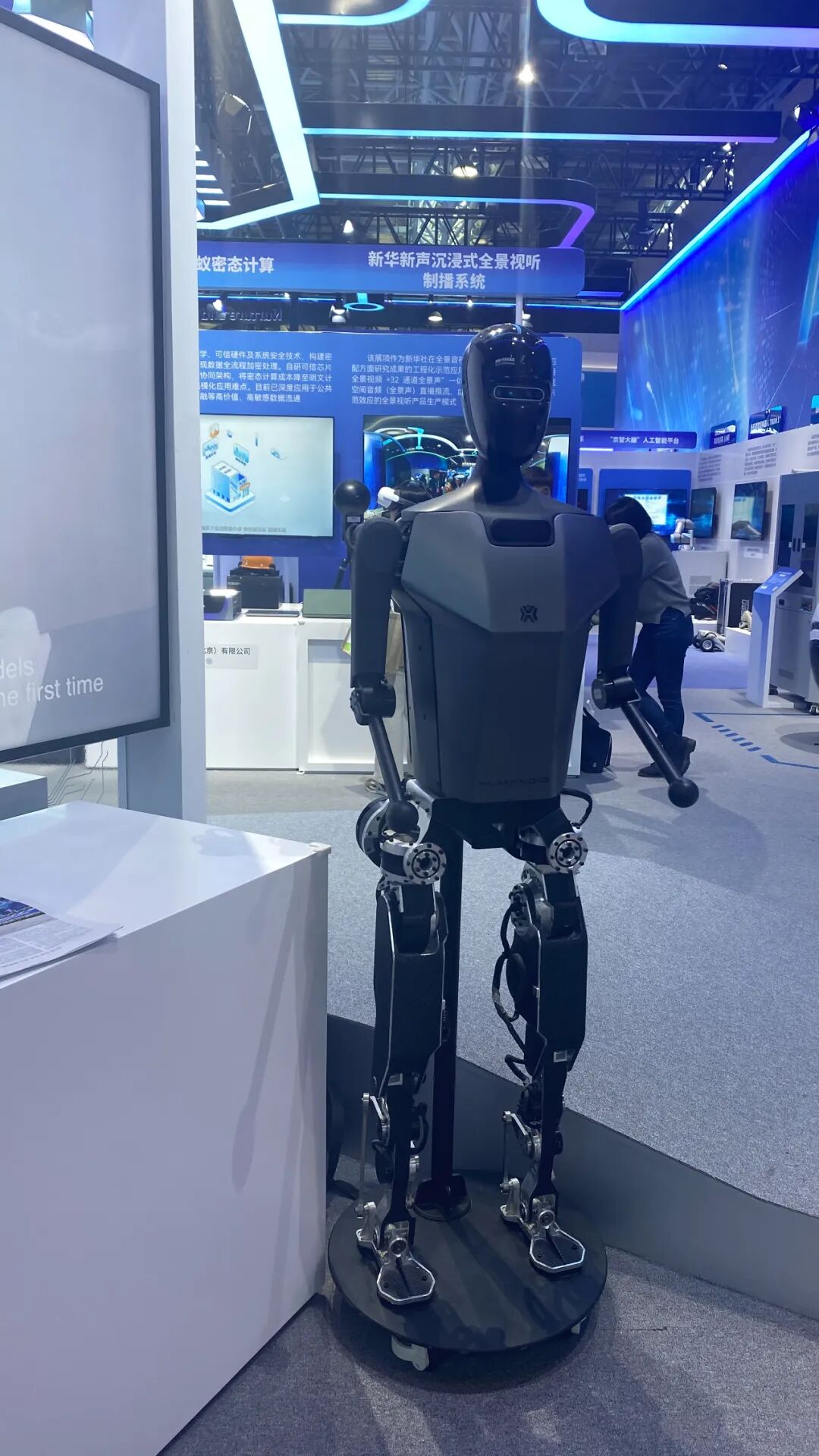
Embodied intelligent robot. Photo by Li Hang/Times Weekly
Of course, the empowerment of AI for urban development is not limited to the manufacturing industry. Wang Peng, an associate researcher at the Beijing Academy of Social Sciences, said that beyond the industrial dimension, AI is becoming a key force in spawning new industries, optimizing the consumer side, and improving the level of social governance.
Specifically, on the consumer side, AI can expand new consumption scenarios integrating online and offline through technologies such as intelligent recommendation, personalized customization, and voice interaction. For example, in the cultural and tourism industry, an AI travel assistant can customize exclusive travel plans according to tourists' interests and time, breaking free from the constraints of traditional group tours. In the field of healthcare, an intelligent medical assistant can help patients make appointments, query reports, and even provide preliminary health consultations.
At the social governance level, AI can assist cities in achieving refined management. Whether it is alleviating traffic congestion through intelligent transportation systems or using AI monitoring equipment to detect potential safety hazards, it can improve urban operation efficiency and make governance more precise and efficient.
"AI has become a manifestation of the country's core strategic competitiveness," Lin Xianping believes. The repeated mention of "Artificial Intelligence +" in the Government Work Report marks that the country's attitude towards AI has fully risen to the application level of in - depth integration with the real economy and empowering all industries. The rapid follow - up of local governments shows that the development of artificial intelligence has changed from an "optional question" to a "compulsory question" and is a strategic opportunity that must be seized.
This article is from the WeChat official account "Reading City Notes Studio", author: Li Hang. Republished by 36Kr with permission.