Decode Epson's green path with this sustainable report card.
Remember the isolated printing cubicle in the corner of the office? In a traditional and typical office, the printing room is usually partitioned off and located away from the working area. In our general impression, a printer is like a "small pollution source", constantly emitting heat and unpleasant odors during operation.
This is because traditional laser printers print by heating toner, which not only produces carbon dioxide that pollutes the air but also generates unpleasant smells. Therefore, the printing room is often placed in a corner far from the working area, as if it has been "exiled".
So, how can we rescue these marginalized printers?
To completely change this model, we need to start from the underlying logic of printing technology. The above-mentioned laser printing mainly relies on chemical processes, which not only produce odors and pollution but also consume a large amount of energy. However, ink can actually be directly sprayed onto paper through physical means, with no pollution or odor throughout the process. It can even be placed beside the desk or the bedside, while significantly reducing energy consumption.
This new type of physical printing method is an innovative black technology called "Heat-Free Cold Printing Technology". As the name suggests, it is a printing technology that does not require heating. This is an environmentally friendly innovation independently developed by Epson, a technology manufacturing enterprise, and it has now been applied to all of Epson's ink tank printers. Data shows that in 2024, the cumulative global sales of Epson ink tank printers exceeded 100 million units.

In fact, this is just a small piece of Epson's environmental protection puzzle. Not only in the printing process itself, but the industrial chain of the digital manufacturing industry is long, delicate, and complex. If we take a broader view, from the selection of raw materials for products, production and manufacturing, to consumption and recycling, each link is prone to environmental risks. However, if we want products to truly achieve a low-carbon transformation, every link cannot be ignored in order to establish a full-life-cycle green closed-loop from the source to the end.
01
From production to use, "lock in carbon" at the source
Do you know? The T-shirt in your wardrobe may very likely have gone through a "pollution marathon".
The traditional clothing printing process requires multiple steps such as plate making, plate washing, plate setting, and drying. The process is cumbersome, consumes a huge amount of water, and is accompanied by serious chemical pollution. Moreover, in order to balance the comprehensive cost of clothing production, they have to be mass-produced, which easily leads to resource waste.
However, Epson has completely changed this traditional model with a more environmentally friendly digital printing technology: it does not require plate making and can directly print patterns on fabrics. This not only significantly reduces water waste and sewage discharge but also shortens the production cycle from a few minutes to a few hours.
This technology not only subverts the high-pollution and high-energy-consuming model of traditional clothing printing but also brings new possibilities to the industry. It can shift from large-scale standardized production to flexible small-batch customization, which not only meets consumers' demand for personalization but also significantly reduces the impact on the environment.
Using innovative technology to reshape the traditional has also brought a new wave of imagination to the cultural and tourism industry. From the digital reproduction of ancient cultures to the immersive interpretation of modern scenes, digital light and shadow are now becoming a new growth point for China's cultural and tourism industry. Epson uses projection technology, with digital light and shadow as the medium, to break the boundaries of space and time, integrating history, culture, and technology to create a brand-new sensory experience.
This year, Epson completed an outdoor light and shadow show on the building walls in the Xiongan New Area. With the help of Epson's 3LCD laser engineering projectors, colorful artistic light and shadow appeared on the building walls in Xiongan, integrating digital technology and visual art. Without having to travel long distances, audiences can experience the beautiful scenery in the distance through immersive light and shadow technology. This combination of technology, art, and environmental protection makes visiting an exhibition not only a visual enjoyment but also a practical action to practice a low-carbon lifestyle.
The combination of technology and environmental protection is increasingly widely used in today's society, but Epson put forward practical environmental protection goals many years ago and has been continuously deepening and improving them. As early as 2008, Epson announced its "2050 Environmental Vision". In 2021, Epson further revised its environmental goals, planning to achieve negative carbon emissions and completely eliminate the consumption of underground resources by 2050.
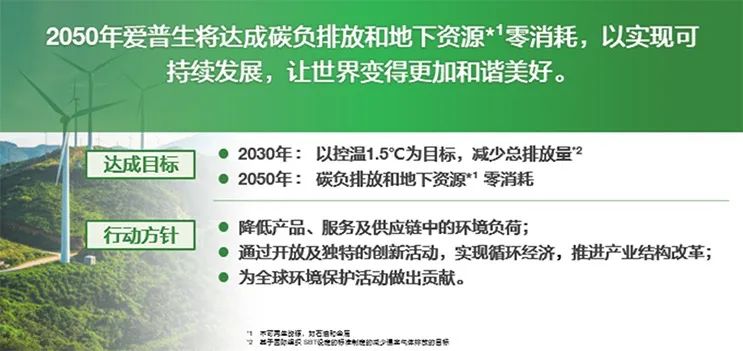
"Underground resources" is a high-frequency term in Epson's sustainable development report. Epson classifies those non-renewable or difficult-to-renew natural resources as underground resources, including minerals, fossil fuels, metals, etc. These resources are usually found in the earth's crust, and their extraction and use will have a significant negative impact on the environment.
To this end, Epson actively promotes the development of the circular economy and reduces the burden on the environment through a series of measures such as using renewable resources, reducing the size and weight of products, extending the service life of products, and promoting recycling and reuse.
For example, Epson uses recycled plastics in the production process of printer bodies, thus reducing the use of petroleum-derived plastics. In addition, Epson is also collaborating with the University of Tokyo to develop a new plastic technology called Pararein, which is a biomass plastic made from euglena starch. It is expected to replace traditional plastics, reduce dependence on fossil fuels, and further reduce the pollution of plastic waste to the environment.
Of course, the invisible "carbon footprint" is also being finely managed. According to Epson's latest "2024 Annual Sustainable Development Report", since the fiscal year 2023, Epson's global factories have achieved a transformation to 100% renewable electricity.
In terms of greenhouse gas emission reduction, Epson has also achieved good results: by the fiscal year 2024, the emissions in Scope 1 (direct emissions from the use of fuels) and Scope 2 (indirect emissions from purchased energy) have been reduced by 80% compared with the fiscal year 2017, and the emissions in Scope 3 (emissions from the entire value chain of the enterprise) have also been reduced by 35%. This achievement is due to Epson's extensive application of energy-saving equipment and facilities and systematic measures to eliminate greenhouse gases.
In fact, Epson's goal is to achieve negative carbon emissions, which means minimizing the emissions of all greenhouse gases (including Scope 1, 2, and 3) in its business activities, and then removing an equal amount of carbon dioxide from the atmosphere as the remaining greenhouse gases, so as to basically achieve zero greenhouse gas emissions and then remove more carbon. This goal adds an extra layer of challenge on top of carbon neutrality.
Therefore, the responsibility of carbon reduction is extended to the entire product value chain. Epson not only needs to do a good job in its own emission reduction but also actively drives the green transformation of the supply chain, encourages suppliers to adopt zero-carbon logistics solutions, and actively explores innovative technologies to remove greenhouse gases. Based on these efforts, Epson is steadily moving towards the goal of achieving negative carbon emissions by 2050.
All these green and low-carbon initiatives stem from Epson's corporate DNA of "economy, compactness, and precision", which promotes the entire enterprise to transform towards a more compact, efficient, and low-carbon direction. This technological concept has long gone beyond the scope of technology itself and has become a corporate cultural concept, thus helping to create greater social value.
02
From recycling to sharing, give resources a "second life"
In most companies, the fate of waste paper is usually to be thrown into the recycling bin and wait to be collected and transported away. However, Epson has completely changed this process through its innovative dry fiber technology. This "waste paper rebirth technique" can separate the fibers of waste paper in a waterless state and recompress it into new paper. The paper can be recycled right in the office, giving every piece of waste paper a new life.
PaperLab, independently developed by Epson, is a dry fiber paper recycling system. According to the introduction in Epson's latest sustainable development report, the PaperLab A - 8100 consumes only 1/100 of the water used in ordinary paper manufacturing, greatly reducing water consumption and enabling waste paper to regain its utilization value. Now, Epson has widely applied the PaperLab dry fiber paper recycling system in many of its global factories for paper recycling and re - manufacturing.
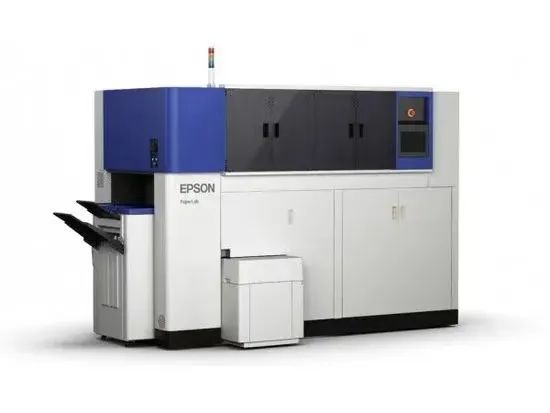
PaperLab dry fiber paper recycling system
In addition, the application scenarios of Epson's dry fiber technology are constantly expanding. For example, in the textile industry, this technology can reconstruct textile scraps and transform them into new raw materials for reuse in production, realizing the "rebirth" of cotton yarn.
Not only is Epson good at the "waste paper rebirth technique", but it also performs the "alchemy" on old consumables.
With the continuous iteration of technology, the problem of electronic waste has become increasingly serious, and "electronic waste mountains" have appeared in many parts of the world. Heavy metal pollution has become a major problem in environmental governance. To reduce the environmental impact of products, Epson has also extended its low - carbon and environmental protection concept to the terminal recycling link of products. Epson's recycling system is like an "alchemist" for old consumables: old consumables are no longer the end but the starting point of new materials.
Epson's metal powder manufacturing technology is a typical example. Since 2020, Epson has carried out the recycling and reuse of silicon wafers in its semiconductor manufacturing business, refining them into metal powder and reusing them in the product production process. This measure not only reduces Epson's waste generation and carbon dioxide emissions but also reduces the use of underground resources (such as test silicon wafers). By the end of the fiscal year 2021, Epson's Atmix company had recycled 8.5 tons of silicon wafers, practicing the concept of the circular economy with actions.
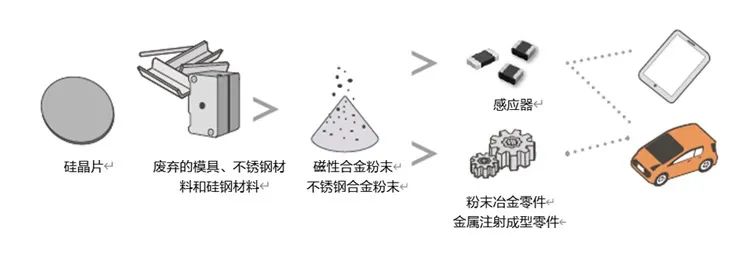
Flow chart of metal powder technology
It is reported that Epson's Atmix company is building a new factory to recycle and process waste metals within the group and from the market into raw materials for ultrafine metal powder products, thus establishing a manufacturing process for metal resource recycling. The factory is planned to start production and operation in June 2025.
Moreover, Epson has extended its environmental protection actions globally. By cooperating with global partners and setting up recycling points, Epson gives discarded equipment a "rebirth opportunity" all over the world. Epson's latest sustainable development report shows that in recent years, the number of recycled finished products and ink cartridges of Epson has been increasing continuously. In the fiscal year 2023, the recycled product finished products of Epson reached 342,000 tons, and the number of recycled ink cartridges reached 62,000 tons.
In the context of global resource shortages, the sharing economy and the circular economy have become hot topics and gradually penetrated into all aspects of our lives. From shared bicycles to shared power banks, these innovative models have not only changed our way of life but also provided new ideas for the efficient use of resources.
In Epson's view, printers can also become part of the sharing economy. They are creating a "carpooling era" for printers, reducing resource waste and environmental load through sharing and recycling.
Compared with other regional markets, the printer market in China shows greater differences due to the different usage needs of different users. Therefore, Epson innovatively cooperated with communities and launched the "Ailuobo Convenient Printing Service" based on the sharing economy in the second half of 2024. This service is available in community convenience stores, stationery stores, large - scale chain stores, and Internet flash warehouses that residents often visit, allowing users in need to enjoy more convenient green printing services at a lower cost.
In addition, since 2022, Epson has also launched an official refurbished machine activity. Consumers can purchase refurbished products at a more favorable price through Epson's official channels. These refurbished products have undergone strict testing and certification and have the same usage experience and quality guarantee as new machines.
Each Epson officially certified refurbished product has undergone a comprehensive functional test to ensure that its performance meets the standards. This measure not only reduces the environmental load of the product throughout its life cycle but also provides users with a more cost - effective choice, further promoting the development of the circular economy.
From Heat - Free Cold Printing Technology to digital printing, then to dry fiber and metal powder manufacturing technology, and finally to the community - shared printing that everyone can participate in, Epson is using innovative technology and creativity to break the "high - pollution" label of various traditional industries and make environmental protection accessible.
An enterprise's environmental protection responsibility should not be limited to the product itself but needs to run through every link from production to recycling in order to truly achieve a full - life - cycle green closed - loop from the source to the end. Epson is also conveying such a concept with practical actions: environmental protection is no longer just a simple slogan but can be integrated into every detail of life with care, and small actions can bring about great changes.