"Fuchi Bio" Secures Several Million US Dollars in Angel Round Financing for Developing a New Type of Plastic with a 95% Recovery Rate | Exclusive from 36Kr
In a person's lifetime, the "microplastics" deposited in the brain may reach 10g, equivalent to the weight of two credit cards! And the deposition of microplastics in the brain may increase the risk of degenerative diseases such as Alzheimer's.
In early February, a paper published in the top journal "Nature Medicine" presented the above research conclusion, once again triggering public attention to the issue of "microplastics" in the human body. In fact, not only in the brain, but scientists have also found tiny plastic particles in the human liver, kidneys, and even the uterine placenta.
The risk of plastic pollution is invading people's health. In the past, only about 9% of the billions of plastic products could be recycled. To alleviate this problem, many enterprises are actively developing new types of biomass plastics, such as degradable PHA (Polyhydroxyalkanoate), PLA (Polylactic Acid), PCL (Polycaprolactone), etc., to replace petroleum-based plastics that are difficult to degrade, such as PET (Polyethylene Terephthalate), PE (Polyethylene), PP (Polypropylene), etc.
Recently, the personnel of Jay Keasling Laboratory, an international pioneer in the industrialization of synthetic biology, have established a company called Future Bio. Through a bio-manufacturing approach, they have successfully developed a new type of plastic with a recovery rate of up to 95%: Biomass Vitrimer (vitreous epoxy resin). According to Wang Zilong, the co-founder and CEO of the company: This "future plastic" can be completely depolymerized when it enters a hydrochloric acid environment, and the decomposed biomass products can be recycled as new raw materials and re-enter the plastic use cycle system.
36Kr exclusively learned that Future Bio (https://www.fuche.bio) has recently completed a millions of US dollars angel round of financing, led by Yaotu Capital, with XF Ventures, XtalPi, Capital O, and IMO Ventures as co-investors, and Leap Capital as the exclusive financial advisor. The new round of financing is mainly used for team building and pilot verification. At the same time, Future Bio has also established an AI R & D strategic cooperation with XtalPi to continuously drive the R & D and upgrade of materials and processes.
Developing a Highly Integrated "Cell Factory"
It is understood that Wang Zilong and Seokjung Cheong, the co-founder and Chief Technology Officer of Future Bio, are both postdoctoral fellows at Jay Keasling Laboratory at the University of California, Berkeley, specializing in protein engineering, strain modification and other technologies. In addition to the guidance of Jay Keasling as a scientific and technological advisor, Future Bio has also invited Howard Chou, the former director and technical director of Cathay Biotech, to join as a fermentation mass production advisor.
Plastic recycling and reuse is not a new topic. Both petroleum-based plastics and bio-based plastics require the consumption of a large amount of raw material resources. For bio-based plastics, the raw materials required for production are mostly carbon sources such as glucose and palm oil, which mainly rely on food conversion. In addition to human health, from the perspective of food and energy security, efficient, low-cost, and large-scale plastic recycling and utilization is also an urgent problem to be solved.
The Vitrimer material was first invented by French scientists in 2007 and was initially used in scenarios such as the manufacturing of aviation glass. Due to the complexity of its skeleton molecules and other reasons, it is difficult to be synthesized through chemical methods, resulting in high production costs and has not been widely applied.
In terms of technology, traditional plastic molecules are usually linearly polymerized, while the biomass Vitrimer developed by Future Bio is "three-dimensional extended polymerization", so it can achieve a higher mechanical performance strength and be applied to a variety of usage scenarios.
In order to achieve the bio-manufacturing of Vitrimer, Future Bio has developed a complex protease: polyketide synthase. Wang Zilong compares it to the intelligent manufacturing workshop of a new energy vehicle. Using polyketide synthase for enzymatic catalysis is like producing high-purity cyclic lactones on a highly integrated production line.
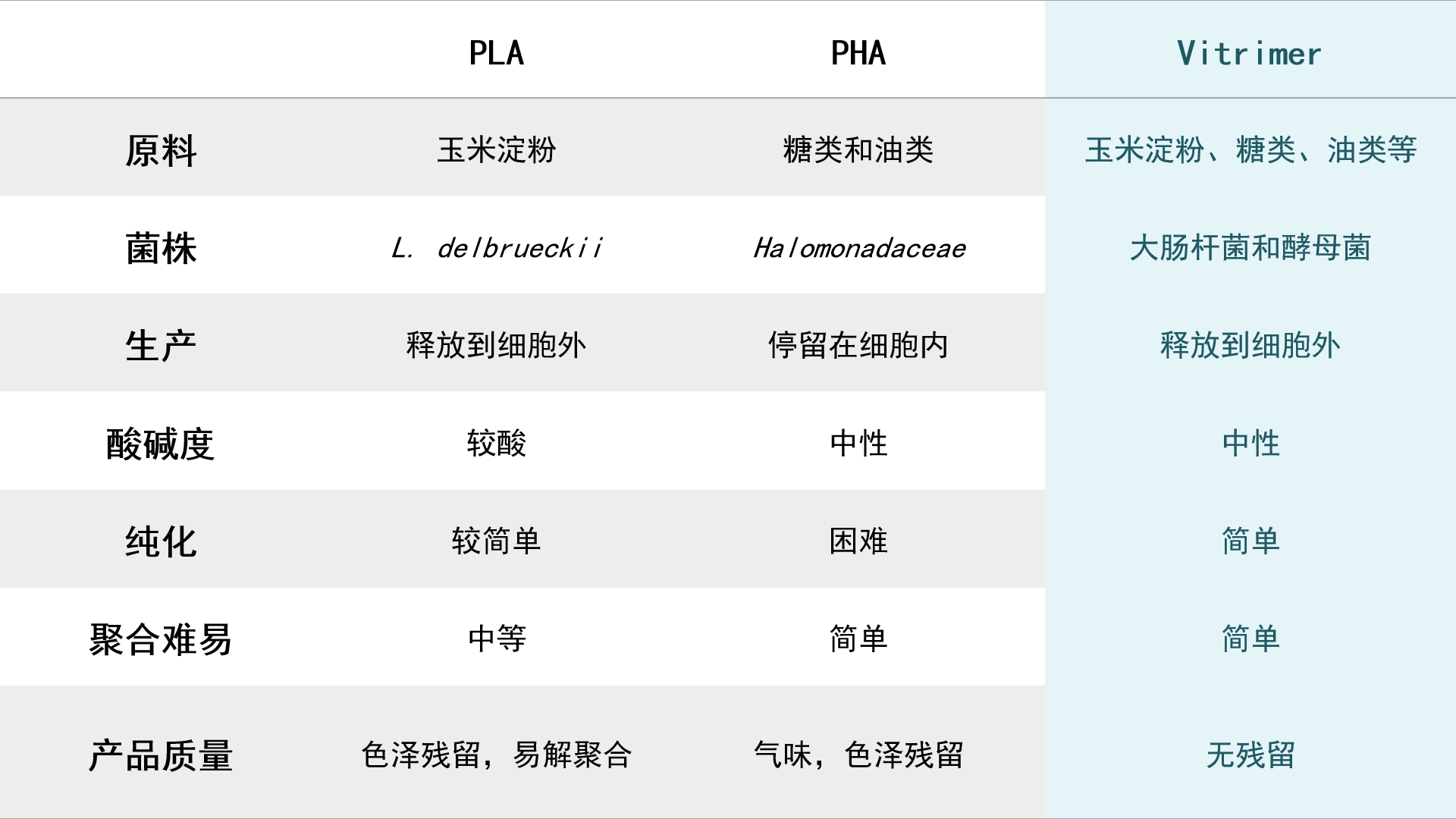
"The strains we use are model strains such as Escherichia coli and yeast; the compound molecules that make Vitrimer are released outside the cells and crystallize and precipitate when they are supersaturated at medium and low concentrations, and the fermentation environment is neutral. The production process does not require changing the pH of the fermentation environment or extracting the product by breaking the (cell) wall, so the purity of the fermentation product is relatively high, which can significantly save the cost of the purification process," Wang Zilong introduced.
Provided by: Future Bio
How to Achieve Efficient Plastic Recycling and Reuse
Synthesizing new Vitrimer molecules through a bio-manufacturing approach and developing them into plastics with different properties, such as plastic containers and automotive plastics, is the first step in application. And the core that excites the Future Bio team is the recyclability of this plastic product.
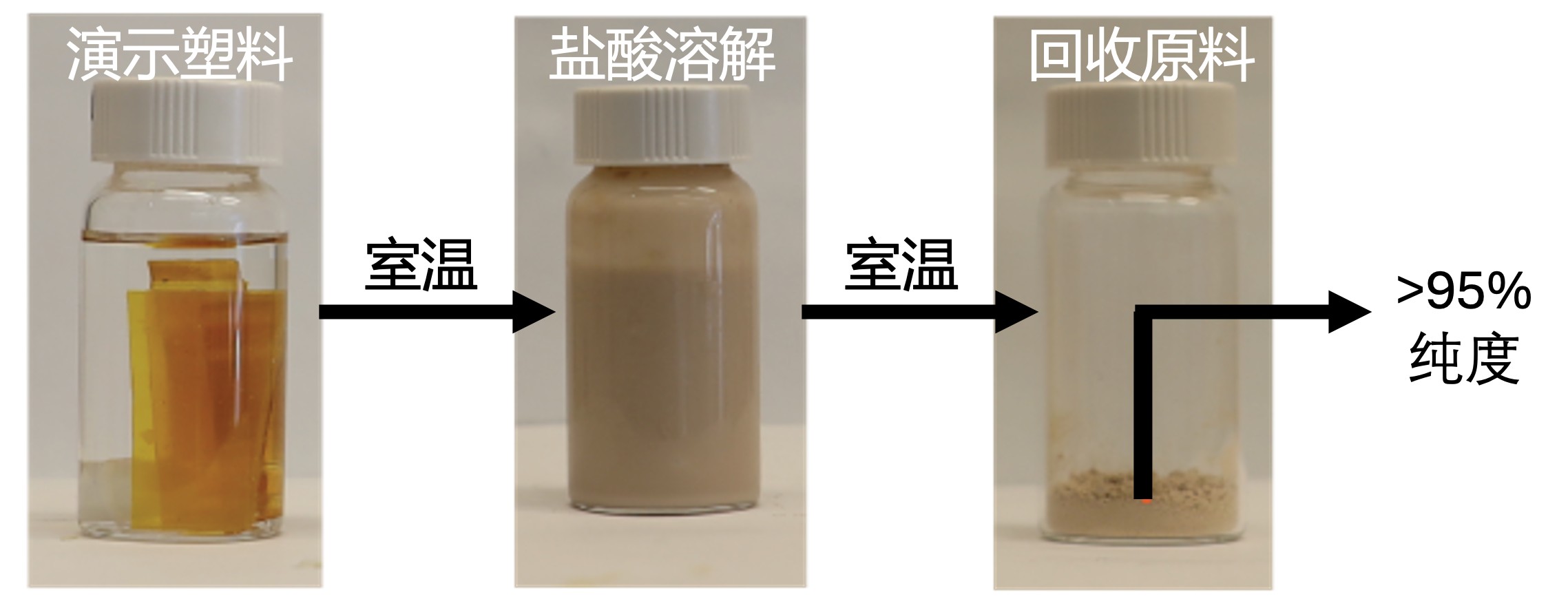
Wang Zilong introduced that by placing the biomass Vitrimer they developed in a hydrochloric acid environment for a period of time, this new type of plastic will be dissolved. "The acid hydrolysis breaks the molecular bonds, allowing it to be decomposed from a polymerized state of high molecules to a discrete state of small molecules. These small molecules, like the raw materials, can be recycled. Moreover, to separate these raw materials from the solution, only a physical method of 'mesh sieve filtration' is required, without the need to add additional catalysts or complex separation and purification steps. This greatly reduces the cost."
Provided by: Future Bio
Although government departments will provide certain subsidies for this behavior, recycling plastic products scattered in every corner of society has a long chain and high cost. Only when the cost of plastic recycling is low enough and the economic incentive for the utilization of renewable resources is large enough can it possibly drive all parties in the industrial chain to do so spontaneously.
Currently, Future Bio has been exploring commercial application scenarios and attempting to collaborate with first-line brands in industries such as packaging, automotive, printing, and home furnishing to provide them with recycled plastic products with similar performance and a high recovery rate.
For example, in the automotive manufacturing industry, some parts are a mixture of plastic and metal. Manufacturers want to recycle the metal, but the working hours and cost of disassembling the plastic are high. "If this high-performance recyclable plastic is applied and the parts are placed in a hydrochloric acid environment, the plastic will quickly dissolve, leaving only the metal part," Wang Zilong introduced.
In addition, for example, large printer brands need to recycle hundreds of millions of printer cartridges every year and adopt a mechanical processing method to recycle the plastic, with a relatively low reuse rate. Therefore, when the performance and cost are controllable, they have a certain motivation to replace it with a new type of recyclable plastic.
Not only that, for various application scenarios, with the support of the AI platform at the University of California, Berkeley, biomass Vitrimer has successfully achieved a technological breakthrough of freely fine-tuning the molecular structure and corresponding prediction of material properties, and can directionally control the plastic dissolution temperature, etc.
Many brands are interested in bio-manufactured plastics with a high recovery rate and strongly support alternative products that can meet high-performance requirements and are green and recyclable. To meet the huge market demand, "The current core is still to increase production and reduce costs."