Under the AI wave, the demand for computing power has soared. Who can come out on top in this round of new infrastructure?
Where is the ultimate battlefield of artificial intelligence? The answer is convergent, and that is: computing power.
Whether it is the "Hundred Model Battle" triggered by large models or the various AI applications derived from the model development, they all cannot do without the support of computing power. As the producer of computing power, data centers have blossomed everywhere in the country this year, taking advantage of the policy trend.
In September this year, eleven departments including the Ministry of Industry and Information Technology jointly issued the "Notice on Matters Concerning Promoting the Coordinated Development of New Information Infrastructure". Among them, computing power infrastructure, as an important part of the new information infrastructure, was highlighted. Specifically, the document emphasizes optimizing the layout of computing power infrastructure, encouraging the coordinated development of the network and computing power facilities, and promoting the green and low-carbon development of key facilities such as data centers.
The country's high attention and support have brought new vitality to the computing power infrastructure industry chain and provided a strong driving force for the development of the computing power industry. These are undoubtedly good news for the leading manufacturers of computing power infrastructure.
On December 13, Lenovo held the "Heterogeneous Intelligent Computing, Stable and Efficient - Lenovo Computing Power Infrastructure New Product Launch", and jointly with AMD launched eight new server series products in one go, including the Lenovo Wentian, ThinkSystem V3 series server product families, and a new ThinkSystem AMD tower server.
Specifically, in terms of performance:
In terms of computing power, the memory bandwidth of the new-generation server has increased by 33%, and the performance in the cloud server application scenario has increased by 17%, while in the HPC and AI scenarios, the performance can be increased by up to 37%;
In terms of the AI engine, the performance of AI workloads has doubled. Deploying the Lenovo Wanquan Heterogeneous Intelligent Computing Platform breaks through the computing efficiency bottleneck. At the same time, it is equipped with the Lenovo AIOps system management intelligent engine for intelligent early warning and avoidance, reducing the number of component failures to 50%;
In terms of green energy saving, Lenovo Wentian Poseidon liquid cooling solution makes the PUE lower than 1.1, and uses an intelligent sensing power management system for precise dynamic regulation to reduce power consumption and continuously create green computing power.
"The computing power industry we are engaged in today is actually a national strategy. Under the guidance of the national strategy, how to help the Chinese computing power industry find a breakthrough is two very important key tasks." Chen Zhenkuan, Vice President of Lenovo Group and General Manager of Lenovo China Infrastructure Business Group, said in an interview after the conference.
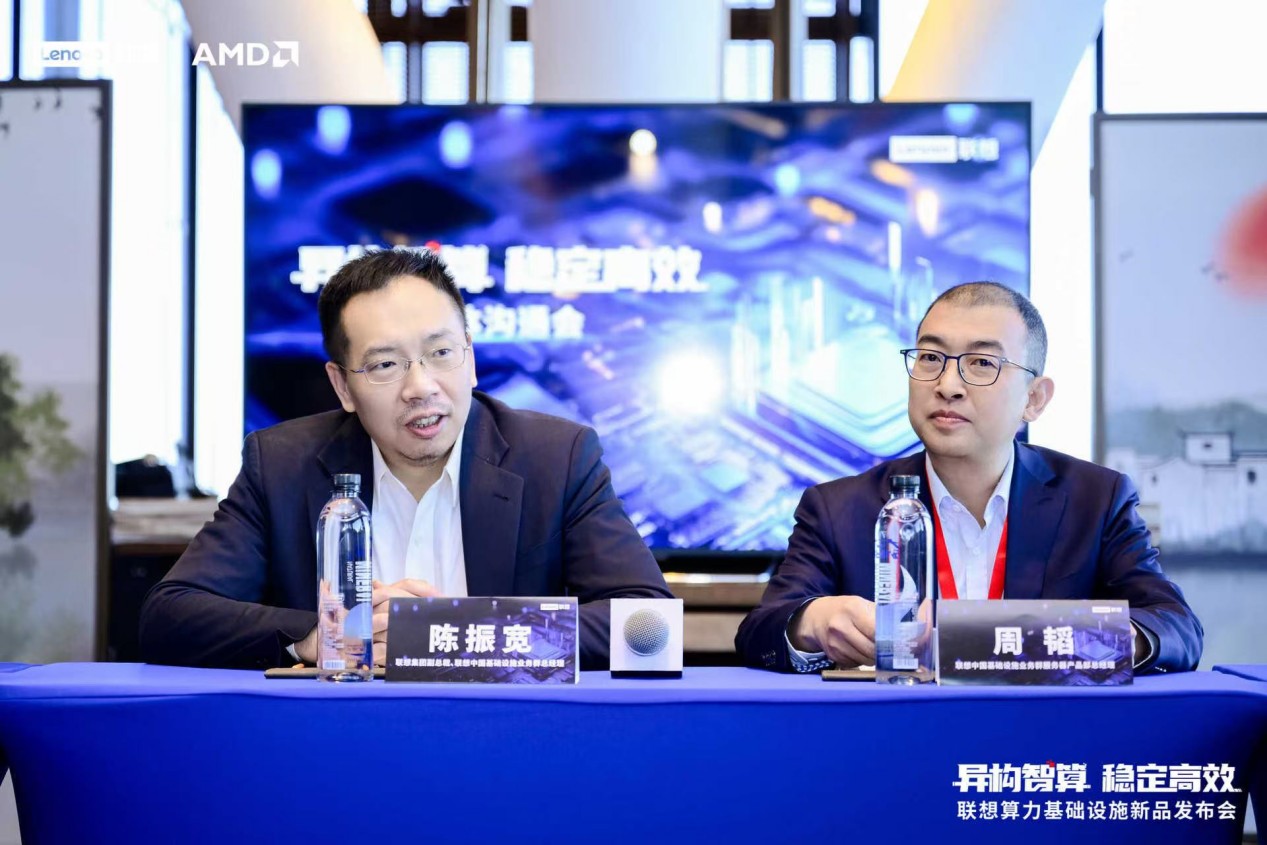
Lenovo Computing Power Infrastructure New Product Launch, Source: Official
1. "Dual Brand" + "One Horizontal and Five Vertical" Strategic Layout
In the server market, Lenovo has implemented a "dual brand" strategy - In February 2023, Lenovo launched its first localized brand "Lenovo Wentian", proposing the brand value proposition of "Local Innovation, Agile and Efficient", forming a "dual brand" strategy for Lenovo servers in the Chinese market with ThinkSystem.
This move is regarded as Lenovo's effort to better serve the localized needs of Chinese customers and support the country's need to promote independent innovation and the development of new-quality productive forces.
Then, when it comes to localization, it means that the development of Wentian needs to take into account the needs of the local Chinese market. In the current AI explosion, Lenovo has even carried out AI planning for all Wentian series products to serve AI businesses.
"50% of the R & D expenses will be in the direction of artificial intelligence. At the same time, we are determined to continuously invest in and evolve the liquid cooling technology." Chen Zhenkuan told 36Kr.
In addition, in order to further implement the demand for the full-stack AI package service, Lenovo has determined a one horizontal and five vertical strategy this year. This sounds mysterious, but it is actually easy to understand when explained:
The five verticals are the five pillars of infrastructure, including five subdivided fields: servers, storage, data networks, software, and hyper-convergence;
The one horizontal is to make these five verticals AI-enabled, referring to the Lenovo Wanquan Heterogeneous Intelligent Computing Platform, which can achieve efficient and agile collaborative capabilities in a heterogeneous and diverse environment.
Regarding the relationship between "Wentian" and "Wanquan", Chen Zhenkuan also gave a further detailed explanation.
"Wentian is the infrastructure, and Wanquan is the heterogeneous intelligent computing platform. Based on the Lenovo Wanquan Heterogeneous Intelligent Computing Platform, we have built the Lenovo Wanquan Industrial Ecological Alliance. This is to enable Lenovo not to go it alone but to go far together, and to be able to collaborate efficiently with chip enterprises, platforms, and equipment manufacturers." Chen Zhenkuan said.
2. Green Computing Power Becomes the Mainstream Choice
In today's computing power industry, not only are the performance requirements of servers important, but with the establishment of China's dual-carbon goals, the energy conservation and emission reduction of data centers have become a key issue.
In terms of energy saving, the traditional air-cooling heat dissipation has become outdated. Previously, the development of liquid cooling technology was mainly for contact heat dissipation of the CPU. Now, the demand for heat dissipation functions has increased, and the proportion of liquid cooling and air cooling continues to increase. Further requirements have also been put forward for functions such as GPU heat dissipation, memory, and network cards.
In the heat wave of the AI 2.0 era, the power consumption of the intelligent computing center has become the "Achilles' heel". In Chen Zhenkuan's view, with the explosion of the construction of intelligent computing centers, liquid-cooled servers will also usher in a golden age.
Using liquid instead of air to cool the server - this is the magic of liquid-cooled servers. It not only greatly improves the heat dissipation efficiency but also achieves a qualitative leap in energy consumption and noise control.
As the energy consumption problem of data centers becomes increasingly prominent, liquid cooling technology, like a clear stream, has brought a revolutionary solution to the industry. The national and local policies frequently emerge, strongly supporting the development of liquid-cooled servers. From the "Green Data Center Government Procurement Demand Standards" to the special support of local governments, the spring of liquid-cooled servers has arrived, and liquid-cooled servers have thus become the new darling of the market.
In fact, Lenovo has already started the layout of liquid cooling technology 20 years ago. Since 2012, relying on continuous technological innovation, Lenovo has continuously optimized its own liquid cooling heat dissipation solution. Currently, Lenovo's sixth-generation "Poseidon" liquid cooling technology has achieved support for multiple types of GPUs and CPUs, with a heat dissipation efficiency of up to 98%, and the best PUE can be reduced to 1.1, greatly reducing the energy consumption level of the data center.
"Under the double pressure of the simultaneous growth of computing demand and computing energy consumption, liquid cooling technology has changed from 'optional' to 'mandatory'." Chen Zhenkuan said that computing power not only needs to become more intelligent but also more green. Among them, the cooling capacity of liquid cooling is 1000 to 3000 times higher than that of air cooling, and liquid cooling has lower environmental requirements and stronger adaptability.
In this regard, Lenovo takes the liquid cooling technology that empowers the development of green computing power as the key, and releases the "Lenovo Wentian Poseidon" liquid cooling brand for local users. This brand is built based on Lenovo's leading liquid cooling technology for 20 years, and it is more focused on the domestic market. It aims to provide local customers with liquid cooling solutions that meet national standards, match the design of Chinese data centers, and are compatible with local processors and software ecosystems, helping customers accelerate green upgrades.