Yang Zhen from Beidian Digital Intelligence: "Domestic Computing Power PoC Platform", Seeking the Optimal Solution for Computing Power through Scenario Evaluation | WISE2024 King of Business Conference
From November 28 to 29, the two-day 36Kr WISE2024 Business King Conference was grandly held in Beijing. As an all-star event in the Chinese business field, the WISE Conference has reached its twelfth edition this year, witnessing the resilience and potential of Chinese business in an era of constant change.
In 2024, it is a year that is somewhat ambiguous and where changes outweigh stability. Compared to the past decade, people's pace is slowing down, and development is becoming more rational. 2024 is also a year in search of new economic drivers, and the new industrial changes have put forward higher requirements for the adaptability of each entity. This year's WISE Conference takes "Hard But Right Thing" as the theme. In 2024, what is the right thing has become a topic we are more eager to discuss.
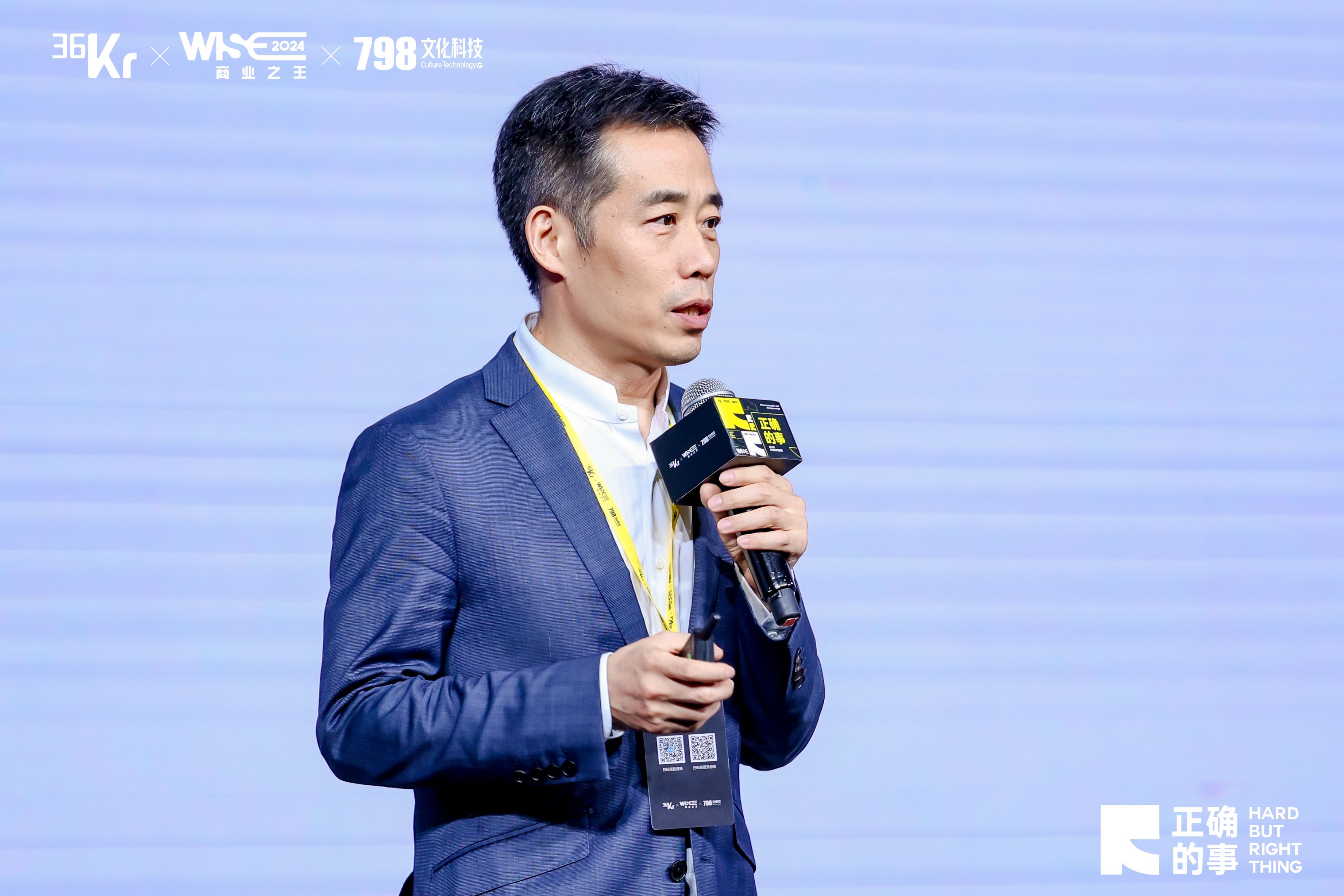
Yang Zhen, CMO, Head of Strategy and Marketing of Beidian Digital Intelligence
On that day, Yang Zhen, CMO and Head of Strategy and Marketing of Beidian Digital Intelligence, delivered a speech with the theme of "Domestic Computing Power PoC Platform: Finding the Optimal Solution for Computing Power through Scenario Evaluation".
What is the "right thing"? In today's AI industry, dissecting such a question has become particularly complex. But from the perspective of the revenue of the artificial intelligence industry in 2023, the true integration of artificial intelligence into real life is still a long way off. The chip layer accounts for 90% of the industry's revenue, the model layer accounts for 7%, but the application and tool layer only accounts for 3%.
There are three problems that artificial intelligence faces in truly achieving practical application. Computing power is the first problem to be solved, and industry enterprises do not understand the performance and applicable scenarios of domestic computing power chips, and subconsciously tend to reject the use of domestic chips. How to make good use of domestic computing power is the key issue. The second problem is how to bridge computing power and scenarios, so that domestic chips and models can be adapted to better exert the effect of the models. The third problem is how to enable domestic chips to work together, exert a cluster effect, and give full play to the computing power advantages of different domestic chips.
Beidian Digital Intelligence has launched the country's first domestic computing power PoC platform, breaking the industrial chain gap between the supply and demand sides of domestic computing power. The domestic computing power cluster provides vertical scenario evaluation, adaptation and verification services. At the same time, it provides a variety of computing power adaptation test spaces for AIGC audio-visual, finance, government affairs, industry, medical, embodied intelligence, transportation and other multi-field AI application enterprises, promoting the adaptation of domestic computing power chips and scenarios, putting domestic chips into use, and promoting the arrival of the artificial intelligence era.
The following is the speech record of Yang Zhen, CMO and Head of Strategy and Marketing of Beidian Digital Intelligence:
Yang Zhen: Today, I believe every enterprise is attracted by this topic - doing difficult but right things. Artificial intelligence is the hottest topic at present, and how to make use of computing power is a difficult but right thing. This is very in line with today's topic, how difficult it is and how to deal with it.
The Transformation of Productivity by General Technology: A Difficult and Long Process
Artificial intelligence is the invention of a new general technology. Every new general technology that has emerged in human history has brought about industrial changes, industry changes, and changes in everyone's life, constantly pushing human civilization forward bit by bit. The first three industrial revolutions are not as thorough as the artificial intelligence revolution, which should be a qualitative leap in the entire human civilization.
But is this leap easy? It is extremely difficult. Take electricity as an example. Before the invention of electricity, it was steam power. At that time, there were already factories, and all factories were driven by steam power; it took 50 years from the invention of electricity and generators to the point where electricity truly entered factories to replace the power source and turn all factories into electric power factories. One can imagine how difficult it is. It is not only the replacement of the power source, but also the replacement of new production tools, production lines, and a complete production system. It is not only technology, but also processes, organizations, systems, and changes in everyone's ideology.
This year, AI mobile phones and AIPCs have been continuously launched. Personal computers were born in the 1970s and 1980s, but it was not until the new century that personal computers fully entered enterprises. It was not until a series of tools such as ERP and CRM could exert the role of computers and bring about a qualitative change to enterprises that they would be popularized.
Returning to artificial intelligence, artificial intelligence emerged in the 1950s, but it was not until the proposal of deep learning in 2006 that it attracted widespread attention. There were theories such as decision vectors in the 1950s, and at that time, The New York Times also predicted that artificial intelligence was coming and that machines helping people do things could be realized within ten years. However, it took 50 years for this to come true. It was not until the new century that machine learning emerged, and it was not until 2021 that the neural network system won in the competition, and the term neural network was finally recognized by everyone. Similarly, it was only when GPT3.5 emerged with the so-called intelligence and brought a new perception to everyone that people truly realized generative artificial intelligence. Although there were previously Deep Blue playing chess and AlphaGo playing Go, people did not truly experience the situation where it truly generated intelligence.
The Practical Application of Artificial Intelligence: Daring to Use, Knowing How to Use, and Making Good Use of Domestic Computing Power
At this time, another problem arises. Artificial intelligence is a general technology. How far is it from truly entering thousands of industries and affecting everyone's life? This can be seen from the revenue data. The three major elements of artificial intelligence are computing power, algorithms, and data, currently, it is those who sell shovels who make money. In 2023, the chip layer accounted for 90% of the entire artificial intelligence industry's revenue, the model layer contributed 7% of the revenue, and the application and tool layer only accounted for 3%. From this data, it is still a long way from the practical application of artificial intelligence in everyone's life.
Why is it so far? The vast majority of general technologies will first break through in the To B end before entering the industry and society. People may have begun to use robots to write articles and search for things, but if artificial intelligence wants to enter enterprises, having only chatbots is not enough; a system needs to be built.
For enterprises, especially Chinese enterprises, it is not easy to build this system. Computing power is actually the first problem to be solved. There are nearly 30 GPU manufacturers in China. Many people do not know how good domestic intelligent computing chips are, what scenarios they can support, and how to use them. Therefore, subconsciously, they also tend to reject things they do not know and still want to use imported chips. How to use and how to make good use of domestic computing power is actually a quite crucial matter. At the same time, due to China's industrial structure, we can see that there are more than 30 enterprises in the chip layer and a "Hundred Model Battle" in the model layer. The entire artificial intelligence industry chain in China is still in a relatively discrete state and has not entered a convergence period, making it more complicated for enterprises to choose which chips and models to use and how to build an intelligent body platform. Constructing enterprise-level applications and enterprise-level workflows is something that everyone is thinking about.
Bridging Computing Power and Scenarios: The PoC Platform Accelerates the Arrival of the Artificial Intelligence Era
Today we are talking about the domestic computing power PoC platform. The second question is, why is the domestic computing power PoC platform needed? General Secretary often says to see the reality clearly, recognize the gap, find the path, and solve the problem. There is a generation or two gap between the entire domestic computing power and the advanced computing power in the international arena, but overall, domestic computing power is not unusable. They all have their own parts that perform very well, but users actually do not know where domestic computing power is useful and how to use it.
Based on this situation, for the computing power supply side, when no one provides it with scenarios, it actually lacks a training ground. What can be provided are only theoretical data of single chips, but it is difficult to obtain cluster data.
Overall, the production capacity of domestic chips is still limited. The overall output of a single domestic chip is insufficient, and it is difficult to meet the demand. The computing power users also often tell us that they want to use domestic computing power, but it is not enough. They actually have scenarios and models, but the model tasks are always in queue, waiting. This is the practical problem we need to face.
This brings up the third question, why can't domestic chips work together? Maybe you have heard that each chip has its own ecosystem, and this ecosystem forms its own business closed loop. However, there is a barrier to collaborative operation between different ecosystems. In other words, in many intelligent computing centers, even in the same intelligent computing center with different clusters, each is a different computing power chimney, and it is difficult to work together. For users, they do not know which one is good, and the total amount of a single chip purchased is not enough. This is a very big problem.
This time, for the PoC platform, we have launched a large number of scenarios, such as the financial, industrial manufacturing, and AIGC audio-visual scenarios. In this scenario, everyone can put their own scenarios in to see how the domestic computing power performs in the corresponding scenarios, whether it is easy to use and applicable. We hope that through such a platform, everyone can correctly understand domestic computing power and whether the domestic computing power cluster can effectively support the actual scenario usage.
In order to enable domestic chips to work together, there are many difficult but right things, or rather, a lot of hard work to be done. There is a need for running-in to achieve the adaptation between chips and models to support the best performance of chips and models. This is a single model. The Hybrid Cluster is to break up different computing power clusters to form a huge virtual computing power pool, and provide corresponding computing power support and services externally according to the actual scenarios. There are many things to be done. First, it is necessary to enable different computing power clusters managed to support different models without distinction, and there are many things to be done.
We have achieved the cross-general adaptation of more than 10 types of domestic chip computing power clusters and the adaptation of more than 20 mainstream base large models. In order to support the mainstream base large models, we first completed the operator supplementation and automatic optimization to enable the cross-adaptation of all mainstream chips and base models. If two chip clusters collaborate, it is okay to make some patches. However, if we want to achieve the collaborative operation of all managed computing power clusters and work together externally, the patch approach will not work. We have written a unified communication library to enable different computing power clusters to communicate using our communication library.
Earlier, it was mentioned that there is a generation gap between some domestic computing power and imported computing power. We are exploring whether the algorithm has the opportunity to define the hardware to accelerate domestic chips. We have done many things similar to time compression and compilation optimization to accelerate the hardware through software.
Because we are a huge virtual computing power pool, providing computing power services externally actually requires a powerful and sensitive scheduling strategy. We have developed multiple sets of sensitive scheduling strategies, to effectively and accurately allocate different computing powers in the entire computing power pool according to different tasks to support various tasks. We are also working on scheduling to enable computing power to be like electricity, capable of peak shaving and valley filling, achieving collaborative operation of different clusters and providing services without distinction.
In the past, services were provided in a leasing manner, rented by the unit or by the horsepower. When we achieve such a technology, we can actually charge based on consumption and throughput. You are only charged for the computing power you use, and you will not be charged for the time you occupy when you are not using it. This enables many small and medium-sized companies, development groups, and even individual developers to be able to afford computing power and use high-quality computing power.
After the basic work is completed, it provides effective support for scenarios such as government affairs and medical care. When it comes to this, many difficult parts will be mentioned. In fact, when conducting the entire computing power evaluation and adaptation, it is necessary to distinguish the atomic-level scenarios behind, such as speech recognition, image recognition, and error correction, in order to call the corresponding parameters and indicators in each chip.
Our domestic PoC platform has been implemented in the Beijing Digital Economy Computing Power Center to provide external services. Last week, Xinhua News Agency, People's Daily, and others have reported on it. We hope to build a platform where both the users and the domestic computing power providers can move towards each other, promoting the use of domestic computing power like electricity and accelerating the practical application of the entire artificial intelligence era.
Let me briefly introduce who we are. We are an enterprise under Beijing Electronics Holding Co., Ltd. We were established on August 1 last year, and it is now the 16th month. Due to our youth, we are an artificial intelligence state-owned enterprise, and we also take the originality, subversiveness, and leadership of General Secretary's requirements for technology enterprises as our own requirements. When the People's Republic of China was founded, Jiuxianqiao was once the cradle of New China's electronic industry. The Beijing Digital Economy Computing Power Center and the domestic PoC platform are about one kilometer away from here. We also hope that Jiuxianqiao can become a new artificial intelligence highland in the artificial intelligence era and promote the accelerated practical application of the fourth industrial revolution of artificial intelligence in China.