Coping with the fiscal and taxation challenges of enterprises going global and improving the efficiency of capital management.
Enterprises Going Global, Funds Come First.
Over the past decade, transplanting and replicating the "Chinese Model" to more localized markets has become a definite strategy for various industries to discover the second growth curve. Data from the Ministry of Commerce indicates that in 2022, China's foreign direct investment has encompassed all industry categories of the national economy.
However, simultaneously, many enterprises with great growth potential that are going global are encountering inefficiencies in fund management.
It is widely recognized in the industry that in the situation where the supply chain advantages are becoming increasingly mature and the going-global ecosystem has been constructed and enhanced, the challenges that beset enterprises in taking the initial step to go global are often the key winning points to triumph in the global competition.
If Chinese enterprises going global are a massive ship sailing towards a distant voyage, then fiscal and taxation management is the helm of this colossal ship. It not only pertains to the compliant operation of an enterprise in the localized market but also directly influences how an enterprise maintains cost reduction and efficiency enhancement in the era of globalization, and embraces the vast blue ocean with a healthy and positive operation and management logic.
In the complex and mutable international environment, the efficiency and safety of fiscal and taxation are no longer unalterable solutions but areas worthy of continuous exploration and innovation. Hidden dangers in processes such as transactions, payments, and fund management are like a cluster of reefs that need to be avoided through digitalization and intelligence.
The era of traditional accounting management has vanished in the continuously emerging digital products. Currently, Chinese enterprises are going global at an unprecedented scale and speed. From the high handling fees of cross-border payments to the complex tax policies, from the risk of exchange rate fluctuations to the difficulties in fund pool management, every link tests the financial wisdom of enterprises going global. And the maturity of the going-global industrial ecosystem lies in these technical manufacturers that are deeply engaged in different tracks such as payment, fiscal and taxation, SaaS, IT, and marketing. They have not only transformed from the labor-intensive in the "foreign trade era" to a high-end development path with both hard and soft strengths but are also adept at assisting Chinese enterprises in enhancing their global survival ability with agility and flexibility.
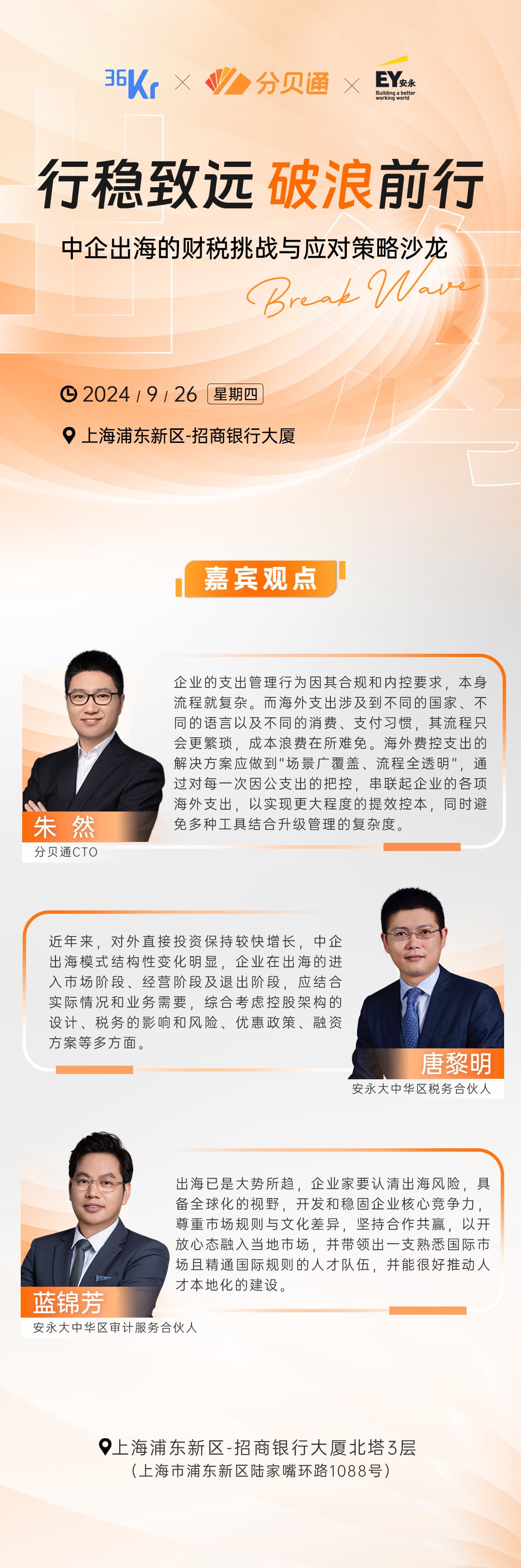
Before embarking on the journey, preparations must be made. With an increasing number of high-quality exchanges and cutting-edge observations that bridge the information gap of Chinese enterprises going global, the challenges of going global are gradually being decomposed into opportunities. On September 26, the salon "Fiscal and Tax Challenges and Response Strategies for Chinese Enterprises Going Global" was successfully held at the China Merchants Bank Tower in Shanghai. The salon jointly organized by 36Kr, Duobeitong, and EY aims to jointly construct a bridge to assist start-up enterprises in growing, bring the high-potential business model of the Chinese market out, and set sail for the global market.
Duobeitong is a technical service provider dedicated to offering fund management solutions for enterprises. In 2023, Duobeitong launched a relatively comprehensive international business travel solution, which opened up the entire process of capital expenditure from budget, pre-expense control, consumption scene control, payment, automatic entry of financial vouchers, and electronic accounting archives. Data from the same year reveals that the GMV of Duobeitong's international business travel business increased by 500 times year-on-year.
According to Duobeitong's "Integrated Expenditure Management Report", currently 23% of enterprises have begun to actively explore overseas expenditure management solutions, and 18% of enterprises are seeking a suitable overseas expenditure management platform. This not only demonstrates the determination of Chinese enterprises to "go global with high quality" but also is the outcome of service providers like Duobeitong seizing a massive business opportunity: aiming at the needs of Chinese enterprises to reduce costs and increase efficiency in the going-global path, and helping them save money efficiently without affecting business efficiency.
EY is one of the world's leading audit, tax, strategy, transaction, and consulting service institutions. The EY team, in line with the increasingly globalized trend of client businesses, integrates the businesses in more than 150 countries and regions around the world into the following three regions: the Americas, EMEIA (Europe, the Middle East, India, and Africa), and the Asia-Pacific region, making EY one of the most highly integrated professional service institutions in the world. EY China Overseas Investment Business Department connects EY's global professionals to facilitate mutual collaboration and provide globally consistent high-quality services for the international development of Chinese enterprises.
The following are some golden quotes from the speeches of some guests: