Hard Krypton Exklusiv | Yisheng Technology, gegründet von einem Professor der Universität Hongkong, erhält eine Angel-Finanzierung in Höhe von mehreren hundert Millionen Yuan und widmet sich der Entwicklung eines Gedächtnissystems für Roboter
Autor | Qiu Xiaofen
Redakteur | Yuan Silai
Hard Kr has learned that "TranscEngram" has completed an angel - round financing of hundreds of millions of yuan. The investors in this round come from both industrial capital and state - owned platforms, including Zhong Sheng Pharmaceuticals under CP Group, Pudong Venture Capital, Zhangjiang Science and Technology Investment, Zhangjiang Hi - Tech, Hongxin Electronics, Yunhui Capital, Woken Capital, Jinduo Capital, etc.
"TranscEngram" is committed to starting from the first - principles of science, using the closed - loop of "perception - prediction - interaction" to build a unified "brain + cerebellum" system for robots, and exploring the next - generation interpretable autonomous intelligence (Autonomous Intelligence).
The funds from this round of financing will be mainly used for the research and development of interpretable embodied control large models and physical world models, the construction of multi - modal full - humanoid motion interaction data and algorithm training pipelines, the expansion of a top - notch talent team, and the construction of R & D centers and industrialization bases in Shenzhen Qianhai and Shanghai Zhangjiang, so as to accelerate the commercial application of the embodied intelligent brain and cerebellum systems that can self - correct and continuously evolve.
"TranscEngram" was founded in September 2023 by Professor Ma Yi, the founding dean of the School of Computing and Data Science at the University of Hong Kong, a world - class artificial intelligence expert, together with Professor Gao Shenghua and Professor Yang Yanchao. Ma Yi is the winner of the "David Marr Prize", the highest honor in the field of computer vision, and a Fellow of IEEE, ACM, and SIAM. He has more than twenty years of theoretical accumulation in visual perception and intelligent systems. He also maintains long - term in - depth cooperation with top - notch global scholars such as Emmanuel Candes, the winner of the Shaw Prize, and Yann LeCun, the winner of the Turing Award, to jointly explore the next - generation form of artificial intelligence.
In the view of Professor Ma Yi, current large models are essentially "encyclopedias" with a vast amount of static knowledge. They complete open - loop training in a closed world. Due to the lack of self - verification and error - correction mechanisms in the physical world, they "know what happens but not why", which leads to hallucinations. True intelligence should not stop there.
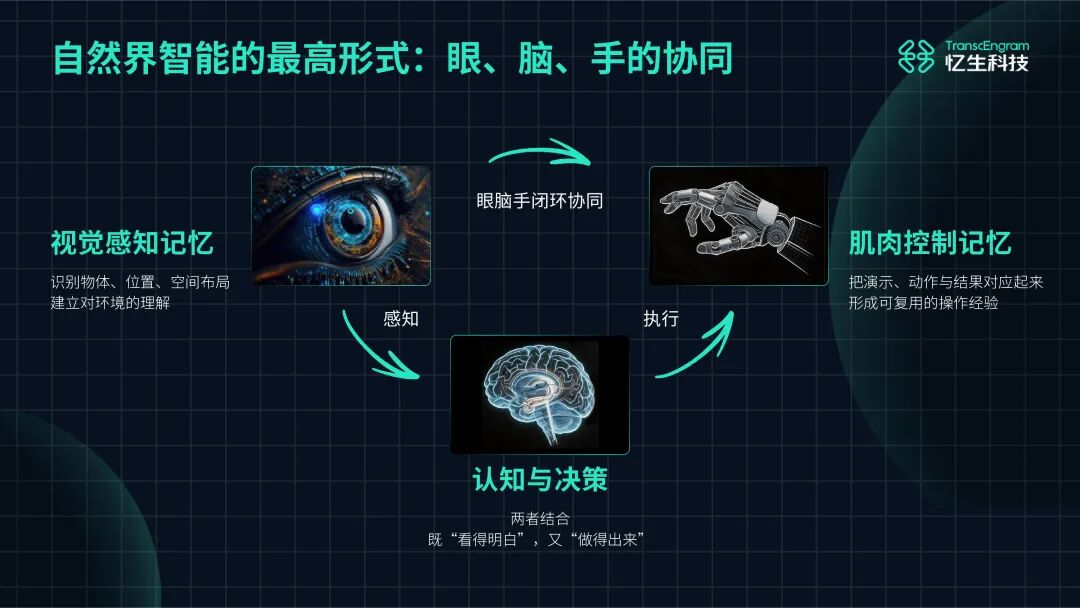
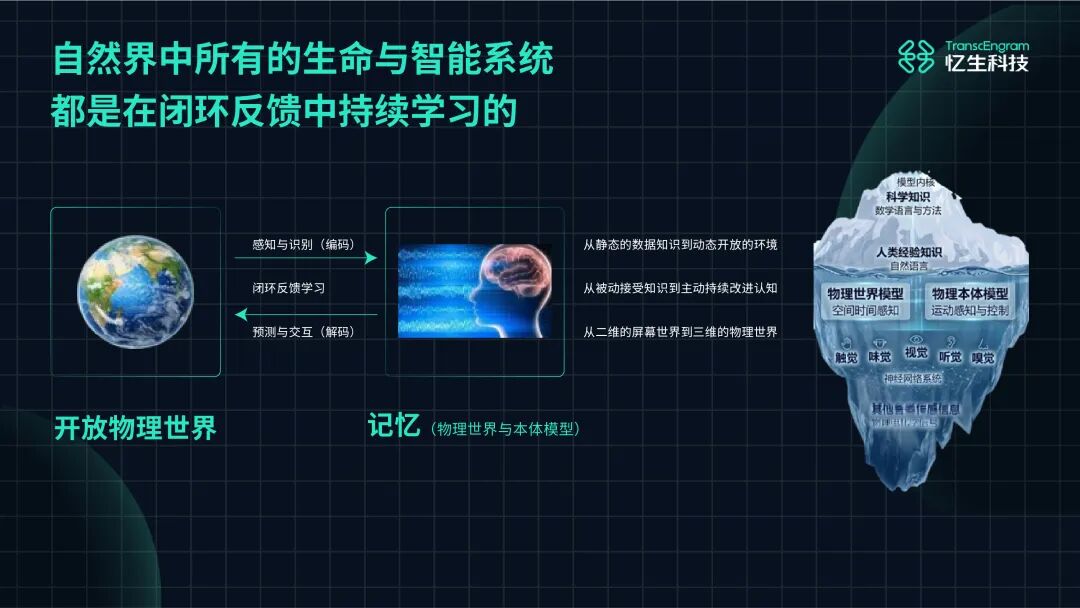
He believes that the core logic for "TranscEngram" to push robots into the AI 2.0 era is: to learn in the closed - loop feedback of "perception - prediction - interaction" like life. Taking humans as an example, the eyes, brain, and hands have long achieved a high degree of coordination and unity - vision obtains memory for prediction, and the hands complete tasks through interaction.
(Quelle/Betrieb)
To this end, TranscEngram has built a unified "brain + cerebellum" architecture, endowing robots with the same closed - loop ability:
"Visual memory" of the brain: Imitating the human eye, it acquires and understands the physical model (spatial and geometric relationships) of the external environment and conducts complex reasoning;
"Muscle memory" of the cerebellum: Imitating the human hand, it acquires and improves the body model through motion control and generates high - frequency, stable motion control strategies.
(Quelle/Betrieb)
This architecture completely breaks through the limitation of the "self - unawareness" of static knowledge in a dynamic environment. Yang Yanchao, the co - founder of "TranscEngram", introduced that relying on the white - box interpretable network structure, robots can automatically extract interaction concepts from massive data, abandon the dependence on manual labeling and fixed task lists, and achieve self - evolution and incremental learning.
In terms of actual effectiveness, this architecture shows significant generational advantages. Compared with the traditional VLA model, TranscEngram's memory - based generative cerebellum architecture has more than three times improvement in the average performance of multi - tasks, and can complete multiple tasks with high quality using a single model, with a success rate of over 95%.
More importantly, its core memory mechanism is not strongly coupled with the robot body. It can capture the physical and semantic structures behind tasks and achieve skill transfer across different bodies (such as grippers, dexterous hands, and different arm spans).
This is the key to breaking through the industrial bottleneck. In the past, traditional robots relied on fixed programming. Once the scene or tool changed, they had to re - adjust parameters and retrain. However, "TranscEngram" uses the memory mechanism to carry the spatial and temporal structures behind tasks, enabling robots to complete the closed - loop of "see - remember - do - learn", thus getting rid of the dependence on massive labeled data and truly having the generalization ability to draw inferences from one instance.
Yang Yanchao said that when facing unfamiliar equipment or new tasks, robots can index relevant skills and generate execution strategies by observing human demonstrations, and then complete the demonstrated tasks. This not only greatly reduces the deployment cost but also enables robots to have the evolutionary potential to handle infinite tasks in the real world.
On the commercialization level, "TranscEngram" is not limited to model delivery but has built a four - product matrix covering the entire link:
1. EngramTeleOp Intelligent Real - Machine Remote - Operation Data Acquisition System:
Man - machine integration: Using the advanced "generative cerebellum" law mapping to replace the rote point - to - point calibration, the delay is controlled within 10ms, achieving smooth operation like a shadow following a shape and ensuring that the collected data is clean and smooth.
Cross - body and cross - region: Operators can start teaching robots after only 5 minutes of deployment, supporting one person to control various bodies with different structures. At the same time, it supports ultra - low - latency remote operation over a thousand - kilometer public network (such as real - time remote control of a real machine in Shenzhen from Shanghai across regions).
2. EngramEgo Executor - Perspective Motion Data Acquisition System:
This system is based on the executor's first - person perspective. Through low - cost and lightweight wearable devices, it can efficiently obtain high - quality full - humanoid posture data containing implicit common sense such as center - of - gravity transfer and torso force - borrowing in non - laboratory real - world scenarios, and extend it to every scenario in the real physical world.
3. EngramControl Intelligent Motion Memory Control System:
It refines the collected and demonstrated data into reusable "motion law memories", reducing repeated programming and enabling robots to have the zero - sample generalization potential of "learning after one observation".
4. EngramNav Environment Memory and Navigation System:
It endows robots with the ability to remember environmental objects, positions, and spatial layouts, supporting large - scale unstructured obstacle - crossing and precise spatial movement.
Currently, TranscEngram is focusing on promoting two application paths:
High - end hotel service scenarios: Entering the standardized links with high digitalization and long working hours, covering service closed - loops such as card making, washing and folding in the laundry, clothing delivery, and guest - room tidying;
High - end manufacturing flexible assembly scenarios: Deeply involved in fields such as aerospace, solving the pain point of difficult model change in traditional production lines, and improving quality control and cooperation efficiency.
"TranscEngram" has established R & D and data centers in Shanghai, Shenzhen, Beijing, and Sichuan, and has completed adaptation and cooperation with leading robot enterprises such as Zhiyuan, Fourier, and Galaxy General.
Professor Ma Yi said that embodied intelligence is transforming from "bustle" to "solidity". TranscEngram will be driven by both basic principle innovation and real - data closed - loop, providing a solid and reliable general technology base for the era of autonomous intelligence in the physical world.
Here is an excerpt from an interview by Hard Kr with Yang Yanchao and Shi Zhiru, the co - founders of "TranscEngram":
Hard Kr: What parts does your memory system consist of?
Yang Yanchao: The memory system we defined includes two parts: visual memory and muscle memory. Visual memory is about spatial memory, depicting the geometric and object structures in the environment; muscle memory is about temporal memory, depicting the trajectory and timing structures in interactions.
Hard Kr: Has this memory system been verified in real scenarios? What's the effect?
Yang Yanchao: We have verified it in actual scenarios, and the large - scale and productization of the model are also things we are promoting. In terms of effect, compared with the current VLA architecture, the memory - based generative cerebellum architecture has obvious advantages in multi - task learning scenarios. In the average performance of multi - tasks, it has more than three times improvement compared with the existing VLA model. For example, when a model processes tasks such as coffee making, clothes folding, and tea brewing at the same time, it can achieve a success rate of over 95% without changing the model.
Hard Kr: Why does your world model emphasize "memory - based"? How is it different from others' world models?
Yang Yanchao: There are many versions of world models at present. If only doing three - dimensional reconstruction or video generation, they often lack memory and continuous learning ability. Our difference lies in that we emphasize that the world model must be based on the memory mechanism: only with memory can experience be accumulated; only with prediction can the consequences of interaction be understood; only with continuous learning can the changing environment and tasks be continuously adapted to.
We focus on physical - world interaction, so we won't over - model at the pixel level. Instead, we build the world model at the memory - based level, enabling robots to understand the environment, remember experiences, predict results, and continuously learn new tasks.
Hard Kr: Can this memory system only be used on robots in the future?
Yang Yanchao: No. This memory - based world model can be used in any autonomous learning system, including robotic dogs and other autonomous systems that need to interact with the physical world. As long as the system needs to perceive the environment, accumulate experience, predict results, and continuously improve, our memory system and world model have application space.
Hard Kr: What are your relatively clear commercialization scenarios now? How is the commercialization progress?
Shi Zhiru: We focus on human - power scenarios with a high degree of digitalization, long - time work requirements, and that can be replaced by robots. For example, the overall hotel service: currently, hotels still need people for cleaning, front - desk service, and delivery. Although logistics robots have solved the delivery problem, a more complete unmanned self - service hotel is still in development, including front - desk service, laundry in the laundry, item delivery, light tidying, and cleaning in guest rooms.
The hotel environment is relatively controllable, suitable for the deployment and verification of intelligent agents. So we will start from scenarios such as laundry, clothes folding, clothing delivery, front - desk reception, card making, and basic customer service, and gradually build our own scenario closed - loop.
We are also exploring scenarios in industrial production with high safety and quality requirements, such as aircraft manufacturing in the aerospace field. The manufacturing of airplanes, rockets, and satellites usually has good digital models and information systems such as "pulsating factories", which are suitable for the implementation of our brain - and - cerebellum solutions.
This kind of scenario is not only to replace human labor but more importantly, to improve the ability of flexible production and quality control. When tools, steps, or scenarios change, traditional programmed production lines and collaborative robotic arms often need to be redeployed. We hope to use embodied intelligent algorithms and memories to enable robots to be deployed faster and cooperate with humans more naturally.
Hard Kr: What hardware partners and customers do you have now?
Shi Zhiru: Our positioning is a general embodied intelligence base and skill service provider, which determines that we have an extremely open and inclusive ecological cooperation circle.
Since we have self - developed EngramMotorNeuron (cross - body control translation engine), we can efficiently redirect the capabilities learned by the cerebellum across heterogeneous bodies. In Shenzhen, Beijing and other places, we have completed the adaptation of "memory - based" motion control and dexterous operation with many first - tier embodied intelligence and motion - control upstream enterprises such as Galaxy General and Trans - Dimensional Intelligence, verifying the universality of our cross - heterogeneous body skill transfer.
We are currently carrying out in - depth scenario - implementation cooperation with some leading manufacturing enterprises. For example, an aircraft parts manufacturer with Airbus background, we are jointly exploring how to embed the "brain + cerebellum" solution into the existing collaborative robotic arms and production processes under the information system of the "pulsating factory" in high - end manufacturing to achieve highly flexible agile assembly.
In addition to the Shanghai headquarters and the Shenzhen R & D base, we have specially established a cutting - edge data R & D center in Sichuan. The core strategic goal of the Sichuan center is to focus on the high - frequency force - tactile feedback of dexterous hands and tactile sensors, focus on tackling refined dexterous operations, and conduct large - scale collection and adaptive application adaptation of dexterous - hand interaction data sets. This will continuously supply the top - notch skill reserves for our future "skill subscription (Skill Service)" in full - scenario and long - time - sequence composite tasks.
Quelle des Titelseitenbildes | Betriebsgabe
Layout | Fan Xinya

Willkommen zum Austausch