Hard-Krypton Exklusiv | Kommilitonen der Tsinghua School of Vehicle and Mobility gründen Embodied-Intelligence-Startup, haben eine Engelsfinanzierung von mehreren hundert Millionen Yuan abgeschlossen und werden in der Automobilindustrie implementiert
Autor | Qiu Xiaofen
Redakteur | Yuan Silai
Hard Kr has learned that the embodied intelligence company 「Guangxiang Technology」 has announced the completion of a cumulative angel round of financing of hundreds of millions of yuan.
The latest round was deeply participated in by leading financial and industrial investors such as Zhuhai Science and Technology Industry Group, Xingzheng Capital, Songhe Capital, Shunxi Fund, Muhua Kechuang, SeeFund, Yichen Capital, and the listed company Xingyun Technology. The old shareholders, Zero One Venture Capital and L2F Light Source Entrepreneurs Fund, continued to increase their investments.
The funds from this round will be mainly invested in the R & D and iteration of the physical native base model, and the commercial delivery of embodied intelligent robots in industrial scenarios will be promoted.
「Guangxiang Technology」 was founded in April 2025 and is an embodied intelligence company jointly incubated by the School of Vehicle and Mobility and the School of Artificial Intelligence of Tsinghua University.
In terms of team configuration, 「Guangxiang Technology」 shows a "industry + academia" gene. Zhang Tao, the founder and CEO of the company, once served as the person - in - charge of Gaode's spatial perception engine. The technology he led has been mass - produced and applied to millions of vehicle - mounted terminals.
Professor Li Shengbo, the co - founder, is an internationally well - known expert in the field of reinforcement learning and autonomous driving. He has published more than 250 papers, with more than 30,000 citations, and has been selected as a highly cited Chinese scholar by Elsevier for five consecutive years.
The other members of the company's team mainly come from technology and robot companies such as Alibaba, Tencent, Huawei, KUKA, and Geek+. They have rich experience in full - stack robot technology and commercial implementation.
In terms of the choice of technical route, 「Guangxiang Technology」 has chosen a path different from the mainstream VLA (Vision - Language - Action) and video - prediction - based world models.
Zhang Tao told Hard Kr that the VLA route is essentially a mapper between perception and action. It relies on the imitation of human demonstration data and has limited generalization ability. The video - prediction - based world model only focuses on pixel - level prediction and cannot describe physical properties such as mass, inertia, and friction, making it difficult to support the generation of general and generalized actions.
In his view, true physical native intelligence is the ability that emerges autonomously in the process of perception, interaction, feedback, exploration, and constraint with the physical world. Therefore, the physical native base model must take physical interaction as the primary principle and be able to continuously learn the laws of the world, the consequences of actions, and task constraints from the physical environment.
For this reason, 「Guangxiang Technology」 has proposed the technical route of the "physical native base model". Its core logic is to enable the model to autonomously develop an understanding of physical laws in the interaction with the physical environment, rather than simply imitating human actions.
To support this route, the company has built a "trinity" technical system composed of the reinforcement learning algorithm matrix Phi - RL Matrix, the physical data asset Phi - Space, and the general physical intelligence development platform Phi - Arch in a coordinated manner -
At the algorithm level, the company has independently developed the top - notch reinforcement learning algorithm matrix Phi - RL Matrix in the industry. Different from the traditional "learning actions by watching videos", the core logic of this set of algorithms is to enable robots to independently master the operating laws of the physical world through massive trial - and - error in simulation and real environments.
At the data level, relying on the physical data asset Phi - Space, 「Guangxiang Technology」 has reconstructed a large number of real scenarios in the virtual world. Using self - developed 3D and physical modeling technologies, the system can not only reproduce the geometric shapes of real scenarios but also accurately simulate physical properties such as mass, friction, and deformation. Combined with generative models, the simulation scenarios can be expanded exponentially, providing almost infinite and low - cost data fuel for algorithm training.
At the platform level, the general physical intelligence development platform Phi - Arch of 「Guangxiang Technology」 has solved the problem of technology reuse. Specifically, it has built a stable engineering system of simulation - training - verification - deployment and has precipitated the underlying data, algorithms, tools, etc. of model training into standardized assets, ensuring the stability of continuous model iteration in the process of rapid technological updates and enabling the "learning results" of robots to be quickly transferred and implemented.
After laying a solid technical foundation, 「Guangxiang Technology」 has also quickly launched its products.
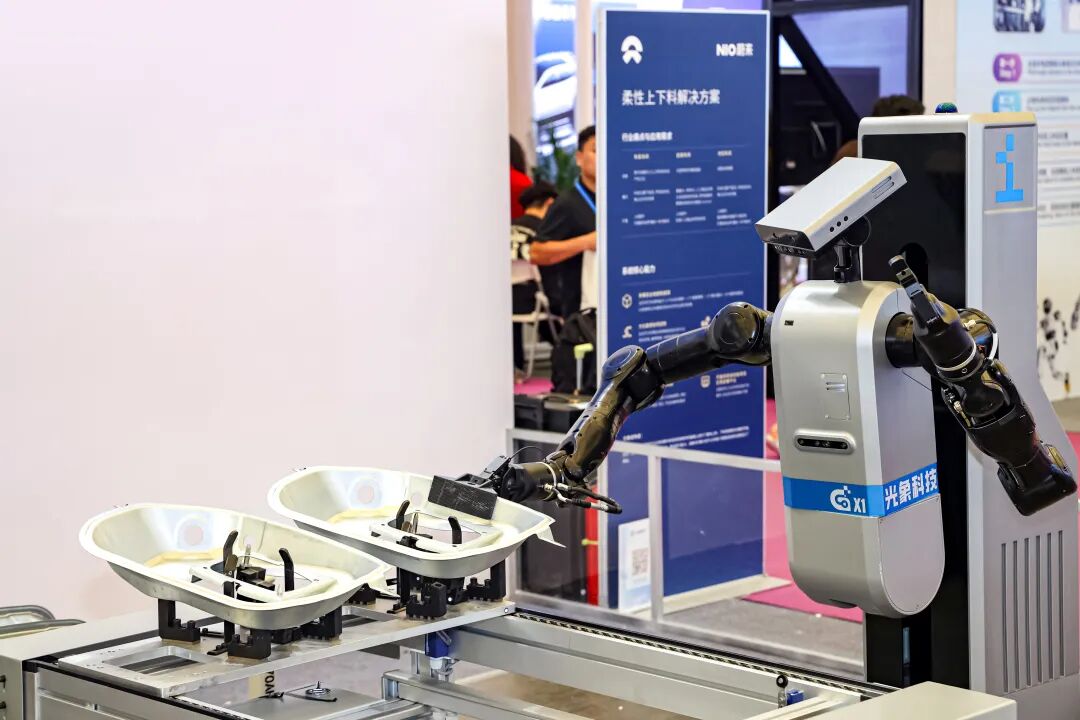
In June 2026, 「Guangxiang Technology」 officially released the industrial - grade self - evolving embodied intelligent robot Phi - Bot X1. This robot, designed specifically for industrial scenarios, uses a four - steering - wheel omnidirectional chassis, supporting active steering, lateral "crab walking", diagonal movement, and in - place rotation. It can be locked autonomously during operation to ensure stability; the lifting waist structure enables its vertical working range to cover 0 to 2.5 meters.
According to Zhang Tao, Phi - Bot X1 has 27 degrees of freedom throughout the body. The dual - arm with full - joint force control supports 1kHz collaborative control and real - time force feedback. It can achieve a positioning accuracy of 10mm and a terminal repeated positioning accuracy of 0.05mm only relying on its own perception, and supports quick battery replacement in 1 minute.
Different from the common practice in the industry of "releasing PPT first and then doing product and scenario verification", before the official release of the product, the robot of 「Guangxiang Technology」 has completed real - world operation verification on the automobile production line.
(Quelle: Unternehmen)
At the 2026 ATC exhibition, Phi - Bot X1 ran continuously for 21.5 hours for three consecutive days, completing the entire process of welding, loading, and unloading on the automobile production line without any errors or interruptions.
In the operation of aligning two holes simultaneously, it can control the dynamic operation accuracy within the millimeter - level and the angle within 0.3° only relying on its own perception, with a 100% success rate of continuous work in a dynamic environment.
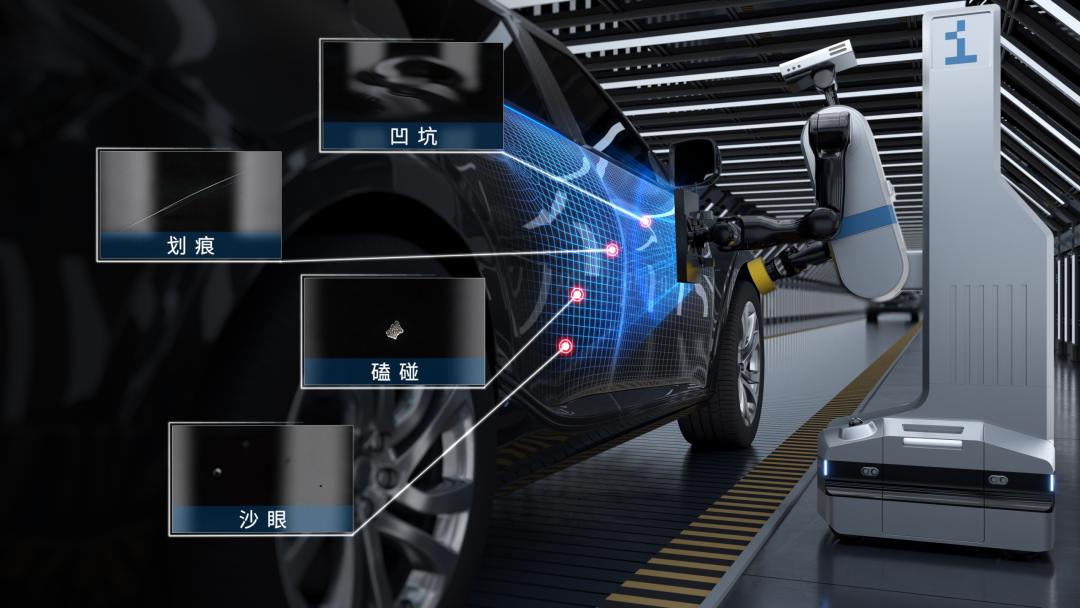
Relying on the generalized skill model, in the mobile quality inspection scenario, the efficiency of Phi - Bot X1 is increased by 51% compared with the non - collaborative method, and the cycle time is saved by 25% to 45% compared with the manual workstations. The deployment cycle is compressed from more than 6 months in traditional automation to weekly or even daily levels.
(Quelle: Unternehmen)
After the initial verification of the feasibility of commercial implementation, 「Guangxiang Technology」 will rapidly expand the implementation scale in the future.
Zhang Tao told Hard Kr that in the century - long automation process of the automobile industry, all the problems that can be solved by existing technical means have already been solved. Embodied robots should tackle the 30% digital gap that "robotic arms and PLCs cannot solve", such as welding, loading, and unloading with the risk of burns, tail - line quality inspection that requires flexible adjustment of the perspective and high consistency, and high/medium/low - position assembly that is unfriendly to workers' cervical and lumbar spines.
At present, 「Guangxiang Technology」 has completed real - world scenario verification around typical high - value workstations such as loading, unloading, and quality inspection in automobile manufacturing and has reached commercial cooperation with many domestic and foreign leading automobile enterprises.
Zhang Tao told Hard Kr that the market scale of robots in the domestic automobile production line is about 100 billion yuan. The company plans to first focus on the automobile scenario and then extend to a wider range of industrial scenarios in 3 to 5 years.
Following is an interview between Hard Kr and Zhang Tao (slightly edited):
Hard Kr: Previously, many embodied intelligence companies tried to enter the automobile scenario without success. There was even a voice in the industry that "the automobile scenario has been falsified". Why did you choose to focus on the automobile scenario in the opposite direction?
Zhang Tao: The entry of robots into the automobile scenario is by no means falsified, but rather "not ready". Most of the companies that entered the automobile scenario in the early stage first told stories and then adapted products, lacking an understanding of the scenario process. Take a certain international luxury automobile manufacturer as an example. A certain humanoid company it cooperated with before used a biped + dexterous hand solution for welding and loading. Due to walking vibrations, the workpiece drop - off rate was 80%. Eventually, it was forced to mount an AGV to barely make it work. This is essentially because the body design did not match the scenario requirements.
Automobile manufacturing is the earliest test field for new industrial technologies. PLCs, robotic arms, and AI quality inspection all originated from here, and the problems that can be solved by existing technologies have already been covered by automation. Embodied robots should precisely tackle those "remaining 30% digital gaps".
Hard Kr: What is the core entry point for embodied robots in the automobile scenario?
Zhang Tao: It is not to replace the 90% of mature robotic arm workstations, but to solve three major types of "automation blind spots": First, scenarios with occupational health risks, such as the risk of burns in welding, loading, and unloading, and the damage to the cervical and lumbar spines in high/medium/low - position assembly;
Second, scenarios with quality consistency requirements, such as tail - line quality inspection, where fixed cameras cannot flexibly adjust the angle and the recall rate of AI quality inspection is insufficient;
Third, flexible production scenarios (such as the dynamic adjustment requirements in the mixed - line production of multiple vehicle models). Our Phi - Bot X1 has achieved zero errors in continuous 21.5 - hour welding, loading, and unloading, and the efficiency of mobile quality inspection is increased by 25% - 45% compared with manual work.
Hard Kr: What is the difference between your so - called "physical native" and the current mainstream VLA and world models?
Zhang Tao: VLA is essentially "action mapping" - after pre - training the VLM, it grafts action experts and learns by fitting human demonstration data. It needs to be retrained when the task or the position of the sensor changes, and its generalization ability is weak. The world model mainly makes world predictions at the pixel level and has limited understanding of the underlying physical laws, especially the causal relationship between world changes and actions. The core of our physical native model is to enable robots to independently master the physical causal laws through physical interaction.
For example, in the scenario of aligning holes during loading and unloading, there is no need to collect a large amount of data on "how to adjust when it is placed crookedly". Instead, the robot can conduct parallel trial - and - error in high - fidelity simulation and independently learn "in which direction to adjust to align when it is stuck". One graphics card can virtually iterate 1000 robots simultaneously, and the cost is much lower than collecting data with real machines.
Hard Kr: How do you view automobile enterprises' self - research on robots? Will it compete with you?
Zhang Tao: If automobile enterprises' self - research on robots aims at "entering their own production lines", the business logic is not valid. The number of production lines of an automobile enterprise is limited, and the solutions developed by one enterprise will not be used by other enterprises, and the data cannot be circulated across factories.
Tesla and XPeng's research on robots is more likely to target the C - end home scenario, which is complementary to our B - end industrial positioning. The advantages of automobile enterprises lie in manufacturing and channels, but embodied intelligence requires a change in the technical paradigm. It is difficult for the traditional Tier1 supply model to develop core algorithm capabilities. Referring to autonomous driving, the self - research results of most automobile enterprises are not ideal.
Hard Kr: Is the hardware of Guangxiang self - developed? Will hardware become a barrier in the future?
Zhang Tao: In the early stage, the company adopted the model of "self - developed design + OEM integration by external suppliers" and will gradually take back the core hardware capabilities later. But in the long run, after the Chinese supply chain matures, the hardware will be quickly equalized.
Hard Kr: Will you target the C - end in the future? What is the rhythm of the listing plan?
Zhang Tao: The C - end will be considered at least 3 - 5 years later. There is a listing plan, but it is not the core goal at this stage. The current focus is on polishing products and implementing scenarios. We are more concerned about how many of the sold robots are in active use because only continuous feedback from real scenarios can form a product closed - loop, which is the core competitiveness of an embodied company.
Hard Kr: What stage is the industry currently in? Is there a bubble?
Zhang Tao: 2026 is the turning point from "looking at demos" to "looking at implementation". In the next 1 - 2 years, the implementation data will determine the direction of the industry. There is indeed a phenomenon of "false implementation" at present, but it will eventually return to the essence of business.
We do not pursue a high short - term valuation. The company was officially founded in April 2025. In the early stage, we spent two or three months in automobile factories to investigate the process, let the robot start working on the production line, and then launched the product. Embodied intelligence is a 10 - or 20 - year track, and it doesn't matter whether it is high - profile in the first year.
Das Bild auf der Startseite stammt vom Unternehmen
Layout | Fan Xinya

Gerne Kontakt aufnehmen