Honda gibt nicht auf und will Nissan mit ins Boot holen, um weiterzumachen.
At the annual general meeting of Honda last Friday, the current President Toshihiro Mibe continued to receive support and was re - elected as a board member. The atmosphere at this meeting was as tense as that at Nissan's general meeting. Just last month, Honda presented its first annual loss in 70 years. Therefore, at the beginning of the meeting, Toshihiro Mibe apologized to the shareholders.
The direct reason for the loss was the reorganization of the electric mobility business, which cost more than $9 billion. Moreover, the aggressive competition from Chinese manufacturers has put Honda under increased pressure in key markets. What was even more surprising to the company's management was the full implementation of US tariff policies and the simultaneous abolition of subsidies for electric vehicles. This has suddenly made the planned electric mobility strategy in North America very difficult.
Toshihiro Mibe admitted at the meeting that the actual market share of pure electric models in the US market after the removal of subsidies was far behind the company's previous forecasts. If the original plan were to be carried out, it would mean that the electric mobility business would not get out of the red for at least five, perhaps even seven years. This would be an extremely critical situation for the company.
He admitted that the shareholders' demands for the management's accountability were justified. But he emphasized that his real responsibility as President was not to step down, but to get the company back on a growth track as soon as possible, "to offer mobility solutions that only Honda can offer" and to act with a sense of urgency.
Another topic that interests the shareholders is the significant change in Honda's strategy. A few years ago, Toshihiro Mibe loudly demanded "priority for electric vehicles". Now, the company has quietly abandoned this strategy and instead put hybrid vehicles in the spotlight. Some shareholders see this as confirmation of their earlier concerns, while others think it is a realistic adjustment to the reality.
In fact, Honda has cancelled the development of two new electric models in the 0 - series, including the originally planned model of the joint - venture brand Afeela with Sony. The project to establish an electric vehicle and supply chain in Canada has also been frozen. Last month, Toshihiro Mibe also gave up the goal of completely stopping the sale of combustion engines by 2040.
Currently, Toshihiro Mibe has clearly shifted his focus to hybrid vehicles and at the same time severely restricted the pure electric vehicle business. His new goal is that the new hybrid models will be the main drivers of recovery by 2030. The first model will be presented next year, and a total of 15 new hybrid models are planned worldwide, especially for the North American market. By 2030, the global sales target for hybrid vehicles will be increased from the original 2.2 million to 2.5 million units.
Honda - Nissan - Mitsubishi, Does an Alliance Still Make Sense?
While Honda admits its mistakes and adjusts its strategy, it also shows the shareholders another way and strongly promotes the upcoming cooperation with Nissan. Toshihiro Mibe said that the cooperation "is progressing quite well and is close to an announcement in some areas". Both sides are working on the projects in a mutually beneficial relationship.
In fact, Honda, Nissan and Mitsubishi are in the final negotiations on the standardization of the next - generation electronic control units (ECU). The ECU is the basis for software execution and the core component for controlling functions such as autonomous driving and in - vehicle information systems. By jointly procuring this key component, these three Japanese companies hope to develop more cost - effective cars.
The data shows that the total global sales volume of the three companies Honda, Nissan and Mitsubishi will reach 7.3 million vehicles in the fiscal year 2025. The increased procurement volume through the standardization of parts will directly reduce the cost per vehicle and thus help them better compete against Chinese automakers and the US manufacturer Tesla. The latter clearly have an advantage in the field of intelligent cars.
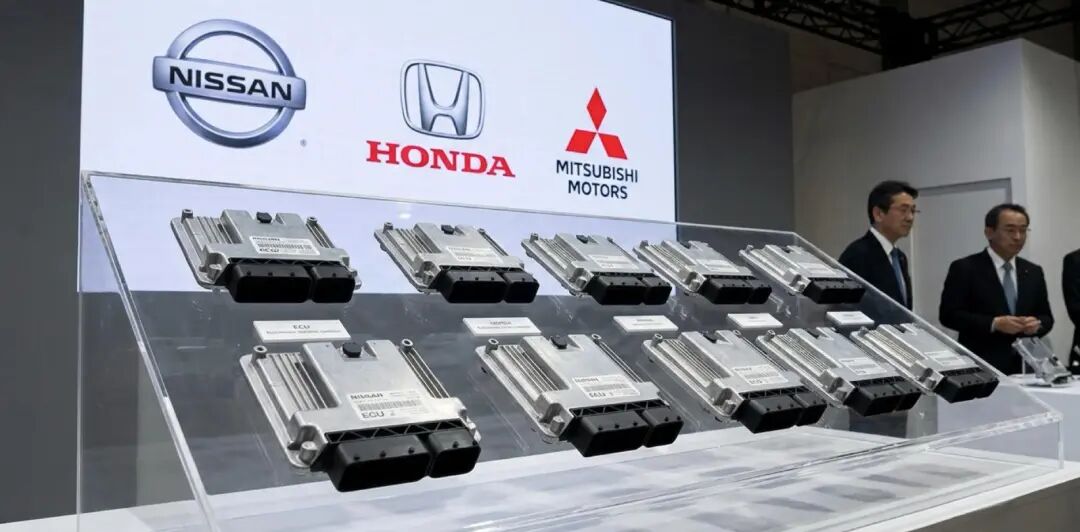
It is reported that the three companies are considering using this general ECU in both pure electric vehicles and hybrid vehicles. Then, the specific conditions for development and procurement will be determined, and Mitsubishi will also be involved in the financing. In addition, Honda and Nissan are dealing with the standardization of the in - vehicle operating system, because in addition to hardware, unified software and the operating system are also important for the efficiency of intelligent vehicle development.
In North America, both sides are trying to reach a common production agreement. Nissan is considering supplying pick - up trucks to Honda and Mitsubishi and is also discussing the joint development of large vehicles. Although details such as the division of research and development expenses have not been fully clarified, all parties are trying to reach a final agreement in the next few weeks. Vehicles with the general ECU could enter the market between 2029 and 2030.
Toshihiro Mibe believes that if the first project is successfully completed, the cooperation in other areas will run much more smoothly.
However, this cooperation is not without risks. Honda and Nissan announced cooperation in five areas, including software - defined cars, in August 2024 and talked about a merger in December of the same year. However, the negotiations broke down in February 2025 and have since continued at the project level.
The French automaker Renault, which holds 15% of the voting rights in Nissan, is currently the biggest potential obstacle. At Nissan's general meeting last week, Renault secretly influenced the shareholders' voting and rejected Nissan's proposal to appoint Motoo Nagai from the Mizuho Financial Group as an external board member. Mizuho has a close relationship with Nissan.
An insider at Nissan directly said: "This shows that if Renault is against something we want to do, it may not be feasible." Since the shareholders' approval is crucial for important decisions of Nissan, such as the appointment of board members, business transfers and capital alliances, the negotiation between Honda and Nissan could get into a dead - end at any time if Renault is against further deepening of the cooperation.
At Honda's general meeting, there were also voices criticizing the management's decision - making delay. A 70 - year - old participant complained: "You have to cooperate with Nissan as soon as possible, but the negotiations are going too slowly." In fact, Honda's situation is currently more difficult than two years ago when the negotiations started.
However, Honda predicts that it will make a profit again in the fiscal year 2026, with a net profit of 260 billion yen and an operating profit of 500 billion yen. However, achieving this goal largely depends on the strong performance of the two - wheeled vehicle business to offset the weakness of the automobile business. For example, the sales volume of the automobile sector in the Chinese market is still low, and the operating profitability is only 2.2%.
At the end of the meeting, Toshihiro Mibe expressed his determination: "In three years, we will acquire the means to defeat new forces such as Chinese automakers. If we can't do this, the four - wheeled vehicle business will get into trouble. We will face this challenge with unwavering determination." Whether this promise can be kept for the shareholders remains to be seen.
Localization in China Shows First Signs
In fact, Honda's problem is not only due to wrong decisions in the electric vehicle strategy. Like most established automakers, it is experiencing unprecedented pressure in the Chinese market. In just a few years, the sales volume has dropped from a peak of 1.62 million vehicles in 2020 to 640,000 vehicles in 2025. According to the current trend, the annual production in 2026 could even fall below 600,000 vehicles.
In April this year, Toshihiro Mibe personally visited China. According to Japanese media reports, his goal was straightforward: he wanted to see for himself how Chinese companies could produce so many cars in such a short time. After visiting a factory of a Chinese supplier in Shanghai, he said: "We simply can't compete with them."
All international automakers have heard of the "Chinese speed", but only a few have actually experienced it. Chinese automakers can bring a new model to the market in two years or even less, while traditional brands often take twice as long or more. Therefore, it seems that new products are presented almost daily in the Chinese market.
Chinese suppliers can not only keep up with this pace but also deliver with a cost - efficiency that industry giants can only dream of. This systemic efficiency is not based on a single technological breakthrough but on the way the entire supply chain works together and makes decisions. This is completely different from the process that Japanese automakers are used to.
However, Toshihiro Mibe's statement does not mean that he gives up. After returning to Japan, he told his suppliers: "We have to act quickly." Therefore, Honda is accelerating the research and development process, moving thousands of engineers to a newly established engineering subsidiary and renewing the previously weakened independent research and development department.
In the past six years, the research and development work was centralized, and decisions were made at the headquarters. This led to long decision - making processes and a slow reaction time. In the new structure, the engineers will have more autonomy. Whether this freedom can actually release a lot of energy is still unclear, but it at least shows that the management has recognized that the previous research and development rhythm can no longer keep up with the competition.
Then, in May this year, Honda released a new global strategic plan. Regarding the Chinese market, it says that Honda will use local standard parts and actively use local resources in new technology areas. At the same time, new energy vehicles will be developed based on the platforms of local partners to improve product quality and cost - efficiency at the unbeatable Chinese speed.
Simply put, this means complete localization. And at the Auto Shanghai in April, the two joint - venture companies Dongfeng Honda and GAC Honda showed a completely different attitude in interviews than before, which was rather conservative.
Ca Dongjie, the deputy general manager of Dongfeng Honda, said that Dongfeng Honda will strengthen the joint development and introduction of platforms from Dongfeng and high - end platforms for new energy vehicles. In the future, the strengths of combustion engines in terms of performance, chassis, quality assurance and handling will be deeply integrated with local intelligence to ensure that the combustion engines can keep up with the pace of the Chinese market. In addition, a strategic partnership will be established with leading Chinese technology companies for new energy vehicles to implement joint projects.
Lin Zhibin, the deputy general manager of GAC Honda, revealed that the two shareholder sides are talking about changing from one - sided technology import to mutual strengthening and in - depth joint research and development. The Chinese and Japanese sides have upgraded to an equal - footing partnership for technological cooperation and ecosystem building. The Chinese and Japanese have agreed to develop the product strategy based on the Chinese market and switch from a global strategy to a strategy that combines global and local Chinese aspects. Local resources will be continuously integrated into product definition, and by 2027, an independent vehicle will be developed based on a Chinese new energy vehicle platform.
In fact, the cooperation has already begun. The CR - V of Dongfeng Honda and the Breeze of GAC Honda are already equipped with a cloud - car infotainment app from Huawei Cloud. By using the computing power of the cloud instead of the computing power in the vehicle, the entertainment ecosystem and voice interaction are greatly improved.
While Chinese brands are building a differentiated competitive position through intelligent driving experience, Honda in China is trying to combine its strengths in chassis, performance and quality assurance, which it has gained over more than a hundred years, with the most advanced Chinese intelligence. Whether this path will be successful remains to be seen, but at least the direction is clear.
This article is from the WeChat account "Automobile - Community" (ID: iAUTO2010), author: Yang Jing. Published by 36Kr with permission.