Das wahre Drehbuch des Schwarzen Dienstags am US-Aktienmarkt
Today's performance of US stocks has surprised everyone! On Tuesday (June 23) in US Eastern Time, the three major US stock indices opened together with a decline. The Nasdaq temporarily fell by more than 2.2%, and the Philadelphia Semiconductor Index temporarily plunged by more than 7%. The Dow Jones Index showed relative resilience and temporarily entered the negative zone.
In the area of individual stocks, Micron Technology fell by more than 13%, SanDisk plunged by more than 12%, Qualcomm fell by more than 6%, and AMD by more than 5%. Stocks in the memory and optical communication industries suffered a total collapse.
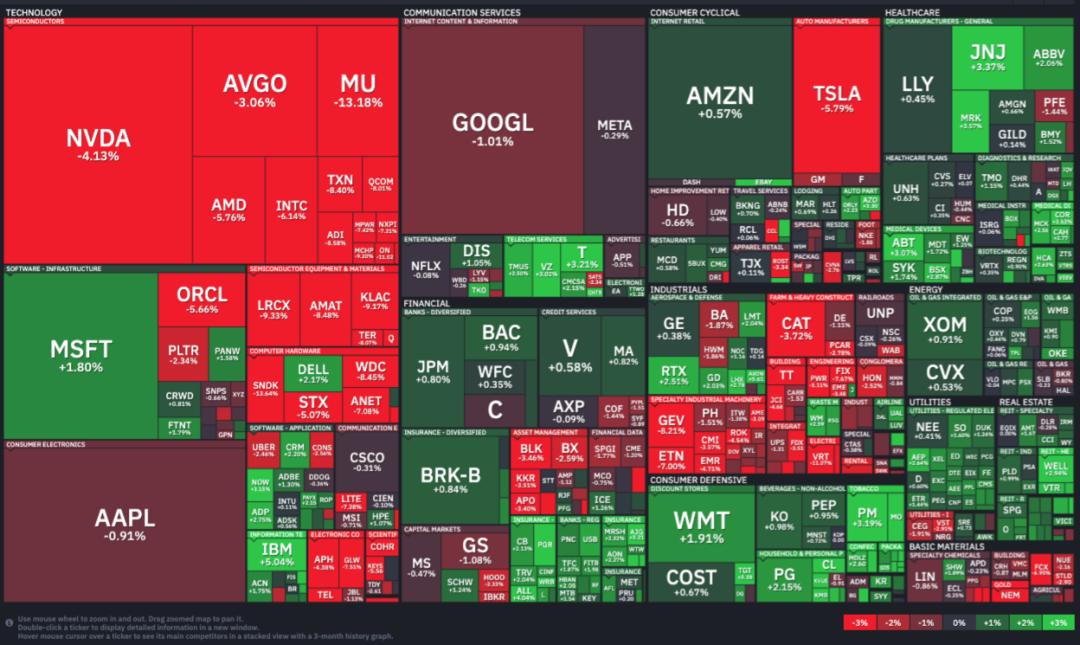
On the same day, the European market also followed with losses. The STOXX 600 Technology Index fell by more than 3.3%. The Nikkei 225 Index closed with a loss of 3.55%. The global technology industries showed a synchronous decline in prices.
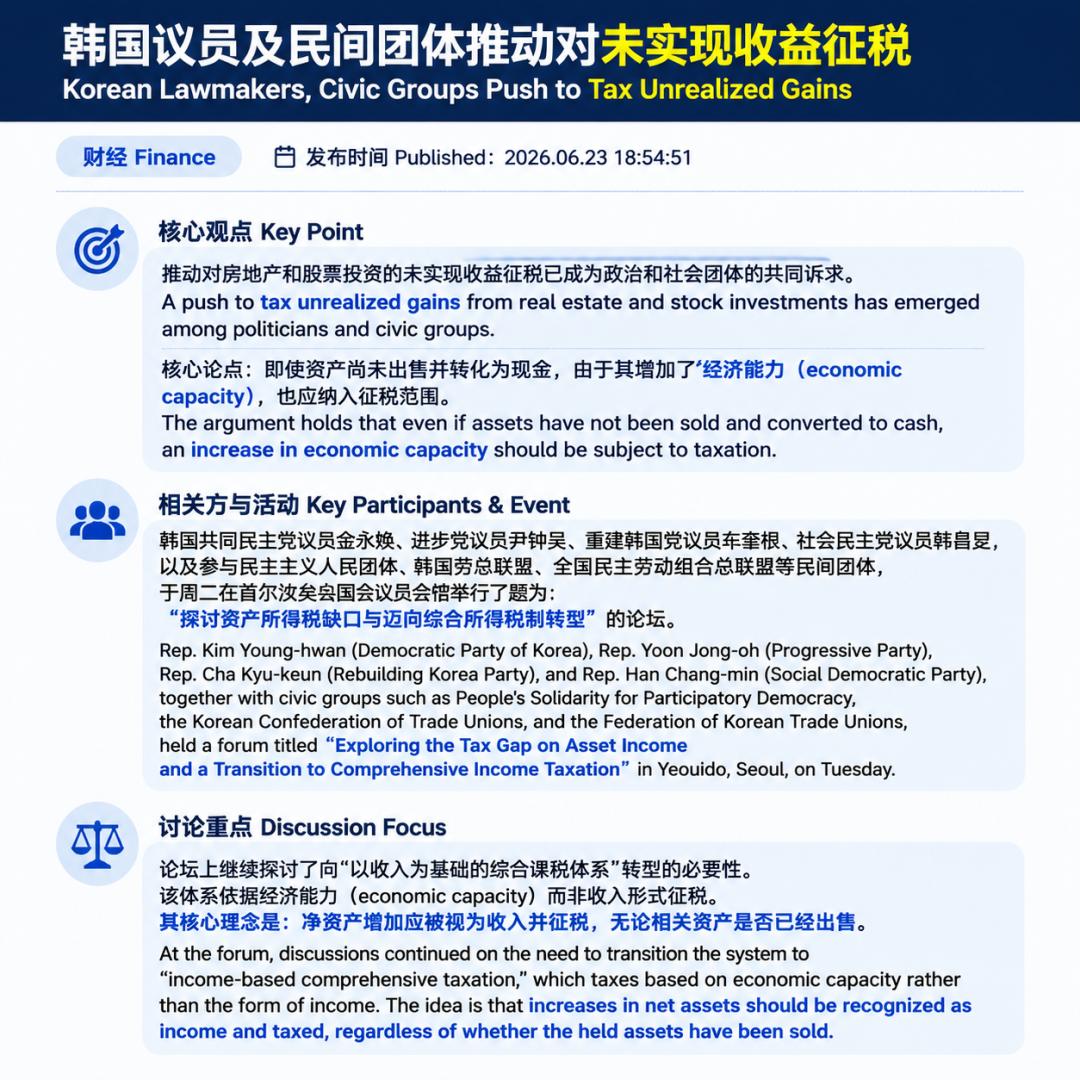
The direct trigger for all this was a "tax essay" from South Korea that was widespread during the Asian trading session - a political discussion document about including unrealized gains from stocks and real estate in the tax system.
How did the "tax essay" from South Korea ignite the South Korean stocks?
During the Asian trading session on Tuesday, the Yonhap News Agency reported that South Korean lawmakers were discussing a tax reform package that would include unrealized gains (book profits) from stocks and real estate in the scope of the synthetic income tax.
The core goal is to switch to the "synthetic income tax approach": Regardless of the type of assets and whether they have been realized or not, the actually increased net assets are used as the tax basis.
Put simply:
Even if investors have not sold their stocks yet, the visible profits on the account may possibly be taxed.
Why did this news have such a strong impact on the South Korean stock market?
To understand this, one must first look at the state of the South Korean stock market before the crash:
First: The South Korean stock market has just reached a new high and is in an extremely overbought state. The day before (the KOSPI index had just exceeded the historical mark of 9,000 points.
Second: The leverage ratio of private investors has reached an extreme level. By early June, the borrowed investment volume of South Korean private investors on the KOSPI market was 29 trillion won, which represents a 71% increase compared to the 17 trillion won at the end of 2025 and has reached the credit limits set by brokerage firms. The leverage funds are highly concentrated in the chip industry.
Third: The two stocks Samsung and SK Hynix together account for almost 50% of the KOSPI weight. This means that the fluctuations of these two stocks can almost directly determine the development of the entire index.
Fourth: The market value of SK Hynix has just exceeded that of Samsung Electronics, which was interpreted by the market as a "peak mark". On June 22, the market value of SK Hynix exceeded 2,080 trillion won and thus exceeded Samsung Electronics. This was the first time in 26 years that Samsung was replaced at the top of the South Korean market value. A strategist from Seoul noted that the overvaluation of SK Hynix compared to Samsung Electronics is an important signal for an overheated market.
Fifth: The president of the South Korean Financial Supervisory Service, Lee Chan - jin, said openly on Monday that he "regrets" having introduced the leveraged ETFs. He said at a press conference: "These are high - risk products. Even if we constantly warn about the risks, the investment enthusiasm does not subside." He even unusually said: "Half - jokingly, I really should have lain in front of the door at that time to prevent the introduction of these products." The "regret" statement of the supervisory authority has itself sent a signal to the market that the risk has "got out of control".
The mechanism of the damage effect of the essay
Against this background, the damage effect of the news about the "taxation of unrealized gains" was multiplied.
In a market where the borrowed investment volume of private investors is 29 trillion won and the credit limits have been reached, the security coverage of most leverage funds is in a delicate balance. This means that a small decline in prices can trigger the need for additional security payments.
After the discussion about the "taxation of book profits", investors are faced with an asymmetric game structure:
1. If they continue to hold, they have to bear the costs of taxing their book profits;
2. If they sell early, they can secure their profits immediately, avoid the tax burden, and at the same time lower the leverage ratio and reduce the pressure on the securities.
In a market where there is no longer a safety margin (the credit possibilities are exhausted), this structure makes "running ahead" the best choice for every rational private investor. However, if everyone runs ahead at the same time, the liquidity dries up immediately, and the sell - off becomes a stampede.
A researcher at the South Korean Financial Research Institute also pointed out that the taxation of unrealized gains could create incentives for investors to sell early to avoid future tax burdens.
The "regret" statement of the supervisory authority about the introduction of the leveraged ETFs further strengthened this panic mechanism. The leveraged ETFs themselves have a daily rebalancing mechanism - when the market falls, the leveraged ETFs have to sell more underlying assets to maintain the leverage ratio. This leads to a self - reinforcing cycle of "price decline → selling of leveraged ETFs → further price decline → more selling of leveraged ETFs".
Between 2 and 3 p.m. on June 23 in South Korea, a large number of forced - selling orders flooded the market. Together with the daily rebalancing pressure of the leveraged ETFs that track chip stocks, this drove the volatility to the peak. Foreign investors sold more than 2 trillion won (about $1.3 billion) of KOSPI components in the morning.
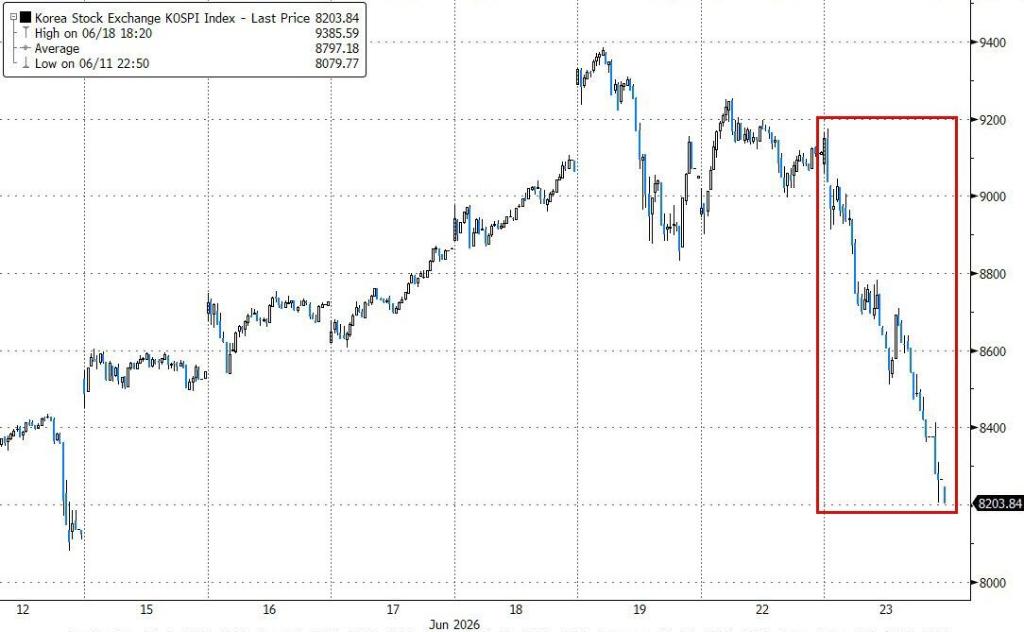
The end result: The KOSPI closed with a loss of 9.99%, and the circuit breakers were triggered twice; Samsung Electronics plunged by 12.31%, and SK Hynix by 12.47%.
Why did the crash in South Korea spread to US stocks?
Direct industrial chain commonalities
Samsung Electronics and SK Hynix are the two core suppliers of global AI memory chips (HBM and DRAM). HBM is regarded as one of the most important components of current AI servers and large data centers.
In the past two years, one of the biggest investment logics of the AI industrial chain has been the long - term shortage of HBM. From Nvidia, SK Hynix, Samsung Electronics to Micron Technology, the valuation expansion of the entire AI hardware industrial chain is based on this expectation.
So when the South Korean chip stocks crash, global investors naturally ask the question: "Does the collapse of South Korean chip stocks mean that there are problems with the demand for AI hardware?" This question is directly aimed at US AI hardware companies such as Micron Technology, Nvidia, and AMD.
The synchronous withdrawal of cross - border capital flows
Besides the industrial chain commonalities, there is an even more direct transmission channel: the synchronous withdrawal of cross - border arbitrage capital.
The foreign institutional investors who hold South Korean chip stocks are also the main holders of US AI hardware stocks.
If they are forced to liquidate or actively reduce their positions during the Asian trading session due to the circuit breaker trigger on the South Korean market, they also have to synchronously reduce the relevant positions after the opening of the US stock market to meet the risk management requirements of their global portfolios (e.g., risk value limits, stop - loss lines).
The portfolio rebalancing mechanism of international capital flows
A global technology fund that holds Samsung Electronics, SK Hynix, Micron Technology, and Nvidia at the same time will usually take a risk management measure to "reduce the exposure to the entire technology industry" when its positions on the South Korean market suffer significant losses, instead of only reducing the South Korean assets. This directly leads to the synchronous sell - off of US AI hardware stocks.
Essentially, it is the same amount of money that synchronously reduces positions in different markets within the same industrial chain.
The "running ahead" effect before the Micron quarterly report
Micron plans to release its quarterly report on June 23 (after the US Eastern Time market closes on Wednesday). This is regarded by the market as a crucial window to observe the demand trends of DRAM and HBM. Since Samsung, SK Hynix, and Micron are in the same industrial chain, Micron's performance is regarded as a leading indicator for the prospects of these two South Korean memory giants.
The problem is that the market's expectations for the Micron quarterly report have been over - inflated - since the beginning of the year, Micron's stock price has risen by more than 260%. Against the background of the collapse of South Korean chip stocks, capital flows choose to minimize risks early before the Micron quarterly report, which intensifies the sell - off of Micron and the relevant semiconductor stocks.
Looking at the trading behavior, institutional investors with a long position in Micron are faced with a very real decision - making difficulty when South Korean chip stocks have already crashed:
1. If the Micron quarterly report does not meet expectations, this will be interpreted by the market as "confirmation of the turning point of global memory demand" against the background of the South Korean crash, and the price loss could far exceed the normal level;
2. If the report exceeds expectations, the price recovery could also be dampened by the panic sentiment on the South Korean market.
This asymmetric risk - return structure makes position reduction before the quarterly report a natural risk management choice for many institutions - especially when there are already negative catalysts in the market, it is easier to justify position reduction at the compliance level as being "cautious".
The warning from Goldman Sachs about the AI industry occurred at the same time
On the same day, a strategist from Goldman Sachs issued a warning in a report: The AI market "is like a stretched rubber band". As soon as one of the large technology companies reduces its AI spending, the valuation logic of the entire AI industry will be restructured.
Goldman Sachs also pointed out a "structural discrepancy": The super - cloud providers are constantly increasing their AI spending, but their stock prices are lagging behind the market, while AI hardware stocks such as Nvidia and TSMC are rising on the contrary - this discrepancy is itself a signal of faulty market price discovery.
The report from Goldman Sachs and the crash on the South Korean stock market occurred on the same day. The overlay effects were significant: The collapse of South Korean chip stocks has translated Goldman Sachs' AI warning into reality, and Goldman Sachs' warning has given a theoretical framework to the panic sentiment in the market.
The overlooked structural factor: The turning point of liquidity
The annual growth rates of the US M2 money supply have been steadily falling since the peak in 2025. The valuation expansion of AI hardware stocks has been highly driven by excess liquidity. When the incremental capital flows (new buying power) decrease, the only support for the high valuation will be the "continuous concentration of existing capital in this industry" - but this means that the market structure is becoming more and more fragile.
The "tax essay" on the South Korean market and the profit - taking before the Micron quarterly report occurred exactly at a time when the turning point of liquidity and the extreme concentration of market shares occurred simultaneously. This is the reason why a political discussion that would actually have only a minor effect under normal market conditions could trigger such a violent chain reaction.
The opinion of StockWe.com
1. At first glance, it is a news reaction, but in essence, it is the "systemic weakness" and the "leverage resonance"
The theory that the "essay made the market crash" is only a superficial causality. Between the legislation and the implementation of the