Cook hat die Karten aufgedeckt: Preiserhöhung
According to a report from the "Wall Street Journal" yesterday, as announced by Zhidx on June 22nd, the huge demand from the AI industry for memory chips is driving a global price increase wave in consumer electronics. Manufacturers such as Apple, Microsoft, Nintendo, and Sony have significantly raised the prices of their products recently. Tim Cook, the CEO of Apple, admitted that the company is unable to handle the increasing cost pressure in the supply chain alone and announced that it will raise the prices of its products in the coming months.
The root cause of this price increase lies in the expansion of the AI industry. DRAM and NAND flash memories are not only the basic hardware for consumer devices such as mobile phones, laptops, and game consoles but also the key resources for AI companies to train and run large models. The explosive growth of the AI industry is consuming a large part of the capacity for similar chips, leading to a serious shortage in the memory chip supply worldwide.
Chip manufacturers are benefiting greatly from this. The three largest memory chip manufacturers in the world - SK Hynix, Samsung Electronics, and Micron Technology - are the biggest winners. In the past six months, the market capitalizations of SK Hynix and Micron have each increased by about four times and have each exceeded the mark of 1 billion US dollars (about 67.7 billion yuan).
And the cost pressure is being passed on to consumers step by step. Last year, the contract price of a mainstream data center memory chip from Micron increased by almost four times.
According to a report from Investing on June 20th, 2026, Goldman Sachs has downgraded its forecasts for global smartphone sales in 2026 and 2027 because the continuous price increase of memory chips is dampening market demand.
In the face of the continuously rising prices of new devices, the market for used and refurbished devices is experiencing new growth. Many refurbishment and trading platforms are focusing on quality assurance and after - sales service.
At the same time, analysts predict that it will take two to three years for new wafer fabs to start operating. The shortage and price increase of chips will last for several more years, and consumers of consumer electronics cannot expect a price drop in the foreseeable future.
01. Price increases in all consumer electronics categories: Cost pressure is passed on to consumers
Consumers can directly feel the price increases in various products. Microsoft set the price of the new Surface Pro laptop at 1,599 US dollars (about 10,800 yuan) last week, which is an increase of 600 US dollars (about 4,062 yuan) compared to the previous model.
Nintendo raised the price of the Switch 2 game console by 50 US dollars (about 339 yuan) to 499 US dollars (about 3,378 yuan) in May. The company officially apologized: "We apologize for the inconvenience caused to consumers by this price increase."
The price of the Sony PS5 Pro console rose from 750 US dollars (about 5,078 yuan) to 900 US dollars (about 6,093 yuan) in April.
The price of the iPhone 18 Pro introduced in September this year could be up to 1,299 US dollars (about 8,794 yuan).
It should be noted that iPhone buyers who want the latest features have a higher threshold to cross. Apple's intelligence functions, including the newly designed Siri, are only supported on the iPhone 15 Pro, the entire iPhone 16 series, and the entire iPhone 17 series. To experience the strongest AI capabilities on the device side, one needs at least an iPhone Air or an iPhone 17 Pro model.
Emily Herbert, a senior analyst and the head of the global used smartphone business at the market research firm Counterpoint Research, noted that hardware manufacturers have no other choice but to pass on the cost pressure to consumers. Either they increase the prices directly, or they make compromises on the hardware configuration.
02. The demand for NAND is approaching that of DRAM: The contract price of mainstream chips has increased by almost four times
The root cause of the price increase lies in the capacity crisis of memory chips, which is caused by the explosive growth of the AI industry. DRAM and NAND flash memories are not only the basic components of consumer electronics but also the key hardware for AI companies such as OpenAI and Anthropic to train and run large language models and code - intelligence agents.
Indong Kim, the vice - president of sales and marketing for the memory division of Samsung Electronics, said in an interview in March that the nature of chip shortages has been constantly changing in recent years. At the beginning of AI chatbots, the industry capacity was completely focused on the production of HBM high - performance memories made of stacked DRAM chips. With the maturity of AI model technology, companies' dependence on NAND flash memories for storing user dialogue histories and other scenarios is constantly increasing.
Kim said: "The expansion of NAND capacity is a new trend. We have observed that the market demand for NAND is approaching that of DRAM."
Intel, which mainly manufactures PC processors and does not produce memory chips, has also felt the ripple effects. Intel said in April that the price increase of memory chips and core components would shrink the entire PC market by about ten percent. David Zinsner, the CFO of Intel, said: "We cautiously assume that the demand in the PC market will continue to decline in the second half of the year."
Even with significant price increases, memory chip manufacturers have no problems with marketing. Data from the data center hardware dealer Circular Technology in Massachusetts shows that the contract price of a mainstream data center memory chip from Micron increased from 350 US dollars (about 2,370 yuan) to 1,300 US dollars (about 8,801 yuan) last year, which is an increase of almost four times.
Brad Gastwirth, the head of global research at Circular, said: "The valuations of chip companies are currently very high. Manufacturers need to make high profits, and in the end, consumers foot the bill. The prices of laptop products that will enter the market at the end of this year will not drop."
03. The market for used and refurbished devices is experiencing a consumption transfer
In the face of the high prices of new devices, the market for used and refurbished devices has become a practical alternative for many consumers. Top brands such as Apple offer official refurbishment channels, and there are also a number of established third - party trading platforms.
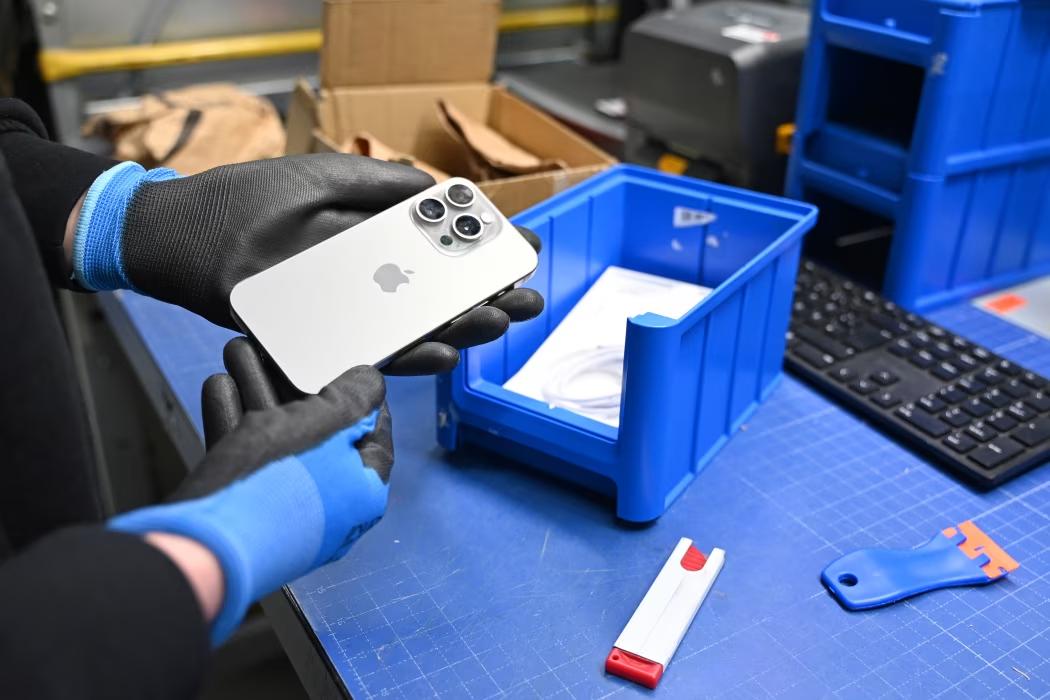
▲ Refurbished mobile phones are subjected to a series of tests before delivery to ensure the quality of their main functions (Source: Getty Images)
Ben Edwards, the founder and CEO of the used digital device trading platform Swappa, said that the problem of fraud attempts in the used digital device market is widespread. Swappa has continuously improved its verification process in recent years to prevent various new fraud methods, including fraud with artificially generated counterfeit product images.
Before buying a used device, consumers can also first evaluate whether their old device can still be repaired. Kyle Wiens, the CEO of the online community iFixit for digital device repair, said that many devices that seem to be defective only need a new battery to be functional again. This can save hundreds of dollars in the cost of a new purchase. The repair page on the Apple website shows the prices for battery replacement for all iPhone models. Even if consumers do not choose official repair, these prices can help them compare the cost of repair and the purchase of a new device.
Wiens said that replacing the battery of an iPhone is very difficult, while the repair of mainstream devices such as the Nintendo Switch is easier.
In addition, Michael Fisher, the operator of the YouTube channel MrMobile for digital product reviews, warned consumers that buying a new device may also require the disposal of old charging cables and accessories. For example, after upgrading to a new iPhone, one has to switch from the Lightning interface to the USB - C interface, which has been used as standard since the iPhone 15 series.
If one prefers a long - term use of a device, Fisher recommended choosing brand models that offer system updates over a long period. Constant system updates can prevent various new cyber security threats.
04. Conclusion: The shortage and price increase of chips will last for several more years
Memory chip manufacturers are accelerating the construction of new production lines to increase capacity. However, building semiconductor wafer fabs easily costs several billion US dollars, and the construction period usually takes two to three years. In addition, the subsequent increase in capacity requires additional time. Analysts predict that the shortage and price increase of chips will last for several more years. This means that consumers cannot expect a price drop in consumer electronics products in the foreseeable future.
From a broader perspective, the memory chip supply crisis shows the profound impact of the expansion of the AI industry on the global electronics supply chain. When AI companies and consumer electronics manufacturers compete for the limited chip capacity, the pricing power tends to be in the hands of the three chip giants in the supply chain. Even Apple, a strong player in the supply chain, has admitted that it is unable to handle the costs alone.
For consumers, it may be the most practical strategy to use official refurbishment channels and third - party trading platforms during the period of price increases and evaluate the repair value of their old devices.
Source: "Wall Street Journal"
This article is from the WeChat account "Zhidx" (ID: zhidxcom), written by Chen Jia and published with the permission of 36Kr.