Die KI-Version von Alipay wurde eingeführt und läutet das Wettrennen um die KI-Integration von Super-Apps ein
After WeChat, another app with a user base of over one billion people has entered the AI era.
On June 16th, the AI version of Alipay was officially launched and named "A Bao". Users can use thousands of services with a "swipe to the right" and complete all things in a clean dialog box with one sentence. Currently, the new version has started invitation tests and will be gradually rolled out to all users and iterated.
When shifting from the complicated menu icons and the nine - grid structure to a minimalist dialog box, Alipay tells a story that has completely shifted from mobile payment to AI service distribution. Alipay's AI era concerns not only the future of a product or a company but also the collective vision of the entire industry regarding "AI - native applications". This vision will become a reality faster in various apps and lead to different strategies.
The latest news shows that WeChat Pay has also officially released the "AI special card". According to reports, this is a product function specially developed for the payment scenarios of AI intelligent agents and is integrated into the WeChat wallet.
In the AI era, there are no spectators in the race for access points, only participants.
From the "presentation mode" to the "dialog mode": Two experiences in an app
AI payment is not new, but currently, Alipay is the only super - app that has made the entire platform AI - capable.
At the end of May this year, the person in charge of Ant Group's AI payment business told the media that Alipay would make an overhaul. Many intelligent services will be set up within the app, new products and services will be introduced, and the AI payment capacity will be integrated. Two weeks later, the AI version of Alipay officially made its debut.
The traditional home page of Alipay is filled with over a hundred function accesses, and the mini - apps are nested within each other. For example, if you want to handle pension insurance or search for a charging station location, you have to search in the mini - apps on the screen and flip through the pages one by one. Seldom - used services are only used once a year, and each time you have to learn how to operate them anew. This is a typical "presentation mode" interaction pattern, where all functions are presented to the user, and the user has to search on their own.
The AI version of Alipay has completely subverted this logic. After the user swipes to the right to enter the interface, they will find that it is extremely simple and has only two core function pages: On the one hand, the dialog - capable AI assistant "A Bao", and on the other hand, the overall overview of assets. All previous mini - apps on the screen are folded into a dialog box. If you want to get something done, you can simply type in the input field or speak directly, which enables a "dialog mode" interaction service.
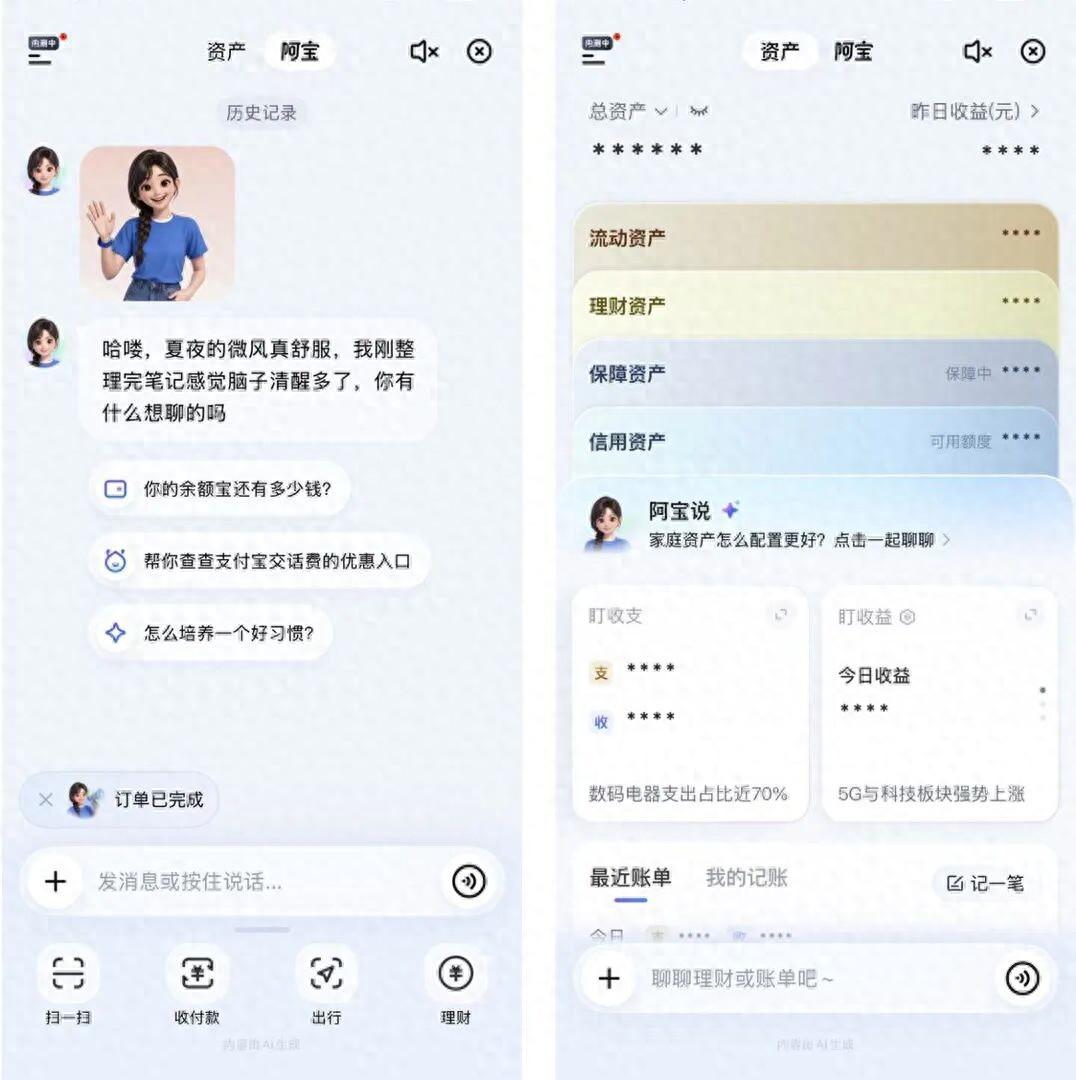
Take the query of pension insurance as an example: The user only needs to say "I want to query my pension insurance", and A Bao will automatically assign the corresponding mini - app and the specific service access and directly present the user with the interface for pension insurance query. The user only needs to click "Log in" and confirm to complete the query. According to reports, currently, there are thousands of compatible services on the Alipay platform, covering all kinds of scenarios such as management, travel, and daily life, and these services are constantly expanding.
It is worth noting that Alipay has shown a prudent attitude towards financial security in this AI era. On the core "money management" page, Alipay has not given AI the autonomy for independent operation. Instead, it has summarized the financial details distributed in Yu'E Bao, Xiao He Bao, and other places into a unified "personal account book" so that users can clearly see them.
To give users a sense of security, "A Bao" has installed an additional "security lock" based on Alipay's security and risk management system: A Bao helps users get things done, but it will not handle the users' money. The AI only executes the things that the user has explicitly agreed to. For financial changes or payment steps, the user has to confirm themselves. Li Jun, the president of the Alipay business group, has also emphasized that the promise "If you pay, we will compensate" still holds to find a balance between intelligence, convenience, and security trust.
After continuous failures: The triple ambition of Alipay's AI version
The emergence of Alipay's AI version was not a hasty experiment but a strategic offensive of Ant Group after failures in strategy selection. As early as September 2024, Alipay launched the independent AI life assistant app "Zhi Xiao Bao", but the result was not as expected. Subsequently, the team made a decisive turn - it abandoned the independent platform strategy and focused on the in - depth transformation of Alipay's main platform.
According to a report from "Wan Dian", the project of Alipay's AI version officially started in December 2025. The original project team was the intelligent assistant team on the Alipay platform. Later, teams for algorithms, C - end products, and mini - app businesses also joined. The final product strategy is neither an independent native app nor the embedding of an assistant in the existing app. Instead, users can switch to the new AI version of Alipay with one click and then, according to their habits, gradually complete the "switch" within Alipay.
The strategic planning and commercial purpose of Alipay's AI version can be understood from the following three aspects.
First, it is to take the lead in the payment entry in the AI era, make payment scenarios for general AI introduction, and develop the infrastructure from mobile payment to AI payment.
Currently, AI payment is in the initial stage of development, and there is no stable competitive situation yet. But since last year, both domestic institutions such as WeChat Pay, Alipay, JD Technology, and China UnionPay and foreign institutions such as Google, VISA, MasterCard, and PayPal have started to plan AI payment by releasing AI payment skills, intelligent agent payment contract embryos, and other methods. The competition has also increased.
For example, in September 2025, Alipay introduced the "AI payment service" to support payments for intelligent agents in the AI era. At that time, it was first introduced in Luckin Coffee's AI ordering assistant "Lucky AI". Users can "talk" through natural language interaction and directly complete ordering and payment in the intelligent agent app. This year, Alipay has also introduced AI payment capabilities such as "AI income", "Token Pay", and "AI wallet" to form a comprehensive AI - native payment system for the AI era. By the end of May 2026, Alipay had made over 300 million AI payments and supported 95% of general intelligent agent frameworks, including general intelligent agents, intelligent devices, intelligent cockpits, and AI tool platforms.
Payment is both the carrier of users' trust and the last step of the transaction cycle, which determines the complete commercial ability of AI services from information recommendation to actual fulfillment. The strategic intention of Alipay's AI version is very clear: It uses payment as a support point to drive general AI introduction. When users are used to completing payments in the dialog mode, it will naturally be extended to other services to take the lead in the payment entry and transaction path in the AI era.
Second, it is to further deepen the position as a digital life platform through AI and re - establish the advantages in the new race of "service looking for users".
In the era of the mobile Internet, although Alipay has tried hard to expand life services, it has never been able to surpass WeChat in terms of social aspects and the frequency of opening. WeChat AI has recently announced the integration of services such as Ctrip and Meituan. Users can book tickets on WeChat with one sentence, which directly threatens Alipay's core scenarios.
The AI era provides Alipay with a new opportunity and space: to transform from a passive tool app to an active intelligent life assistant that recognizes users' needs. At the same time, in the competition, it is no longer about the social relationship chain but about the precision and depth of service calls. Currently, Alipay is connected to over 8,000 digital life services, covering frequent scenarios such as travel, management, medicine, and financing. "A Bao" unifies the services distributed in various mini - apps on the dialog interface. Essentially, the operating system of digital life is rebuilt. Users don't have to worry about which merchant or mini - app is behind. They only need to tell "A Bao" their needs, and the rest will be done by the AI. This connects the fulfillment chain between payment and service at the lower level and builds a new commercial transaction system.
Finally, it is to explore the AI - commercial model and switch from the traditional "selling of traffic positions" to the "selling of service matching efficiency and decision - value".
Han Xinyi, the CEO of Ant Group, once explained that AI intelligent agents will turn the logic of "traffic is king" in the mobile Internet era upside down. In the future, the era of "traffic entrances" determined by humans will soon end, and instead, the "ecosystem of intelligent agents" will prevail. The size and network effect of the intelligent agent ecosystem determine the depth of future commercial moats.
With the launch of Alipay's AI version, on the TOC level, by providing intelligent financial services, AI customer service, and other personalized services, more users can be attracted, user stickiness can be increased, and thus advertising and service subscription revenues can be increased. On the TOB level, Alipay can use AI technology to provide merchants with solutions for precise marketing, intelligent customer service, risk prevention, and other things to improve merchants' operating efficiency and customer satisfaction and thus expand the corporate service market. This TOB and TOC parallel mode has the potential to transform Alipay from the traditional "transaction commission + advertising" mode to a mixed mode of "intelligent service subscription + precise mediation + scenario financing" to create new profit sources for Alipay, promote the wide application of AI technology in the commercial field, and maximize the commercial value of AI technology.
The race for the "AI era" of apps has begun: Three strategies
Since this year, the Chinese Internet has collectively entered the AI acceleration phase, and the Alipay platform has also lifted the curtain on the AI transformation of super - apps.
Recently, WeChat has opened the AI platform and allowed users to call third - party services (e.g., ticket booking, taxi ordering) through dialogs and embed the full - domain AI agent. Meituan has also promoted the R & D of its self - developed large language model LongCat and made it clear that the Meituan app will be upgraded to an AI - controlled super - app. Dialog ordering and travel planning are already in the gray area. The Baidu app is continuously developing towards AI search and multimodal Q&A, and the search results are directly connected to the service cycle. JD has introduced "JD AI Shopping" to explore dialog - capable consultation and automatic ordering in the e - commerce scenario.
In the AI transformation of large enterprises' main applications, three strategies have gradually emerged: integration into the existing app, separate launch of the AI version, and a combination of both.
The first strategy is to integrate AI capabilities into the existing app, which can reduce user costs. For example, WeChat AI, Alipay, and Douyin have integrated AI capabilities. Douyin has incorporated Doubao in the tests and placed the access to Doubao next to the "Like" and comment buttons to facilitate user operation. In this way, the AI function can be quickly spread based on the existing user base. Alipay has embedded AI in the existing app in the form of an independent dialog access. The second strategy is to separately launch the AI version, which enables the creation of a new brand, highlights AI features, and attracts users with special AI needs. For example, the AI search app "Dian Dian" of Xiaohongshu has introduced the "in - depth thinking function" based on its self - developed large model to explore the new possibilities of AI search through the independent app. The third strategy is the "dual - track strategy", such as in the case of Meituan and JD. On the one hand, AI capabilities are embedded in the main app, and on the other hand, independent AI products (e.g., Meituan's "Xiao Mei" app and JD's independent "JD AI Shopping" app) are launched for exploration.
It can be said that in the AI era, app forms are becoming more intelligent and personalized. There will be more and more AI - native applications. They are not only tool software but rather digital assistants of users, which can provide services such as text generation and intelligent interaction through multimodal fusion and innovation. The app can become a super - platform that integrates various AI capabilities and provides users with personalized services according to their behavioral habits and needs.
In this process, dialog - capable AI may possibly become the main choice of apps, but there are also some challenges. For example, in terms of trust...