Ein Embodied AI-Unternehmen, in das HSG und Alibaba investiert haben, hat eine neue Finanzierungsrunde abgeschlossen – mit Beteiligungen von SHT und anderen im Wert von mehreren hundert Millionen Yuan | Exklusiv von Hard Kr
Autor | Huang Nan
Redakteur | Yuan Silai
Hard Kr has learned that the embodied intelligence company Noematrix recently completed a new round of financing worth hundreds of millions of yuan. This round of financing was led by Wuxi Data Group, and the investors include the AI Future Fund (Venture Fund) of Shanghai Jiao Tong University, Shanghai Chuangzhizhi Technology Co., Ltd. (a wholly-owned subsidiary of Shanghai Chuangzhi College), Yicun Capital, etc.
This is also another round of financing completed by the company in the past six months. Previously, Noematrix had received support from multiple institutions, including Prosperity7 Ventures, Sequoia China, C Capital, Alibaba, and Sea Limited.
Noematrix is a company that Hard Kr has been following for a long time. The company was founded in November 2023 and has been focusing on the independent research and development of basic models and systems for embodied intelligence. It has released its core product, the "Noematrix Brain," and has built a software and hardware product system covering the entire process from data collection, model training to deployment verification and the application of embodied robots around it.
The industry narrative of embodied intelligence is undergoing a silent shift. In the past two years, the ability most sought after in the field was "completing an action." Tasks such as grasping, moving, and walking were repeatedly verified in the laboratory or on the demonstration platform. However, since this year, a new measure has emerged: whether robots can work continuously and stably in a real physical environment, rather than completing a one-time demonstration under controllable conditions.
The essence of this shift is the transfer of focus from "action ability" to "engineering stability." To enable robots to deeply understand the operating laws of the real physical world and adapt to the uncertainties of complex environments independently, this is exactly the problem that the current world model is trying to solve.
In terms of data strategy, Noematrix chooses to incorporate real data and simulation data into the training system in parallel. Its "accompanying data collection" solution, which was proposed earliest, can expand data collection to environments such as homes, offices, and industries in a lightweight and low-cost manner through self-developed data collection devices such as the exoskeleton CoMiner and the portable RoboPocket, and gradually build a database covering diverse physical scenarios.
Noematrix believes that real data will make the model more stable and robust after entering the model because it comes from real physical scenarios; simulation data uses its scalability advantage to expand the ability boundary. The two work together, rather than replacing each other. At the same time, the company has also built a closed-loop system integrating AI agents, which is responsible for analyzing tasks, issuing instructions, optimizing collection behavior, and then dynamically adjusting subsequent collection tasks according to the data distribution, greatly improving the efficiency of obtaining high-quality data.
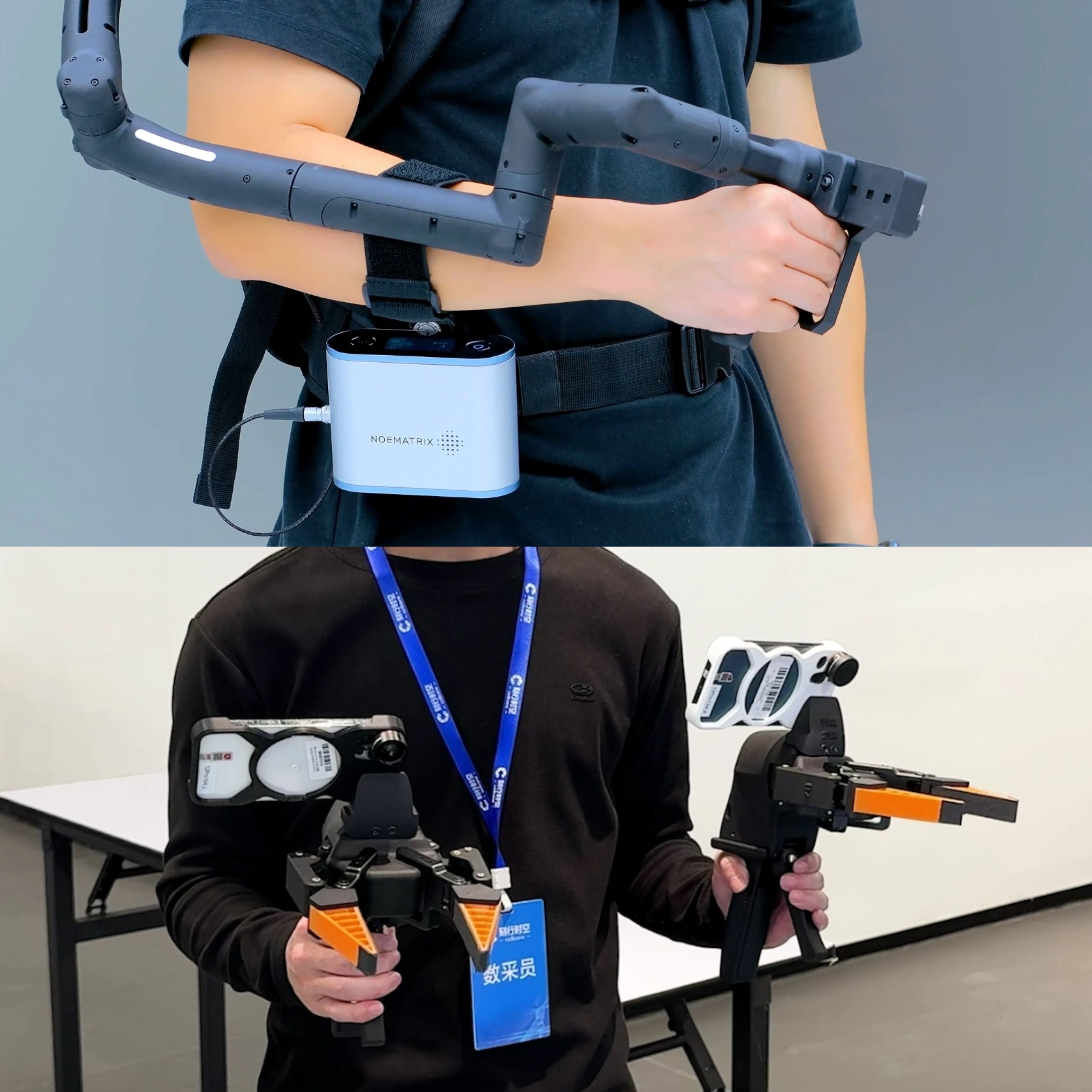
Noematrix's "accompanying data collection" solution (Source/Enterprise)
This data can provide fuel for the training and iteration of the Noematrix Brain. Noematrix adheres to the self-developed route of a general large model for embodied intelligence and conducts model pre-training based on a large amount of real-scenario data, enabling the system to establish a basic understanding of the physical world before being put into actual use; supplemented by force-position hybrid post-training, it further calibrates the model's understanding accuracy of contact states and force sense information, making the action instructions it outputs not only reasonable at the semantic level but also executable at the physical level.
Through this training process, the general embodied brain Noematrix Brain for physical scenarios is continuously refined, providing robots with a complete decision-making closed-loop ability from instruction understanding, task planning to environmental perception and execution feedback. At the same time, Hard Kr has learned that Noematrix also plans to officially release a new generation of self-developed embodied intelligence world model in the near future.
In specific task scenarios, Noematrix's robots have been deployed in batches in pharmacies. The "embedded upgrade" route it adopts does not require the transformation of the original shelf structure. It can be deployed in a space of only 2.5 square meters and directly connected to the existing order system of the store, and can operate stably in the original passage environment.
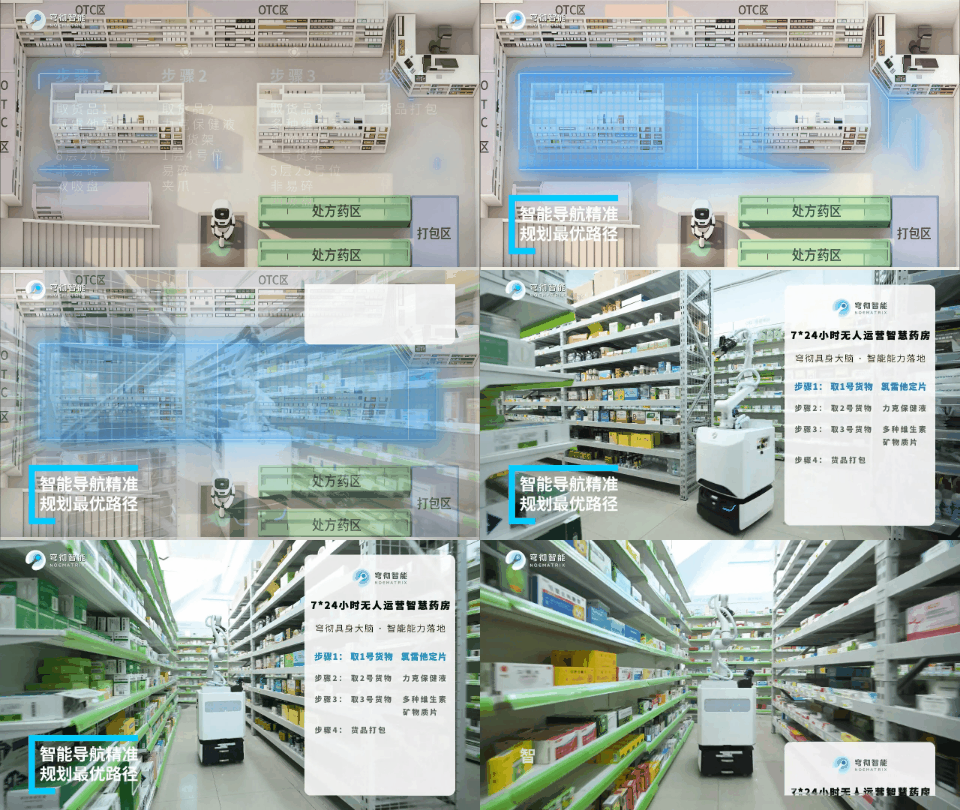
Path planning for navigation (Source/Enterprise)
For a long time, the commercial value of the pharmacy scenario lies in solving the long-standing structural pain points of manpower in the industry. Offline pharmacies generally face the dilemma of scattered night orders but must have a dedicated person on duty. Hiring a person separately has high costs and extremely low cost-effectiveness, which is a pure cost item for the store in the long term. And the fulfillment work of online pharmacy orders is highly standardized, without the need for complex customer communication and sales promotion, only requiring precise and repetitive picking actions, which is exactly the work scenario that robots are best at.
At the same time, there are thousands of SKUs in a pharmacy. The goods are messed up due to searching, the packaging forms are different, and the shelf displays change at any time. All kinds of small-probability situations of complex tasks are normal in the real operation state. Even if the adaptation scenario is simple and the operation process is standardized, it is still full of complex variables that are difficult to reproduce in the laboratory.
The Noematrix team said that what really needs to be dealt with in the pharmacy deployment is more the accumulation of marginal cases, rather than a fundamental breakthrough in the technical paradigm. "A tube of erythromycin eye ointment is difficult to handle stably with a gripper or suction cup because of its small packaging and non-standard placement angle; the grasping logic of a thermometer also needs to be readjusted because it is hung for display instead of being boxed. Such special products account for a small proportion of the entire SKU, but it is precisely them that determine whether the system can be migrated from the laboratory to the real scenario."
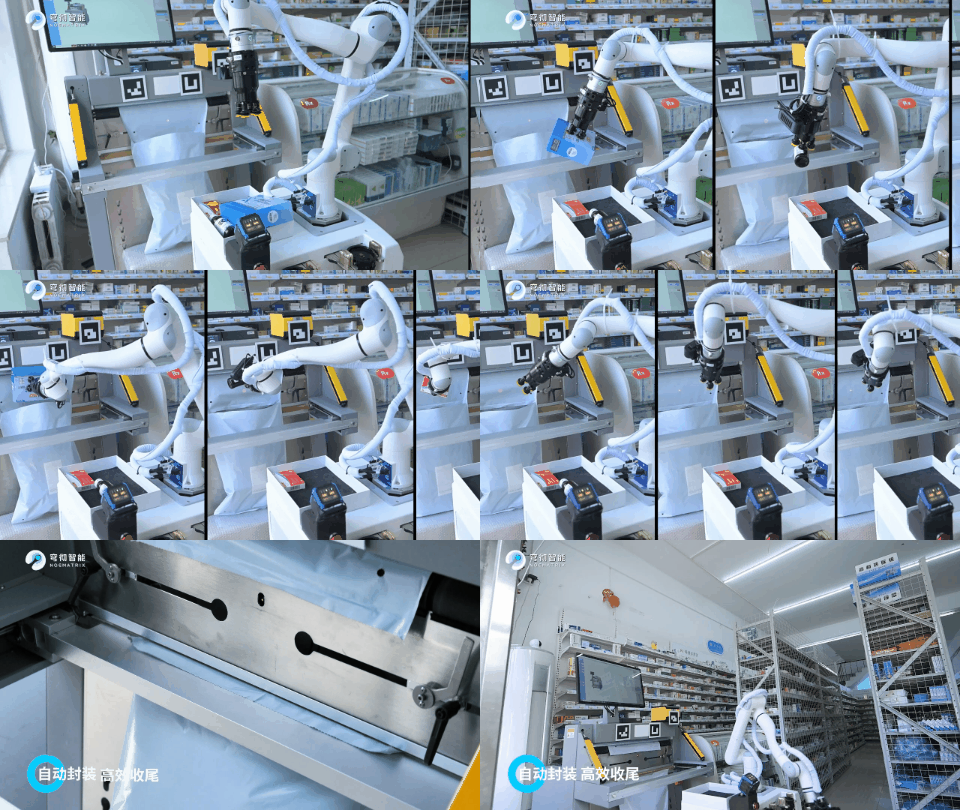
Pharmacy packing (Source/Enterprise)
Currently, Noematrix has reached cooperation with several leading chain pharmacies and entered the commercial delivery stage, with the order scale reaching the level of thousands of units.
After this round of financing, Noematrix will continue to promote the research and development and iteration of a large model for embodied intelligence with strong generalization ability and high autonomous decision-making ability, and accelerate the implementation of embodied intelligence in real scenarios such as general retail and hotel services.
The following is an excerpt from an interview between Hard Kr and Noematrix (slightly edited):
Hard Kr: What mature capabilities does a deployable physical AI embodied brain need to have at this stage?
Noematrix team: For the embodied brain to truly run through offline scenarios, the core lies in three aspects of capabilities.
Firstly, it is the mature and stable algorithm ability. Noematrix released a general grasping model as early as 2021 and has continued to iterate in the following years. The success rate of grasping operations is at a relatively leading level internationally. This set of algorithms forms the technical foundation of our pharmacy solution, enabling robots to maintain a relatively high operation success rate when facing thousands of SKUs.
Secondly, it is the engineering implementation ability. The laboratory demonstration environment is relatively ideal, but when entering a real store, the site layout and the placement of goods are constantly changing, which can easily affect the operation effect of robots. This not only requires optimizing the algorithm but also doing a good job in on-site debugging and hardware adaptation. Relying on the delivery experience of serving hundreds of customers and implementing thousands of scenarios in the past, we have explored a set of mature methods that can make almost no changes to the store and allow robots to quickly enter the site and be put into use.
In addition, there is also support at the data level. There are a large number of marginal scenarios (corner cases) in the real physical environment that cannot be simulated in the laboratory and need to be polished. For example, a tube of erythromycin eye ointment is difficult to handle stably with a gripper or suction cup because of its small packaging and non-standard placement angle; the grasping logic of a thermometer also needs to be adjusted because it is hung for display instead of being boxed. Such special products account for a small proportion of the entire SKU, but it is precisely them that determine whether the system can be migrated from the laboratory to the real scenario. The premise of solving these problems is to have enough and real data from the physical world.
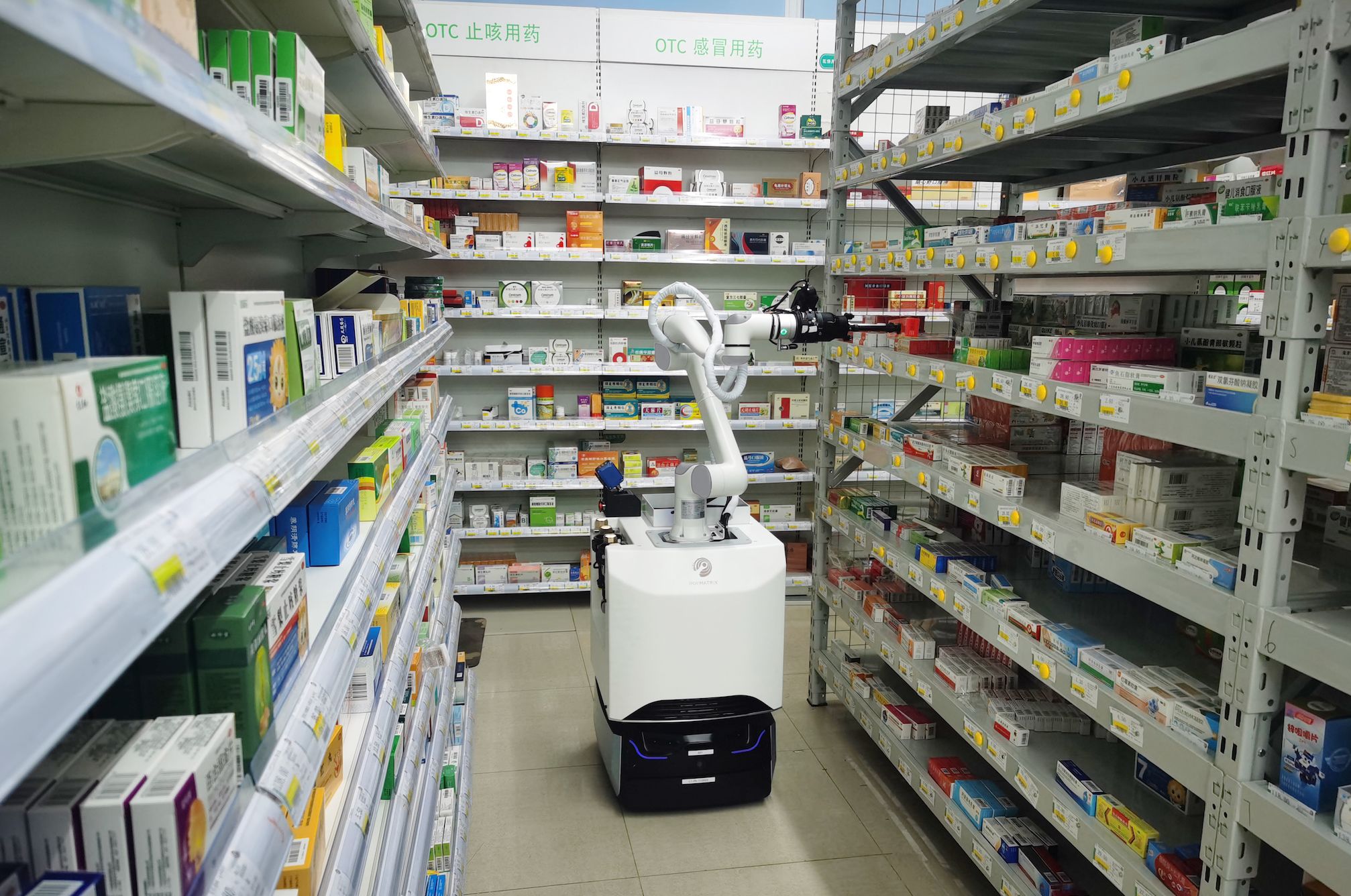
Application of Noematrix's embodied robots in the pharmacy scenario (Source/Enterprise)
Hard Kr: What new demands and trends are presented by clients in the retail pharmacy scenario? How to measure the return on investment?
Noematrix team: Noematrix focuses on the chain pharmacy scenario at this stage. The profit margin of offline pharmacies is already tight, and labor is the second-largest cost after rent. Therefore, it can be seen that the cost reduction demand of clients is very clear. Although the night orders in pharmacies are scattered, someone must be on duty. Hiring a person has extremely low cost-effectiveness, and robots can just undertake the online picking work at night. During the day, they can also assist in processing orders. On average, each store can reduce 1.5 manpower.
This value is reflected in the return on investment. The ROI calculation logic is very straightforward, which is to compare with the labor salary. According to the implementation situation, the payback period of our customers after purchasing the robots is about one and a half to two years. For chain pharmacies, this payback period already has strong implementation value. Currently, the implemented stores are mainly concentrated in first- and second-tier cities, and there are projects running in Guangzhou, Shenyang, Nantong and other places.
Comments from investors:
Shanghai Jiao Tong University and Shanghai Chuangzhi College have long maintained close cooperation with Noematrix in aspects such as joint laboratories and scientific research. This time, the investment platforms under them have simultaneously invested in Noematrix, marking a new stage of in-depth binding of "technology + capital" in their cooperation. Among them, the AI Future Fund of Shanghai Jiao Tong University was initiated by the School of Artificial Intelligence of Shanghai Jiao Tong University, gathering the alumni and industry forces of Shanghai Jiao Tong University to support the "Shanghai Jiao Tong University" artificial intelligence innovation projects with great industrialization prospects. This not only provides a solid backing for Noematrix to continuously introduce high-end scientific research talents and explore cutting-edge technologies but also consolidates its "moat" in the scientific research level of embodied intelligence. In the future, Noematrix will jointly tackle key problems in the cutting-edge technology field of embodied intelligence models with Shanghai Jiao Tong University and Shanghai Chuangzhi College, and accelerate the transformation of embodied intelligence technology achievements into industrial applications.
Wuxi Data Group, as the core force in promoting the development of the digital economy and the marketization of data elements in Wuxi City, will join hands with ecological partners such as Noematrix to jointly launch the city-level all-region "Thousands of Enterprises, Millions of Hours" high-quality dataset consortium action for embodied intelligence and officially release the construction results of the first stage. Next, the two sides will rely on Wuxi Data Group's industrial resources and scenario governance capabilities, combined with Noematrix's technical accumulation in cutting-edge models and embodied brains, to deeply promote the construction of industrial datasets. The two sides will give full play to their respective advantages in technology, data and industrial resources to promote the implementation of embodied intelligence in real production lines.