Bei der diesjährigen Hochschulaufnahmeprüfung sind diese Fachrichtungen bereits von der KI zerschlagen worden.
This summer, Huang Renxun, the CEO of NVIDIA, attended the graduation ceremony of the world - renowned Carnegie Mellon University, a top - tier computer science school. In front of a large group of graduates, Huang Renxun said: "It's unlikely that AI will replace you. But someone who can use AI better than you will."
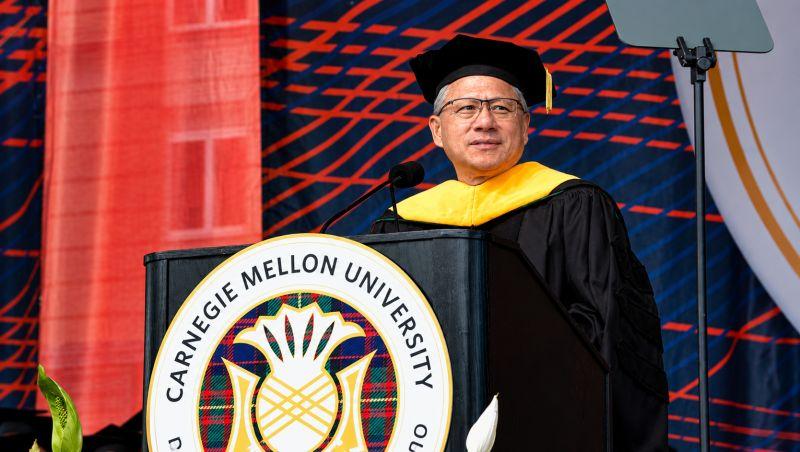
These words seem to console young people on the one hand: "Don't be afraid, AI puts everyone on the same starting line." On the other hand, it also seems to say: "AI is a chance to change your life."
On the other side of the world, 12.9 million examinees have just finished the long college entrance examination and are now facing the decision of which majors to choose, a decision that may determine their entire lives.
In an era of accelerated AI development, how should one actually choose a major?
Your choice has already changed
According to the "Catalog of Undergraduate Majors (2026)" released by the Ministry of Education at the end of April this year, from 2021 to 2025, 12,200 undergraduate majors were cancelled or their enrollment was suspended in universities across China, and 10,200 new majors were added. The number of cancelled majors is 2,000 more than the number of new majors.
And this trend is getting stronger year by year. In 2020, only 518 majors were cancelled in universities across China. Then it was 804, 925, and in 2023, the number rose to 1,670. In 2024, it was still 1,428, which has increased two - to three - fold in just a few years.
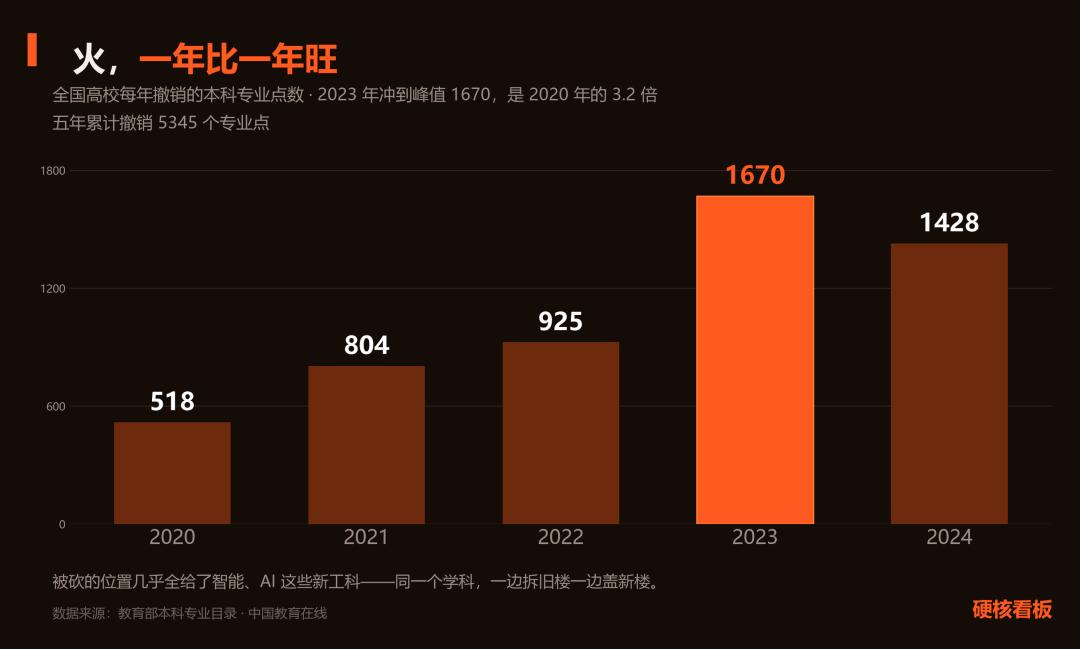
If you look at these data more closely, it shows that the cancelled majors are mainly in the humanities and management, while almost all the new majors are in the natural sciences and engineering.
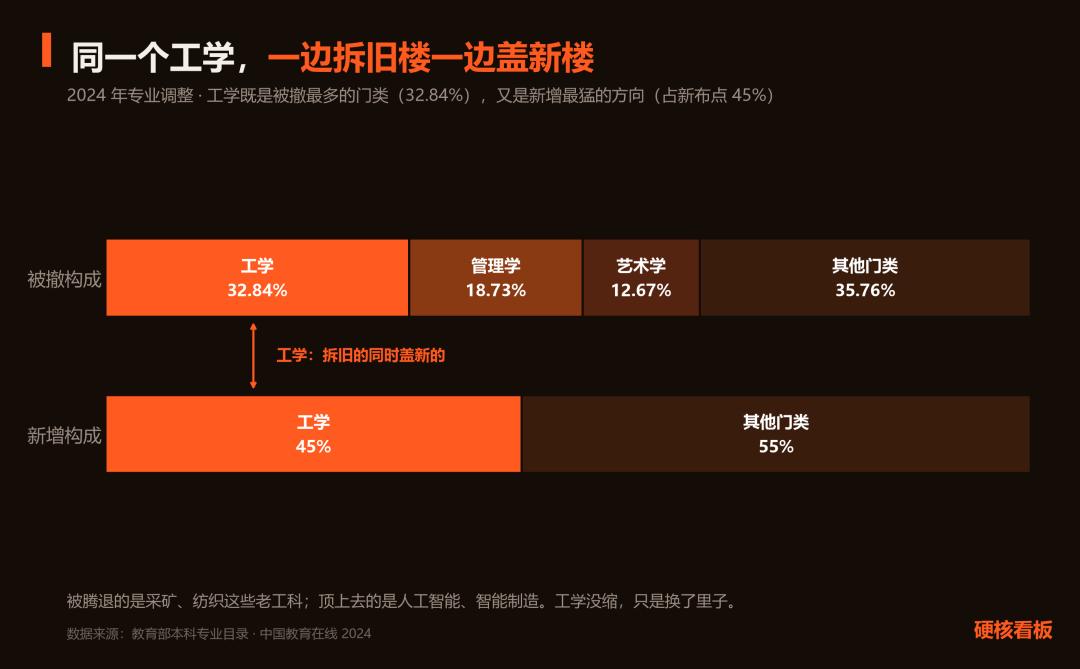
Just in 2024, management accounted for 18.73% of the cancelled majors, and the arts accounted for 12.67%. The most interesting is engineering. It is both the category with the most cancelled majors (32.84%) and the one with the most new majors (45% of the new positions). In the same discipline, old buildings are being torn down and new ones are being built. Old engineering disciplines such as mining and the textile industry are being cleared to make room for new directions such as AI and intelligence.
Maybe you think it doesn't matter which majors are cancelled, because they must be just unpopular majors that no one chooses?
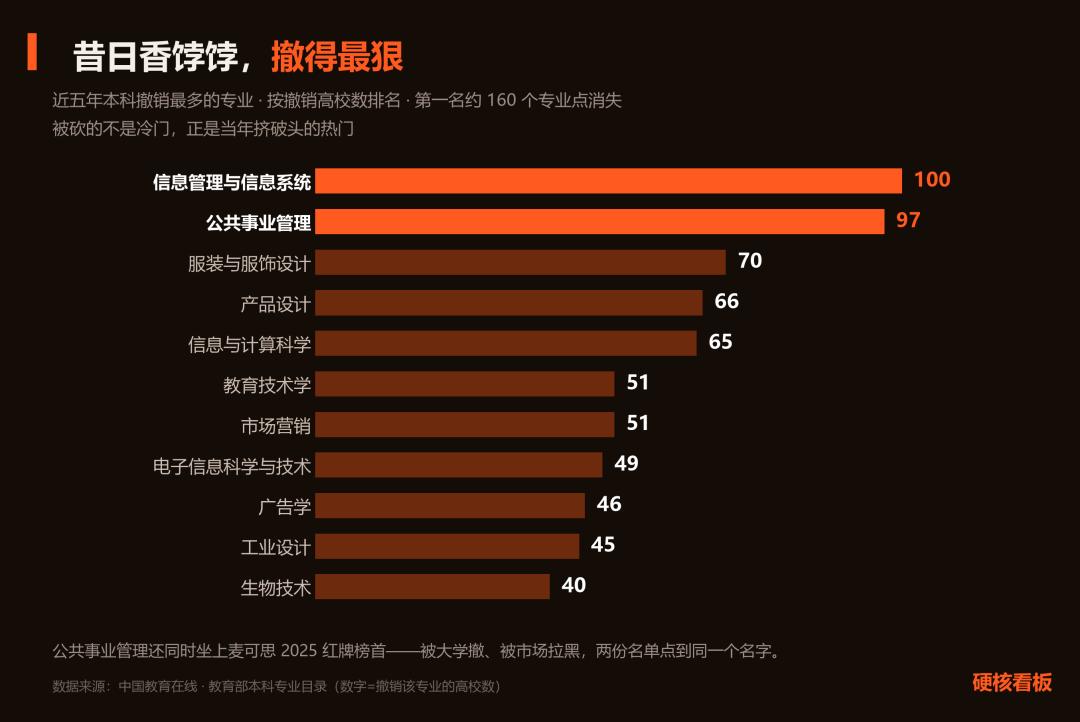
On the contrary, the most affected majors were once the most popular. According to statistics from China Education Online, among the undergraduate majors that were most frequently cancelled in recent years, the first place was "Information Management and Information Systems" with 160 cancelled positions in five years, and the second place was "Public Administration" with 138 cancelled positions. In the field of vocational colleges, the most affected major was "Market Research" with 138 cancelled positions.
The TV series "Du Lala's Promotion" in 2010 made the careers of employees in foreign companies a dream for a generation of workers. Offices, English emails, year - end goals - many people chose business administration and market research because of "Du Lala".
However, after more than a decade, majors such as accounting, market research, and information management, which were once so popular, are now in a sorry state.
Not only do universities cancel these majors, but the job market also shows a red light.
The list of red - flagged undergraduate majors (those with the lowest employment rates, salaries, and satisfaction levels) for 2025, released by the higher - education research institution MyCOS, starts with "Public Administration", which is exactly in second place on the list of cancelled majors. Law and painting are also on the list, and these two majors have been red - flagged for five years. A major that is being gradually cancelled by universities and excluded from the job market year by year, although they are two independent lists, the same majors are affected.
Do you still think accounting is a safe major that is useful everywhere? Wake up, it's 2026!
AI is secretly changing every major - choice decision
Behind the reform of university majors and the cancellation of majors, AI is the biggest driving force.
In 2025, Communication University of China cancelled 16 undergraduate majors and directions such as translation, photography, and comics all at once. The class of 2025 was the last.
Liao Xiangzhong, the secretary of the Party Committee of Communication University of China, said at the National People's Congress: The future is an era of "division of labor between humans and machines". The functions corresponding to these majors will be restructured on a large scale by AI. A top - ranked comic major at the national level can be cancelled just like that. It's not because it's poorly run, but because the career paths corresponding to this major have already been invaded by AI earlier.
In other words, a major being on a university's list of cancelled majors and the corresponding position being on the list of positions replaceable by AI is like two sides of a coin. The more it involves standardized and template - based mental work such as daily translations, customer service, basic design, and routine texts, the more likely it is to be replaced by AI.
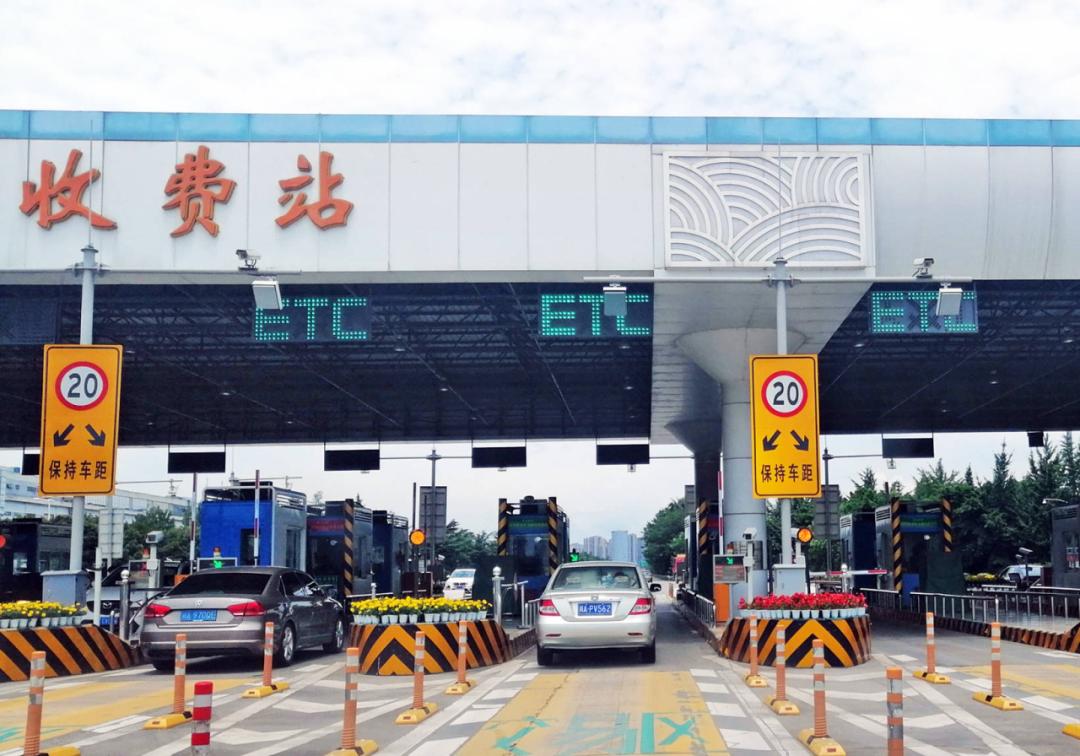
Previously, the job of a highway toll collector was considered a secure job, but ETC has already replaced it.
When you submit a college application, you're basically betting on one thing - you're betting that the position corresponding to the major you choose will still exist in four years. However, what AI does is to gradually remove the stakes on this betting table.
A study by Stanford University this year has shown that the employment chances of young people aged 22 to 25 who are in high - risk AI jobs have decreased by 6% to 16%. Note: It's not about laying off older employees, but about not hiring new employees.
Why do the employment chances of young people decline so quickly?
This is because AI has the greatest impact on entry - level jobs with little work experience. These are the jobs where young people develop their skills and gain experience. So you get into a vicious cycle: I need a job to gain experience - but I need experience to get a job.

If you submit your college application today, it's possible that the corresponding entry - level position will no longer hire new graduates in four years when you graduate. AI doesn't take your job away, it just makes it so that the company no longer needs a new employee to develop its skills.
Global trend: Not just a problem in China
At this point, you might think: Have we in China advanced things too quickly?
If you look around, you'll find that this is a game being played simultaneously around the world.
Back to Huang Renxun's words at the beginning. Why did he say to an entire graduating class: "AI puts everyone on the same starting line"? Because the protective walls formed by the old majors have suddenly been broken down by AI.
Even if you're a humanities major and don't understand programming at all, you can communicate with AI and develop good products with vibe coding. The skills you've learned over four years can be overcome by an AI model in a few seconds.
A well - known study by Goldman Sachs in 2023 estimated that about 300 million full - time jobs worldwide could be replaced by generative AI. The proportion of replaceable work content in administrative jobs can be up to 46%, and in law 44%.
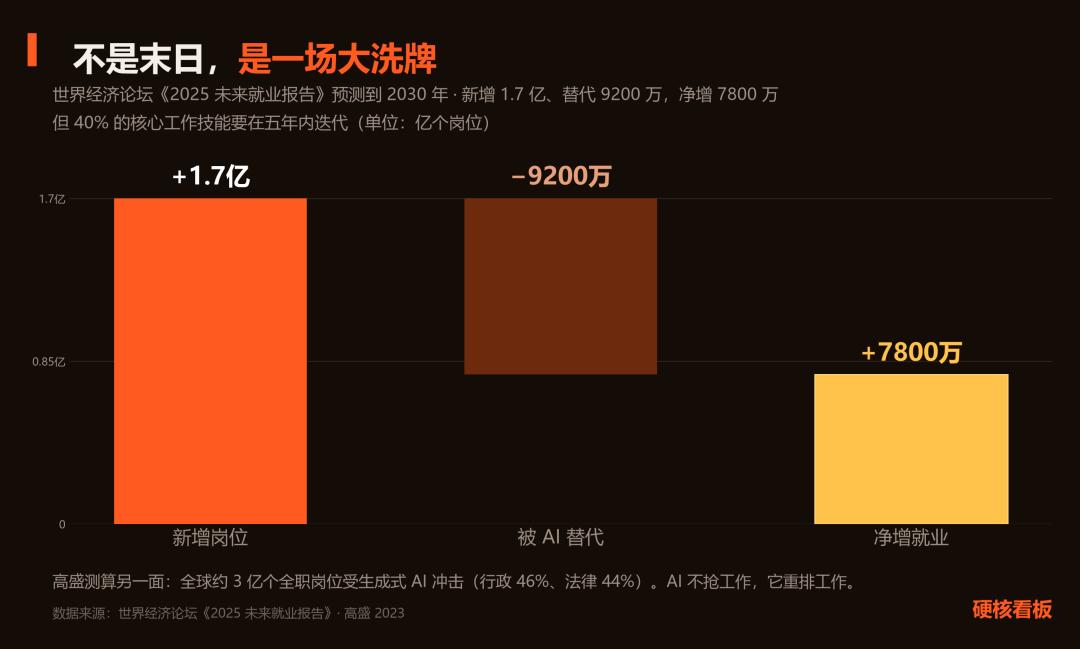
The "Future of Jobs Report 2025" of the World Economic Forum surveyed 1,000 companies and concluded that between 2025 and 2030, about 92 million jobs will be replaced worldwide, and 40% of core work skills need to be renewed within five years.
This is not a Chinese phenomenon, but a challenge that the entire humanity is facing.
In the United States, universities cancelled majors earlier than in China. According to statistics from Bloomberg, the number of computer science students increased by 34% from 2017 to 2022, while the number of students in English literature decreased by 23% and in history by 12%. The University of Chicago suspended the enrollment of doctoral students in several humanities majors. The University of Alaska cancelled 39 academic programs at once. Harvard reduced the enrollment of doctoral students in the Faculty of Arts and Sciences by about 60%.
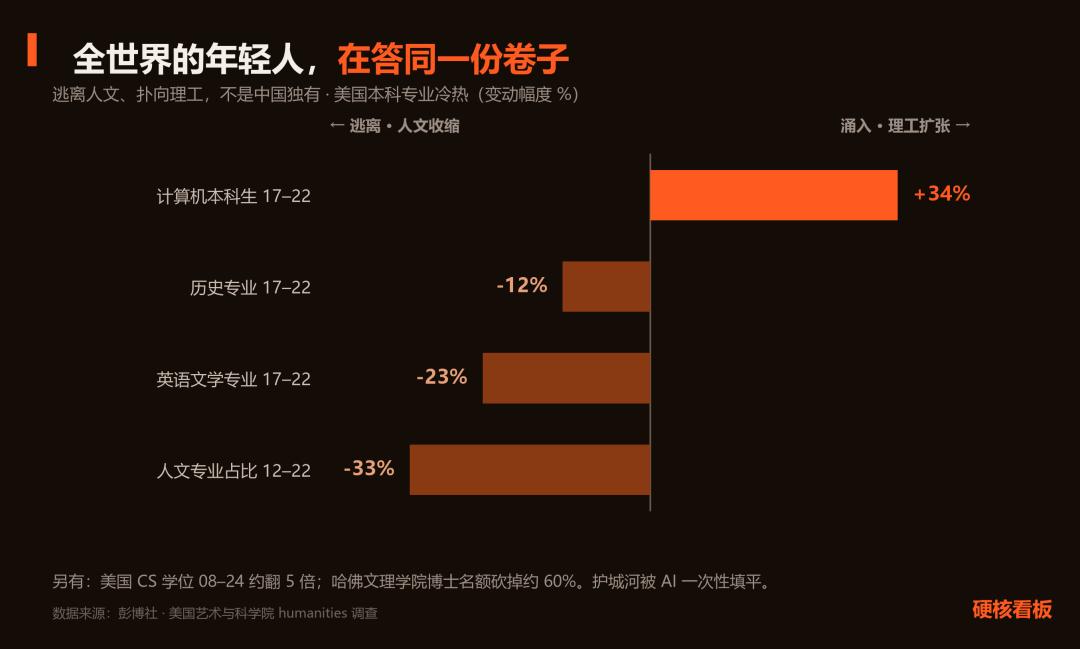
In East Asia, Europe, and North America, young people are aligning their major choices and leaving the humanities in favor of the natural sciences and engineering. The task of choosing a major is being solved by young people around the world, and AI is the common question - asker.
Is an AI major safer?
After reading this, many parents will probably think: Okay, then I'll let my child choose artificial intelligence or embodied intelligence. Then it should be safe, right?
I advise you not to act too quickly.
There is a fatal time lag here: A college degree takes four years, while AI reaches a new generation almost every six months.
If you choose an AI - related major in your first year, by the time you graduate in your fourth year, AI will have been developed a dozen times. What you see as the latest trend in your first year may be the next victim of AI in your fourth year.
Maybe you think that a large number of applicants indicates a real trend and high salaries. At first glance, it's certainly tempting. According to the data from the spring recruitment of Zhaopin in 2026, the average monthly salary in AI jobs is 60,738 yuan, which is about a quarter higher than the average monthly salary in the entire new economic sectors of 48,189 yuan. The more eye - catching these numbers are, the more people flock in the same direction.