Insta360-Lösungsmittel-Lizenzaufhebungs-Welle kommt, warum hält der Aktienkurs nicht mehr?
The Insta360 company, with a market value of over 60 billion yuan, is facing a challenge.
On June 11th, Insta360 reached the first anniversary of its listing. 227 million restricted shares were released, which corresponds to a market value of about 38.8 billion yuan and accounts for 56.5% of the company's current total market value.
For Insta360, whose previous freely tradable market value was only about 5.6 billion yuan, this means that the volume of the released shares is almost seven times the current freely tradable market value.
At the close of the stock market on June 12th, the stock price of Insta360 was 156.49 yuan per share, and the market value was about 62.752 billion yuan, which corresponds to a decline of 4.26% compared to the closing price on June 10th.
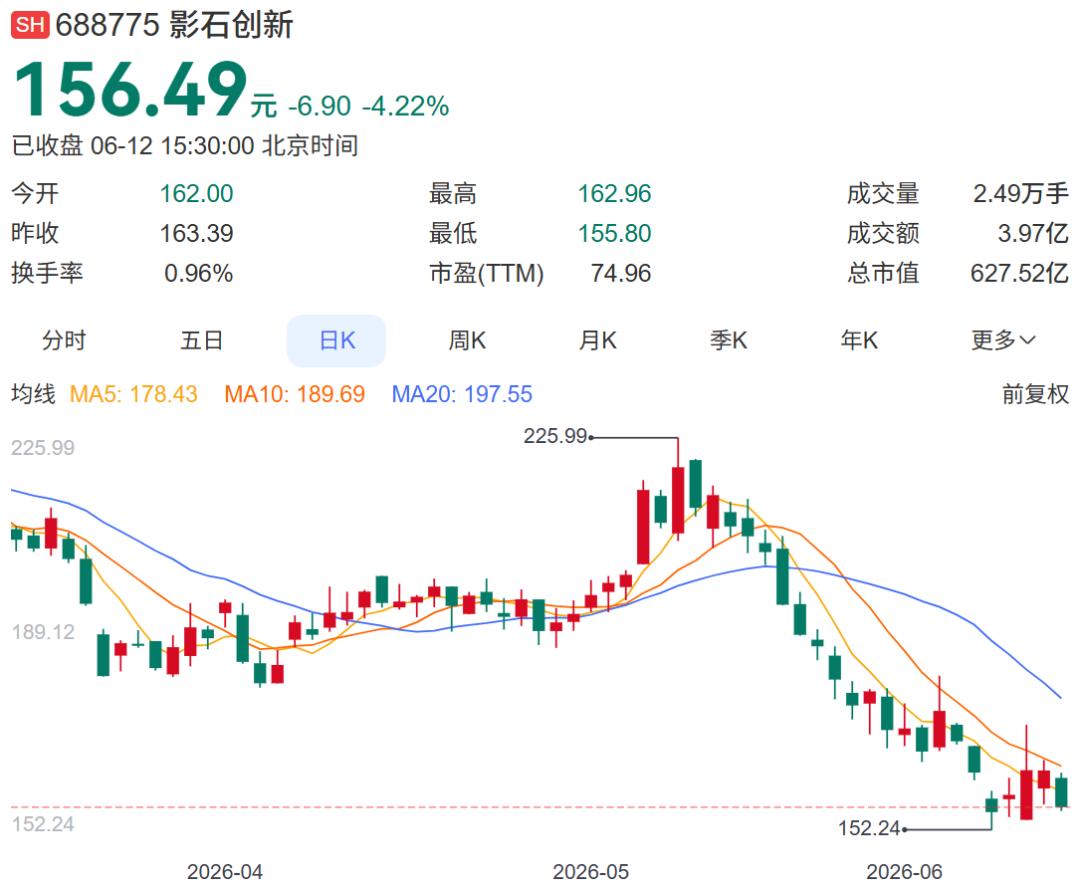
It is a pity that Insta360 could not pass this stress test. This behavior is in sharp contrast to its former glory days.
On June 11th, 2025, Insta360 started trading on the Science and Technology Innovation Board (STAR Market) at an issue price of 47.27 yuan per share. Within just three months, it reached a historical high of 377.77 yuan per share, and the market value once almost approached 150 billion yuan. Now, the stock price has fallen by 60% compared to the highest value, and after the release of the restricted shares, the price shows weakness.
By analyzing the financial data, one can identify the essential reasons.
The co - existence of a high profit margin and a high sales expense ratio indicates a problem that cannot be ignored: Does Insta360's 47.6% profit margin come from the indispensable attractiveness of the products themselves or from continuous marketing?
This is a question about the quality of profits and also a re - evaluation of its business nature.
The reason for the increase in sales without an increase in profits
The reason for the lack of sustainability of Insta360's stock price can be found in the company's performance.
Looking at the growth of sales, Insta360 has actually shown impressive results. In 2025, its sales amounted to 9.741 billion yuan, which corresponds to an increase of 74.76% compared to the previous year and represents a historical high. In the first quarter of 2026, sales increased by 83% to 2.481 billion yuan.
The problem, however, is that Insta360 has fallen into the spiral of increasing sales without increasing profits.
In 2025, Insta360's adjusted net profit did not increase synchronously but decreased by 10% to 850 million yuan. In the first quarter of 2026, this downward trend was even more obvious. The adjusted net profit was only 62.25 million yuan, which corresponds to a decline of 61% compared to the previous year.
Looking at the figures for each quarter in detail, this discrepancy becomes even more obvious. In the first quarter of 2025, the parent - company net profit was 176 million yuan, in the second quarter it rose to 343 million yuan, in the third quarter it was 272 million yuan, and in the fourth quarter it suddenly fell to 137 million yuan.
Insta360 "sacrifices" profits to achieve high sales growth.
At the same time, the profit margin also shows a downward trend. Insta360's profit margin fell from 52.93% in the first quarter of 2025 to 37.53% in the fourth quarter, which corresponds to a decline of 15 percentage points within one year.
Insta360 gives two explanations: On the one hand, it is due to the price increase of storage components, and on the other hand, it is the impact of market competition.
The increase in the cost of storage components is a common challenge on the supply side that the entire consumer electronics industry is facing. Liu Jingkang, the chairman of the company, admitted in a letter to shareholders in the 2025 annual report: "We feel some pressure regarding the short - term storage costs, which may continue to rise in the future and could affect the company's profit margin."
But from an external perspective, the price competition that Insta360 has to engage in is the more difficult challenge.
The Osmo360 panoramic camera model launched by DJI last year was offered at a price of 2,999 yuan, which is 800 yuan less than the initial price of the Insta360 X5. According to a statistic from IDC, Osmo360 captured half of Insta360's market share within three months of its market entry.
The Insta360 X5 was forced to reduce the price by 500 yuan to compete. The product lines for action cameras and drones were also involved in the price competition. The price of the Insta360 A1 drone dropped from 6,799 yuan to 5,499 yuan, which corresponds to a price reduction of 20%. A report from a professional institution shows that the drone is almost sold at cost.
The short - term price competition is only a superficial disruption. The deeper impact is that Insta360's pricing power has been completely broken, and Insta360's big game has been violently overturned by DJI.
For Insta360, the panoramic camera is only one of the successful product categories. The company's ultimate goal is to become a platform - based imaging technology provider that comprehensively focuses on action cameras, gimbal cameras, intelligent accessories, drones, and even portable "photography robots".
Liu Jingkang said: "The short - term profits are characterized by multiple pressures and multiple buffers to achieve long - term corporate performance and healthy development."
But in view of the current corporate performance, where sales increase but profits do not, Insta360's long - term development will not go smoothly.
High profit margin + High sales expense ratio ≠ High quality
Although Insta360's profit margin has declined, it still amounted to 45.74% in 2025. In the consumer electronics industry, this usually means that the products have a considerable brand premium and market valuation power.
However, looking at the cost structure, a contradiction emerges.
In 2025, Insta360's sales expenses amounted to 1.679 billion yuan, which corresponds to an increase of 103.31% compared to the previous year and is much higher than the growth of sales. The sales expense ratio was 17.24%, which means that almost one - fifth of the sales revenue is spent on marketing.
At the same time, the research and development expenses amounted to 1.530 billion yuan, which corresponds to an increase of 96.95% compared to the previous year. The research and development expense ratio was 15.7%, which is about 1.5 percentage points lower than the sales expense ratio.
The double increase in sales and research and development expenses means that Insta360 cannot stop either marketing or research and development, as both together support Insta360's growth business.
It can be concluded that Insta360's high profit margin is the result of "marketing for a high - end image + research and development for differentiated functions" and corresponds to a typical profit model of Internet sensations in the consumer electronics industry.
However, the core of the competitiveness of a technology company should be technological innovation that drives product performance. Marketing should play a more embellishing role. But on Insta360's cost scale, the scale clearly tilts towards the marketing side.
For Anker Innovations, another manufacturer in the industry, the sales expense ratio in 2025 was 22.37%, and the research and development expense ratio was 9.48%. Similar to Insta360, the marketing expense ratio is higher than the research and development expense ratio, but there are also differences between the two.
Anker Innovations' business model covers three main areas: charging and energy storage solutions (about 50% of sales), intelligent innovations (intelligent security systems, cleaning devices, etc., about 27%), and intelligent audio and video products (about 22%). This corresponds to the marketing of multiple product categories and brands, rather than the intensive marketing of a single brand.
In contrast, Insta360's main business is relatively highly concentrated on consumer - oriented intelligent imaging devices (almost 90% of sales), and the competition is highly concentrated. The 17.24% sales expense ratio corresponds to intensive marketing penetration around a single brand.
Moreover, Anker Innovations achieved scale success with sales of 30.5 billion yuan in 2025, and the marginal costs for marketing are continuously optimized. For Insta360 with sales of only 9.741 billion yuan, the 17.24% sales expense ratio exerts much greater pressure on profits than for Anker Innovations.
Therefore, Insta360 must answer a fundamental question: Does the high growth of sales stand on the strength of the products or on the intensity of marketing?
In the first quarter of 2026, Insta360's sales expense ratio was 18.1%, which corresponds to a slight decline of 0.8 percentage points compared to the previous year. At the same time, the net profit rate dropped from 13.01% in the previous year to 1.31%, which is close to the profit threshold.
Obviously, the slight decline in sales expenses has created some breathing space for the profit side, but this has been covered by greater pressures on the cost and expenditure side.
This is a signal that cannot be ignored: If Insta360 reduces marketing expenses in the future to increase the net profit rate, it is questionable whether sales can still achieve high growth.
Currently, Insta360 has a price - to - earnings ratio of 74.51, which is much higher than that of other companies in the industry such as XGIMI Technology (38.09), Ezviz Network (35.34), and Anker Innovations (22.82).
Behind this premium lies the market expectation that Insta360 will continue to achieve high growth. But the fact that sales increase but profits do not, and that it is dependent on marketing, contradicts this valuation logic.
If a company's competitive advantages do not rest on an unmistakable technological barrier but on continuous marketing expenses, then the quality of this company's profits needs to be re - evaluated.
Insta360's core business still exists, but these advantages are being severely tested under the double pressure of increasing competition and strategic marketing financing.
Looking at the release of the restricted shares, Insta360 is facing the following situation: On the one hand, the pre - IPO shareholders still have multiple - fold gains of several dozen times, and they have a strong incentive to sell their shares. On the other hand, the company's growth has reached a peak, competition is increasing, and the profit margin is under pressure. The secondary market's willingness to absorb the shares will be quickly exhausted. When the "story of high growth" meets the "reality of share release", it may only be the most direct reaction of the market that the stock price cannot hold.
This article is from the WeChat account "AI Blue Media Association". Author: Feng Hua, Editor: Wei Xiao. Published by 36Kr with permission.