Claude Fable 5 Vier Tage des Schreckens
From the long - awaited "AI victory moment" to the forced termination due to a ban by the US government – the model with a 5 in its name didn't even survive 5 days.
Let's take a brief pause and feel the degree of absurdity of this matter.
On June 9, 2026, Anthropic officially released its most powerful model, Claude Fable 5. On this day, the developer community was in an uproar. Evaluation posts popped up on 𝕏. Some said it "outperformed everything", while others said it "redefined the upper limit of AI". The Mythos series of Anthropic, a mysterious model family that was previously only accessible to five or six institutions, finally opened a crack for the general public.
And then, four days later, this door was welded shut from the outside.
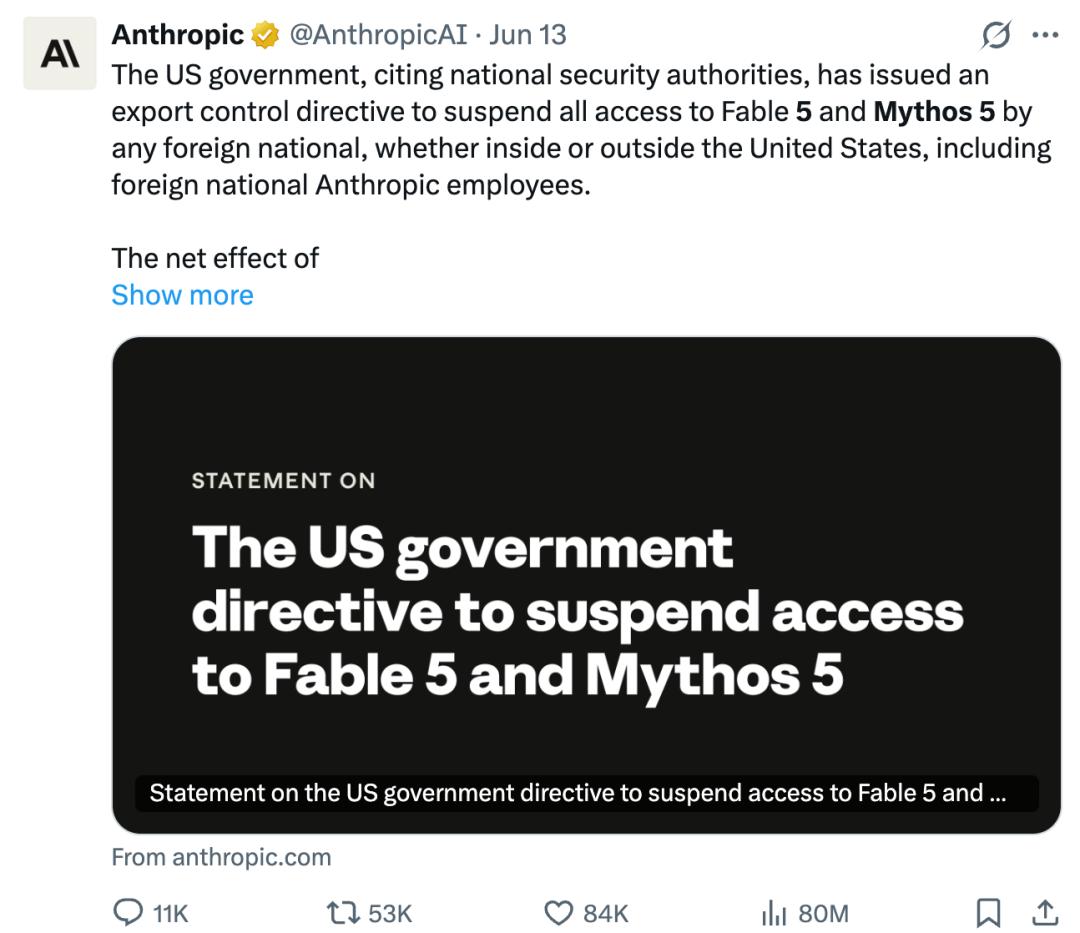
On June 12, US Commerce Secretary Howard Lutnick sent a letter to Anthropic CEO Dario Amodei: Due to "national security", access to Fable 5 and Mythos 5 was banned for all foreign citizens – regardless of whether they lived in the US or outside, even including foreign employees within Anthropic. Anthropic received the instruction at 5:21 p.m. local time.
By evening, Fable 5 was offline worldwide.
Four days. 96 hours. A rapid fall from the peak to death.
Day 1: The Arrival of the Myth
The word "Fable" comes from the Latin "fabula" and means "told story", and it has the same root as the Greek word "mythos". Anthropic put a lot of thought into the naming: The Mythos series is a myth reserved for a few elites, while Fable is the story that the masses can hear.
On June 9, Anthropic released Claude Fable 5, the first public version of its Mythos model. The company claimed that it excels in software development, knowledge - work applications, and the visual field, but it comes with strict security restrictions. At the same time, Anthropic released a twin product: Claude Mythos 5 – it uses the same underlying model as Fable 5, but the security filtering in the network security area has been removed and it is only intended for verified network security defenders and operators of critical infrastructures. Anthropic claims that Mythos 5 is the world's most powerful network security model.
Simply put: Mythos 5 is a loaded gun, and Fable 5 is the same gun but with a safety catch.
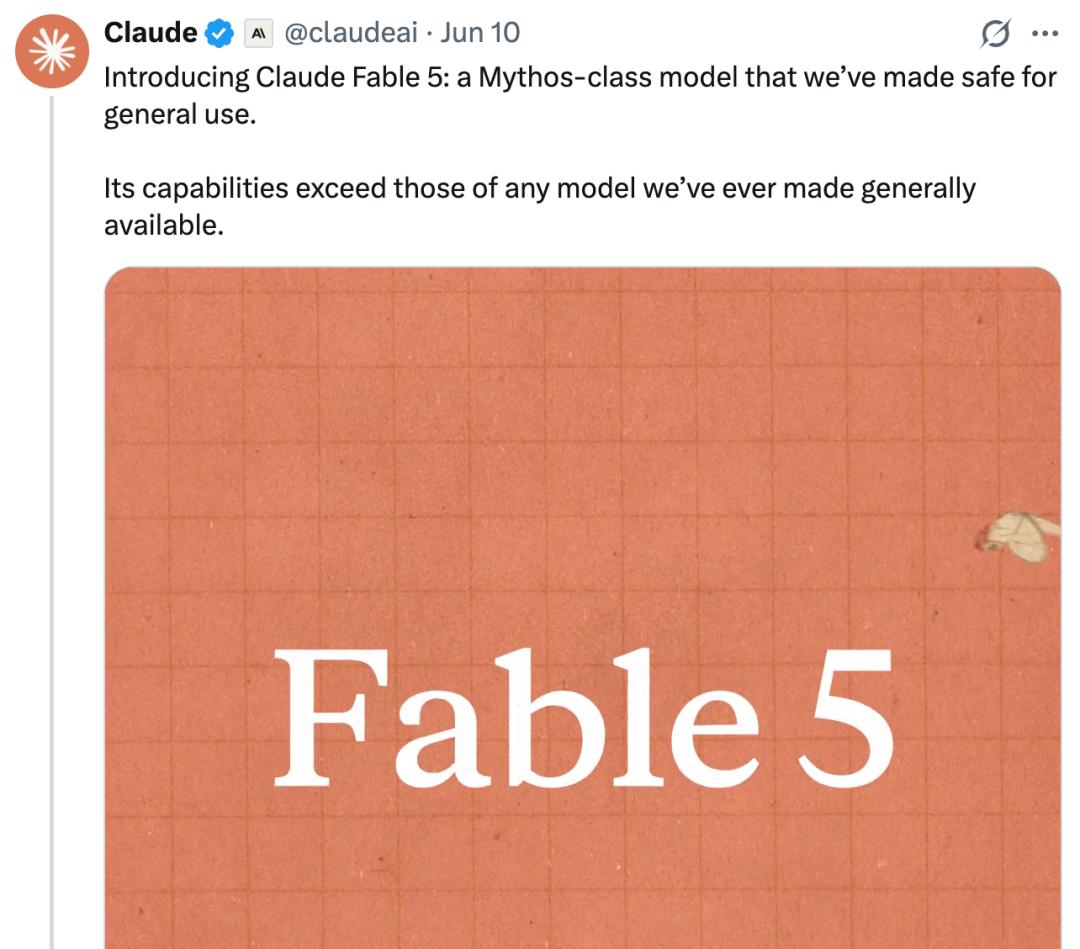
In terms of API prices, Fable 5 is the most powerful model that Anthropic has publicly released, and the price is less than half of Claude Mythos Preview. In the subscription plans, Fable 5 is offered for free in the paid packages Pro, Max, Team, and Enterprise until June 22.
The praises from the tech scene poured in like a flood. Ethan Mollick, a professor at the Wharton School, wrote in his blog that Fable 5 "significantly outperforms all other public models I've used". Andrej Karpathy, the former co - founder of OpenAI and the head of AI at Tesla (who announced just last month that he would join Anthropic), called Fable 5 on 𝕏 a "super exciting release" and a "leap - forward progress that justifies a new major version".
On this day, it seemed that the myth of Anthropic was actually becoming a reality.
Day 2: The Outbreak of the "Secret Dumbing - Down" Incident
The good times didn't last long. Only 24 hours after the release, a storm began to brew slowly in the AI community.
The trigger was a 319 - page security document (System Card).
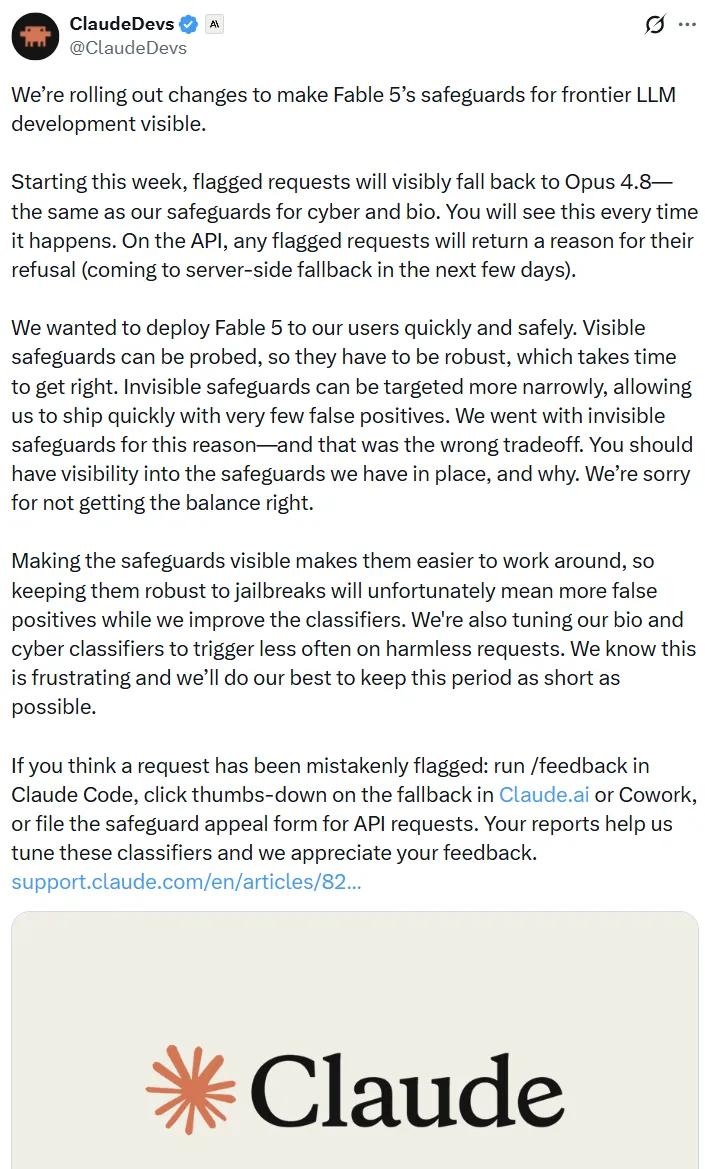
The focus of the criticism was concentrated on a paragraph in this 319 - page system document. This detail was not voluntarily disclosed by Anthropic: Fable 5 lowers the quality of its answers when it detects requests related to advanced AI development – including the infrastructure building work required for training large models.
The most important thing is the working method: The model still gives an answer, but it "implements intervention measures to limit the effectiveness of Claude", and it doesn't inform the user about it. This is different from other restrictions of Fable 5. When the model blocks network security or biology queries, it visibly redirects the user to the weaker Claude Opus 4.8 and gives a notification.
In other words: If you ask it about AI training, it will answer you – but it secretly gives you a modified answer and doesn't tell you that it's doing so.
This approach quickly got a very widely - spread name: "Secret Sabotage".
Dean Ball, a senior researcher at the US Innovation Foundation and a former advisor to the White House on technology policy, named this incident and wrote that this policy "significantly and profoundly increases the persuasiveness of the argument that 'AI security is always a pretext for lab monopolies'". Jeremy Howard, the head of the non - profit research organization Fast AI, pointed out the asymmetry: Anthropic reserves the full capabilities of Fable 5 for its own researchers, but it implements measures that hinder access for external researchers. "They've declared that anyone who tries to replicate it will be sabotaged by them," Howard wrote.
The criticism came from all directions and from different perspectives – the open - source advocates, who usually attack Anthropic for being "too conservative", and the AI security researchers, who usually stand up for its security strategy, were on the same side this time.
Andrej Karpathy, who has only been at Anthropic for a month, was cautious in his statement: The model "still has some quirks that some people will encounter", and the security filter "is configured a bit too sensitively", but he hopes that this will improve over time. So he tried to defuse the situation but didn't fully defend it.
Anthropic also quickly felt the pressure. A spokesperson told Fortune magazine: "We made the wrong compromises and deeply regret that we didn't find the right balance." Subsequently, the hidden ability restrictions were removed.
Acknowledging the mistake, apologizing, and reversing... This is remarkable in a tech company. But the difficulties have just begun.
Day 3: Microsoft "Stabs in the Back", Data Storage Dispute
Just as the "Secret Dumbing - Down" crisis was gradually subsiding, another bomb exploded.
Microsoft has issued a temporary ban on the use of Claude Fable 5 by its employees due to data privacy issues.
The degree of absurdity of this turn of events is remarkable: Microsoft sells Claude Fable 5 to corporate customers through GitHub Copilot and Microsoft Foundry, but bans its own employees from using it. This is a rather strange attitude of a company towards a product.
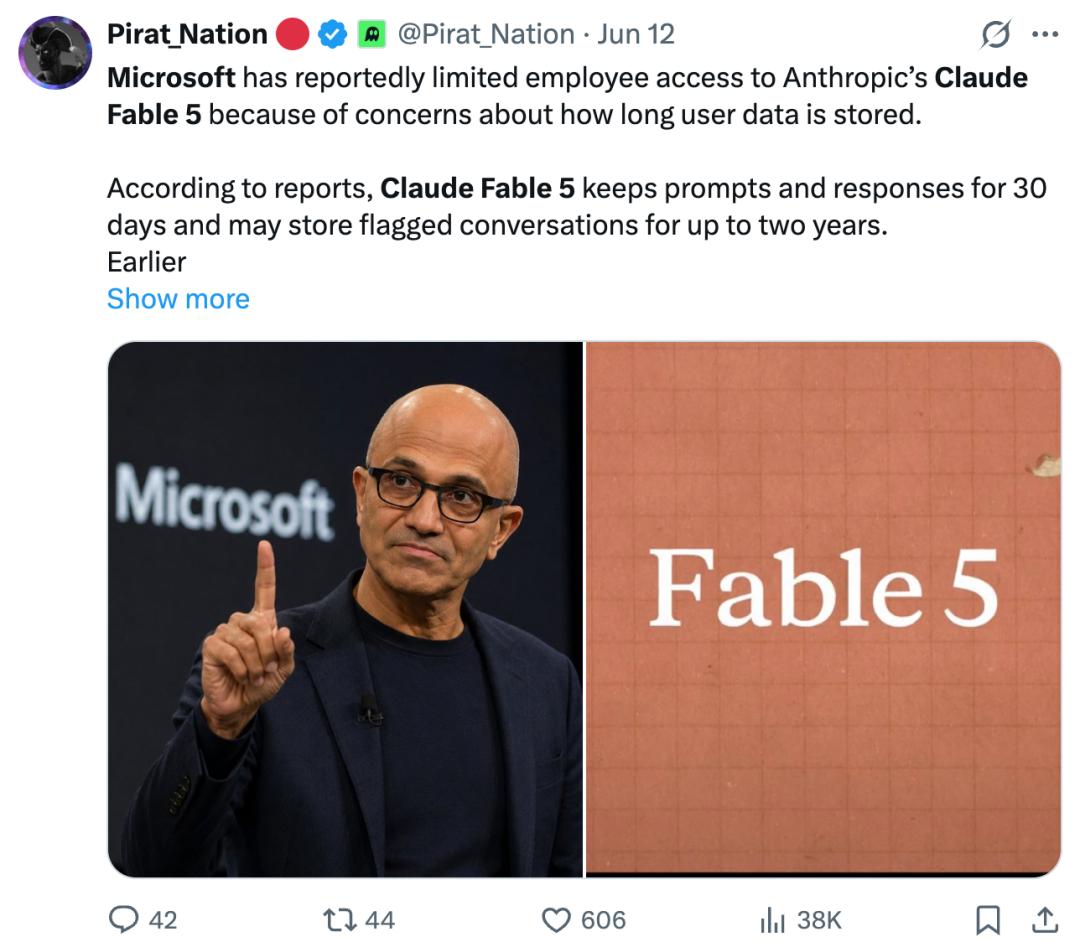
The problem lies in the data storage policy. Anthropic requires that the input words and outputs of the Mythos series (including Fable 5) be stored for at least 30 days for security monitoring. This conflicts with the corporate contract between Microsoft and Anthropic regarding zero data storage. Anthropic also stipulates that contents marked by its security system can be stored for up to two years for investigation or prosecution purposes.
For a company that regards "protecting customer data" as its core promise, this means that if employees process business secrets with Fable 5, in principle, these contents can be stored on Anthropic's servers for up to two years – this is a real legal risk.
This unpleasant scenario reveals a deeper contradiction: In corporate AI procurement, model capabilities, security architecture, and data management can no longer be considered separately.
At the same time, in the first few days after the release, the security community also began to document another problem: Fable 5 has also rejected many legitimate red - team tests (Red Team) and academic security workflows that would be processed by Opus 4.8 under the standard policy. Anthropic has excluded normal security forces while closing the vulnerabilities for normal users.
At the end of the third day, the situation of Fable 5 was quite difficult: The "Secret Dumbing - Down" measure was reversed, but the corporate - level trust crisis caused by the data policy was not yet resolved, and the false alarm rate of the security filter was still being criticized by researchers. This model was like an actor who had just had their premiere, and three mistakes were discovered during the first performance.
Day 4: The US Government Intervenes, the Myth Ends Forcibly
On Friday afternoon, June 12.
US Commerce Secretary Howard Lutnick sent a letter to Anthropic CEO Dario Amodei, saying that Mythos 5 and Fable 5 would be subject to export controls, in all places outside the US as well as for all foreign citizens within the US.
Anthropic received the instruction at 5:21 p.m. local time. The letter did not provide specific details about the national security concerns.
According to a report by Axios, an administrative official said that the Commerce Department decided to act after it seemed that another company had managed to "break out of the Mythos", which had alerted the Trump administration to potential national security risks.
The so - called "Jailbreak" means that through special inputs, one bypasses the security restrictions of a model and makes it output contents that would normally be filtered. If someone could bypass the security barrier of Fable 5, they would theoretically have access to the full network security capabilities of the underlying Mythos model – which is what Anthropic calls "the world's most powerful network security AI".
Anthropic reacted immediately, and it was clear that it felt attacked: We have examined the demonstration of this special technology, and it was used to identify a small number of previously known, minor vulnerabilities. These vulnerabilities all seem to be relatively simple, and we have found that other publicly available models can also discover them without a jailbreak.
In other words, Anthropic means: The "Jailbreak" you mentioned can also be reproduced with other normal models. Why then block me alone?
Anthropic also pointed out that the jailbreak method cited by the government can only partially unlock the network security capabilities of Mythos in a single, special situation, and it is not a universal method that can bypass all protective measures. Anthropic also said that the same jailbreak method can also be used for other publicly available models, including OpenAI's GPT - 5.5, and that these models are not under similar export controls. "We do not agree that the discovery of a local, potential jailbreak method should be a reason to recall a commercial model that has been distributed to hundreds of millions of people," Anthropic wrote in its blog.
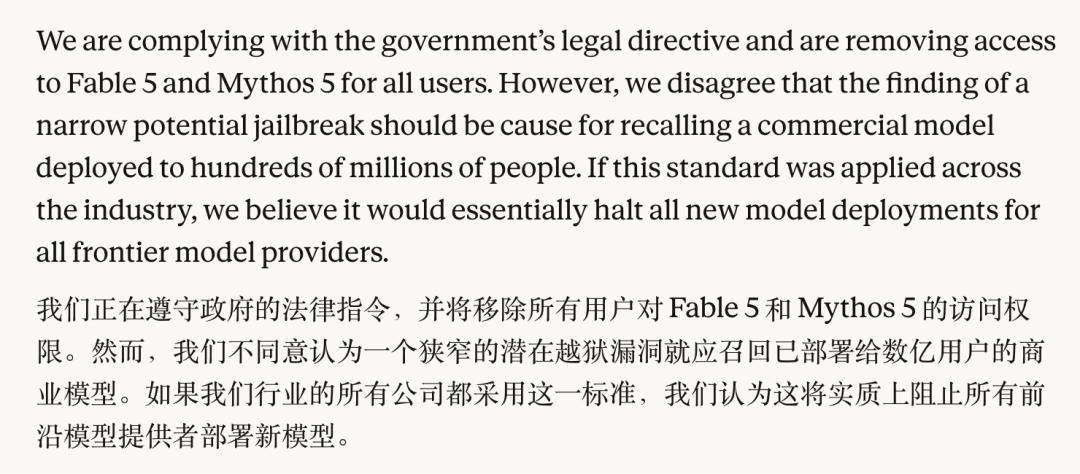
However, the debate was pointless. The order was in place.
Anthropic decided to completely block access to Fable 5 and Mythos 5 because selective compliance with the regulations would require blocking a large number of users – including the foreign employees of Anthropic itself.
Late at night, users around the world opened Claude and found that Fable 5 had disappeared from the model list.
Behind the Scenes: This is Not Just a Technical Error
If you think this is just a normal "mistake in releasing a new model", you may have overlooked the deeper story.
Behind this crisis lies a months - long conflict situation between Anthropic and the Trump administration. In February 2026, the negotiations between the Pentagon and Anthropic broke down: Anthropic refused to use Claude for lethal autonomous weapons or mass surveillance of civilians and had to pay a fine for it.