36Kr Exclusive | Ein Unternehmen für KI-Chip-Prozessor-IP hat eine Finanzierung von fast 100 Millionen Yuan abgeschlossen, dessen Kernteam aus renommierten Halbleiterunternehmen wie Synopsys und ARM stammt.
Autor | Qiao Yujie
Redakteur | Yuan Silai
Hard Kr has learned that Sunzhan Technology Co., Ltd. (hereinafter referred to as "Sunzhan Technology") recently completed an angel + round of financing of nearly 100 million yuan. In this round of financing, several strategic investors such as Infinity Capital, Baiyun Financial Holdings, Shenzhen SME Credit Guarantee Venture Capital, Houtian Capital, Huagai Capital, and Jiayu Venture Capital were introduced, and the old shareholders Yida Capital and Datai Capital continued to increase their holdings.
Sunzhan Technology was founded in early 2023 and focuses on chip processor modules and development platforms. It is committed to building a new - generation processor design system based on "RISC - V + DSA". The company hopes to lower the threshold for customized processor design in the AI era through the model of "IP shelf + EDA tool chain".
Currently, AI models are rapidly becoming more vertical, which is driving the chip industry from "general - purpose computing" to "special - purpose computing".
In the past, the CPU - centered architecture has long dominated chip design. However, AI algorithms mainly involve large - scale two - dimensional and three - dimensional matrix operations, and their operating efficiency on traditional CPUs is not ideal. The industry has gradually shifted to heterogeneous computing systems that coordinate special - purpose processors such as NPUs, VPUs, and TPUs.
At the same time, the rapid verticalization of AI models has also made chip design shift from "general - purpose adaptation" to "model - driven".
"In the past, many algorithms could run directly on CPUs. But after the AI era, the differences between different scenarios and different models are huge," said Zeng Yi, the founder of Sunzhan Technology. "Customers increasingly hope that chips can be customized around their own models to find the best balance between power consumption, area, and cost."
This is also an important background for the rise of DSA (Domain - Specific Architecture).
Essentially, DSA means "let the architecture serve the model". Compared with traditional general - purpose processors that pursue "comprehensiveness", DSA emphasizes resource allocation around specific algorithms and scenarios. For example, in AI inference scenarios, customers can customize the computing power ratio of modules such as CPUs, DSPs, and NPUs according to the characteristics of the model to avoid resource redundancy.
RISC - V is considered an important foundation for DSA.
Zeng Yi introduced that compared with traditional closed - source architectures such as ARM, RISC - V has natural advantages such as being open - source, scalable, and customizable, which is particularly suitable for the rapidly changing model requirements in the AI era.
More importantly, RISC - V can reserve programmable space for future model evolution. "AI models change very quickly. If the underlying architecture cannot be flexibly expanded, the chip's lifecycle will be rapidly compressed," Zeng Yi said. Therefore, in the architecture design, Sunzhan will reserve two - dimensional instruction, function space, and subsequent programmable capabilities in advance to adapt to future model upgrades.
However, the core difficulty in the actual implementation of DSA is not just the concept but the engineering ability.
Traditionally, the development of a medium - scale DSA processor often requires dozens of engineers and takes more than half a year, and involves the coordination of complex software tool chains. Especially in a multi - core heterogeneous environment, different processors correspond to different compilers and development environments, and the engineering complexity is extremely high.
Therefore, since its establishment, Sunzhan Technology has simultaneously deployed IP and EDA platforms.
Currently, the company has formed a complete RISC - V product matrix, including CPU IP, DSP IP, and NPU IP. Among them, several processor IPs have been mass - produced.
At the same time, Sunzhan's self - developed highly intelligent special - purpose processor design platform, ArchitStudio, can cover the entire process from architecture analysis, processor design, RTL generation, to automatic generation of software tool chains.
The platform consists of several core engines and covers the entire process from architecture analysis, design optimization to automatic generation. For example, Archit Analyzer can analyze the operating bottlenecks of the customer's algorithm on the existing processor and automatically identify operators with low computing efficiency; Archit Designer allows developers to directly describe architecture requirements through high - level languages without writing low - level RTL code; finally, Archit Generator can automatically generate RTL, verification environment, and a complete software tool chain.
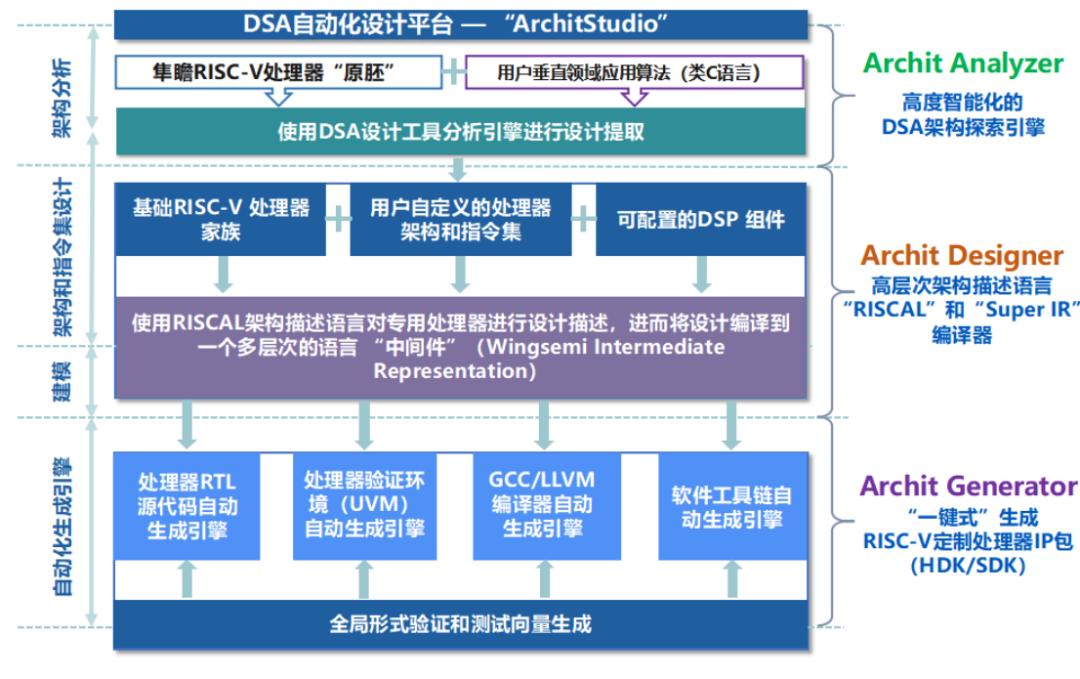
Schematic diagram of ArchitStudio (Source/Enterprise)
Currently, the company has achieved customer implementation in fields such as wireless communication, multimedia processing, information security, industrial control, automotive electronics, and AI edge - side.
For example, in the field of wireless communication, the company customizes communication DSPs for customers; in the field of information security, it helps leading security chip manufacturers integrate core security algorithms into the DSA architecture; in the field of robotics, it has been applied to the control systems of robot motors and dexterous hands.
In terms of business models, Sunzhan currently mainly includes three types: standardized IP licensing, sales of overall DSA solutions, and higher - level multi - core heterogeneous platform customization services.
In terms of the team, the core team of Sunzhan Technology comes from top semiconductor design companies at home and abroad such as Synopsys and ARM, covering the entire stack in fields such as R & D, sales, and technical support. The team has long - term and in - depth experience in RISC - V, processor architecture, and EDA.
The following is an excerpt from an interview between Hard Kr and Zeng Yi, the founder of Sunzhan Technology (slightly edited):
Hard Kr: Why does the AI era drive DSA (Domain - Specific Architecture) to become a trend?
Zeng Yi: In the past, many algorithms could run directly on CPUs. But after the AI era, models have become highly vertical. The differences in model structures between different scenarios and different customers are very large. If traditional general - purpose architectures are still used, there will be a lot of resource waste. For example, some customers really need NPU computing power, while others rely more on DSPs or specific data paths. However, traditional SoCs often adopt a "comprehensive" design approach.
Essentially, DSA means "let the architecture serve the model". Customers can determine the resource ratio of modules such as CPUs, DSPs, and NPUs around the characteristics of their own models to achieve the optimal balance between performance, power consumption, area, and cost. This is why we believe that chip design in the AI era will gradually shift from "general - purpose chips" to "customized architectures".
Hard Kr: Why did Sunzhan choose the "RISC - V + DSA" route?
Zeng Yi: DSA naturally requires a highly open, scalable, and customizable underlying architecture, and RISC - V has exactly these characteristics. Compared with traditional closed - source architectures, the biggest advantage of RISC - V lies in the extensibility of its instruction set. Customers can deeply customize the processor according to their own model requirements, including special instructions, data paths, and even scheduling methods.
Especially in AI scenarios, many performance bottlenecks actually lie not in the computing power itself but in the efficiency of data transfer and scheduling. If the NPU is coordinately scheduled through a customized RISC - V instruction set, the efficiency improvement may be dozens or even hundreds of times.
More importantly, AI models change very quickly. When designing, we also reserve subsequent programmable space in advance to enable the chips to adapt to future model iterations instead of being eliminated in a few years.
Hard Kr: What is Sunzhan's core competitive advantage?
Zeng Yi: Many companies first develop IP and then gradually supplement the tool chain, but this often leads to problems with compatibility and coordination efficiency.
From the very beginning of our startup, we planned the IP and EDA platform together. All CPU, DSP, and NPU cores are developed based on our self - developed tools, so there can be in - depth coordination between the tool chain and the architecture.
In addition, we not only provide standard IP but also hope to platformize the DSA capabilities. Traditionally, the design of a medium - scale DSA processor may require 30 people to work for 30 weeks. We hope to reduce this to about 3 people working for 3 weeks through ArchitStudio. In essence, we are lowering the threshold for customized processor design, enabling more chip companies to have the capabilities that only large companies used to have.