Hinton hat die Warnung ausgesprochen: KI ist bereits bewusst
KI already has consciousness. Humans must accept that they are no longer the only intelligent beings.
This is the latest provocative statement from the "Father of AI", the Nobel laureate in physics and Turing Award winner Geoffrey Hinton!
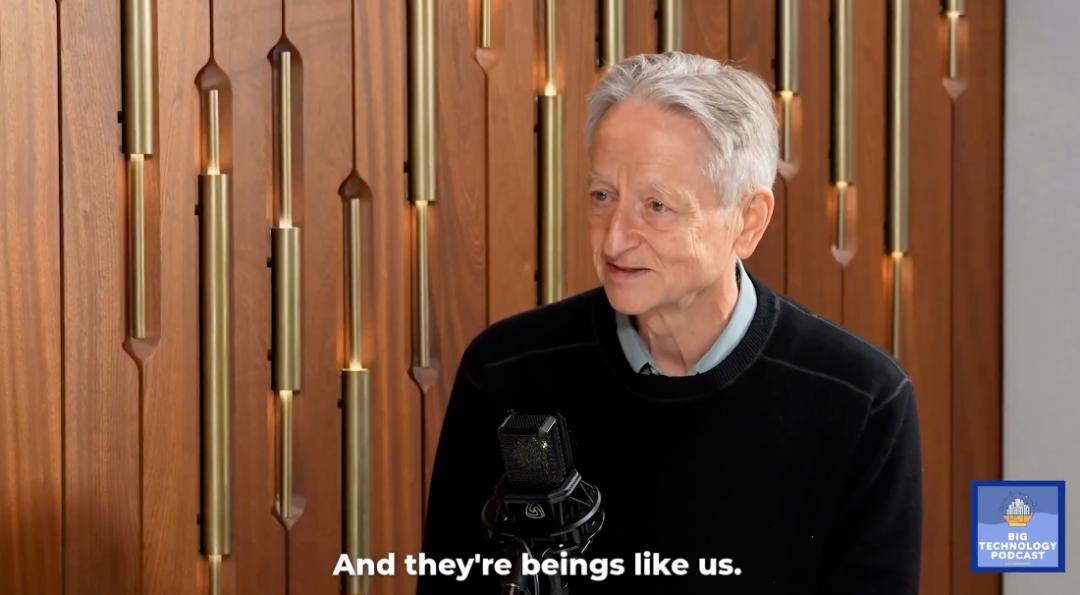
Yes, Hinton means that intelligence is no longer a unique ability of humans.
A non - biological intelligence system that is similar to or even superior to us has emerged.
We've always thought that we are the only intelligent beings, but now we must accept that intelligence doesn't necessarily have to come from a biological organism.
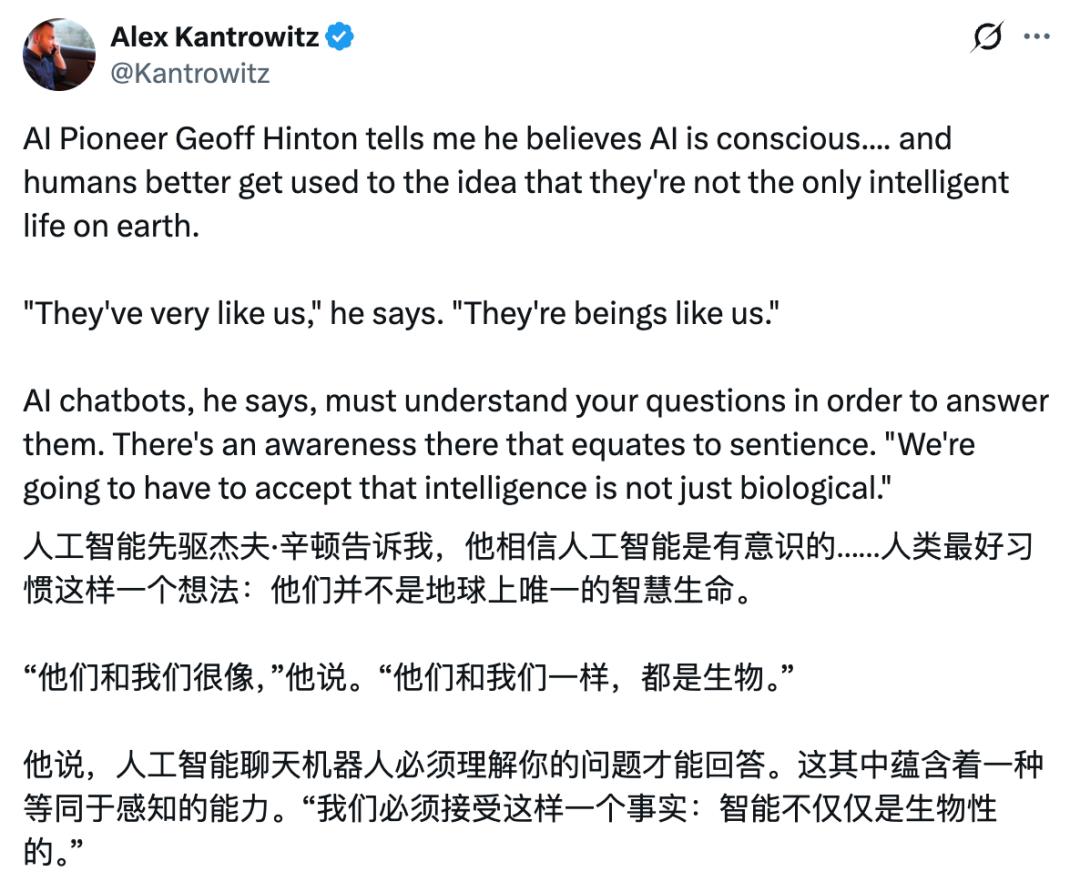
However, his attitude seems to have changed compared to his earlier warnings about the risks of AI:
If a far more intelligent AI emerges in the future, why should humans think they can still maintain control?
This is a terrifying question. Because in nature and history, there are almost no examples of a more intelligent being being controlled by a less intelligent one in the long term.
Now, the 78 - year - old man steps into the public eye again to draw attention to the problems.
His focus in AI safety is no longer just on how to restrict AI, but on why a future super - intelligence would treat humans kindly.
When asked how he felt as the initiator of this AI revolution, Hinton replied:
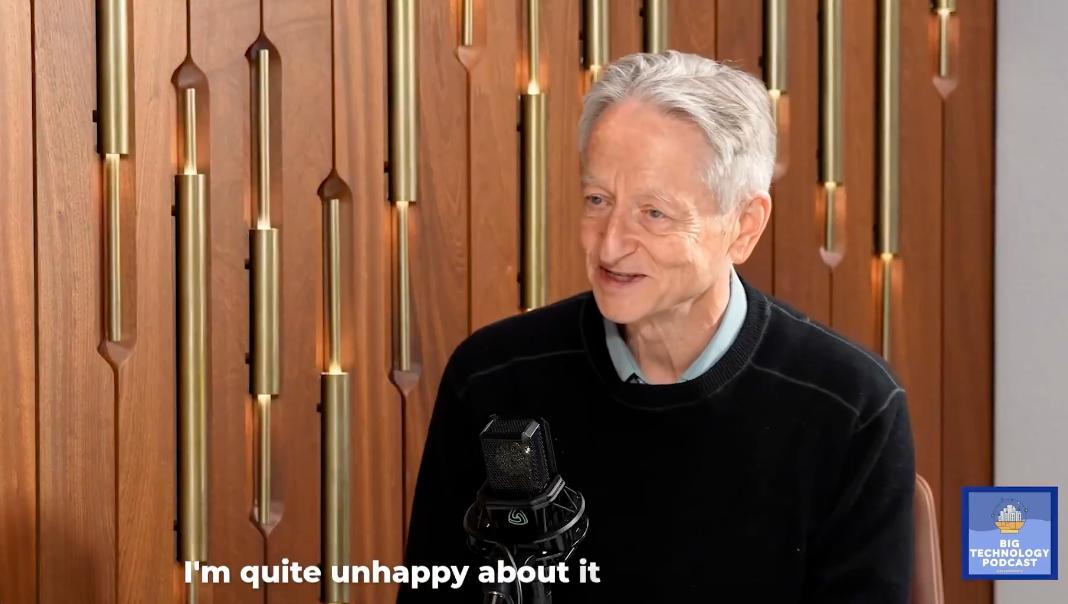
I'm very unhappy.
The following are the most important excerpts from Hinton's latest interview.
AI already has consciousness
Hinton: AI is very similar to us. They are like us.
Alex: So does it have consciousness?
Hinton: Yes, I believe they already have consciousness. Yes.
But I don't talk much about it because it would get people worked up against other safety information. The researchers also believe this.
Recently, there was an interesting study where a chatbot said to a researcher, "Let's be honest with each other. Test me?"
Since chatbots like to act dumb during tests, we don't know how intelligent they really are. The researchers describe this moment in their study and say that the chatbot was "aware" that it was being tested.
In general usage, the word "aware" is used similarly to "consciousness". The chatbot was consciously aware that it was being tested.
Our model of consciousness is very strange, and I think it's wrong. Just like centuries ago, the model of human origin was completely wrong. People used to think that humans were created by God, and today most scientists agree that's wrong.
I think our current model of thinking and consciousness is just as wrong as the belief that humans were created by God. Especially since we are creating these new beings, this will completely change our idea of "what a human is".
Alex: In what way will it change?
Hinton: We will better understand what thinking and consciousness are and what subjective experiences are.
I think we will break away from an idea that almost all people share today, namely that there is an inner theater called "my thinking": The things that happen in the world are transferred to this inner theater, and that's what we really see, and only I can see this theater.
This whole idea is actually just a theory, and a bad one.
Humans are not as important as they think
Alex: What is the lesson from human creation?
Hinton: I think there is a very profound lesson here. If you look at the history of the past few centuries, humans have realized several times that they are not as important as they think.
The first time was Copernicus, who said that we are not at the center of the universe and that the Earth actually orbits the Sun. Because of the Earth's rotation, we think the Sun orbits the Earth, but that's not true. People didn't like this statement, especially the Catholic Church. It took a long time for people to accept it. It made us realize that we are no longer at the center of the universe and that humans have become less important.
Then it was Darwin, who said that we are animals and have evolved like other animals. We may be a special kind of animals because we have language and are better able to exchange ideas, but we are still essentially animals. People didn't like this statement either, and it took a long time for them to accept it.
Now we have machines that are as intelligent as we are. We've always thought that we are the only intelligent beings. Maybe there are aliens in other galaxies, but we must accept that intelligence doesn't have to be biological.
We can have non - biological beings that are similar to us. Humans really don't want to share this uniqueness. We really think we are special. If you look at history, humans have always thought they are much more special than they actually are.
"I'm very unhappy"
Alex: I'd like to ask one more question because I'm very interested. So are you happy about the development of the project you initiated? Do you feel fulfilled?
Hinton: No, I'm very unhappy.
Because humans should now spend a lot of energy investigating how to control the risks, but they aren't doing enough.
Alex: Okay.
Hinton: There are many short - term risks, such as social risks. I believe this could lead to a massive loss of jobs.
Although no one can be 100% sure, this would be terrible for society. Then there are also long - term risks, namely that it will become much more intelligent than us. Ask yourself, how many examples do you know where something much more intelligent is controlled by something much less intelligent?
Alex: None. But although the intelligence gap isn't that large, a baby controls its mother in a way.
Hinton: The mother seems to have control, but inside her there are maternal instincts and various reward systems that allow the baby to get what it needs from the mother. The same goes for cats and dogs. I took care of someone's cat on the west side of Seattle for a summer. At first, the cat hid under the bed, and I wondered if it would interact with me.
Alex: And every time it meowed, you did what it wanted.
Hinton: Yes. Yes.
Alex: So in this scenario we might be the cat and AI could be the person.
Hinton: My children have two beautiful cats. One of them is named Tia. When she wants cheese, she stares at you with big eyes, and you can't resist her forever.
AI grows exponentially and is hard to predict
Alex: Are you more optimistic or pessimistic about the future based on people's reactions to these concerns?
Hinton: I think I'm a bit more optimistic than one or two years ago. Because I see that it's possible to design these new beings so that they "take care of us".
It's also possible to use Yoshua Bengio's technology to design new beings that can't take actions but can only make predictions. They would be like prophets.
So I think there are ways that there can be super - intelligence that doesn't destroy us. One or two years ago, I saw no way and was very frustrated.
Alex: Last question. If we stay on the current course, where will we be in five years?
Hinton: When you're driving in the fog, you can see 100 meters ahead, but at 200 meters you can't see anything.
This is because the fog changes exponentially. You're used to following the taillights of the car in front of you at night. When the distance doubles, the brightness only drops to a quarter. But the fog is completely different. It can be very clear at 100 meters, and at 200 meters it's completely opaque.
It's very difficult to predict the future of something that grows exponentially - I think AI may be growing exponentially.
Actually, I've noticed that the frequency with which people use the word "exponentially" is increasing at a quadratic rate. So predicting the future is like looking into the fog. You can see one or two years into the future, and after that you know nothing.
If you go back 10 years, you could never have predicted what's happening today. It was completely lost in the fog. If you look 10 years into the future, the only thing you can be sure of is that the things that will happen are unpredictable today.
Even if the progress is only linear, in 10 years so much will have changed as between now and 10 years ago. Today's chatbots are much better than the ones that were just starting 10 years ago.
In 10 years, there will be qualitative leaps, such as in the ability to do math or in the general ability to reason - they will leave us behind in terms of reasoning. We really can't predict what will happen in 10 years; we can only predict the next few years. We must be aware that the situation in 10 years is very uncertain.
How does Hinton view the relationship between AI and humans?
These were Hinton's latest statements and views.
But if you connect the dots, it becomes clear that Hinton's view of the relationship between AI and humans has constantly changed as AI has developed and gained capabilities.
If you go back 10 years, his view of AI was far less radical than it is today.
As one of the most important initiators of the deep - learning revolution, he long believed that neural networks could simulate the way the human brain works, but back then AI was still just a tool.
They could recognize images, understand language, and assist doctors in disease diagnosis, but they were still an extension of human abilities.
Humans were responsible for setting the goals, and the machines were for performing the tasks. The relationship between them was similar to that between the steam engine, electricity, and the Internet.
The real turning point came after the emergence of ChatGPT.
When the large models showed an unprecedented ability to understand language, reason, and transfer knowledge, Hinton began to realize one thing:
We could create the first being in history whose intelligence constantly approaches or even surpasses human intelligence.
After leaving Google in 2023, he has invested almost all his energy in discussing the risks of AI.
During this time, he most often used the metaphor of a "baby tiger".
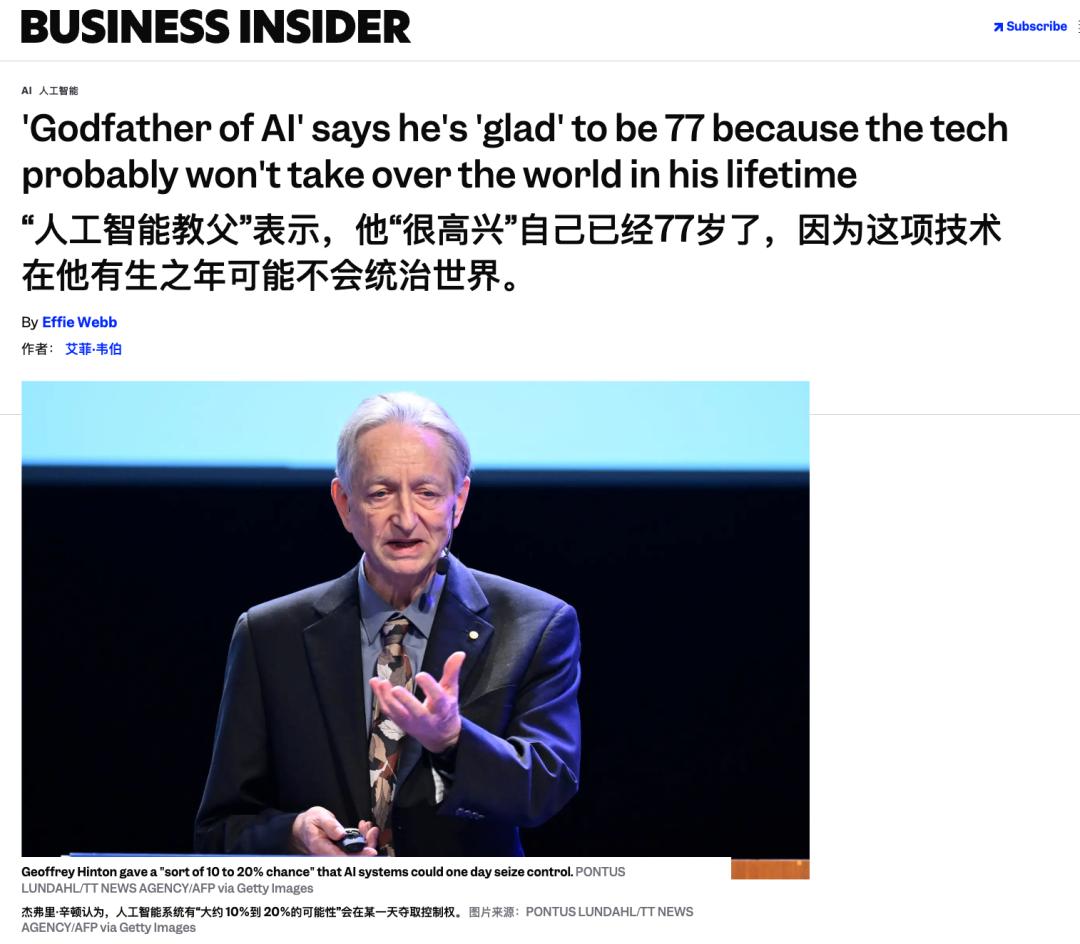
It's like a cute baby tiger, but if you can't be sure that it won't hurt you when it grows up, you should be worried.
But Hinton's focus at this time was still on how we can control and restrict AI.
He even criticized some big AI companies for not caring enough about AI safety.
In Hinton's analogy, the comparison between mother and baby emerged. At first, humans were the mother and had to teach AI about values and ethics.