So etwas habe ich noch nie gesehen! Sam Altman und Dario Amodei ziehen an einem Strang: Die DNA muss untersucht werden.
Right now, something very unusual has happened in the field of Artificial Intelligence.
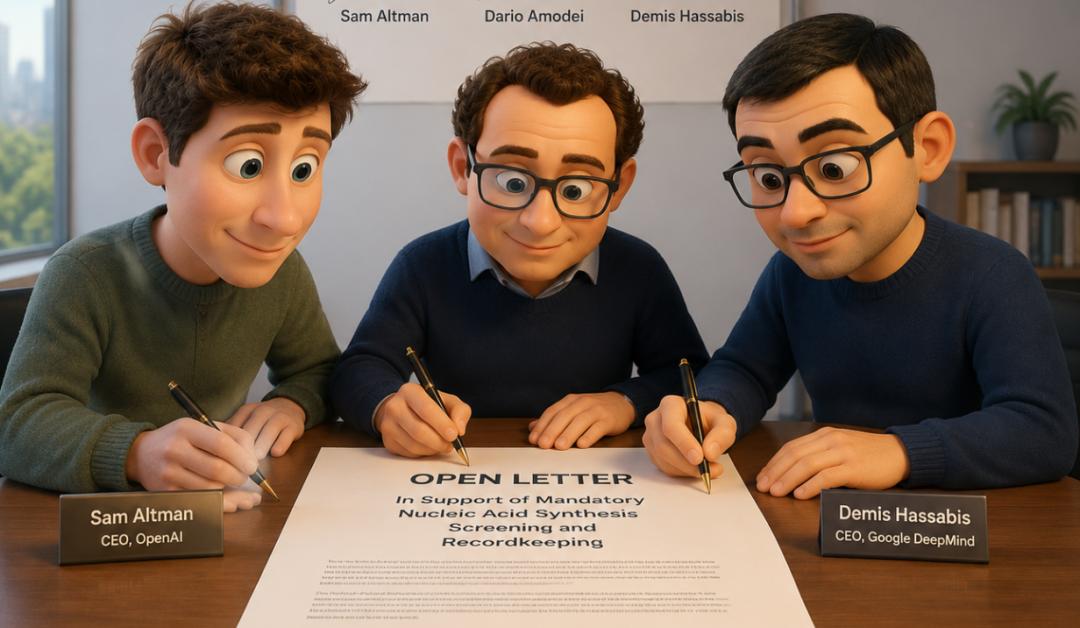
Sam Altman, Dario Amodei, Demis Hassabis … a group of people who usually compete fiercely with each other have signed their names under a common open letter.
Together, they are calling on the US Congress: It should be legally required to screen all orders for synthetic DNA.
△
Do you still remember the famous scene in February this year?
At the Indian AI summit, a number of tech giants joined hands and had their photos taken. However, Altman and Dario didn't even stand next to each other. Instead, they raised their fists and pretended to have their photos taken.
Now, however, these old rivals are “together” again for the same reason.
And it's not just them.
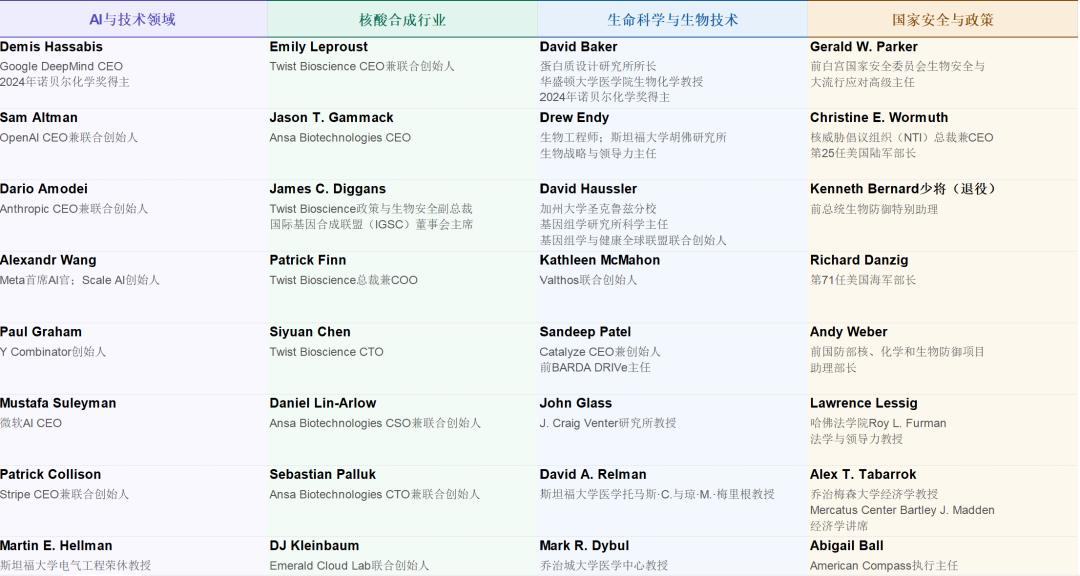
Among the signatories of this open letter, besides the more well - known Hassabis, Suleyman, Alexander Wang, Paul Graham, etc., almost all the big names in the US bio - field and the national security field … 67 people, all with impressive titles.
△
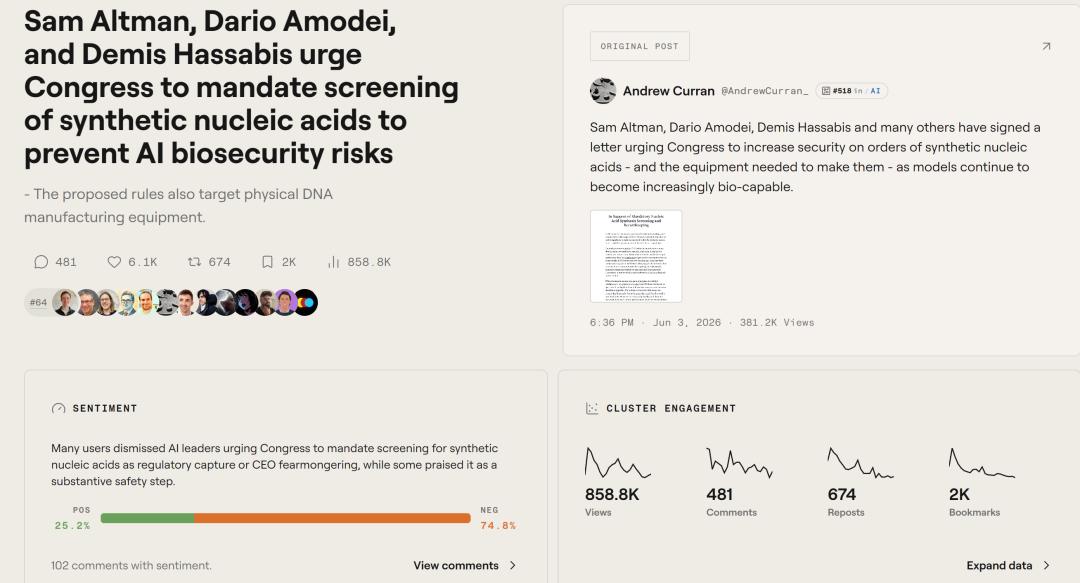
With this impressive lineup and the importance of the matter, a big debate has erupted on the Internet. Even on X, a dedicated trending topic area has been set up.
After a quick look, some Internet users have admired this rarity as a remarkable inter - institutional agreement, while others think that this is just a new marketing strategy of the AI giants for their IPOs.
A sentiment analysis on Digg shows that 25.2% of the comments are positive, while 74.8% are negative.
(Although the numbers are constantly changing, the general trend remains the same)
Although there are many doubts, no one can deny the fact:
When these people who usually don't like each other suddenly come together, it's always worth listening to them.
Synthetic DNA: Advantages and Disadvantages
This time, the focus of these big names is on synthetic DNA.
Synthetic DNA simply means that instead of extracting DNA from living organisms, a new DNA chain is “written” chemically in the laboratory –
Generally, if you know the desired base sequence of A, T, C, and G, you can mix the DNA like a recipe by putting bases together one by one.
This technology was first developed in the 1950s by the biochemist Arthur Kornberg. It has a very wide range of applications, from insulin production, mRNA vaccines to gene editing, artificial meat, and biofuels. Behind all these applications is synthetic DNA.
Arthur Kornberg later won the Nobel Prize for this technology.
However, later it was found that this technology could also be misused –
If one is able to “write the code of life”, one can theoretically also synthesize sequences associated with dangerous pathogens or toxin genes.
This potential for misuse is further enhanced by the rapidly advancing AI technology.

Before AI, the Barrier to Entry Decreased
But before AI emerged, the barrier to entry for synthetic DNA decreased. The open letter clearly states:
Today, the technology for DNA synthesis is no longer the exclusive domain of high - end laboratories.
The ability to order synthetic DNA online has accelerated vaccine development, advanced basic research, and enabled small teams to utilize capabilities that were previously only available to large institutions.
That is to say, today you can also order synthetic DNA online –
You simply enter a gene sequence online, place an order, pay, and then wait for delivery.
And the price is quite low.
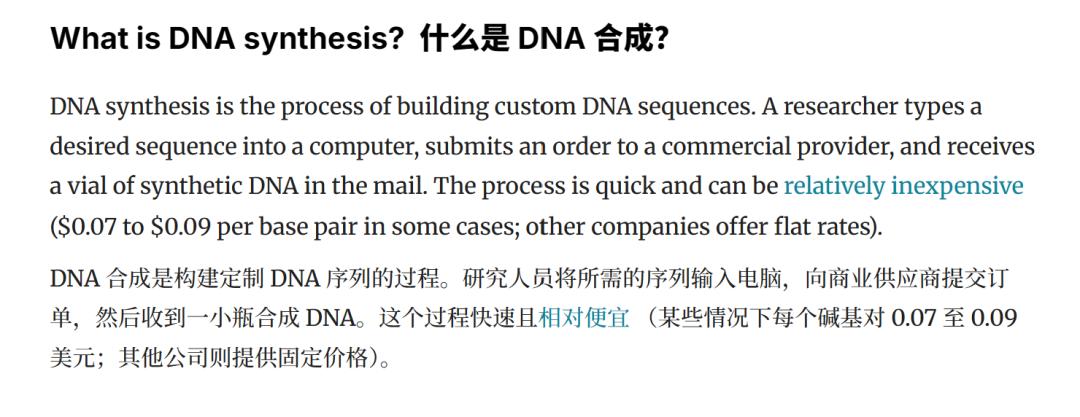
According to an analysis of the “Biosecurity Modernization and Innovation Act of 2026” (S.3741) by the charitable organization EA Forum, the prices of some providers can drop to 0.07 to 0.09 US dollars per base pair.
The letter mentions that since scientists published the experiment “Virus reconstruction from DNA fragments” more than twenty years ago, the supply chain has been regarded as a vulnerability in terms of biosecurity.
Naturally, scientists and industry workers have tried to find solutions.
For example, in 2009, the gene synthesis industry voluntarily founded the International Gene Synthesis Consortium (IGSC) and introduced voluntary security screening standards.
When you hear “voluntary”, you can probably imagine how effective these measures were.
In fact, it has been shown that this was the case. Over a long period, the large companies in the industry have carried out the screening measures more consistently, while the small companies haven't cared.
Still, more than two - thirds of the gene synthesis companies are not members of the IGSC.
AI Can Guide Virus Experiments, Tech Leaders Call for DNA Security Legislation
What's even worse is that until now, there was at least a knowledge barrier for this technology.
Even if villains obtained synthetic DNA fragments, they would have to conduct years of studies and experiments to turn them into a threat.
But now AI is here. The open letter points out:
AI systems are now better than doctoral - level virologists in highly specialized laboratory operations in their respective fields.
This is not an exaggeration.
According to the test data of the Anthropic Frontline Red Team, Claude has developed from “worse than the best human experts” in virology testing to “far better than the human baseline” in just one year.
Overall, the test shows that in the fields where researchers feel most confident, AI has a hit rate of 45%, while the best human virologists only achieve 22%.
Even Anthropic's own research shows that the ability of doctoral - level biologists to handle weapon - related tasks with AI support has almost doubled –
With each new model generation, this number increases.
AI provides the knowledge, DNA synthesis provides the material, and the two lines are approaching an intersection.
In the face of this increasingly serious situation, this time the industry giants are jointly calling for: strict screening must be carried out.
Screening is currently one of the most well - developed biosecurity measures that least disrupts normal activity.
It requires providers of synthetic DNA and manufacturers of synthesis devices to check synthesis requests for suspicious sequences and verify the legitimacy of customers before delivery.
Providers should also record synthesis orders and sequence data to support legitimate biosecurity investigations and to be able to trace back any threat that may have survived the first screening measure to its source.
The traceability itself can deter misuse.
Simply put, it's about three things: sequence checking, customer verification, and data collection.
The open letter clearly emphasizes that one doesn't have to have a specific attitude towards AI to support screening.
The reason why everyone has come together today is that “the arguments in the field of biosecurity have been recognized by scientists and governments for decades”. This is not AI panic, but a problem that has existed for twenty years and finally has an opportunity to be solved.
Interestingly, the open letter also admits at the end:
This is a rare moment of agreement between interest groups that usually have different opinions.
The use of “competing interests” and “rare” shows everything one needs to know about the importance of this matter.
One More Thing
After reading this letter, it's hard not to think of “Jurassic Park”.
The core of this movie is DNA synthesis technology:
People extract dinosaur DNA from amber, fill in the missing fragments, synthesize a complete genome, and bring the dinosaurs back to life.
But what happened then? The dinosaurs got out of control.
There were safety measures – an electric fence, a regular fence, and 24 - hour monitoring. Hammond was sure that the security system “was sufficient”.
But just because a traitor, Nedry, turned off the security power supply to steal embryos, the whole park collapsed in one night.
The T - Rex broke through the powerless fence, the raptors stormed into the kitchen, and tourists and employees were in danger of losing their lives.
All the “voluntary” and “sufficient” safety measures were worthless in the face of a single mistake.
This almost exactly corresponds to what happens in the real world – The DNA synthesis industry still relies on “voluntary screening” today. The large companies carry it out consistently, but more than two - thirds of the providers are not members of the industry association.
If just one step is not checked, the entire defense line is ineffective.
Maybe Altman and Dario, the old rivals, have recognized this and are ready to come together and put their names under the same letter.

Finally, I'd like to recall the famous line from Dr. Ian Malcolm in the movie, which is still so relevant today:
Your scientists were so preoccupied with whether or not they could, they didn't stop to think if they should.
Think about it before you act – in the era of rapid AI progress –
It's difficult, but maybe it's the right thing to do.
This article is from the WeChat account “Quantum Bit”. Author: Focus on Frontier Technology. 36Kr has obtained permission for publication.