Warum haben die Photovoltaik-Giganten alle so große Schwierigkeiten mit ihrem Energiespeicher-Geschäft?
Energy storage as a lifesaver for photovoltaic giants is not that easy to grasp.
Today is the first day of the opening of the SNEC Photovoltaic Exhibition.
The exhibition hall was full of people. One had to wait half an hour to get a 58-yuan meal package, which is called the "Shanghai money" box. When I sat down to eat, the young man opposite me said with a somewhat self-deprecating smile:
These boxes are sold much better than photovoltaic modules and batteries.
As is well known, photovoltaic modules are as cheap as cabbages today compared to the expensive boxes. Since the photovoltaic industry is difficult to operate, almost all photovoltaic giants have placed their energy storage products in the most prominent position at this year's exhibition stand.
Integration of photovoltaics and energy storage, the second growth curve, GWh series delivery - these are the stories that the giants like to tell the most this year.
Two weeks before the opening of the exhibition, JA Solar Technology announced on its official WeChat account: Wang Junsheng will be appointed President of JA Solar Energy Storage Company, effective immediately.
The fact that JA Solar changed two leaders for the energy storage industry in two years clearly shows that JA Solar now values the energy storage industry. In 2025, the sales revenue of JA Solar Technology was 49.1 billion yuan, and there was a loss of almost 5 billion yuan. No specific figures about the energy storage industry were mentioned in the annual report.
The difficulties of JA Solar are a reflection of the photovoltaic giants in the energy storage industry.
Last year, almost all leading photovoltaic companies put the energy storage industry at the forefront of their strategies. The reason is simple: The core business no longer brings profits.
According to the statistics of China Energy Network, the total losses of nine photovoltaic giants such as Tongwei, TCL Zhonghuan, Longi and JinkoSolar in 2025 were over 43.5 billion yuan, at most 50 billion yuan. Some institutions predict that the total losses of all listed photovoltaic companies this year, including those in the second and third tiers, will exceed 60 billion yuan.
On the other hand, the annual reports of leading energy storage companies look quite different. In 2025, the net profit of Sungrow Power Supply reached about 13.5 billion yuan, an increase of 22% compared with the previous year; the net profit of Hyperstrong Energy Technology was 950 million yuan, an increase of 47%; and the sales revenue of the energy storage sector of CATL was 62.4 billion yuan.
When it has become the norm in the industry that components have negative margins, the energy storage industry seems to be a lifesaver.
But the problem is obvious - photovoltaic companies have channels, brands and customers. It seems logical to sell energy storage to those who have previously bought components from them. But this path is not smooth.
Why is it so difficult for the giants that have stood out in the fierce competition of the photovoltaic industry to be successful in the energy storage industry?
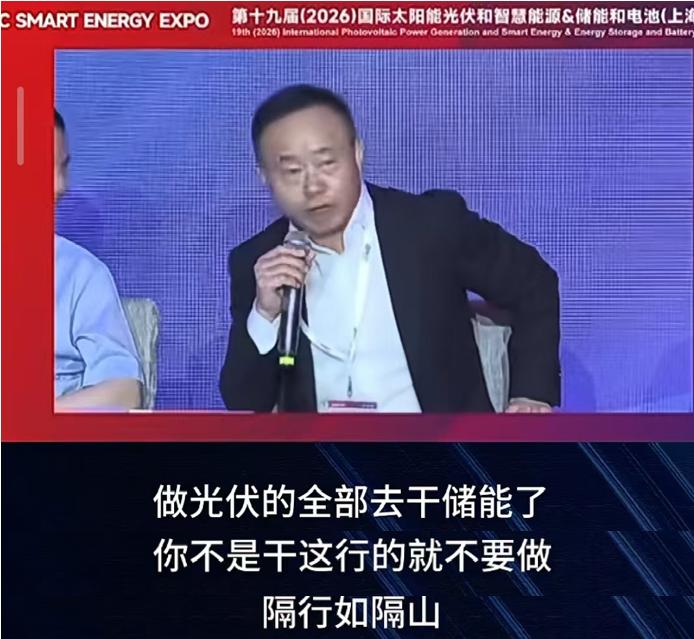
Perhaps the most apt explanation is the sincere statement of Shi Zhengrong, a photovoltaic tycoon, at a forum - "Each industry is like a world of its own."
01 The gap is larger than expected
In fact, there is already a gap in the energy storage business of photovoltaic giants.
In this group, Canadian Solar and Trina Solar are the two companies that are relatively far ahead in the energy storage industry.
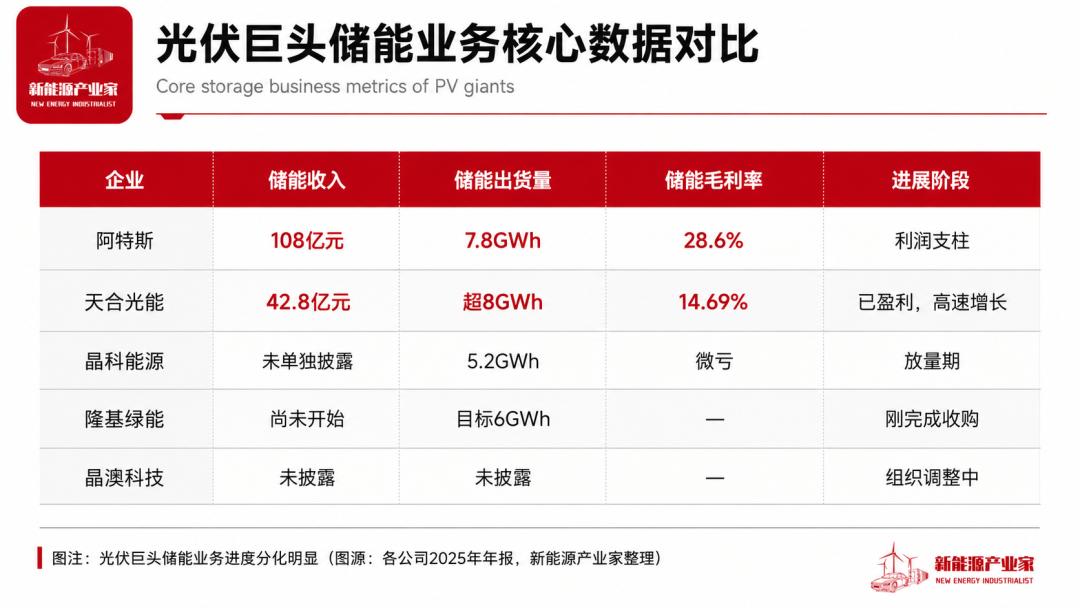
In 2025, the sales revenue of Canadian Solar from energy storage systems was 10.8 billion yuan, the profit margin was 28.6%, and the delivery of large-scale energy storage was 7.8 GWh. The energy storage industry accounted for 27% of the total sales revenue and was already a solid profit pillar. In the context of the industry's overall loss, Canadian Solar achieved a net profit of 1.016 billion yuan.
However, this success did not come suddenly last year. Its subsidiary for energy storage, e-STORAGE, has been established in North America, South America and Australia for years and has already built independent sales, engineering and maintenance teams.
In June 2025, Canadian Solar's SolBank 3.0 passed the Canadian CSA TS - 800 large - fire test - one of the few energy storage products in the world that could pass this test.
In other words, Canadian Solar is successful in the energy storage industry not because it sells many photovoltaic modules, but because it has invested enough time in this sector.
Trina Solar also deserves attention.
In 2025, the sales revenue of Trina Storage was 4.28 billion yuan, an increase of 83% compared with the previous year. The delivery was over 8 GWh, and the proportion of overseas income was over 60%. The energy storage industry has already made profits and has become an important profit growth point for the company. The goal for 2026 is to double the delivery to 15 to 16 GWh, and the existing overseas orders are over 12 GWh.
In contrast to Canadian Solar, Trina Solar pursues the strategy of "Full - Stack Self - Development" - everything from the battery cell to the system is self - produced. The three core systems BMS, EMS and PCS are all self - produced. It is not easy to source battery cells from outside, assemble them in a cabinet and sell them, but real investment is made in technology.
The other companies are obviously still in the exploration phase.
In 2025, the delivery of energy storage by JinkoSolar was 5.2 GWh, a very rapid increase of over 380% compared with the previous year. The existing orders are over 10 GWh, and the company plans to double the delivery in 2026. In the investor communication in the first quarter of 2026, it was stated that the profit margin of the energy storage industry in the first quarter was about 16%. But due to the delay in order implementation and the small amount of order implementation, there is still a certain loss in the energy storage industry.
There is still a long way between volume increase and profitability.
Longi Green Energy acquired a majority stake in Suzhou Jingkong Energy only in January this year. 6 GWh is only an operating target, and the actual delivery has not started yet. JA Solar has not separately published the sales revenue from the energy storage industry.
The question is: Is delivery on a GWh scale already a success? A comparison with the real energy storage leaders shows it.
In 2025, the sales revenue of Sungrow Power Supply from energy storage was 37.3 billion yuan, the delivery was 43 GWh, and the profit margin was 36.49%. The sales revenue of CATL from energy storage was 62.4 billion yuan, the delivery was 121 GWh, and the profit margin was 26.71%.
Canadian Solar has achieved the best result in the photovoltaic group with 10.8 billion yuan, but compared with Sungrow Power Supply, it is still less than a third.
The huge difference in scale makes us can't help but wonder where the difficult points for component companies in the energy storage industry lie?
02 Channels can help you reach customers, but not keep them
The biggest advantage of photovoltaic giants in the energy storage industry is - the channels.
The logic sounds reasonable: I have global channels and brands, and there is a certain overlap in customers. If they have bought my components, it is natural to buy my energy storage systems too.
The problem is that components and energy storage are two completely different businesses.
Components are standard products. Customers look at efficiency, price, brand and delivery ability. Once a module is manufactured and installed, the manufacturer hardly needs to do anything during the module's lifespan.
Energy storage is completely different.
From contract signing to the operation of a large - scale energy storage power plant, a series of inspections such as grid connection planning, fire protection certification, BMS and EMS settings, power trading strategy and long - term maintenance inspection must be passed.
Customers are not just buying a battery cabinet, but a system project that must constantly interact with the power grid, political measures and local regulations.
Photovoltaic channels can help companies open the doors of customers. But the questions that need to be answered after entering the door - such as how to set up the grid connection, who is responsible for safety, who undertakes maintenance and how to optimize power trading - are completely different from selling components.
Zhang Jianhui, the founder of Hyperstrong Energy Technology, said in an interview: "Energy storage is not simply a simple connection of standardized battery cells or PCS, but a customized solution based on the specific situation."
This sentence means: Energy storage companies are not just selling devices, but a customized solution for a specific situation.
Let's look at a series of data - the profits. Only a few photovoltaic giants make money in the energy storage industry.
The underlying logic is that the price of large - scale energy storage on the Chinese market is very low, and the profit margin is generally between 15% and 20%. To achieve a profit margin of over 25%, one must establish oneself in overseas income. And overseas income requires precisely the abilities such as grid connection experience, safety certification and long - term maintenance, which take time to accumulate.
Therefore, it is not easy to really make money in the energy storage industry and get a price premium.
03 How can one overcome the time barrier?
Besides the differences in abilities, there is still a threshold that is difficult to overcome: the time window.
Sungrow Power Supply started its career with inverters and has almost 30 years of experience in power electronics and grid technologies. In 2025, the energy storage system was already its largest business segment, and the sales revenue proportion was over 41%.
CATL also did not start the energy storage industry recently. From battery cells to system integration, the company delivered over 70 projects worldwide in 2025, and the delivery volume increased by over 160% compared with the previous year.
All these are things that have been accumulated over the years - material systems, manufacturing processes, BMS algorithms, EMS platforms, safety certifications in different countries around the world, all must be acquired step by step.
Photovoltaic companies can quickly build capacities, produce products and get orders today. But the path from "producing products" to "producing good products" is not easy to bridge with money.
If there are problems with the grid connection of a power plant, who does the customer call first? Who is responsible if the battery weakens more than expected after three years? Can the EMS strategy respond promptly to price fluctuations in the power market?
These abilities must be acquired piece by piece through projects, and there are no shortcuts.
Longi Green Energy acquired a capacity of 31 GWh and global grid connection experience immediately by acquiring Jingkong Energy. The starting point is actually not low. But whether it can really assimilate the team, technology and customer relationships of Jingkong will only be shown in the future.
Yang Bao, the president of the energy storage department of Trina Solar, once said sincerely: "The competition in the energy storage industry is not only about price, but also about safety, maintenance and long - term compatibility with the power grid."
This sentence applies to all photovoltaic companies entering the energy storage industry.
And there is still an important question: How long will the time window for latecomers in the energy storage industry remain? The safety requirements...