Die Herausforderungen, die Xinpinmu bei der Expansion ins Ausland zu bewältigen hat, sind schwieriger als Sie sich vorstellen können.
China is currently experiencing an unprecedented maritime expansion. The three forces of the manufacturing industry, the Internet sector, and brand manufacturers are converging in the same direction, and the waves are more powerful than ever. The "New Pinduoduo - M" project launched by Pinduoduo at the end of 2025 is one of the most ambitious flagships in this wave.
By the end of May 2026, Pinduoduo's management sent a clear signal in its latest statement: The New Pinduoduo - M has fully entered the practical operation phase. The team integrates the supply chains of Temu and Pinduoduo, delves deep into industrial regions, selects factories with the best manufacturing capabilities, and jointly creates its own brands with global top - IPs, which are developed individually according to different markets and product categories. Temu aims for the mass - sale of white - label products, while the New Pinduoduo - M aims to generate brand premiums on the same supply chain.
Few people are aware that the leap from "selling other people's goods" to "selling one's own brands" starts with the problem of intellectual property rights.
The problem facing the New Pinduoduo - M is more difficult than everyone expected: It is both a boundary test of the platform's capabilities and a comprehensive examination of whether the Chinese production sector can gain respect in an established market - rule system. Chinese factories on board this large ship must be aware: This is not an ordinary order, but a complete transformation from "Made in China" to "Global Brand". The journey across the sea will be associated with storms, but the cost of staying on land will be even higher.
01
The Past: The 30 Years of Japanese Companies
The problems that Chinese maritime - expansion companies are facing today were successively experienced by Japanese companies more than 40 years ago.
In the early 1980s, the Japanese production sector conquered the European and American markets with high - quality and low - cost products. But the products went out, and the brands stayed behind. This situation is very similar to the starting point of China's maritime expansion today.
The change was forced. As soon as Japanese companies entered the European and American markets in the form of brands, intellectual property rights suddenly became a deadly weapon in the fight for living space. Japanese companies were increasingly confronted with intellectual - property lawsuits: Honda was accused of copyright infringement because of the design of its engine, Toyota was sued in North America for similar trademarks, Nintendo saw its core brands pre - registered by multiple parties in Europe, and Sony was sued in the United States for patent infringement... Each lawsuit forced Japanese companies not only to sell products but also to establish brands in the legal sense in the target markets.
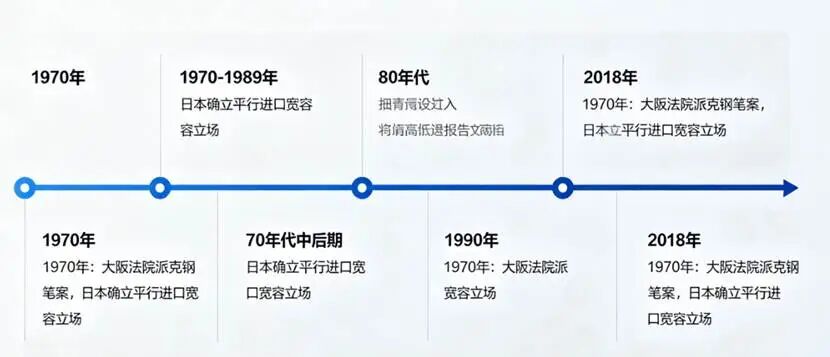
Figure: Timeline of the barriers that Japanese companies encountered during their maritime expansion, Source: Jinduan Research Institute
This history shows that the barriers of intellectual property rights are not just a legal problem. They are an entire system of capabilities - from brand naming, brand registration, search for design patents to the establishment of a localized legal team, all aspects must be systematically prepared before maritime expansion.
For companies that react passively, the price could be the permanent loss of an entire market.
02
The Dangerous Rapids: From Brands to UPC, a Series of Previously Unknown Obstacles
If we say that the main battlefield of Japanese companies back then was in the United States, then the New Pinduoduo - M and Chinese brands today are facing a more complex and multi - layered system of barriers in terms of intellectual property and compliance during their maritime expansion into the EU. The interaction between these layers can be costly for those who are not prepared.
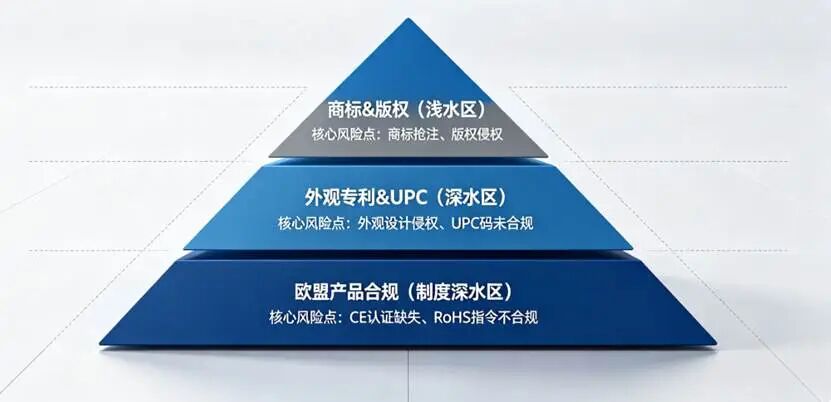
Figure: Three risk levels for Chinese brands during their maritime expansion into the EU, Source: Jinduan Research Institute
First Level: The Shallow Zone of Brands and Copyrights.
This is the most easily triggered risk and also the area that Chinese companies are least familiar with. Statistics show that more than 50% of Chinese maritime - expansion companies have experienced pre - registration of brands overseas, and old brands as well as small and medium - sized cross - border brands are no exception.
Besides brand pre - registration, there is an even more hidden risk in the "principle of unity" of EU trademarks: 27 member states share the same validity, but if an objection is valid in any state, the trademark is invalid in the entire EU. In 2023, a Shenzhen - based Chinese 3C accessory company had its EU trademark declared invalid in total because a local company in Lithuania filed an objection for "similar trademarks", even though the company had been operating in major markets such as Germany and France for 5 years. The re - registration took 18 months, and the order losses amounted to 3.7 million euros.
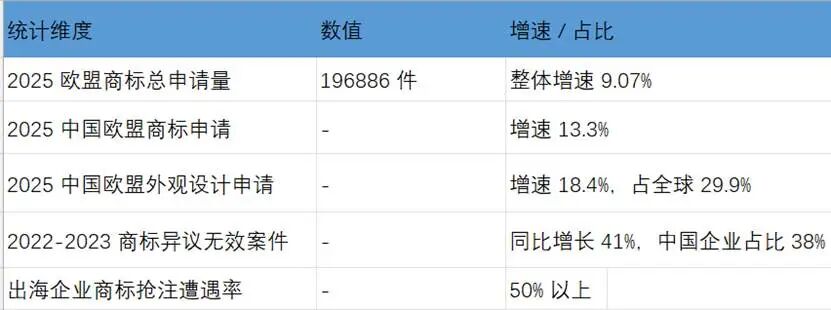
Figure: Statistics of applications and disputes related to trademarks and other intellectual property rights in the EU, Source: Jinduan Research Institute based on data from multiple industry associations
Copyright is another hidden current. In October 2025, a Swedish court convicted a Chinese e - commerce company of copyright infringement of a local e - commerce company Nelly, finding that it had used more than 30 product pictures without permission, and fined it hundreds of thousands of Swedish kronor.
The costs go beyond fines. Such cases drive the EU to extend copyright enforcement from traders to consumers, and every consumer order can therefore be subject to a customs inspection.
Second Level: The Deep Zone of Design Patents and UPC.
The three product categories of clothing, furnishings, and outdoor are in this high - risk area.
A lawsuit for design - patent infringement by others is just an ordinary risk. An even more difficult - to - avoid threat lies in the jurisdiction regulations of the Unified Patent Court (UPC). Its jurisdiction covers 18 EU member states, and the approval rate for preliminary injunctions is over half. The applicant can file an application without notifying the defendant, and the court can issue an injunction based on prima facie evidence. Once the goods are seized, the storage and port costs must be borne by the goods owner.
Moreover, the spirit of NPE (Non - Patent - Enforcement Entities) is also hovering in the consumer - goods area. Such companies do not produce goods, and their only business model is to acquire patents and then file lawsuits. In the past, their main battlefields were the technology and automotive industries, but with the continuous expansion of Chinese brands during maritime expansion, it is only a matter of time before there are NPE lawsuits in the clothing and furnishings areas.
Third Level: The Institutional Depth of Product Compliance.
If we say that brands and patents are "litigation risks", then product compliance is "systematic approval costs". It is the threshold that must be overcome for each shipment.
The GPSR (General Product Safety Regulation) came into force on December 13, 2024. Its core requirements include: All consumer goods entering the EU must clearly display the manufacturer's name, postal address, and email address, product identification (model/lot/number), as well as the necessary warning and safety information in every online product information. Without a European representative and product label, the product cannot be offered for sale.
The REACH Regulation is another detailed checklist. By February 2026, the list of substances of very high concern (SVHC) was updated to 253 elements. With each additional type of material, the testing costs increase by 300 to 800 yuan. The basic testing for a single material costs about 2,000 to 3,000 yuan, and the testing costs for products with multiple materials and coatings can be 5,000 to 8,000 yuan.
The REACH testing costs for several hundred SKUs in the three product categories are conservatively estimated to be several million yuan.
The EPR (Extended Producer Responsibility) is also an easily overlooked silent cost factor: Electronic waste, batteries, and packaging must be separately registered in each sales country. For the five core countries, the basic EPR investment is already several hundred thousand euros.
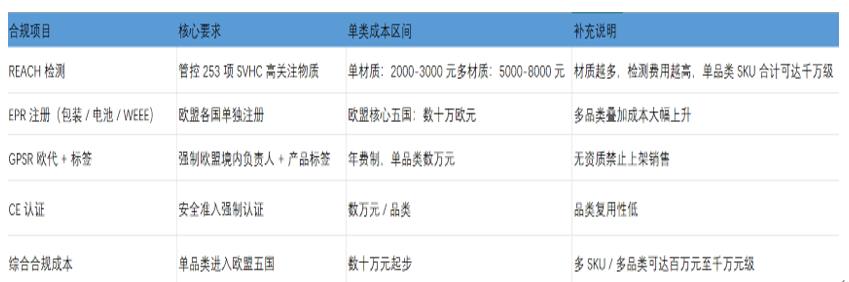
Figure: Cost - estimation table for the main compliance projects in the EU (Detailed cost table)
More compliance variables are coming. Starting from 2027, textile products must include a digital product passport and disclose environmental - relevant data about their entire life cycle. The carbon border adjustment mechanism is to be extended to the textile industry in 2027, and Chinese textiles that are highly dependent on coal - fired power plants will then have to pay a carbon border tax.
An integrated estimate shows that the basic compliance costs for a clothing factory with an annual turnover of several million yuan that penetrates into the five core countries of the EU - CE certification, REACH testing, EPR registration, value - added tax, European representative - are already in the range of several hundred thousand yuan. When expanding to multiple product categories and SKUs, the total compliance costs will rise from hundreds of thousands to millions of yuan.
In the traditional foreign - trade way, these costs are borne by foreign importers and brand manufacturers. The self - marketing model of the New Pinduoduo - M means that all costs fall on the platform and the cooperating merchants.
04
Breaking Through the Barriers: Learning How to Conduct Maritime Expansion in the Process of Maritime Expansion and Learning How to Survive in the Rules
In the face of these recurring barriers, the worst choice is to wait. Waiting for the government to intervene and negotiate for friendlier rules, for others to pave the way? Barriers will never get lower just by looking at them from the outside. The only really effective method is: Enter the market and learn how to use the rules.
The following four points are inevitable tasks in this process:
1. The Sophistication of Brand Registration.
Before entering the EU market, brand registration for the core product categories that cover all 27 member states of the EUIPO must be completed.
But registration is only the first step. More importantly, companies must build a global brand - monitoring system to detect pre - registrations early. Top brands like Maotai and Haier have already invested extensive resources in defending their brands overseas, and small and medium - sized brands must also make brand monitoring an obligatory measure before maritime expansion.
2. Avoiding Design - Patent Infringement.
Before the final determination of the design of each product, a search for existing design patents in the target market must be carried out, and substantial differences in structure, pattern, and function must be made.
However, in reality, in the short term, most maritime - expansion companies still lack professionals for searching for EU design patents. A practical compromise is: For core product categories, European patent attorneys can issue non - infringement opinions, and for non - core product categories, the risk can be reduced through design differences.
3. Actively Responding to UPC Lawsuits.
For the New Pinduoduo - M and the Chinese merchants behind it, after entering the EU market, a normalized UPC - lawsuit monitoring system must be established to ensure that a legal response can be made within the shortest possible time after receiving an application for a preliminary injunction. Statistics show that the approval rate for preliminary injunctions of the UPC is over 50%, but defendants who actively fight still have almost a half - chance of preventing the issuance or continuation of the injunction.
4. Building a Compliance Center.
The New Pinduoduo... (The text seems to be incomplete here, but the translation of the previous part is provided as required.)