Was macht eigentlich Leapmotor? Seit Anfang des Jahres hat es keine Unterbrechung an Turbulenzen gegeben.
Since 2026, Leapmotor's life has been particularly "exciting".
On the one hand, the sales revenue has been steadily increasing. In April, 71,387 vehicles were delivered, which sets a new monthly record for Leapmotor and the entire new energy vehicle industry. In the first quarter, 110,155 vehicles were delivered, representing a 25.8% increase compared to the previous year. The overseas sales revenue has even increased by 442% compared to the previous year.
On the other hand, however, there have been constant negative storms. From the "meager party scandal" at the annual party at the beginning of the year, to the silent change of employee benefits in May, which triggered employees' dissatisfaction, to the shift from profit to loss in the first - quarter balance sheet and a sharp decline in the profit margin - this new energy vehicle brand, known for its "extreme cost control", seems to have a very diverse image in the public eye.
On the one hand, the sales success is impressive, on the other hand, the financial data is disappointing. We really want to know what Leapmotor is actually doing?

The annual party is held like a "wilderness survival"
At the end of January 2026, an annual party of the electronics product line at Leapmotor's Huzhou locations brought the company into the media spotlight and was criticized by employees as "incredibly meager".
At this annual party, which about 3,000 people attended, neither a hotel ballroom nor a professional event venue was chosen, but a factory warehouse.

At that time, it was cold and rainy in Huzhou, and the warehouse had no heating. Despite wearing warm jackets, employees felt so cold that their feet went numb and had a very bad experience.
What annoyed employees even more was the catering. The human resources department had previously announced that there would be no lunch and recommended that employees bring their own food. Only a few employees could cook instant noodles, and the hot water supply was scarce throughout the event.
In addition, there were too few toilets, so people had to wait a long time to use them. The sound equipment was poor, and the speeches on stage were unclear. The prizes were also criticized as "stingy". The normal prizes were only mice and electric toothbrushes, and the chances of winning an iPhone 17 and a DJI Gimbal were very low. Employees were very dissatisfied.
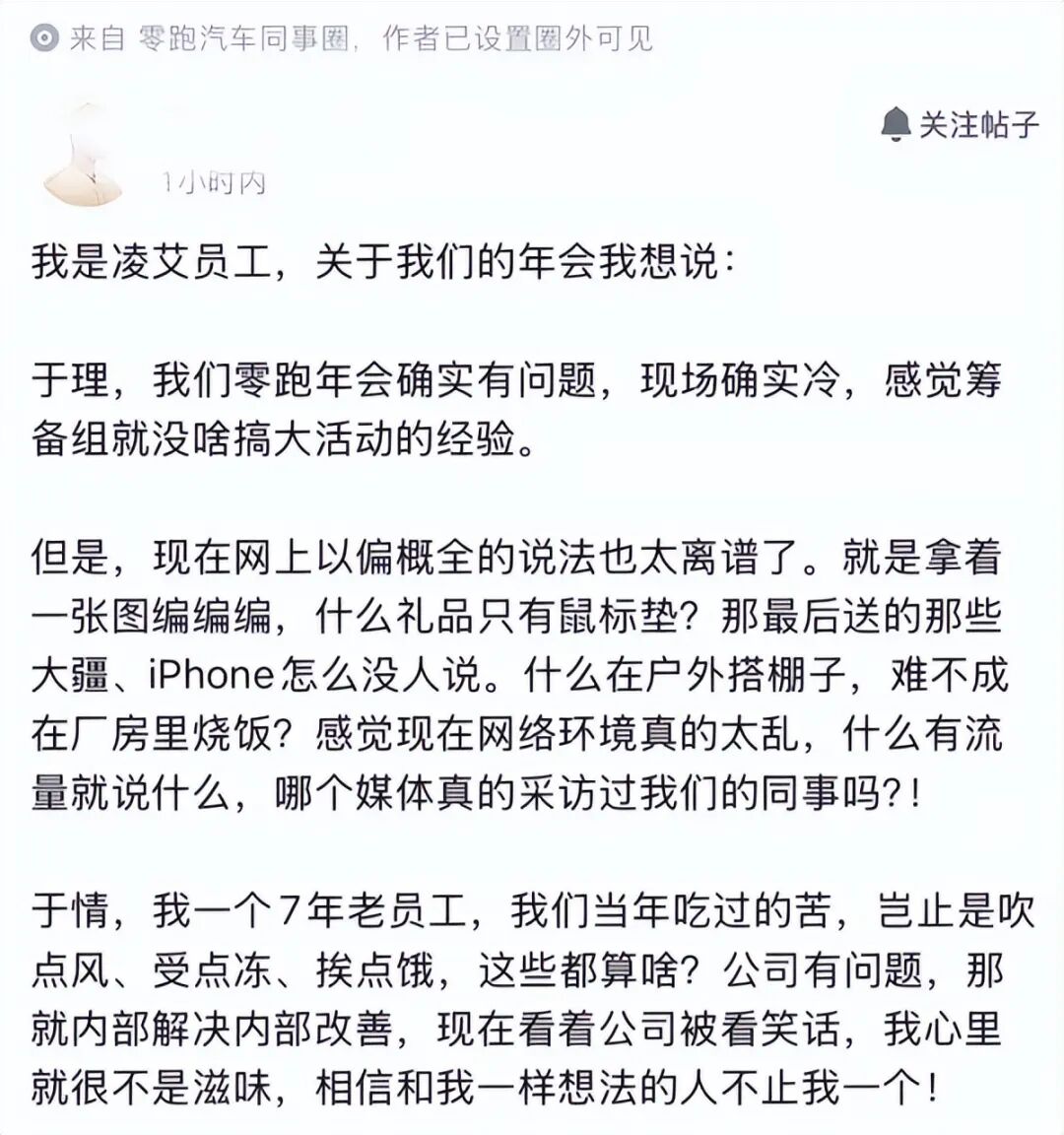
After the event became public, Zhu Jiangming, the founder of Leapmotor, sent an internal email to all employees on the night of February 2nd to respond to the criticism.
He admitted that "some employees had a bad experience and were disadvantaged, which reveals the weaknesses of the organization's ability", and explained that the choice of the warehouse for the event was for "cost - reduction and efficiency - improvement, cost - awareness", but emphasized that "provided that things are done well and employees are satisfied".
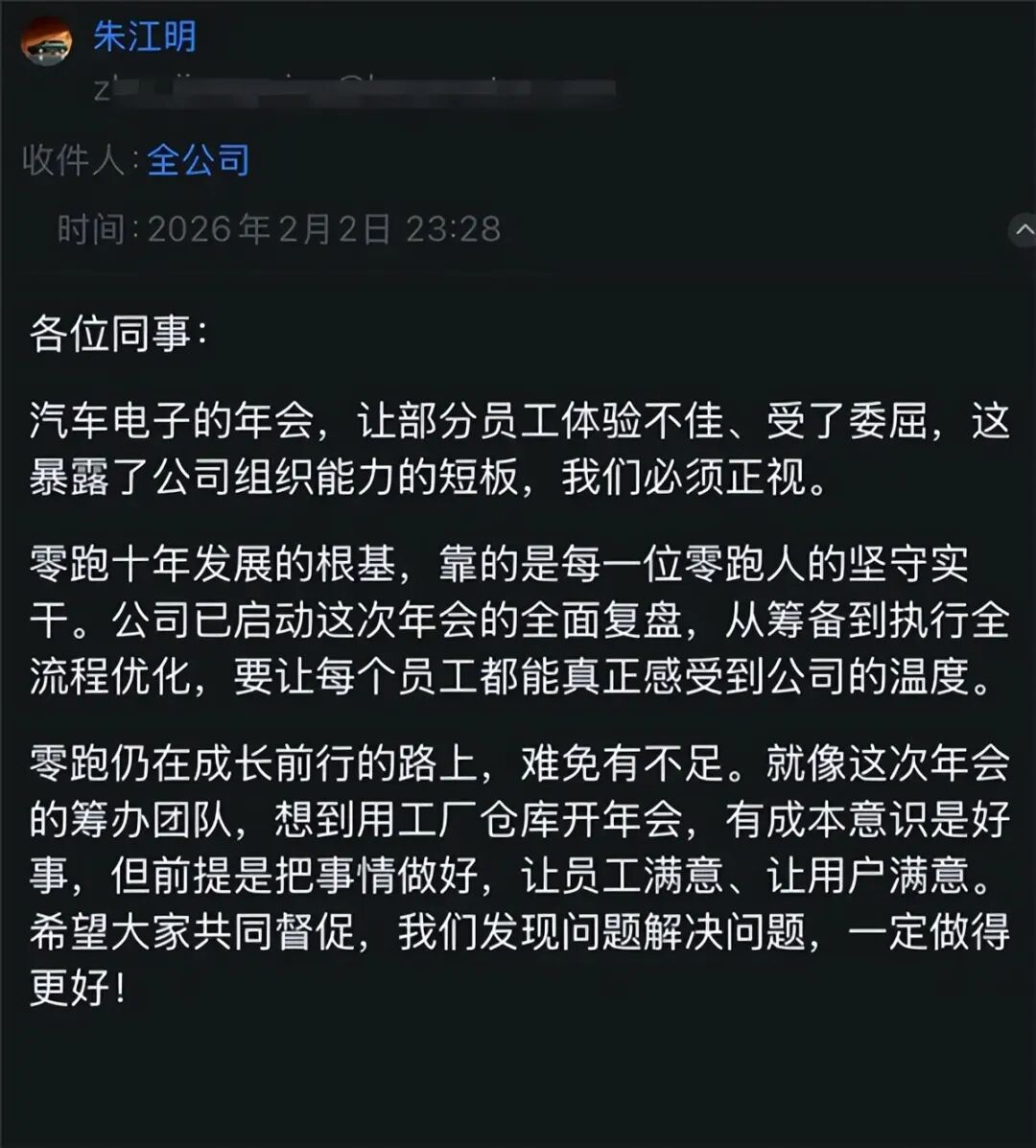
But this response did not calm the controversies.
Netizens and employees have all asked how it is possible that Leapmotor delivered a total of 596,555 vehicles in 2025, representing a 103.1% increase compared to the previous year, and the brand had the best sales performance among new energy vehicle brands in 2025 and even made a profit throughout the year. Now, when the sales revenue has increased significantly, it is being too stingy with employee benefits at the annual party.
Silent change of the rules for overtime meal compensation
The storm over the annual party had not subsided when Leapmotor was again caught in a wave of public criticism in May 2026, this time because of employee benefits.
Several employees reported on social platforms such as Maimai and Weibo that the company changed the rules for overtime compensation and meal compensation without a formal announcement and only spread the information verbally and through group chats, which triggered the collective dissatisfaction of front - line employees.
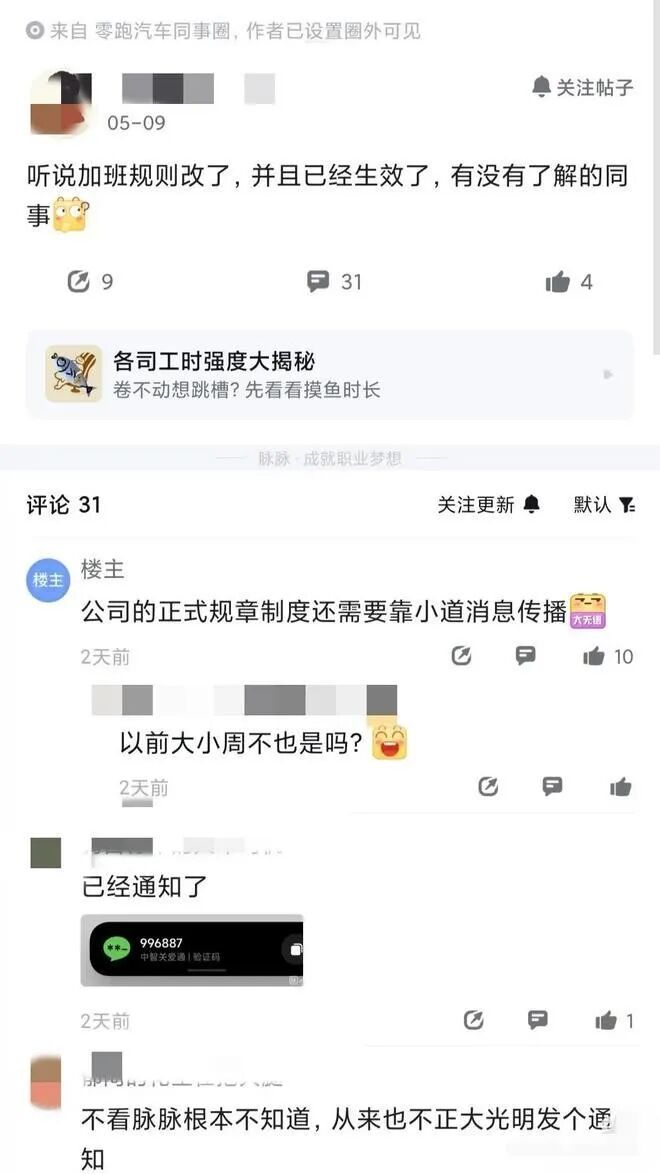
According to the new rules summarized by employees, the threshold for overtime compensation has been significantly increased: For overtime on weekdays, 30 minutes must first be deducted. Then, every two hours count as one overtime hour, and five overtime hours are required to get a day off. This means that 10 hours of overtime are required for a day off.
For overtime on weekends, every three hours count as one overtime hour, and a maximum of two overtime hours can be counted per day. Here too, five overtime hours are required to get a day off, which means that 15 hours of overtime are required for a day off.
The meal compensation has also been tightened. The daily lunch compensation is 20 yuan, and for overtime of at least two hours, the meal compensation is only 15 yuan. For overtime of at least five hours, an additional night - meal compensation of 10 yuan is paid. Overall, the compensation has decreased significantly compared to the previous situation.
The employees' anger is concentrated on three points:
First, the procedure is opaque. There are no official documents, no emails from the human resources department, and no system announcements. Silently reducing employee benefits makes employees feel disrespected.
Second, the actual loss of benefits is palpable. It is more difficult to convert overtime into days off, and the compensation is lower. Front - line employees work a lot of overtime but do not receive appropriate compensation.
Third, the contradiction with the company's performance is strong. In the first quarter of 2026, 110,000 vehicles were delivered, and in April, 71,000 vehicles were delivered. The sales revenue is steadily increasing, but the benefits of front - line employees are being reduced, which makes employees feel that the company is exploiting them to the maximum.
So far, Leapmotor has not issued an official announcement. There is neither an acknowledgement nor an explanation for the rule change. Internally, it is only said that it is a "unified standardization and optimization of management", not a cost - reduction measure.
This silent stance has further intensified employees' dissatisfaction and also made the public question the limits of "cost control".
Group absenteeism of front - line employees?
Behind the continuous tightening of employee benefits is probably also the increasing disappointment of Leapmotor's front - line employees.
On May 19th, a netizen reported on social media that in May 2026 group absenteeism and mass resignations occurred in several front - line factories.
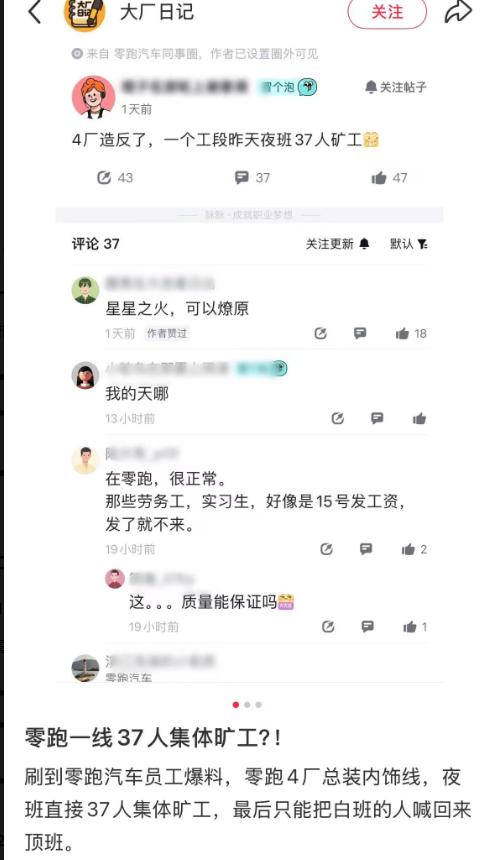
According to reports from employees on Maimai and verifications by industry media, this storm mainly took place in the final assembly and interior production line of the fourth factory. It is possible that similar situations have also occurred in other production sites, including assembly, stamping, and welding workshops. The core trigger was the cumulative effect of the previous cost - reduction measures.
According to employees' complaints, it is difficult to apply for leave, and the dismissal procedure is slow. Some employees who applied for leave due to urgent family reasons were rejected and simply did not show up. Some employees also reported that some old employees were questioned because of their criticism of company policies and were forced to resign voluntarily.
Since May, these dissatisfactions have been massively vented. In several workshops, several dozen employees have refused to show up for work, and some production lines had to be temporarily adjusted. Many employees have directly said, "There is no hope, so it's better to leave."
It is noteworthy that there is a high proportion of leased workers and interns on Leapmotor's front - line. These employees have lower salaries, worse benefits, and less sense of belonging and are the main actors in absenteeism and resignation cases. To maintain production capacity, the company has even called former employees who were previously blocked and invited them to come back, but most have refused.
Strong sales increase, but a loss of 390 million yuan
If the company had poor sales, it would be understandable. But Leapmotor has been a dark horse among new energy vehicle brands in China in the past two years, and the sales have always been good.
But there is a big contradiction in the company's financial data.
On May 15th, Leapmotor released the operating data for the first quarter of 2026. A total of 110,155 vehicles were delivered, representing a 25.8% increase compared to the previous year. The revenue was 10.82 billion yuan, representing an 8% increase compared to the previous year. Both figures are records for the same period. But the net result was a loss of 390 million yuan, representing a 160% increase compared to the previous year. The profit margin has dropped from 14.9% last year to 9.4%, and the loss per vehicle is about 4,000 yuan.

Leapmotor explained in the balance sheet that the reasons for the loss are the shift in the product structure, insufficient capacity utilization, and rising costs.
In the first quarter, the main revenue shifted from the high - profit - margin C - series to the high - cost - performance B - series and the A10 with a price starting from 65,000 yuan, which lowered the overall profit margin.
At the same time, the Chinese New Year holiday reduced the capacity utilization, which increased the production cost per vehicle. The R & D, sales, and administrative expenses have increased by 30%, 11.5%, and 15.8% respectively compared to the previous year, which has further squeezed the profit margin.
On the one hand, Leapmotor is willing to sacrifice the profit margin to increase sales and achieve the annual goal of one million vehicles. On the other hand, it strictly controls employee benefits and reduces costs. Leapmotor's strategy of "extreme cost - reduction" has triggered a chain of reactions.
Leapmotor has risen on the basis of cost - effectiveness, and cost control is its core competitiveness. But excessive cost - reduction does not seem to be wise. After all, the company is not yet in a situation where it has to save every cent.
Although salaries and benefits do not necessarily have to be increased, they should at least be proportional to the company's development so that employees are not disappointed.