Ehemaliger Samsung-Manager spricht über Distanz: Ist das Speicher-"Superzyklus" am Ende?
At a recent forum hosted by the Korean Academy of Engineering, a speech has made international industrial waves.
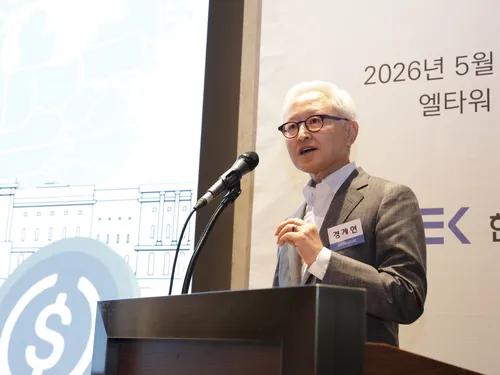
On May 18, 2026, Dr. Kyung Kyu - hyun, the former head of Samsung Electronics' semiconductor business, stated at the forum that the "super - cycle" of memory chips driven by the demand for artificial intelligence may end by the end of 2027. He predicts that the memory chip market will then come under pressure again to lower prices due to the continuous capacity expansion in the industry.
Kyung Kyu - hyun is highly respected in the global semiconductor field: Until May 2024, he was the President and Co - CEO of the Semiconductor Division (DS) of Samsung Electronics and a member of the Korean National Academy of Engineering.
In South Korea, it is common among the upper - class society to inscribe educational degrees and titles on tombstones, which shows how important social recognition of status symbols is. Kyung Kyu - hyun's diverse authoritative roles add more weight to him in the semiconductor industry.
Moreover, Kyung Kyu - hyun is well - known in the industry for his accurate predictions about the cycle of the memory industry, which makes his latest remarks even more credible.
However, his remarks come at a critical time when Chinese memory chip companies are preparing for their IPOs and the global industry landscape is rapidly reshaping. Therefore, this view has triggered fierce debates in the industry.
Rational warning or competitive narrative?
Kyung Kyu - hyun's assessment is based on the classic supply - demand model. He claims that the global memory chip capacity will reach a new high by the end of 2027, with the continuous capacity expansion of Chinese manufacturers being the main driver.
According to traditional industry rules, this warning has a real basis, as the memory industry has always been difficult to be free from cyclical fluctuations.
But this rather conservative logic has proven to be wrong in reality. In the last round of the competition for AI memory technology, Samsung was too conservative in the development of High - Bandwidth - Memory (HBM) products and missed the access to the market. Kyung Kyu - hyun resigned from his position as the head of Samsung's semiconductor business last year due to this strategic mistake.
In a company like Samsung, the dismissal of a top - manager should change his conservative thinking patterns. But he still claims that the super - cycle of the memory industry will soon end. The background is that the global memory industry is currently reshaping.
From the factors he mentioned, it can be seen that he mainly focuses on the over - capacity and price decline in the field of traditional memory chips, while ignoring the high - value memory solutions driven by the AI wave. (Read more: Exclusive: Samsung indirectly responds to its withdrawal from the Chinese household appliance market with "supply - chain restructuring")
This corresponds to a deliberate redirection of the market view back to the traditional memory chip market, which is characterized by intense competition.
As an experienced manager and authority in the flat - panel display and memory chip industry, it is interesting to wonder why Kyung Kyu - hyun deviates from the current industrial transformation and makes these remarks.
Strategic differences between established providers and new challenges
Interestingly, Kyung Kyu - hyun from Samsung publicly warns of over - capacity and a downward cycle in the general memory chip field, while Samsung does not stop its investments in the development of high - value memory solutions. In South Korea, the production of HBM and advanced DRAM is being expanded in Pyeongtaek and Hwaseong, and the investment in the flash memory factory in Xi'an, China, increased by 67.5% in 2025 compared with the previous year to increase the production of high - value memory solutions for AI demand.
Industry experts have pointed out that Kyung Kyu - hyun's view has obvious limitations: Apparently, he is influenced by Samsung's success formula, which is based on mass production and investment against the cycle. These experiences limit his assessment and make him judge from the perspective of an established market leader.
What is even more remarkable is the timing of his remarks, when Chinese memory chip companies are growing strongly.
On May 17, 2026, Yangtze Memory Technologies Co., Ltd. (YMTC) updated its IPO documents, and Kyung Kyu - hyun's remarks came after this update.
The rapidly growing YMTC is being observed by the entire industry, and its strong capabilities in the field of memory chips are increasingly recognized. The strategic turn made by its CEO Zhu Yiming in 2024 is often discussed in the industry.
At that time, YMTC decided to shift the focus of its production from the established DDR4 products to the more advanced DDR5 and LPDDR5X products.
This decision is not based on ignorance of the cycle, but on an independent assessment of technological generational changes and the structural changes in AI demand. YMTC is trying to explore new growth opportunities through precise positioning in the next - generation products.
No matter what Kyung Kyu - hyun has in mind, the weakening of the industry during the catch - up period of Chinese memory chip companies can damage the confidence in the Chinese industry and scare off the capital markets.
Similar story: The repetition of the media campaign in the flat - panel display industry
In fact, before analyzing Kyung Kyu - hyun's motives, a similar situation can be considered. For those who observe the competitive and cooperative relationships in the East Asian manufacturing industry, this situation is not new. More than a decade ago, a similar scenario played out in the liquid - crystal display (LCD) industry. (Read more: In line with the times - Exclusive interview with Wang Dongsheng, the father of the Chinese LCD industry)
At that time, Samsung and LG Display were the dominant providers. When Chinese companies such as BOE and TCL CSOT began mass - investing in high - generation production lines, the same view spread in the industry: The expansion of Chinese companies was "irrational" and would lead to global over - capacity and industry losses. (Read more: 7 - year - old Yiswim wants to go public. Is the capital blindly investing in Wang Dongsheng?)
However, the further development of the industry has shown a different result. Chinese flat - panel display companies have overcome the strong cyclical fluctuations and finally taken the leading role in the LCD industry. They are also continuously closing the technological gaps in high - value areas such as OLED.
The cycle philosophy at that time, which was regarded as a "law", has finally proven to be a stage in the dynamic development of the industry landscape, not the end.
Top managers of Korean memory companies are very good at media manipulation and often express their views at critical times. Behind these remarks is a strategy driven by various interests.
They like to use their familiar cycle models to define market boundaries and intensify risks to preserve the existing industry landscape and secure their competitive advantages. (Read more: "Father of the liquid - crystal display" Wang Dongsheng wants to capture a part of the chip market)
From the flat - panel display to the memory industry, a recurring phenomenon is: When the scale success of the challengers reaches a critical point, the voice of "cycle warnings" suddenly gets louder. This is a prominent phenomenon in industry competition.
It can be concluded that Kyung Kyu - hyun's pessimistic remarks aim to strengthen the existing advantages of Samsung or the Korean memory chip industry.
By exaggerating the cycle risks and weakening the motivation in the industry, he tries to slow down the expansion of the Chinese and global memory industries and secure his leading position.
If Chinese capital and industry members are influenced by such authoritative voices and doubt their beliefs, this is exactly what the opponents want.
The other side of the cycle: Opportunities for the pioneers
There is no doubt that the memory industry is highly cyclical. All players, including the emerging Chinese memory industry, must respect and respond to this regularity.
But if one regards the cycle as the only decisive factor, one may overlook the structural changes. The current industry environment is different from the past: The data flow generated by AI creates a continuous and potentially developing demand for new memory solutions.
In addition, the restructuring of the global supply chain provides new providers with a different entry opportunity.
History shows that cyclical fluctuations are the norm in the industry, but not an insurmountable obstacle.
The real difference lies in whether companies can maintain strategic perseverance in the troughs of the cycle, invest in promising technologies, and seize the opportunities with leading products and capacities in the upward phase of demand.
For today's Chinese memory industry, the central question is whether it can build the ability to overcome the cycles through continuous technological innovation, precise capacity planning, and efficient management while recognizing and respecting the objective industry laws.
The final result of industry competition will always be determined by product quality, technological reserves, and cost advantages. The mood in the media public will change with the next cycle of industry development.
This article is from the WeChat account “Wall Street Tech Eye”, author: WS - Team, published by 36Kr with permission.