Telekommunikationsanbieter bringen AI-Datenpakete auf den Markt: Rettungsanker oder neue Geschäftsquelle?
When it comes to the marketing of tokens, the three major telecommunications provider platforms are now directly competing with cloud providers and large language model (LLM) providers.
Recently, China Telecom, China Mobile, and China Unicom have successively introduced token packages for individuals and enterprises, priced and marketed the computing power of LLMs in the form of similar "data tariffs".
China Mobile Shanghai has named a price of "1 yuan for 400,000 tokens". China Telecom has introduced a personal package starting from 9.9 yuan per month, while China Unicom offers Shanghai OPC customers a free test amount of 30 million tokens.
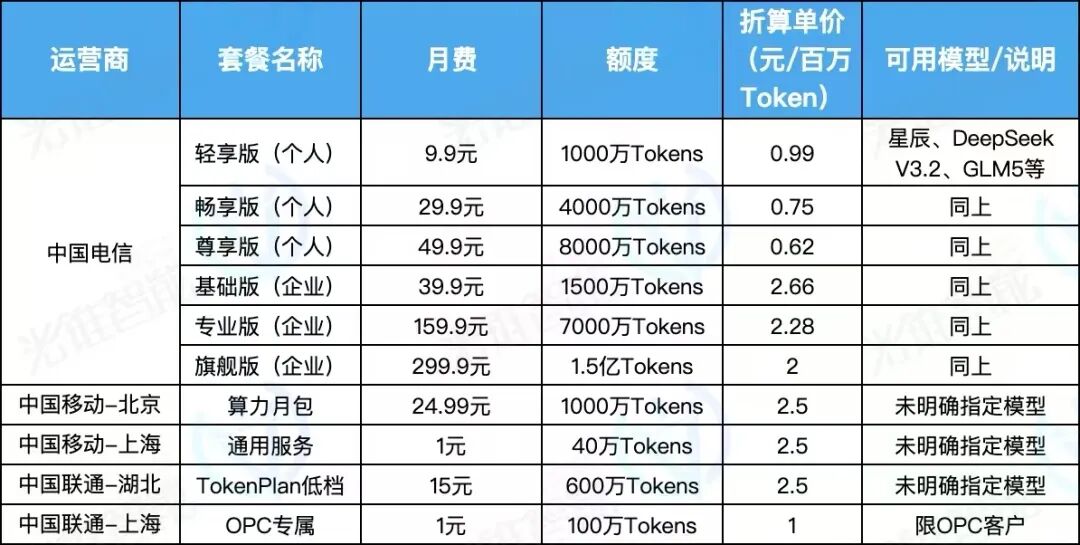
(Note: The packages of telecommunications providers are based on a "monthly limit" system. Unused tokens will be deleted, and if the limit is exceeded, additional tokens must be purchased. The converted unit prices are only theoretical values, and the actual costs depend on the monthly consumption percentage.)
Suddenly, AI computing power has entered the "mobile phone bill" and has become a new unit of measurement for telecommunications providers alongside SMS and data volume.
After the three major telecommunications providers released relevant news, the stock prices in the capital market have developed positively. In the consumer market, however, only a few developers and enterprise customers seem willing to buy the token packages.
"The first month of the telecommunications provider's token package costs 9.9 yuan, but it takes five minutes to generate the first word. The execution speed is very slow, and the currently used LLMs are not particularly intelligent." So said a product manager of a cloud provider to Guangzhui Intelligence.
He gave a vivid metaphor for the difference between using tokens from a cloud provider and those from a telecommunications provider: "It's like getting used to a luxury hotel and suddenly moving to an ordinary guesthouse. Something is always missing."
In addition, some users have directly said: "There are no useful models in the telecommunications provider's token packages. I need tokens for GPT 5.5 or Claude 4.7. Can other tokens compete with these?"
The marketing of tokens by the three major telecommunications providers is not positively evaluated in the entire consumer market. Even within the providers, many employees are not yet informed about the token package service.
In the current token economy market, cloud providers are the undisputed main players and dominate most of the LLM API channel market. The three major telecommunications providers, who are now entering this market, naturally also want a share of this new market.
An expert from the telecommunications industry has also stated that this is the first time that the three major Chinese telecommunications providers have brought tokens as standardized telecommunications products to the retail market and offered "token + connection + security" as a unified tariff. If China Telecom, China Mobile, and China Unicom follow suit, this could mean that part of the LLM API channel market will shift from cloud providers to telecommunications providers.
Why are the three major telecommunications providers so determined to sell token packages? Do they have a chance to compete against cloud providers and LLM providers?
It can be observed that when AI computing power is billed according to consumption like electricity and water, the three major telecommunications providers are turning around together and trying to reshape their business models with token packages. But behind this transformation lies the worry about the end of data volume profits, or have they actually found the "ticket" to the intelligent era?
A Forced Transformation
At first glance, the introduction of token packages by the three major telecommunications providers seems to be the sale of computing power, but in essence, it is an attempt to survive.
To understand this, one must first look at the urgent business situation of the providers. According to the annual reports of the three companies in 2025, the sales growth of all three providers has fallen below 1% (China Mobile: 0.9%, China Telecom: 0.1%, China Unicom: 0.7%).
In addition, data from the Ministry of Industry and Information Technology shows that in 2025, the volume of data traffic in China increased, but the revenue decreased. The data volume increased by 17.3%, but the revenue decreased by 3.1%. The ARPU (average revenue per user) has been continuously falling (China Mobile: 46.8 yuan, China Telecom: 45.1 yuan). The growth of the number of users has reached the point where the number of mobile users exceeds 1 billion and the penetration rate exceeds 70%. The space for new growth is extremely limited.
At the same time, the total investment of the three providers in 2025 was 289.8 billion yuan, a decrease of 9.1% compared to the previous year. While the total investment is decreasing, the investment in computing power infrastructure has increased significantly. This trend was even more obvious in 2026.
China Telecom plans to invest 25.5 billion yuan in computing power infrastructure, an increase of 26% compared to the previous year, and the proportion of total investment will increase to 35%. China Unicom has planned capital expenditures of about 50 billion yuan, with the proportion of computing power investment exceeding 35%. China Mobile is accelerating the construction of a powerful computing power system.
This means that the three major telecommunications providers "reduce traditional investments and secure computing power", that is, they reduce investments in 5G networks and other traditional areas and divert resources to AI computing power. The problem is, how can they convert the investment in computing power into revenue?
Under these circumstances, the "data volume economy" that the providers have built in the past twenty years no longer works. If data volume in gigabytes no longer leads to revenue growth and computing power dominates the market, the three major telecommunications providers must find a new "unit of measurement".
Tokens provide exactly this possibility, and telecommunications providers have the computing power, network, and control capabilities required for token production.
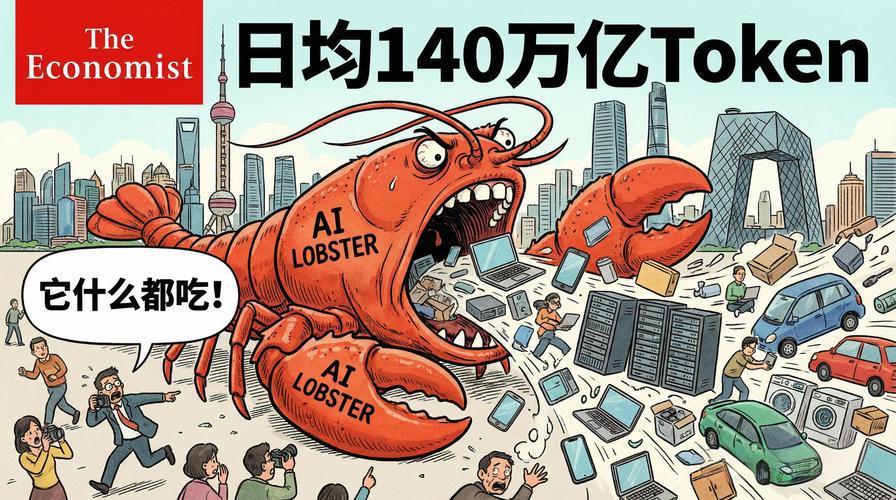
Liu Liehong, director of the National Data Administration, has released a series of data: The daily token usage in China has increased from 100 billion at the beginning of 2024 to 100 trillion at the end of 2025 and has already exceeded 140 trillion in March 2026. Within two years, the usage has increased by more than a thousand times.
Therefore, the token economy is breaking out worldwide, and every company that sells computing power is starting to focus on selling tokens.
The three major telecommunications providers are of course no exception. Ke Ruiwen, chairman of China Telecom, stated at the 2026 annual general meeting: "We are focusing on the token service as our main business line and transforming from data volume management to token management."
Dong Xin, chairman of China Unicom, has proposed a new business model for computing power management called "Agent + Token + AI Cloud".
In summary, the introduction of token packages by the three major telecommunications providers is a strategic decision made by traditional communication giants under the pressure of industry decline, unused assets, and the change of the era.
Their core goal is to avoid the fate of "pipelines", revitalize computing power resources, and gain power in AI infrastructure to become "computing power providers" from "data volume providers" in the era of the token economy.
The problem is, will this work? And if telecommunications providers become competitors with cloud providers and LLM providers from partners, will they share the cake or fight each other?
The New Three - Power Game in the Token Economy
With the entry of the three major telecommunications providers into the token sales market, the token market has been divided into three main groups:
First, there are cloud providers. Mainstream cloud providers such as Alibaba Cloud, Tencent Cloud, and Volcengine have successively introduced token plan programs.
Compared with other providers, the core logic of cloud providers when introducing token packages is platform binding. That is, they not only sell tokens but also "model supermarket + development tools + enterprise services".
For example, Alibaba Cloud's Bailian offers a team token plan, which is billed at 198 yuan per seat per month and provides multi - model scheduling, agent development framework, and enterprise security.
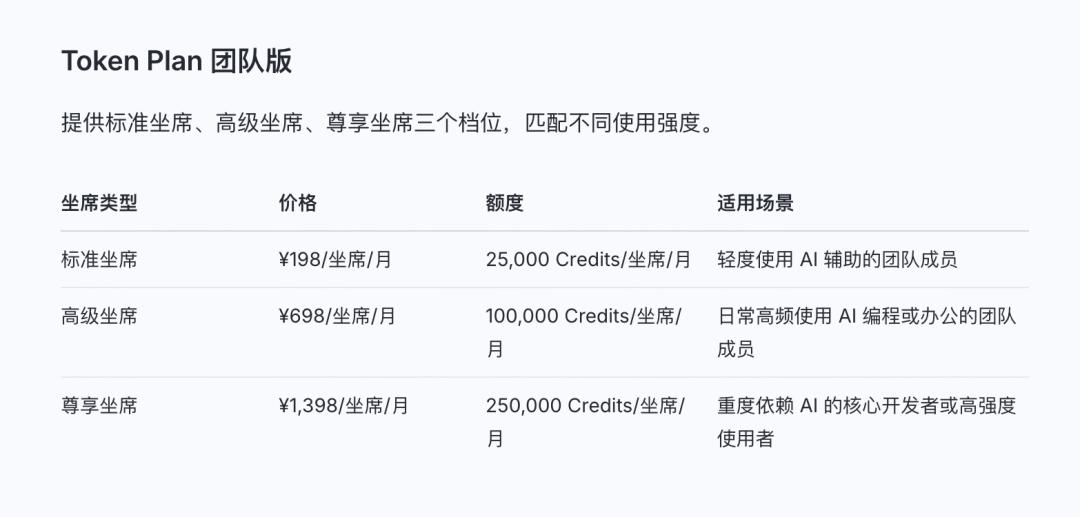
(The prices of Alibaba Cloud's team token plan)
Tencent Cloud has introduced a general and a Hy (Hunyuan) series token plan and sold self - developed models and third - party models together. Volcengine has introduced a coding plan (40 yuan per month for 18,000 requests) and bound it to ByteDance's Doubao model ecosystem.
"We introduced the team token plan to encourage enterprise users to use the model capabilities efficiently within a controllable framework by setting an appropriate usage limit and binding to the product and to avoid disorderly use." So said a marketing expert from Alibaba Cloud.
In his view, Alibaba Cloud's team token plan can also help better match supply and demand and deeply integrate the AI product ecosystem (such as Tongyi Qianwen, DQ) with the enterprise workflow to form a closed - loop service from interaction to calculation to result generation.
That is, the core logic of cloud providers when selling tokens lies in selling platform capabilities.
Their advantage is that once developers connect to their platform, they will have high migration costs if they switch platforms. Because cloud providers not only offer tokens but also enterprise functions such as protocol monitoring, rights management, and multi - model A/B tests.
Regarding the token packages of the three major telecommunications providers, Qianwen, the product manager of Alibaba Cloud, directly said: "The introduction of similar services by the three major telecommunications providers will surely exert a certain competitive pressure on Alibaba Cloud, especially for price - sensitive customers. Users may choose the more cost - effective option."
But she also made it clear that the core competitiveness of Alibaba Cloud lies not only in price but also in the stability of infrastructure, brand trust, and the reliability of enterprise services. These are still its key advantages.
Compared with other providers, the core logic of LLM providers when selling tokens is model binding. That is, if my model is the best, developers will naturally come to me.
For example, MiniMax is the world's first token plan that supports all modalities (text + speech + image + video + music) and is offered from 29 yuan per month. Xiaomi MiMo costs from 411.84 yuan per year and supports 8 models. It emphasizes inference ability and framework efficiency. The coding plan of Zhipu AI has increased by at least 30%, and it relies on model capabilities to maintain its pricing policy.
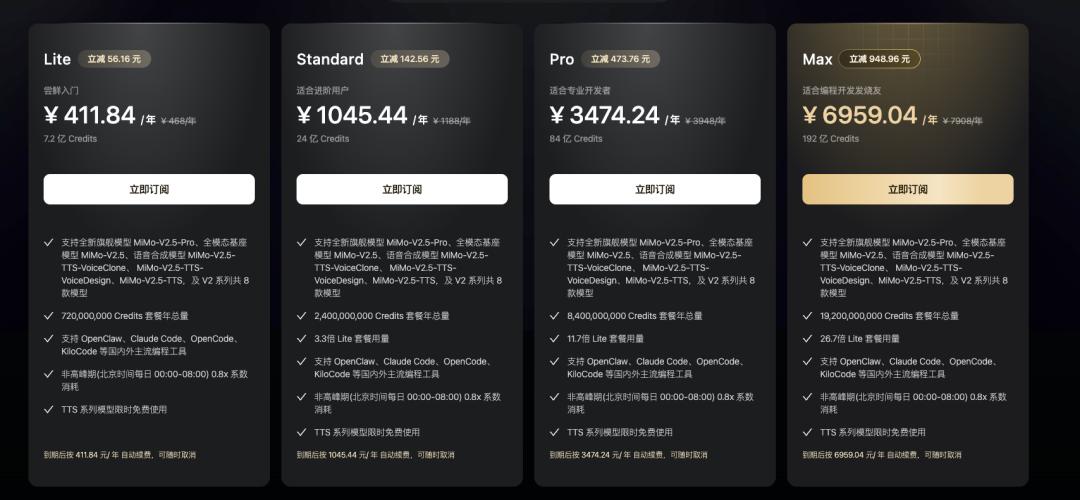
(The subscription prices of the XIAOMI MiMo token plan)
The concern of LLM providers is that they do not have their own infrastructure and depend on cloud providers for computing power costs. If cloud providers raise prices, model providers will be in a difficult position. The costs at the upper level increase, and the prices at the lower level become lower and lower.
With the entry of telecommunications providers into the token battle, a major war for users, developers, and enterprise customers may break out.
But from the current market situation, the sale of token packages by telecommunications providers has no impact for the time being...