Das "magische Feld" des Internets: Künstliche Intelligenz löst eine Retrobewegung aus.
Recently, there has been a particularly popular technical debate on X/Twitter. The original post has reached nearly ten million views, which is equivalent to the top spot in the hot topics on Weibo.
The trigger was on May 8, 2026, when Thariq Shihipar, an engineer on the Anthropic Claude Code team, published a tweet titled «Using Claude Code: The Unreasonable Effectiveness of HTML». Essentially, he said that he had completely abandoned Markdown and switched entirely to HTML as the output format for AI.
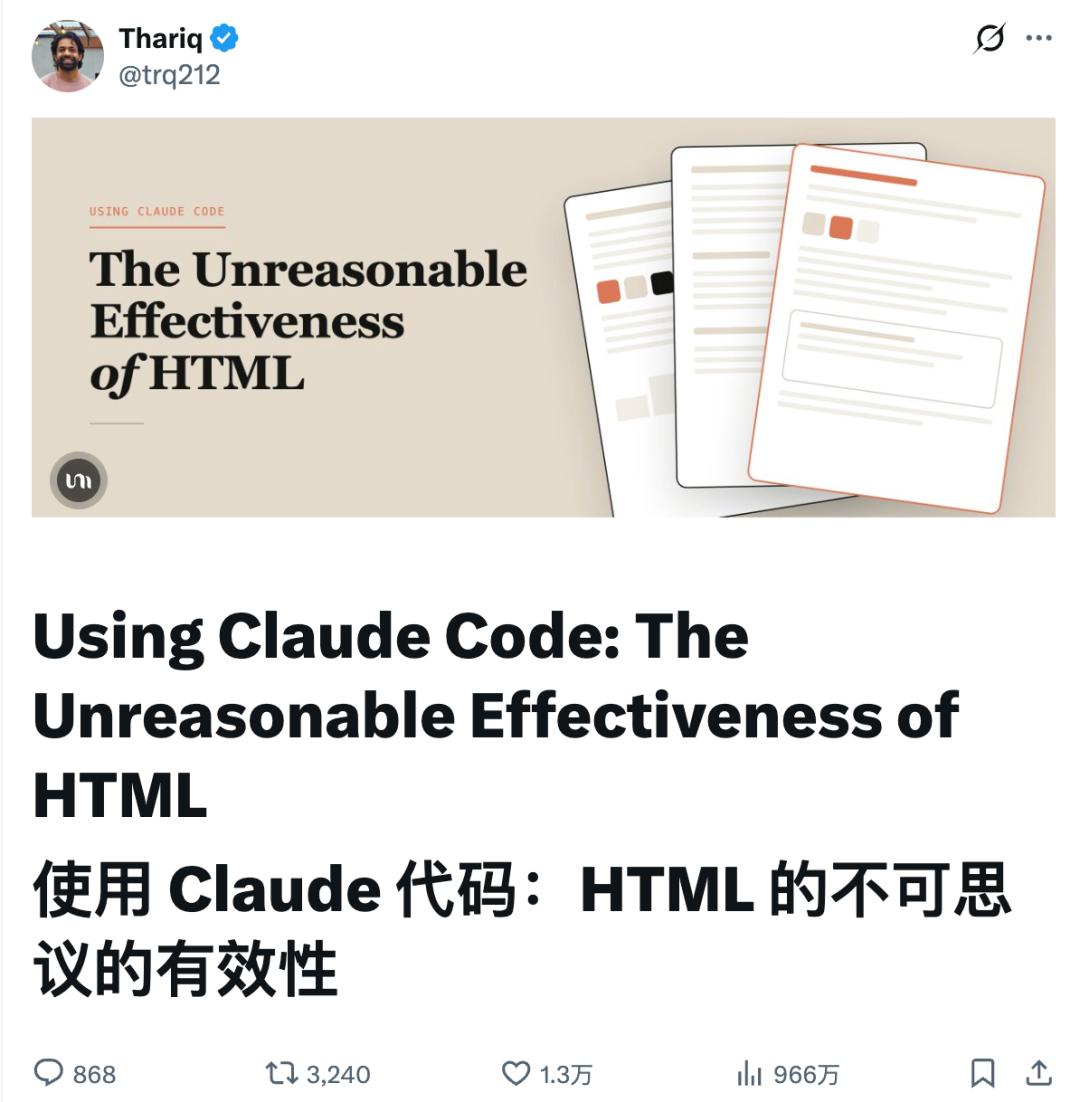
This tweet has caused a stir in the tech community. Just a few months ago, everyone in the AI self - media community was firmly convinced that «Markdown is the best format» because of its simplicity, plain text, and friendliness to agents. But now, someone from the Anthropic team, a pioneer in AGI, has said: Sorry, HTML is better.
One must consider that HTML was invented in 1993 when Tim Berners - Lee created the World Wide Web. After more than thirty years, the latest AI technology has taken it up again.
By the way, the current «Hummer wave» has also made the command - line products from the DOS era popular again. OpenClaw, Claude Code, and Hermes are the «Doubao» of the new era. In the past, it was difficult to define the style in text input prompts, and there was a time when people preferred JSON formats for input prompts.
To be honest, these products with a strong code style are currently difficult for ordinary users to accept. After 20 years of Internet development, people are used to GUI interfaces, and this return to the past seems to be a celebration for tech geeks.
No wonder some people complain: The tech scene is like the fashion scene, a cycle. Now, the Y2K retro classic from the turn of the millennium is in vogue. Examples are HTML, Markdown, JSON, CLI command lines...
But is all this a magical return to the primitive era of tech enthusiasts or the future that will inevitably prevail?
I. The Essence of the Format Debate
Back to the previous text: Thariq from Claude Code said a very important sentence: «I edit these files myself less and less often.»
This is a huge change brought about by AI. When AI agents help you write documents, make plans, and write reports, your role as a human changes from «creator» to «reviewer». What does a reviewer need? An attractive, easy - to - read, and clear format. The linear, symbol - based text presentation of Markdown is hardly readable after 100 lines.
But HTML is different. It can enable tab switches, draw SVG flowcharts, add interactive buttons, and create responsive layouts. Our recently developed WhaleGrid PPT can generate over 10 attractive HTML files with one sentence. Every piece of news or AI model update can be directly implemented in an intuitive and exciting presentation website.

It must be said that products like Codex are very powerful. After a simple input, it starts collecting planning sketches and content, then designs the components and layout, and finally generates the code for the presentation page. Many pages can even be supplemented with pictures.
In the past, it was almost as if the MD format would become the standard. The entire AI community was very enthusiastic about MD files.
The Google Stitch team created a specification called DESIGN.md. A GitHub repository called awesome - design - md reached 52,000 stars in five days. The core idea is that «Markdown is the format that LLMs can read best».
We have also developed an MD alignment tool - Whale Typesetting. The main advantage is that MD relatively fixes the text formatting and can achieve the beauty of the content with very low token costs. For the layout design of WeChat accounts, you can currently use the still - free Whale Typesetting.

The question is: Does Whale support HTML or Markdown? My opinion is that this is not about a «format debate», but a fundamental question: Is the content in the AI era intended for machines or for humans?
The part intended for machines can be in Markdown, JSON, or plain text. The part intended for humans can be in HTML, interactive interfaces, or visualizations.
II. The Revival of the Command Line
If the return of HTML is still «within expectations», the revival of the command line (CLI) is really «surprising».
In April 2026, the Tencent Cloud Developer Community published an article titled «Why are all AI programming tools developing «retro» CLI interfaces?» At the beginning of the article, a fact is raised: The CTO of Perplexity has abandoned the MCP protocol specially developed for AI and instead used the simplest stdin/stdout - that is, the standard input and output of the command line.
His reason is very simple: MCP is too cumbersome, and the command line, this «antique», is the protocol that AI should use best.
Look at the current AI programming tools: Claude Code from Anthropic runs in the command line, Google's Gemini CLI runs in the command line, the Terminal tool Warp financed by Altman has become open - source and has reached 35,000 stars. Alibaba's Qoder CLI, Tencent's CodeBuddy Code... all have a black background and white text in the command - line interface.
This would have been unthinkable five years ago. At that time, the entire industry was striving for «Low - Code», «No - Code», and «Drag - and - Drop», and wanted to reduce all operations to mouse clicks. What has happened now? The coolest developers are sitting in front of the terminal window again and communicating with AI via the keyboard.
Why? Because the GUI was developed for humans - with symbols, metaphors, and realistic designs to reduce cognitive load. But AI doesn't need any of that. AI needs precise, structured, and clear commands. The command line is inherently such a thing: Enter a command, return a result, without unnecessary visual distractions.
In the Tencent article, there is a very good sentence: «For AI, the GUI is a metaphor, while the CLI is a language. Metaphors need to be translated, language only needs to be interpreted.»
The DOS command line was developed in 1981. 45 years later, it has returned in a new form.
III. Who Will Succeed, Who Will Fail?
After the revival of HTML and CLI, the question «Who will succeed, who will fail?» becomes an interesting topic.
Look at the currently popular directions in the AI scene: The use of JSON as a communication protocol between agents, the use of SVG for drawing flowcharts and data visualization, the use of a single HTML file for complete interactive applications... Various retro technologies are emerging and finding many followers.
Whale is conducting some experiments: Generating single - sided HTML web pages with frontend design, creating 3D scenes with native JavaScript in threejs - builder (recommendations in older articles at the end of the text), creating videos with React in Remotion - essentially, «old technologies» are being used to solve «new problems».
When Claude Design was released in April this year, it shook the entire design community. Did it do something revolutionary? No. It simply makes the AI output HTML + CSS + JavaScript and creates an interactive website. The stock price of Figma dropped by 2% on that day.
So, will SaaS die? The current trend suggests so.
Especially after Anthropic released 11 new plugins for Claude Cowork, which directly take over finance, sales, and other business processes, the market fears that traditional software could be replaced by AI. This has led to a sharp decline in the market capitalization of companies like Salesforce. This event is called the «SaaSpocalypse», that is, the end of SaaS (Software as a Service).
But will AI become more complex in the future? AI outputs HTML → People find it nice, but it's not enough → More complex interactions and data management are needed → HTML is no longer enough, a separation of frontend and backend is needed → A database for storage is needed → A user system is needed → It will... etc. Isn't this exactly SaaS?
Warp is a living example. It initially wanted to become a «collaborative terminal» and imitate the collaborative experience of Google Docs. Later, it found that this path didn't work and transformed into a «AI - agent development environment». But look at its current form: A terminal + AI capabilities + cloud cooperation + subscription model. Isn't this a SaaS that looks like a CLI?
So, this cycle may really come back. Only that the new SaaS is based on AI agents and the interaction layer may be a mixture of CLI and HTML, instead of the traditional GUI. It will be easier, faster, and more flexible, but essentially, it remains «Software as a Service».
IV. The Newest and at the Same Time the Oldest?
In the fashion scene, there is a saying: Fashion is a cycle. It comes back every twenty years. In 2024, the Y2K fashion from the turn of the millennium is in vogue again, which means that the low - rise jeans, glitter, and metallic textures from around the year 2000 are back on the runway.
Wikipedia clearly states: When people imitate the fashion from the turn of the millennium, they are imitating the optimism of that time. The same thing is happening in the tech scene.
When we imitate HTML, we are imitating the immediacy one has when simply opening the browser. When we imitate the CLI, we are imitating the feeling of control when solving a problem with a single command. When we imitate Markdown, we are imitating the simplicity when one thinks that plain text is everything.
Recently, the CEO of an AI startup in Whale's friend circle has created an HTML summary page after each podcast listening. Recently, he even excitedly announced that he will give courses explaining how to create «friend - circle PPTs».
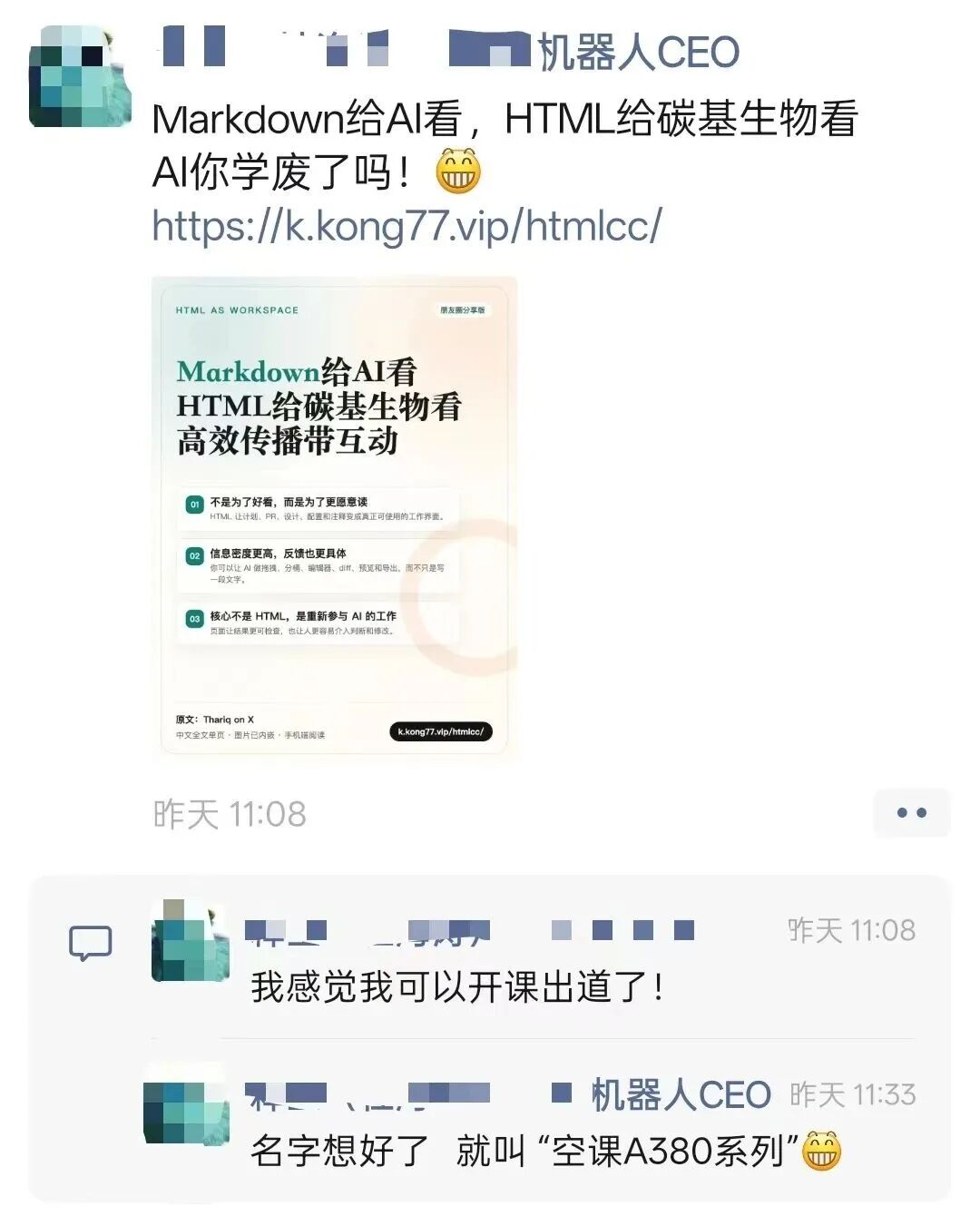
This is a feeling of AI success experience. In the past, all companies were striving for «platformization», «ecosystemization», and «closed systems», and wanted to tie users to their own systems. If you wanted to create a PPT, you had to open PowerPoint. If you wanted to draw a picture, you had to open Figma. If you wanted to write a document, you had to open Notion.
Each tool was an island, but AI has broken these islands. In the future, no large company can build high barriers anymore.
If Claude Code or any open - source Hummer tool directly outputs an HTML file that can be opened in any browser and viewed by anyone without installing any software - then why do you still need PPT software? If a Markdown file can describe the entire design system and AI can generate a pixel - accurate interface from it - then why do you still need Figma?
VI. The Essence of the Retro Movement: Return to First Principles
Ultimately, the essence of this «retro movement» is not nostalgia, but a return.
The technology of HTML was very popular even during Whale's student days. I still remember that Jobs said that HTML5 would finally unify PC and mobile and become the format for all web pages. But in reality, it couldn't even defeat Flash.
In the past ten years, the software industry has built too many abstraction layers. A simple web page has to go through React compilation, Webpack packaging, Docker containerization, Kubernetes orchestration, CDN distribution... The chain is getting longer and longer, and each layer solves the problem created by the previous layer.
After the arrival of AI, it doesn't recognize these abstraction layers. It only recognizes the most basic things: text, files, commands, protocols. So, it naturally chooses the simplest and most direct way to complete its tasks.