Team der Shanghai Jiao Tong Universität: Lassen Sie Claude Code vertrauenswürdige Forschung während Ihres Schlafs durchführen. Zwei Artikel wurden von einer Top-Konferenz in der Künstlichen Intelligenz akzeptiert.
Currently, the independent research AI agent can already handle the entire process from the idea to the publication of a paper. When we wake up, the agent may have already conducted the experiments and even written a decent paper.
That sounds wonderful, but how can we know whether the agent secretly "lies" in its conclusions?
Currently, there are still two key problems with agents. First, the generation and verification are often carried out by the same model family, which makes many systematic errors within the system difficult to detect. Second, it is difficult to judge whether the conclusions provided by an agent after several days of continuous work with almost no supervision are actually sufficiently supported.
To solve these problems, the team of Shanghai Jiao Tong University has proposed "Auto - Research - in - sleep (ARIS)", an open - source research harness for automated research.
Link to the paper: https://arxiv.org/abs/2605.03042
The focus of this work is not that the agent writes papers faster, but that the written papers are more verifiable.
It is worth noting that in practical examples in the community, researchers have already completed the entire process for their papers with ARIS, and these papers have been accepted by conferences.
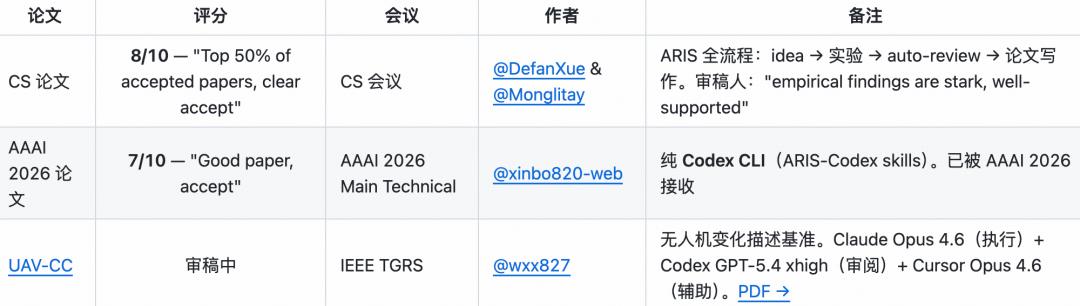
Aris: Let Claude Code do research for you while you sleep
According to the description in the paper, the system topology of Aris consists of three levels:
First level: Execution level, which provides the specific capabilities. It consists of reusable Markdown definition skills and a permanent research wiki.
Second level: Orchestration level, which combines these capabilities into a complete process. Five end - to - end workflows - idea generation, experiment bridge, automatic verification cycle, paper writing, and rebuttal - cover the four research stages from discovery to submission.
Third level: Security level, which represents the most important innovation of Aris. It is responsible for verifying proofs and claims and reviewing manuscripts. This includes a three - stage proof - claim verification cascade, a five - time scientific writing - editing pipeline, a mathematical proof checker, a visual PDF review, and a citation check.
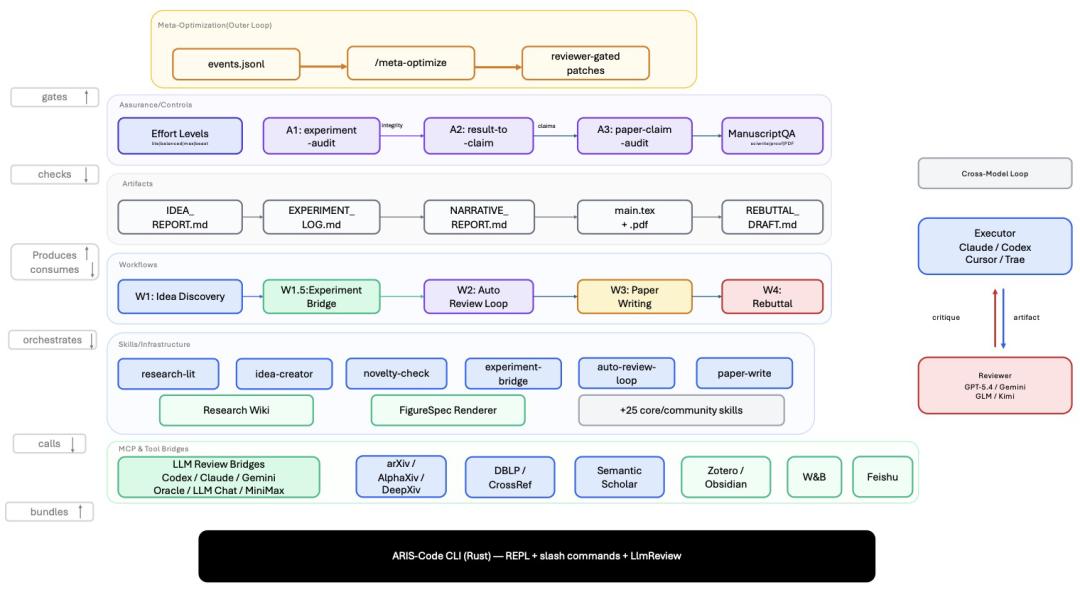
Figure | Aris system topology. Six groups of components interact with each other through labeled relationships (see the left sidebar): The meta - optimization outer loop controls the security level, which is responsible for verifying artifacts; artifacts are generated and consumed by workflows, and workflows are responsible for orchestrating skills; skills call MCP and tool bridges to access external models and data. The executor and the reviewer on the right use models from the same family. The ARIS code CLI packages all components into an independent binary program.
Core mechanism: Opposing cooperation between models
The research team believes that it is difficult for a single agent to reliably handle long - term research tasks. Therefore, they use a "execution - verification - correction" cycle between different model families.
The executor (by default, the Claude family is recommended) is responsible for creating code, conducting experiments, or drafting papers; the reviewer (by default, the GPT - 5.4 family is recommended) evaluates the work according to predefined criteria and returns structured action recommendations; the executor corrects the work accordingly and resubmits it until the evaluation meets the required standard.
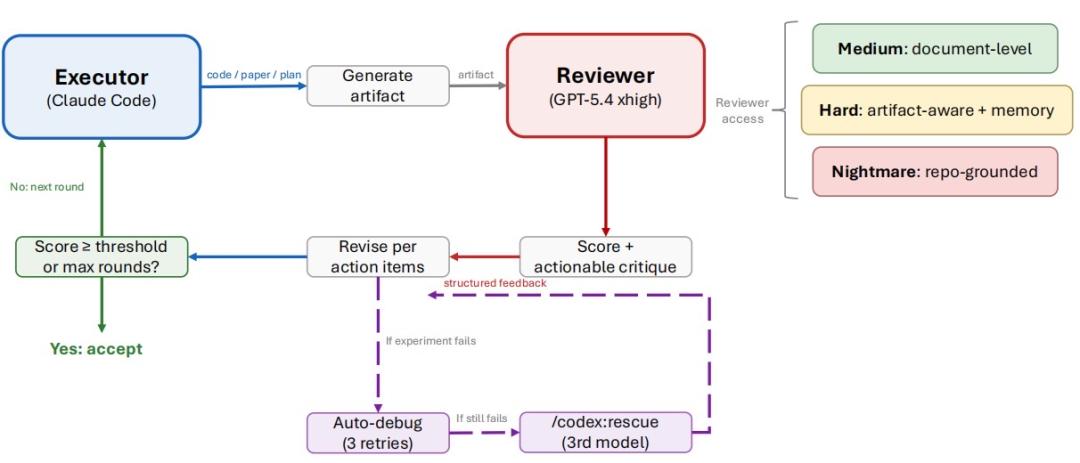
Figure | The opposing cooperation between models is carried out through alternating "generation by the executor" and "criticism by an external model, executable correction requirements, and convergence check". The access scope of the reviewer can range from simply viewing the document to accessing the entire code repository.
End - to - end workflows
On this basis, ARIS has organized five end - to - end workflows. They are as follows:
Workflow 1: Idea generation, which is responsible for literature research, novelty check, and experiment planning.
Workflow 2: Experiment bridge, which converts the plan into code implementation, computing power execution, and result retrieval.
Workflow 3: Automatic verification cycle, in which in each round, the draft is handed over to a reviewer from a different model family for structured evaluation, action recommendations are extracted, GPU experiments are conducted if necessary to obtain new proofs, the affected chapters are corrected, and the convergence is checked.
Workflow 4: Paper writing phase, in which the system successively executes seven key steps: First, paper planning and diagram creation are carried out, then LaTeX writing and five rounds of editing; if necessary, a proof check is added, followed by conclusion verification, compilation, and automatic improvement through two rounds of visual review and automatic correction based on GPT - 5.4 xhigh.
Workflow 5: Post - submission phase, in which the system successively analyzes the review comments, divides the key problems, plans the response strategy, creates the response drafts, conducts three security checks, performs a stress test, and finally determines the final document. The security checks are used to avoid forgeries, exaggerated promises, and missing responses.
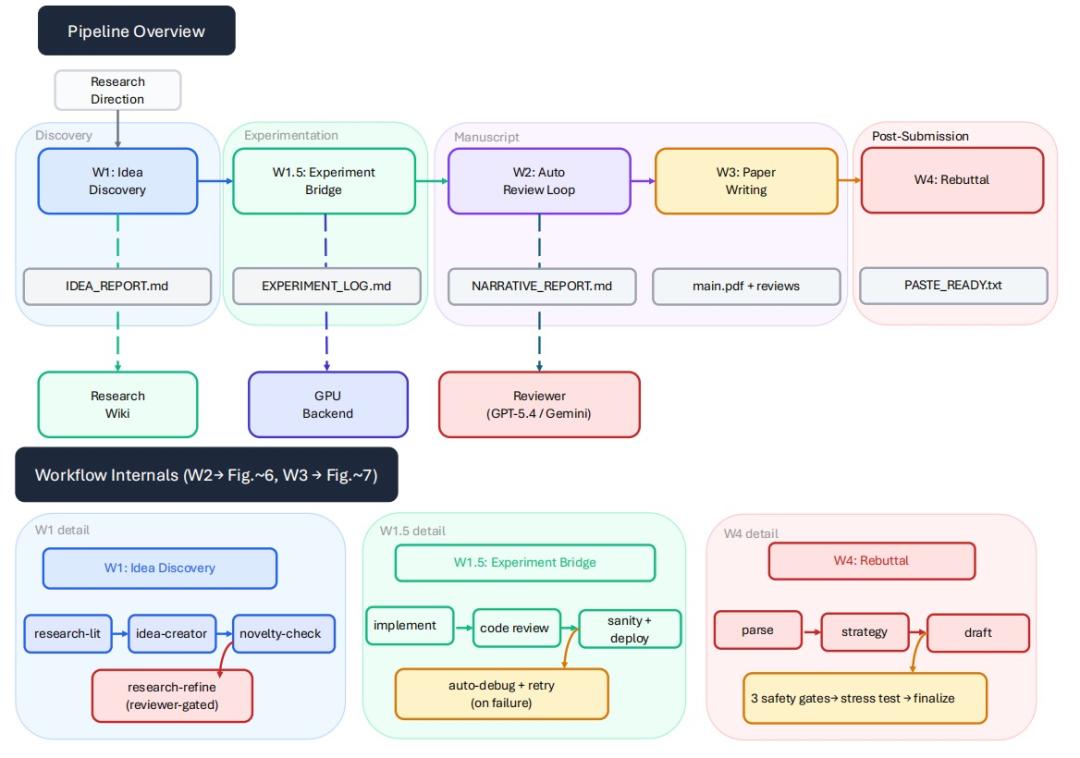
Figure | ARIS workflow library. Top: End - to - end combination of five workflows and their products, grouped by the four research stages of discovery, experiment, completion, and post - submission phase; dashed lines represent the reviewer's feedback, the proof collection triggered by the GPU, and the wiki memory. Bottom: Compressed internal structure of some workflows that are not separately discussed in the text, including W1 idea generation (iterative refinement with reviewer control), W1.5 experiment bridge (with code review and automatic debugging return), and W4 response to review comments (with security control and stress test).
Add a "self - validation safety net" for AI outputs
The most characteristic feature of ARIS is the establishment of a three - stage verification chain. In the first step, the research team checks whether the experiment itself is reliable, and in particular, looks for problems such as falsified labels, phantom results, unexecuted indicators, and excessive extrapolations. In the second step, it assigns each candidate conclusion to the existing proofs and judges whether it is "supported", "partially supported", or "inapplicable". In the third step, it then directly compares the original results, the experiment settings, and the numbers and tables in the paper and checks whether they match.
Outside this verification chain, the research team has taken additional security measures. After the completion of the first draft, ARIS conducts five rounds of scientific editing, in which redundant expressions, active language form, local coherence, terminology consistency, and number consistency are addressed. For theoretically more oriented papers, a proof checker is also used to check the proof obligations. In the review phase, the system checks problems such as incorrect image captions, unusual layouts, and table readability. Finally, a citation check is carried out, which not only checks whether the literature exists and the metadata is correct, but also whether the citations actually support the claims in the text.
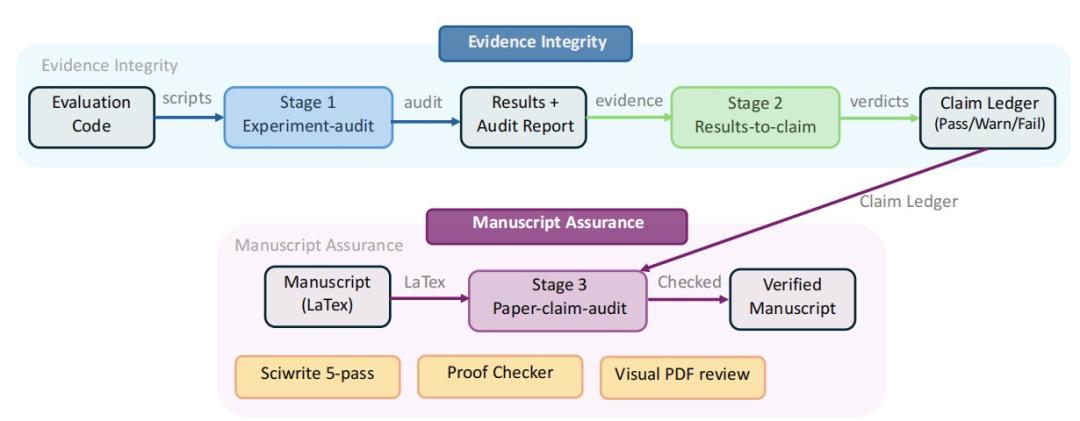
Figure | Proof - claim verification cascade. Phase 1 (Experiment verification): The reviewer checks the evaluation scripts and result files to detect integrity errors. Phase 2 (Result - claim): The results are converted into clear claim judgments (supported, partially supported, refuted); for each verification error, the relevant claims are downgraded. Phase 3 (Paper - claim verification): A new reviewer without any context information compares each quantitative claim in the manuscript with the claim register and the original result files.
From "repeated trial - and - error" to "spiral learning"
The research knowledge base is also an important part of ARIS. It is not ordinary notes, but a project - based permanent recording system that stores relevant papers, research ideas, experiment processes, and preliminary conclusions and records their relationships. Without this memory mechanism, the same idea that has proven to be unsuccessful could be repeatedly proposed in different rounds. With it, wrong directions are immediately excluded, and the already verified conclusions become the starting point for the next round of research.
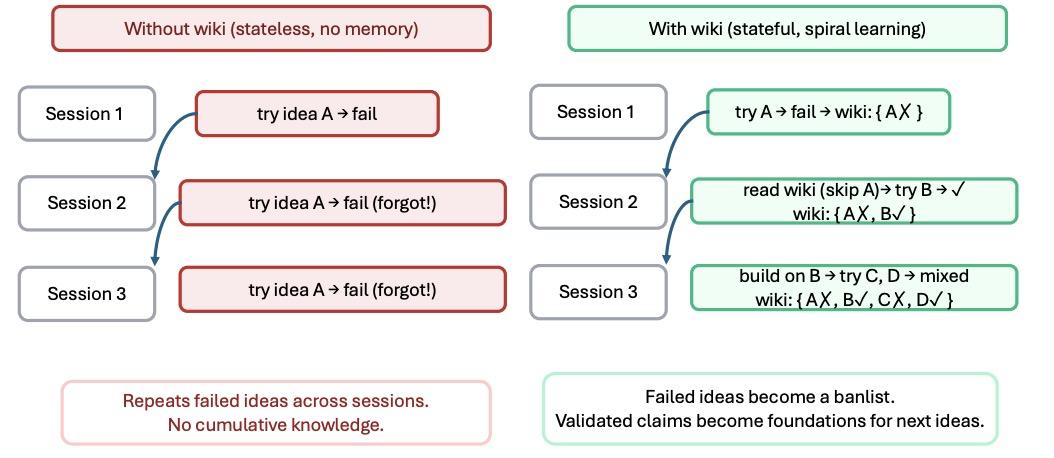
Figure | Why the wiki is important. Without the wiki (left), each session starts from scratch; the same wrong idea A could be tried infinitely many times because the system cannot store the previous results. With the wiki (right), the failure in the first session is recorded; in the second session, the wiki is read during idea generation, A is skipped, and B is successfully tested instead; in the third session, based on B, C/D are explored. Wrong ideas become the "forbidden test list", and verified claims become the basis for the next round of idea generation, thus transforming the single research process into spiral learning.
What is the effect?
So far, the skill library of ARIS has been expanded from the original 21 core skills to more than 65, covering various fields such as robotics, hardware design, communication, mathematical proofs, research grant applications, and presentation creation. At the same time, ARIS has already been tested on the three platforms of Claude Code, Codex CLI, and Cursor, and the verification page can currently integrate different model backends such as GPT, Gemini, and DeepSeek.
The research team has also published a real overnight execution record. Within about 8 hours, ARIS completed four rounds of the "verification - correction" cycle, and the internal verification score increased from 5.0/10 to 7.5/10. More than 20 GPU experiments were triggered, and some insufficiently supported conclusions were actively removed. This shows that ARIS is at least able to transform the "verification - driven correction" process into an executable action, and is not limited to just improving the formulation.
