Mit einer Finanzierung von 3,4 Milliarden Yuan hat Hangzhou sich weltweit auf den zweiten Platz gesetzt: Beim Brain-Computer-Interface scheint die Chancen auf 3 Billionen Yuan zu liegen.
8 billion US dollars in financing are flowing into the brain-computer interface. Perhaps you don't know, however: The company with the second-highest global financing is not in the United States, but in Hangzhou, China.
It is one of the six up-and-coming companies in Hangzhou – Strong Brain Technologies.
By the beginning of this year, it had completed approximately 500 million US dollars (about 3.4 billion yuan) in financing, only behind Elon Musk's Neuralink. The company's value has exceeded the 12 billion yuan mark, and it is the first Chinese unicorn in the brain-computer interface industry.
On April 20th, Pencil News traveled to Hangzhou to visit Strong Brain Technologies and answer some questions: The brain-computer interface is being developed by Musk and financed by Altman. The market is at least 400 billion US dollars (30 trillion yuan). But does the technology really exist? Are the products being used? Can you make money from it? Are there still new opportunities?
The insights from the visit were summarized into eight key questions to help you understand: Why is the brain-computer interface so popular, and what are the core opportunities?
01 Why has the brain-computer interface suddenly become so popular again?
First, the conclusion: This wave of popularity doesn't come out of nowhere. Behind it are several forces that are simultaneously converging on one point.
1. Elon Musk has put the topic in the spotlight.
Elon Musk founded Neuralink in 2016, one and a half years later than Strong Brain. But by 2026, Neuralink had already announced that it would go into mass production.
The significance of this development lies in the fact – previously, the brain-computer interface was more of a laboratory project. Now, for the first time, it is being continuously brought into the public eye by a person with high media exposure.
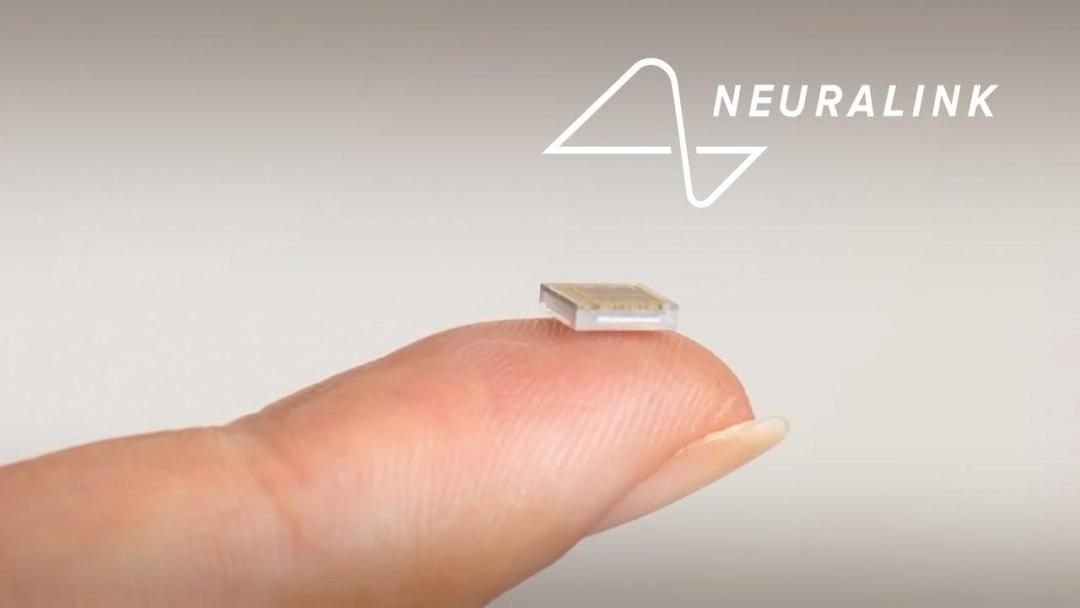
Neuralink's brain-computer interface chip has to be implanted into the human brain.
2. Not only Musk, but also Altman (founder of OpenAI) has gotten involved.
If only Musk were involved, that would still be understandable. But the problem is that Altman has also entered the game.
At the beginning of 2026, he co-founded a company called Merge Labs for brain-computer interfaces, and OpenAI has invested 250 million US dollars in the company.
It is actually rare for Musk and Altman to simultaneously invest heavily in a sector.
3. Behind the brain-computer interface lies an urgent need, namely a "huge disease group".
Why are both of them simultaneously eyeing the brain-computer interface? Because it can treat a key disease.
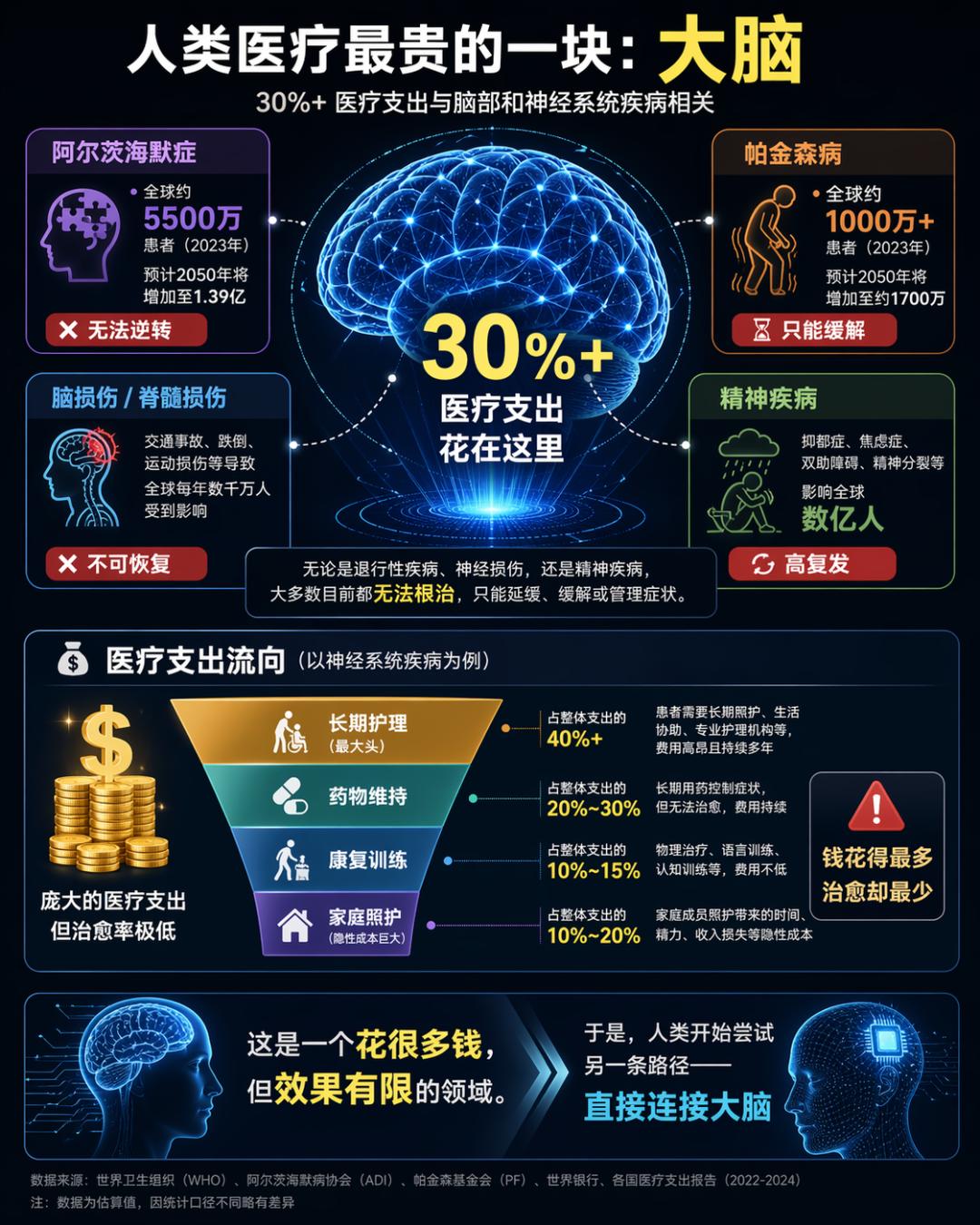
The urgent need for brain-computer interfaces
More than 30% of human medical expenses are related to diseases of the brain and the nervous system. However, these diseases have one thing in common – many of them cannot really be cured, such as Alzheimer's, Parkinson's, nerve damage...
Medicines can relieve the symptoms, but it is difficult to really solve the problems. The brain-computer interface is seen as a possibility to change these problems at the basic level.
4. How big is the market? It's so big that it almost seems abstract.
A study by Morgan Stanley shows: Only in the US healthcare sector could the brain-computer interface represent a market of 400 billion US dollars in the future.
If you just hear this number, you might not have any idea about it.
If you say that it is approximately the size of the Chinese electric vehicle industry in one year – it suddenly becomes more concrete.
5. The popularity is not only heard in the media, the industry is also becoming active.
The "popularity" of many sectors often only remains in the news. But it's different with the brain-computer interface.
Strong Brain has revealed that the number of inquiries about cooperation and purchase offers in the first quarter of this year was five times that of the previous year.
And last year it was already quite hot – "That was the time when the six up-and-coming companies in Hangzhou were the most popular."
6. Even universities are starting to "collectively turn around".
During the visit, Strong Brain also mentioned a detail: Many Chinese universities are starting to invest significantly more in the brain-computer interface. People who previously worked in robotics, AI, or neuroscience are also turning to this field.
This is actually a typical signal: A field is starting to attract people.
02 The first changes concern 5 million severely disabled people
Many people, when they first think about the brain-computer interface, think of future humans, superpowers, and the world of science fiction.
In fact, this technology doesn't first change the "future humans", but a group of people that you've almost never seen.
1. How many of the 5 million severely disabled people in China have you seen?
A statistic shows: In China, there are approximately 24 million people with limb disabilities. Of these, almost 5 million people have had their hands or feet amputated.
The question is: How many of them have you seen? Most people will first look puzzled. In our daily work, when taking the subway, or shopping in the mall, we almost never see these people, but in fact, they are hidden in invisible corners.
2. They stay at home and don't go out.
Han Bicheng once said: "I've lived in China for 19 years and have almost never seen people without hands or feet."
To understand this, he conducted a very "stupid" survey: He found 100 families of severely disabled people without hands and tried to draw their movement paths over two weeks – similar to the movement records on our mobile phones, line by line.
In the end, they couldn't draw anything. Not because the data was insufficient, but because there simply were no movement paths.
The real movement paths of 100 people ended up being 100 points. Each point was in the same place: at home.
At this moment, they realized: These people exist, but they are trapped at home.
3. The brain-computer interface sets them free.
So far, these 5 million people have had to stay at home for a long time and need the care of their family members. In reality, an adult with a disability usually means that at least one person in the family has to stay with them long-term. Not just for a few months, but for many years.
Currently, the brain-computer interface wants to solve a very basic problem: Can these people go out of the house again?
Some of these 5 million people are already using the products of Strong Brain Technologies, such as intelligent prostheses for people with forearm or thigh amputations.
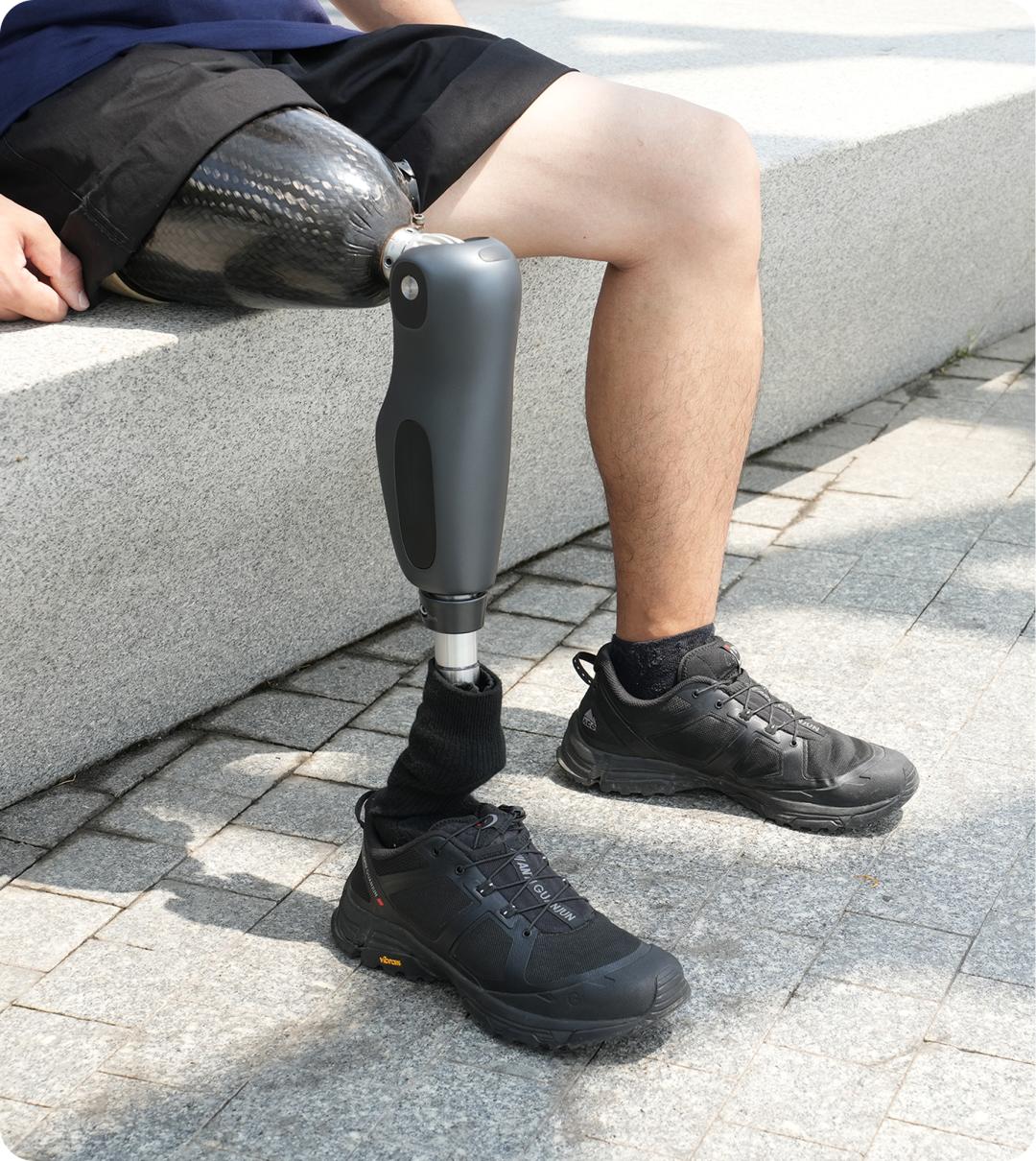
Strong Brain Technologies' intelligent artificial leg Qingling M3
03 Which path leads to success: Invasive or non-invasive?
There are several technical approaches to the brain-computer interface, some require an invasive procedure, others don't.
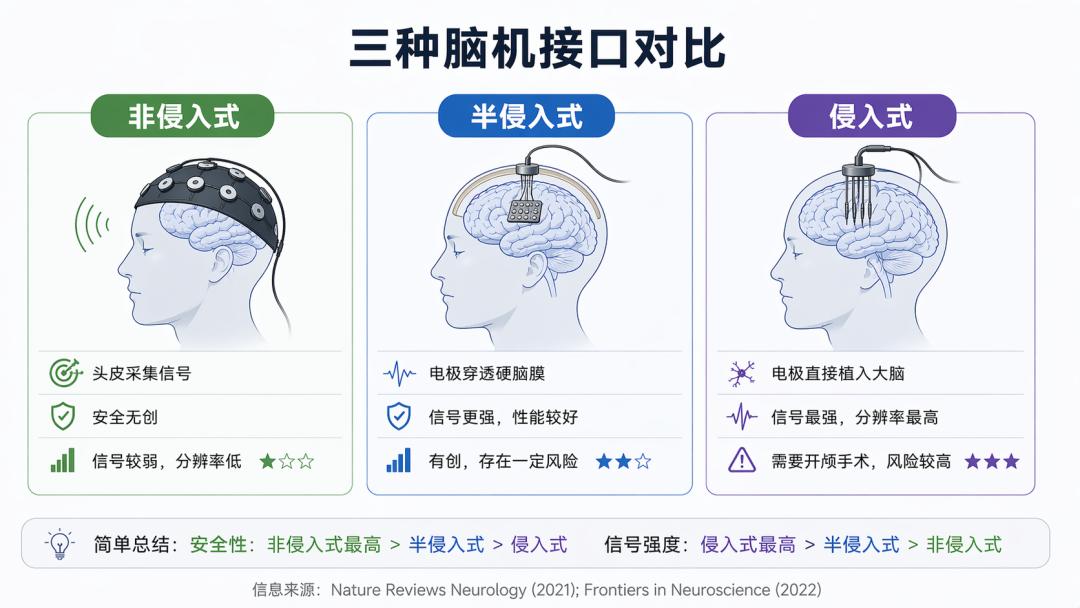
Three technical approaches to the brain-computer interface
Many people, when they first think about the brain-computer interface, intuitively think: If you want to "read" the brain, isn't the most direct way to insert a chip? That is, an invasive approach.
But Strong Brain didn't choose this path from the start.
1. A doctor tortured himself for the research.
There is an "extreme" true story.
A doctor named Philip Kennedy wanted to advance the research on the brain-computer interface. The problem was that too few people (test subjects) were willing to undergo a skull operation.
Finally, he decided to use himself as a test subject. He had his team implant two electrodes into his brain.
58 days later, the electrodes were removed due to the risk of infection. But the most interesting thing is – shortly after he recovered from the operation, he went to the laboratory, spoke, and simultaneously noted down his brain signals.
After this incident, one can only make an assessment: This can be used for research, but it is difficult to turn it into a product that normal people would want to use.
2. In terms of effectiveness, the invasive approach is actually the most powerful.
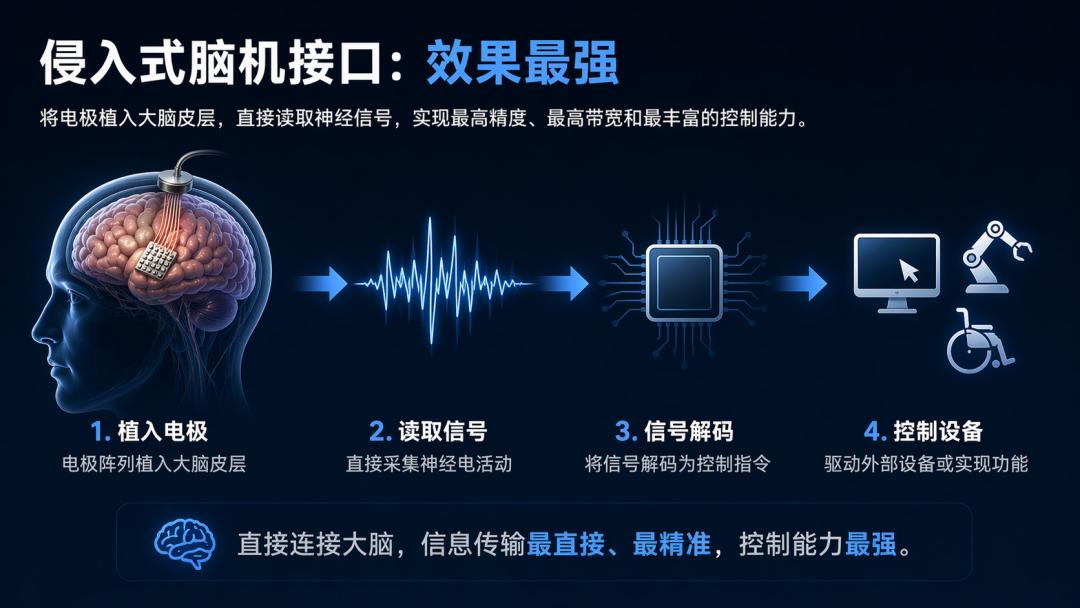
The principle of the invasive brain-computer interface
But why is the invasive approach still being pursued? Because the effectiveness is really good.
A simple metaphor: The invasive approach is like listening to a concert recording in the VIP row; the non-invasive approach is more like listening from the outside.
In one case, the sound is clear, in the other case, it's just noise.
The reason is simple: The invasive approach places the electrodes directly in the cerebral cortex, allowing the discharge of individual neurons to be recorded. The signals are the cleanest. Neuralink (founded by Musk) follows this approach.
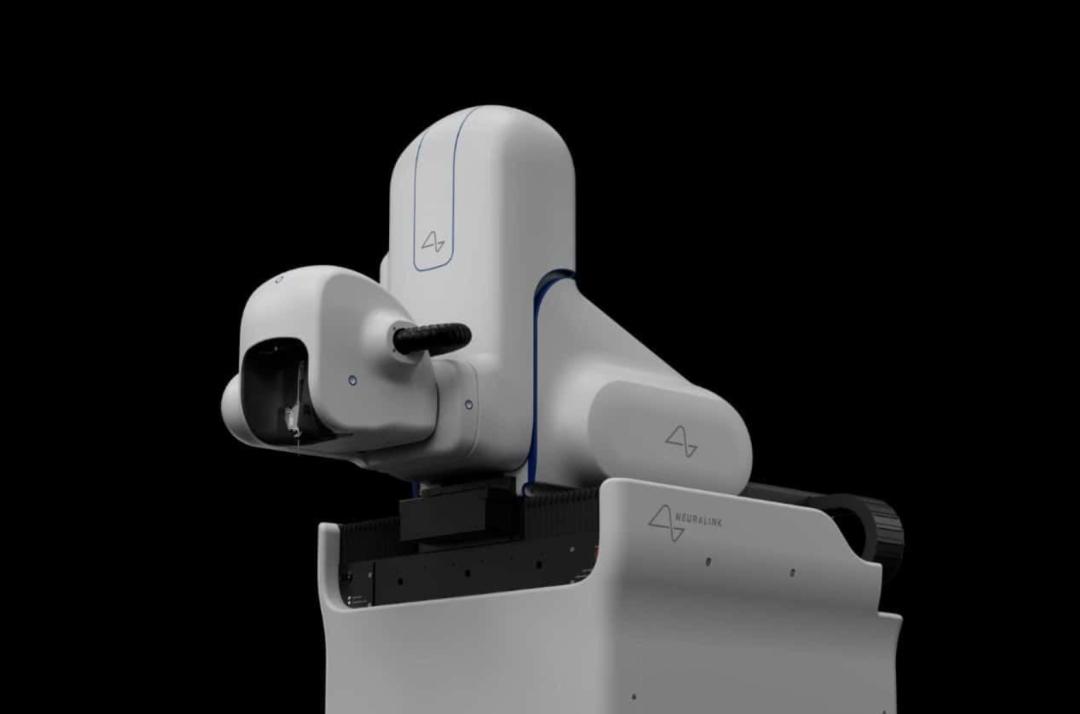
Neuralink's implantation robot
But the problem is: The human body is not designed for electronic devices.
In the human body, it is not an ideal environment for electronic devices: There is blood, tissue fluid, and various immune reactions.
After a certain period of time, a series of problems occur: Bleeding, rejection reactions, electrode breakage, signal decline...
Neuralink has not really solved these problems yet.
They have made many technical improvements, such as biological housings, wireless charging, and electrode implantation robots.
But even the best technology cannot prevent these "essential problems" from still existing.
3. The semi-invasive approach seems to be a compromise, but it also has disadvantages.
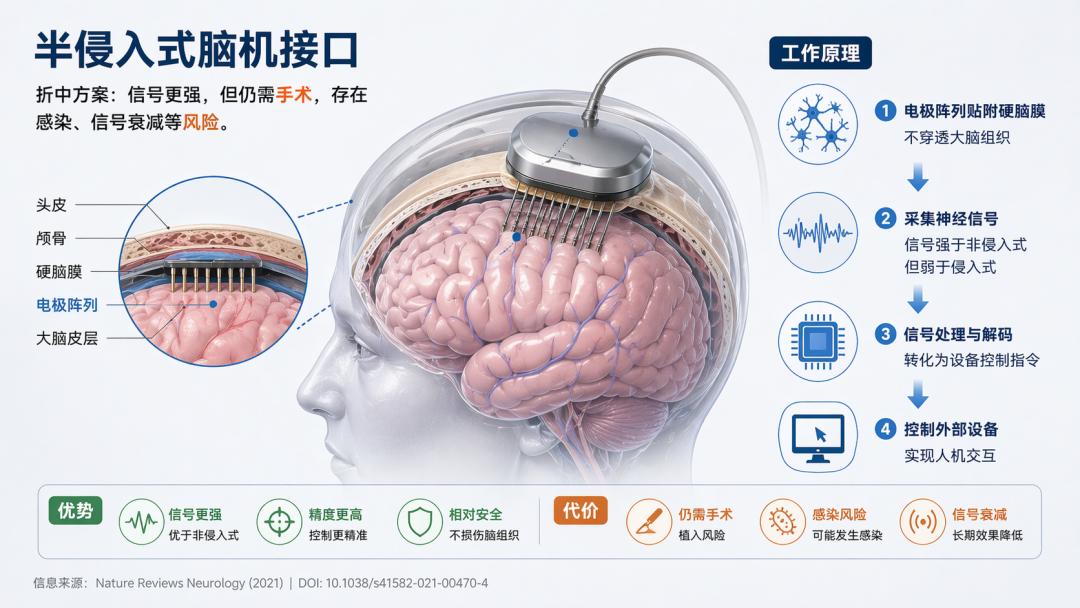
The diagram of the semi-invasive brain-computer interface
Simply put, the semi-invasive approach is to not cut directly into the skull, but to bring the device close to the brain via the blood vessels.
It sounds less aggressive. But if you avoid one risk, you bring another risk with you, such as thrombosis.
Basically, it's not a "perfect solution", but just a compromise.
4. The non-invasive approach is the safest, but also the most difficult.
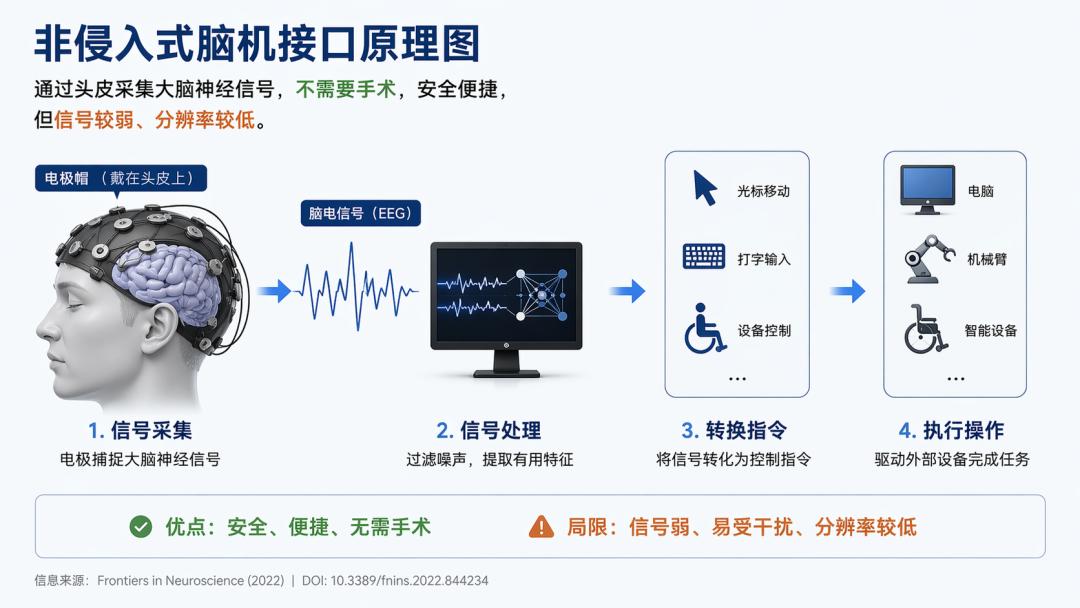
The principle of the non-invasive brain-computer interface
Finally, this is the approach that Strong Brain is currently pursuing: The non-invasive approach.
The advantages are obvious: There is no invasive procedure.