Hinter den 2,67 Millionen Fahrzeugen mit NOA in städtischen Gebieten: Fünf Mächtige kämpfen um die Spitze, und die Reihenfolge der ersten Liga in der intelligenten Fahrtechnik wird festgelegt.
Regarding autonomous driving technology, some propose skipping Level L3 and directly transitioning from the current Level L2 to Level L4. Others believe that Level L3 is an inevitable step on the path to full autonomy at Levels L4 and L5. Safety must be quantified based on public data, and users also need a process to familiarize themselves with the technology.
But no matter how you look at it, the intelligence of electric vehicles is a process that cannot be reversed and must be carried through to the end.
In the whole year of 2025, the number of newly registered vehicles with urban NOA (Navigate on Autopilot, i.e., automatic navigation driving) was 2.67 million, accounting for about 11.6% of the total number of newly registered Chinese passenger cars (23.05 million). That means about every ninth new car is equipped with urban NOA.
The industry predicts that the penetration rate of Level L2 combined driver assistance is expected to exceed 70% in 2026. Meanwhile, the penetration rate of the urban NOA function is also rising rapidly.
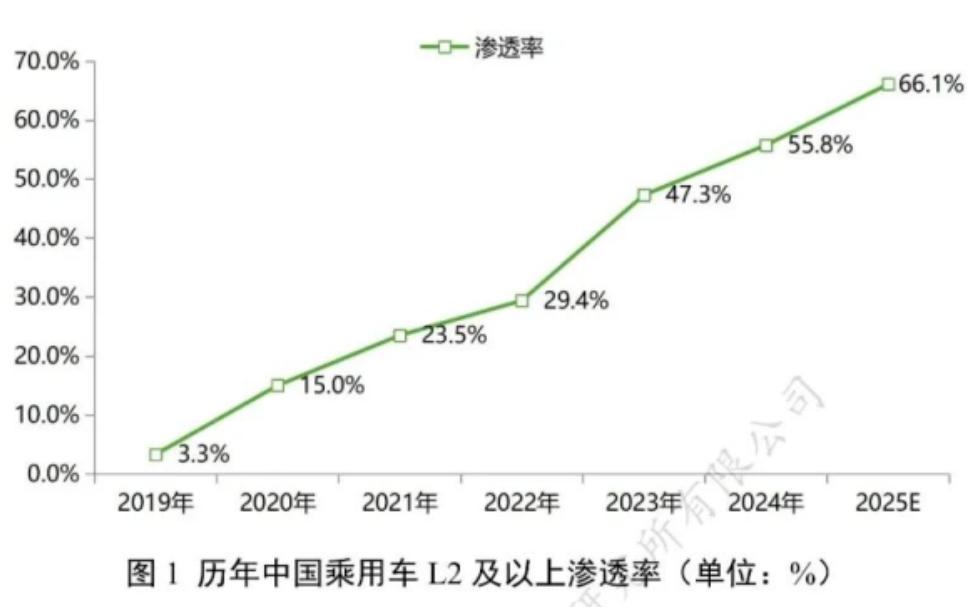
Fig./ Penetration rate of L2 and above for Chinese passenger cars in previous years Source/ Screenshot from "New Energy Views" on the Internet
Jin Yuzhi, Senior Vice President of Huawei Technologies Co., Ltd. and CEO of Yinwang Co., Ltd., announced at the 2026 High - Level Forum for the Development of Intelligent Electric Vehicles that by the end of 2025, Huawei Qiankun Intelligent Driving had installed a total of 1.4 million systems in vehicles. And if the pre - sale price of the Huajing S, which is standardly equipped with Huawei Qiankun Intelligent Driving ADS 4.0 and the Hongmeng Cockpit, is below 200,000 yuan, Huawei's "equalization of driver assistance technology" has already begun.
XPeng's second - generation VLA (Visual - Language - Action) model has managed to "convert visual signals directly into driving maneuvers", to provide ordinary users with a safe and comfortable driving experience.
There is also news about Tesla's FSD (Full - Self Driving, i.e., full autonomous driving): Tesla's FSD V14.3 version has been locally adapted for the Chinese market and is expected to be rolled out to Chinese users via OTA from early to mid - May 2026, to compete with local driver assistance technologies.
So, in the wave of the electric vehicle industry where everyone is promoting "intelligent driving", who belongs to the top group of intelligent driving? Or even the absolute leader? And what are the evaluation criteria? This is a question worth discussing.
1. Three strict criteria to select the top group of intelligent driving
In the face of the increasingly fierce competition in the field of intelligent driving, although all vehicles have L2 driver assistance, there is a difference between "having driver assistance" and "having good driver assistance". To belong to the top group, one must meet at least three strict conditions.
First, the functionality must be complete. Highway NOA, urban NOA, and all - scenario parking are essential.
Highway NOA is already widely spread, while urban NOA is the real breakthrough point. If an automaker has not even implemented urban NOA or can only use it in a few cities with high - precision maps, it is still far from the top group. By the end of 2025, about 150 models from around 35 brands were already equipped with an urban NOA system.
Urban NOA has now become the core criterion for evaluating driver assistance technology. Some brands claim to be able to "drive anywhere in China", but in reality, they may only cover a few dozen provincial capitals. Those who can achieve wide coverage and stable availability are still in the minority at present. This is the "first qualification" one must meet to belong to the top group.
Second, the driving performance must be stable. The maturity of the technology is a strict criterion.
The vehicle's ability to drive without high - precision maps is currently the crucial breakthrough point - overcoming the dependence on high - precision maps and being able to "drive anywhere in China" tests the system's perception and decision - making ability on unknown roads. High - precision maps are not only updated slowly and expensive, but also many remote road sections are not covered at all. If users go on a trip to other cities and cannot use the driver assistance, the driving experience will be greatly affected.
The map - free concept relies on the vehicle's own perception and real - time mapping ability and therefore requires a very high algorithm quality. Currently, Huawei, XPeng, Li Auto, and others are working on map - free driving, but the actual performances still vary. Stable driving performance also includes the frequency and quality of OTA updates. The driver assistance system must be continuously improved. If it is not updated for a quarter, one can quickly fall behind the competitors.
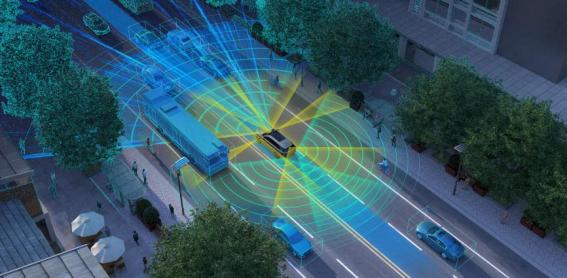
Fig./ Map - free concept of the sensor system of Wei brand Lanshan Source/ Screenshot from "New Energy Views" on the Internet
Third, the hardware must be solid. Lidar, high - performance chips, and the fusion of multiple sensors are the physical basis for high - quality algorithms.
Of course, with hardware, it's not about installing as many components as possible, but about whether the hardware can effectively support the algorithm. Some models are equipped with three lidar sensors and four Orin - X chips with a computing power of over 1,000 TOPS, but the actual driving experience may not be better than that of a system with 200 TOPS. On the other hand, some models reduce the number of key sensors for cost reasons, which leads to a significant deterioration in driver assistance ability.
Companies in the top group will not blindly stack hardware but ensure that there is sufficient redundancy to allow room for the algorithm to develop further. Tesla's pure visual concept is a different technology philosophy, but most top Chinese companies in the industry use lidar sensors.
China has divided driving automation into six levels from L0 to L5. Among them, L0 to L2 belong to "driver assistance", while L3 to L5 represent real "autonomy". The current market talk about "high - quality driver assistance" still refers to Level L2 of combined driver assistance.
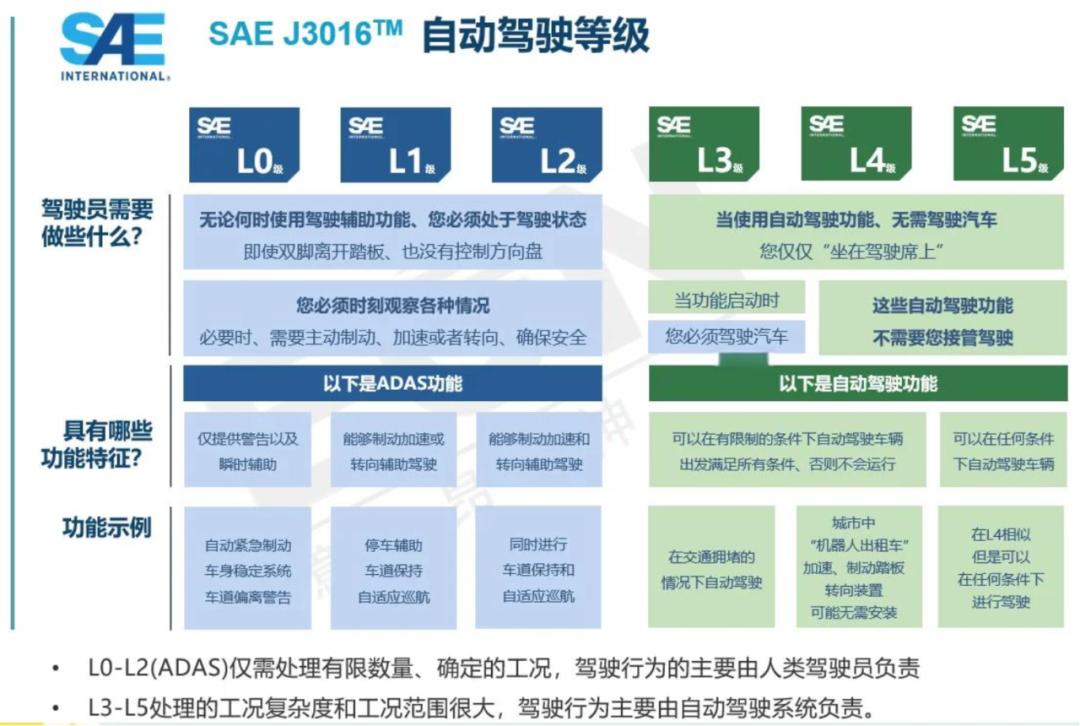
Fig./ Driving automation levels Source/ Screenshot from "New Energy Views" on the Internet
Level L2 requires the driver to constantly pay attention to the traffic situation and be ready to intervene at any time; Level L3, on the other hand, allows the driver to take their eyes off the road while the system is operating. Although the driving experience has been greatly improved with functions like urban NOA, it has not legally exceeded the boundaries of Level L2.
It must be clear that many vehicles in the 100,000 - yuan price segment promote "L2 driver assistance", but the actual driving experience is very different from high - quality NOA. What they call "L2" is actually very basic driver assistance such as Adaptive Cruise Control and Lane Keeping Assist. Vehicles at this level are still far from the top group.
2. One at the front, many strong: Analysis of the strengths of the five main players
As mentioned before, the current high - quality driver assistance still belongs to Level L2. Companies in the top group are sometimes referred to as L2+, L2.9+ or even 2.9999, but definitely not as L3. The driver still has to monitor the entire journey. Urban NOA can autonomously perform complex maneuvers such as traffic intersections and unprotected left turns, but legally, it is still "driver assistance".
Currently, companies in the top group generally have achieved map - free driving and are no longer dependent on high - precision maps. "Map - free" means that the vehicle relies on real - time perception and mapping and can directly use the driver assistance when entering an unknown road for the first time without having to wait for map updates. Therefore, candidates in the top group do not have to activate the driver assistance "city by city". Modern end - to - end large models and world models enable vehicles to understand traffic situations like humans and predict road conditions, so that they can "drive wherever there is a road".
The driver assistance technology is developing and improving rapidly. From the current market situation, a pattern of "one at the top and many strong competitors" is emerging in the top group, with the five main players each having their own strengths.
The Huawei Group is currently the leader in the field of driver assistance technology. In the whole year of 2025, Huawei Qiankun Intelligent Driving ADS with 745,000 vehicles with urban NOA once again won the market leadership position and accounted for about 28% of the market.
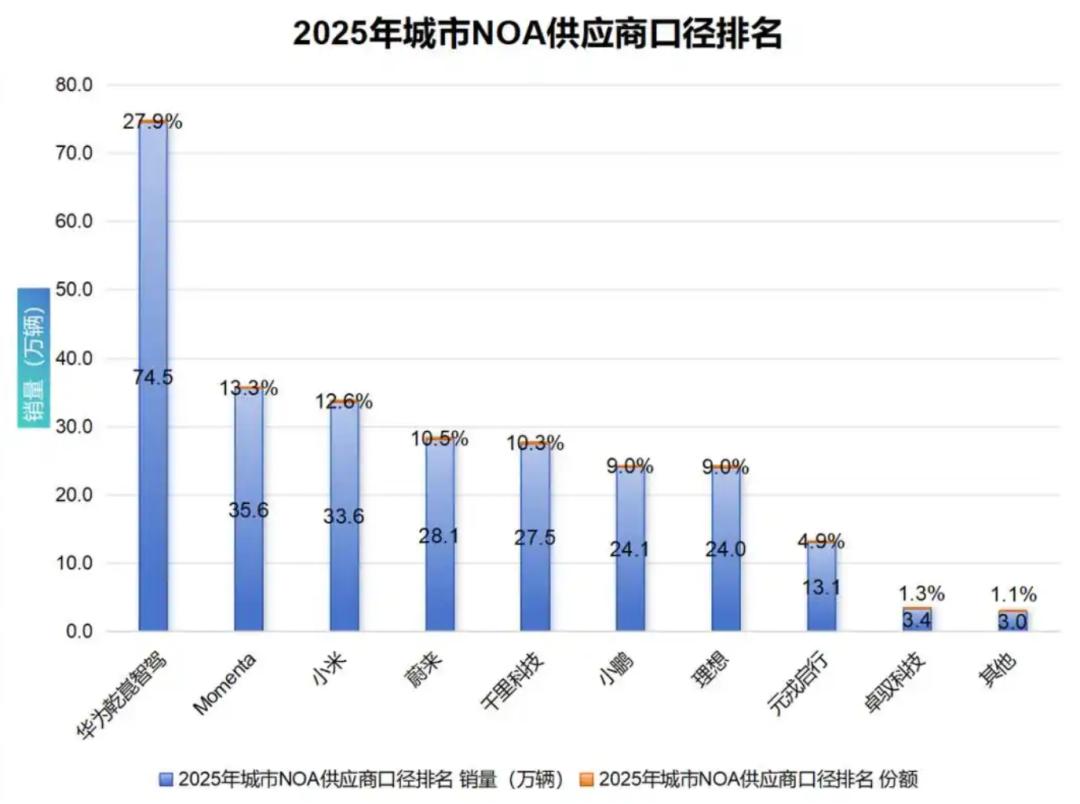
Fig./ Ranking list of urban NOA providers in 2025 Source/ Screenshot from "New Energy Views" on the Internet
Huawei's strength lies in complete in - house development - from chips, operating systems to algorithms and sensors, everything is in its own hands. ADS 3.0 uses an end - to - end large model and the ability to drive without maps, and covers highways and urban roads across China. The user experience is highly rated. One owner reported that his AITO M9 can autonomously choose the best lane on complex highway interchanges in Chongqing and it is almost never necessary to intervene.
At the same time, Huawei is accelerating the spread of the technology by optimizing hardware costs. The number of millimeter - wave radar sensors is reduced from six to three, and the computing power of the chips is lowered from 400 TOPS to 200 TOPS to offer high - quality driver assistance in the 200,000 - yuan and even 150,000 - yuan price segments.
XPeng has also been working in the field of driver assistance technology for years. XPeng was one of the first automakers to talk about "complete in - house development". In 2021, it introduced Highway NGP, and in 2022, it was the first in the industry to implement Urban NGP. Currently, XPeng's XNGP uses end - to - end technology and has managed to "drive anywhere in China". Urban NOA covers all cities in China, and wherever navigation is possible, AI driver assistance can also be used.
A testing agency tested the XPeng G6 in the city. On a 50 - km route, manual intervention was only required twice, which shows stable performance. XPeng has strong in - house development capabilities, and urban NOA was implemented early and has wide coverage. However, the hardware costs are relatively high, and the spread of high - quality driver assistance to mid - and low - priced models is relatively slow.
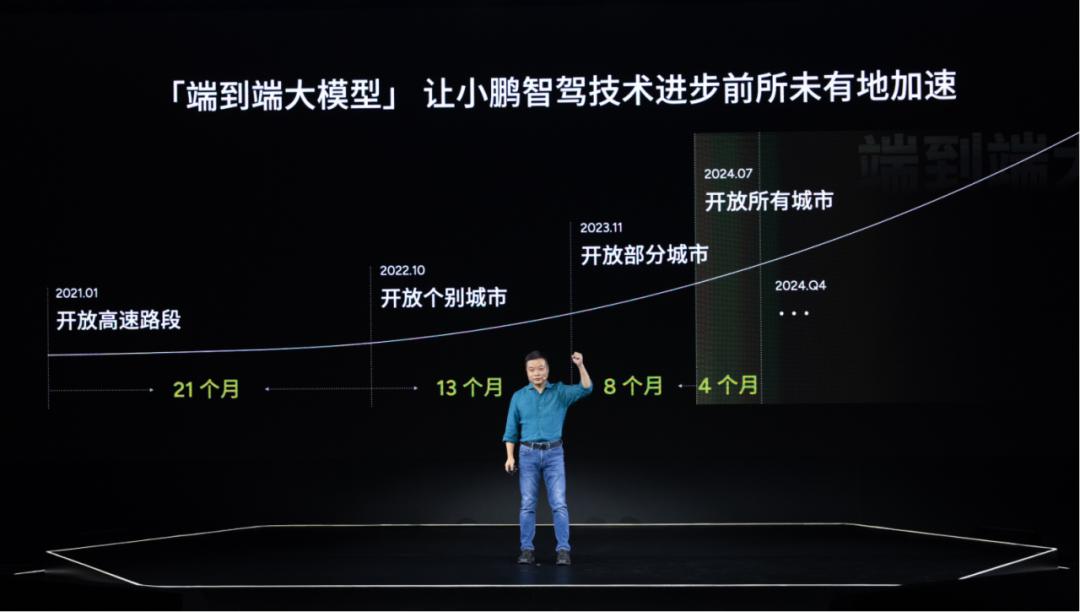
Fig./ XPeng's XNGP End - to - End Large Model Source/ Screenshot from "New Energy Views" on the Internet
Li Auto pursues a strategy of "optimization for family trips". The Li AD Max system shows stable performance on the highway and is easy to operate. Mr. Li, the owner of a Li L9, reported that he always activates NOA on the Jingjin Expressway and hardly ever has to intervene. The system changes lanes...