Marktanteil von 27%, Jahresumsatz von nur 500 Millionen Yuan: Die "Erster"-Dilemma der AR-Brille XREAL
In 2026, when the "battle of a hundred smart glasses" has already begun, how are the players in the industry actually faring?
On April 1st, Shenzhen-based AR glasses company XREAL officially submitted its prospectus to the Hong Kong Stock Exchange, preparing to make a bid for a Hong Kong IPO as the "first smart glasses stock".
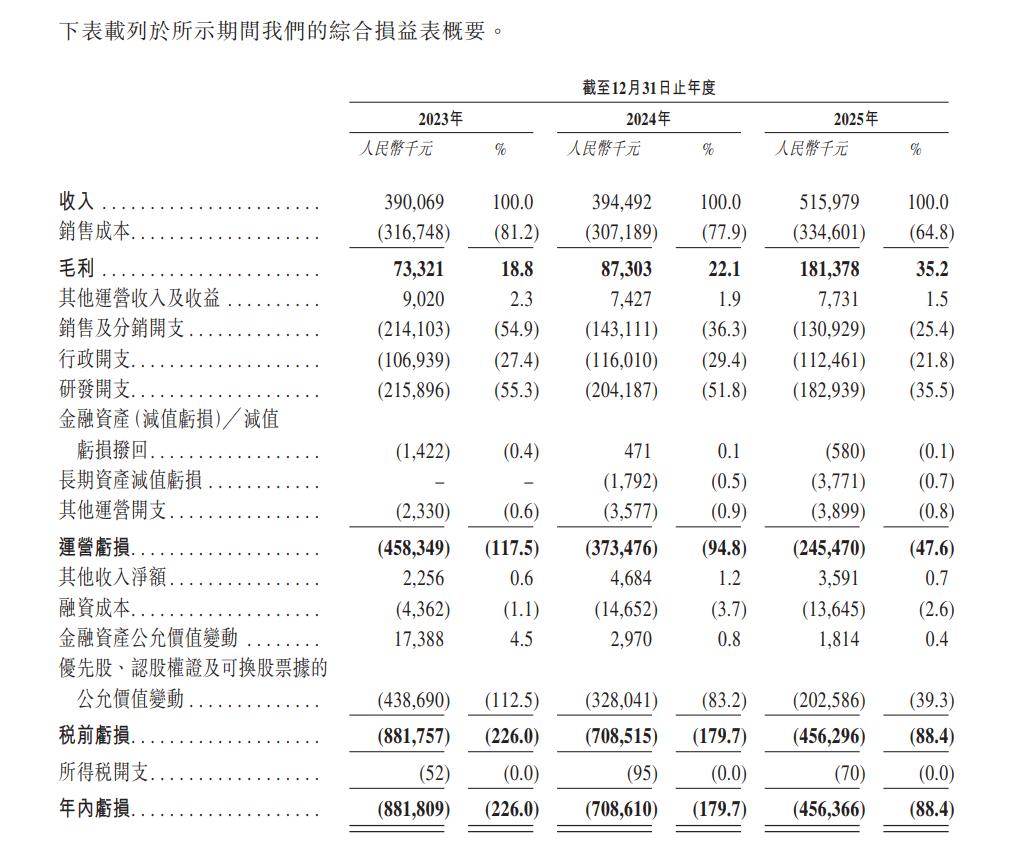
The prospectus shows that in 2025, XREAL's revenue reached 516 million yuan, with a gross profit margin of 35.2%. This level of revenue quality is quite rare and excellent in the smart hardware circle. At the overall operational level, the company is still in a loss-making state. The adjusted net profits were -437 million yuan, -375 million yuan, and -250 million yuan. In addition, the prospectus also mentions that the company's market share has ranked first in the global AR glasses market for the fourth consecutive year.
However, there are also some "regrets" hidden in XREAL's seemingly good data. Because the revenue of 516 million yuan is about the same as the annual income of a medium-sized chain restaurant.
Is this result because XREAL is not "working hard" enough? Obviously not.
From the perspective of revenue quality, the company's gross profit margin has climbed from 18.8% in 2023 to 35.2% in 2025, and the adjusted net loss has narrowed from 437 million yuan to 250 million yuan, indicating that XREAL is in a state of "striding forward".
Behind the numbers in XREAL's prospectus lies the most real embarrassment in the AR glasses industry - when you're the biggest fish in a small pond, you're still essentially a small fish.
Perhaps, from the perspective of peer competition, XREAL is already strong enough. But from the perspective of the consumer electronics track, the "pond" for smart glasses is still too small.
Financial analysis: The "refined poverty" beneath the high-growth appearance
When you open XREAL's prospectus, the first thing that catches your eye is a set of beautiful growth curves.
Financial data shows that the company's revenue increased from 390 million yuan in 2023 to 516 million yuan in 2025, with a compound annual growth rate of about 15%; the gross profit margin doubled in three years, rising from 18.8% to 35.2%. But when we reduce these numbers to the essence of the business, we'll find a completely different story.
First of all, the revenue structure is relatively single. As a company that sells smart glasses, XREAL's business really "only sells smart glasses".
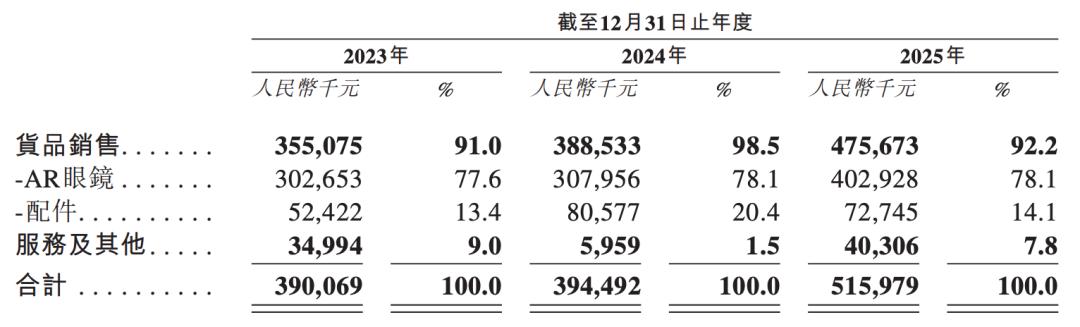
In 2025, out of XREAL's 516 million yuan in revenue, AR glasses sales accounted for 403 million yuan (78.1%), accessories accounted for 73 million yuan (14.1%), and services and others accounted for 40 million yuan (7.8%). This means that the company almost completely relies on hardware sales and is highly concentrated in three major product lines: the Air series (entry-level, with an average price of about 1,656 yuan), the One series (mid - to high - end, with an average price of about 3,196 yuan), and the Light - Ultra - Aura series (flagship/developer version, with an average price of about 3,665 yuan). In 2025, the One series sold 111,000 units, contributing the majority of the incremental volume; the Air series sold only 17,000 units, a significant decline from the 104,000 units sold in 2024; the Light - Ultra - Aura product line sold 4,973 units throughout the year.
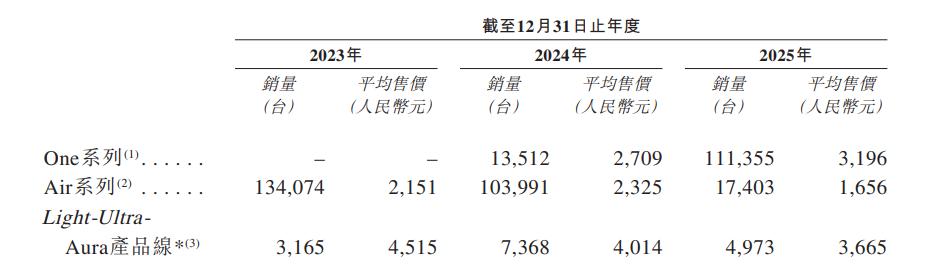
This sales structure of "shrinking entry - level and booming mid - to high - end" explains the increase in the company's gross profit margin - the gross profit margin of the One series is significantly higher than that of the Air series. But it also exposes a problem: XREAL is shifting from "volume - based" to "price - based", which is a typical characteristic of a small market.
This kind of market performance has occurred in many innovative hardware industries, such as the early days of the sweeping robot industry. Generally speaking, the normal market sales structure should follow a "pyramid" structure, where entry - level products have the highest sales volume, followed by mid - to high - end products. But for a small - scale market, since entry - level products are difficult to form a scale to "spread out" the various costs of the entire product line, if manufacturers want to further increase revenue, they can only improve the experience of "fully - equipped" products, and the result is naturally a price increase.
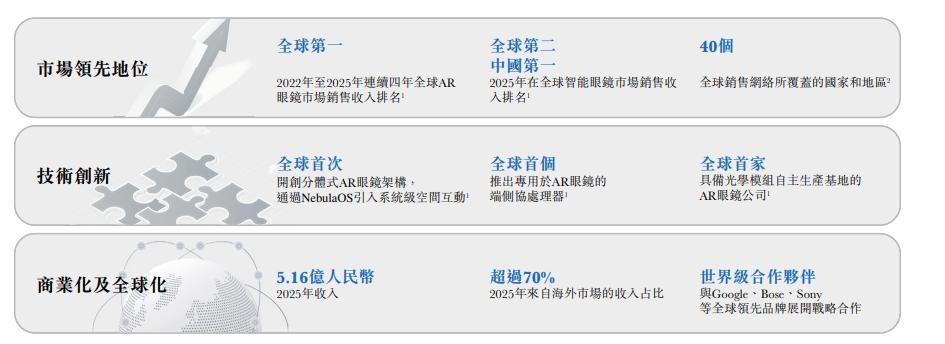
According to data from iResearch, in terms of sales revenue, XREAL ranked first in the global AR glasses market for four consecutive years from 2022 to 2025. In the overall smart glasses market, including non - display smart glasses, XREAL ranked second globally and first in China in terms of sales revenue in 2025. In 2025, XREAL's global AR glasses revenue market share was 27.0% and its sales volume market share was 24.8%, both ranking first.
But from another perspective, XREAL's revenue of 516 million yuan also proves that the "size" of the entire market is just this big. Compared with the TWS earphone market or the smartwatch market, the scale of the AR glasses market is not even a fraction.
Although the market is not large, under the pressure of the "battle of a hundred smart glasses", companies in the industry can't just "take it easy". They can't neglect the R & D and sales expenses.
The prospectus shows that from 2023 to 2025, XREAL's R & D expenses were 216 million yuan, 204 million yuan, and 183 million yuan respectively. The absolute value decreased, and the proportion of R & D expenses to revenue decreased from 55.3% to 35.5%. The prospectus attributes this to "improved R & D efficiency", but another interpretation might be: when the market ceiling is visible, increasing R & D investment is not "cost - effective".
As of the end of 2025, XREAL had 382 domestic patents in China and 99 overseas patents, covering fields such as optical design, end - side co - processor architecture, and spatial perception algorithms. But in a small - scale market, these technological barriers are more like a "refined toy" - you have the best technology, but there are few consumers willing to pay for it.
In addition, although XREAL's gross profit margin of 35.2% looks good, after subtracting sales and distribution expenses (131 million yuan), R & D expenses (183 million yuan), and management expenses (112 million yuan), XREAL's adjusted net loss still reached 250 million yuan. And XREAL sold a total of 133,731 pairs of glasses in 2025. Calculated, XREAL loses 1,800 yuan for each pair of glasses sold.
So, to maintain long - term competitiveness, XREAL simply doesn't have the time to "hold on".
At the end of 2025, XREAL's cash and cash equivalents were only 64 million yuan, a significant decrease from 205 million yuan in 2024. Although the prospectus explains that this is mainly due to an increase in inventory and cash outflows from operating activities, it's obvious to anyone with a discerning eye that for a company that is still in the red and has a tight cash flow, IPO fundraising has become a "must - option" rather than an "optional one".
Moat and the future: How can the big fish in the small pond swim into the deep sea?
Since the market is so small, what kind of story has XREAL told itself?
This story contains two key words: technological positioning and ecological bet.
Different from the "assembly model" of most AR glasses manufacturers, XREAL is one of the few players in the smart glasses track that does "full - stack self - research". From the X - Prism optical engine, the X1 end - side co - processor, to the NebulaOS operating system and the Real3D spatial algorithm, XREAL has established a vertically integrated technological system.
The result of this deep coupling is a generational gap in product experience. Taking the Motion - to - Photon (MTP) latency as an example, XREAL's X1 chip can reduce this indicator to less than 3 milliseconds, while the industry average is usually between 10 - 20 milliseconds. The jitter rate of the spatial anchoring algorithm is less than 0.5mm, which means that virtual objects are almost "motionless" in the real space. At the same time, in order to maximize the release of technological capabilities, in 2021, XREAL built an automated manufacturing base in Wuxi, becoming the world's first AR glasses company with the ability to independently produce optical modules.
The combined significance of these two technologies is that it makes users feel as if they are "holding a large screen all the time" when viewing spatial images, greatly reducing the "motion sickness" feeling when viewing AR images.
What is the monetization path for accumulating these technological advantages? At present, it seems that XREAL has chosen a smart strategy: to be the "hardware partner" of giants.
The most notable strategic shift for XREAL occurred between 2024 and 2025. The company shifted from strongly promoting its self - developed NebulaOS to deeply cooperating with Google and became the "lead hardware partner" of the Android XR platform. The next - generation flagship product, Project Aura, is expected to be equipped with the Android XR system, integrating Google's Gemini AI and multimodal perception capabilities.
This is a practical trade - off: self - developed OS allows you to have control, but in a small - scale market, developers have no reason to develop applications specifically for you. Embracing Android XR means giving up some control in exchange for the application support of the entire Android ecosystem.
The prospectus reveals that XREAL is collaborating with ASUS ROG to develop 240Hz high - refresh - rate gaming glasses, exploring AR experiences in smart cockpits with NIO, and launching customized AR glasses with leading Chinese mobile phone manufacturers. All these collaborations reflect XREAL's strategic shift from NebulaOS to an "open - source ecosystem".
This dual - wheel drive of "B - end empowerment + C - end trial" may be the key for XREAL to break through the revenue ceiling. In 2025, XREAL's revenue from technology development services for enterprise customers reached 40 million yuan. Although the proportion is only 7.8%, the gross profit margin is significantly higher than that of hardware sales. This means that XREAL may have the opportunity to explore a subscription - based business model in AI software services - when hardware sales reach the market capacity limit, software and services may become the second growth curve.
But before that, the most important thing for XREAL is to maintain its current position.
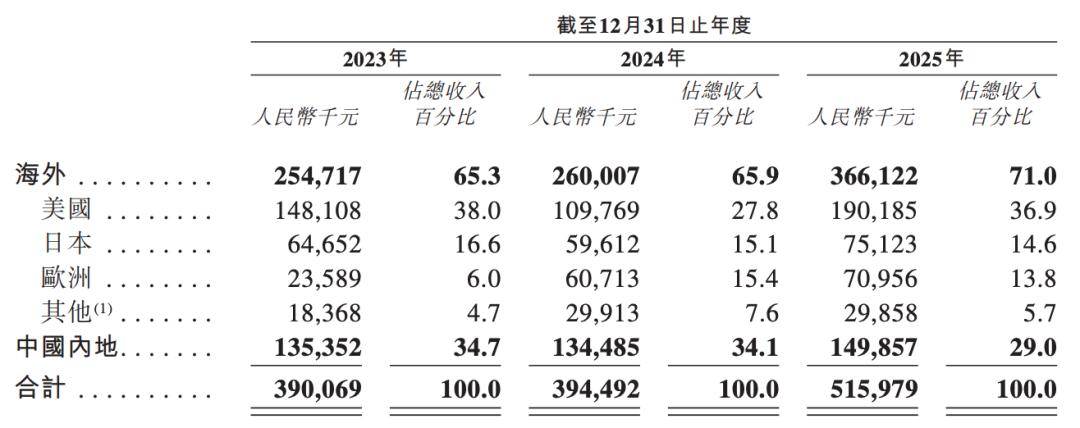
XREAL's global performance is still quite good. In 2025, more than 70% of its revenue came from overseas markets: the United States accounted for 36.9% (about 190 million yuan), Japan accounted for 14.6%, and Europe accounted for 13.8%. The company has entered 40 countries and regions and has local sales and operation teams in North America, Europe, and Japan.
This ability to "compete in foreign markets" is an advantage that sets XREAL apart from many domestic competitors. When the domestic AR glasses market is caught in a price war, XREAL can obtain a higher brand premium overseas. The prospectus shows that XREAL's direct sales revenue accounts for 70.8%, which means that the company has control over user data and brand awareness, laying a foundation for future software service monetization.
Conclusion
XREAL's prospectus is a typical example of being "small but beautiful".
It proves that in the field of Chinese hard - tech entrepreneurship, in - depth technological exploration, global layout, and cooperation with ecological giants can build a solid moat in an early - stage market. But it also reveals the cruel reality of the AR glasses industry: before the market demand truly explodes, even the global leader can't get rid of the dilemma of a "small market".
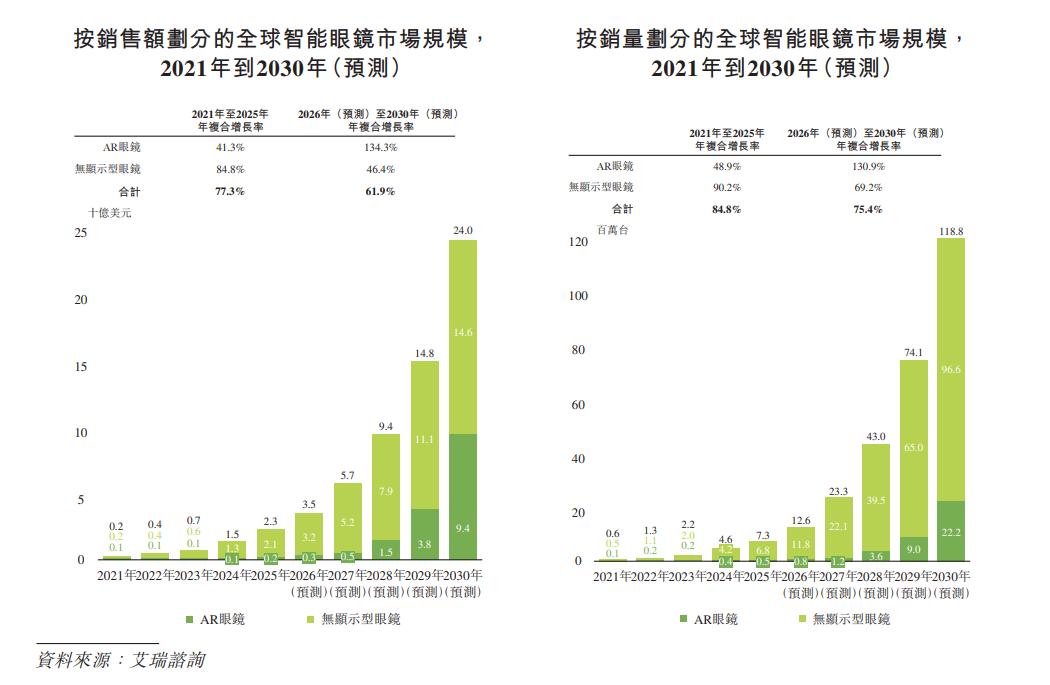
According to iResearch's forecast, the global AR glasses market size will reach $9.4 billion by 2030. If this forecast comes true, XREAL is expected to achieve a leap - forward growth in revenue with its first - mover advantage. But if the market growth fails to meet expectations, or if giants like Apple and Meta enter the market more aggressively, XREAL's 27% market share may be quickly diluted.
In any case, XREAL's choices deserve respect. In the long - distance race of hard - tech, those who survive are often not those with explosive power, but those with endurance and a sense of direction.
This article is from the WeChat official account “Guangzhui Intelligence” (ID: guangzhui - tech), author: Someone who focuses on cutting - edge technology. It is published by 36Kr with authorization.