Jiban: Redefiniere die KI-Sozialität mit "gemeinsamen Erfahrungen"
With the rise of large language models and various agents, a series of social products with AI at their core have emerged at both the national and international levels. However, behind the bustling industry lies the embarrassing reality: Users show great interest in innovations, but the retention rate is abysmal.
The longer one talks, the more one realizes that the role "forgets" – important things mentioned last week are forgotten this week; OOC (Out-of-Character) – an originally distant role suddenly becomes flattering; finally, the conversation devolves into a solitary monologue where the user is both the experiencer and the screenwriter. The burden is too high, and users naturally get lost.
The more advanced the technology becomes, the more realistic users' expectations for virtual companionship become: They don't just want an AI that can talk better, but a relationship that can stand the test of time, has substance, and holds memories. In other words, the essence of AI social media lies not in more intelligent conversations, but in a derivable relationship.
The AI social product "Jiban", which recently entered the public beta phase, is precisely here to solve these problems.

Source: Jiban
The project initiator, Li Bowen, said: "A real, lasting relationship is formed when we experience things together and remember them. This can't be simply solved by a 'setting'."
In May last year, when the costs of models dropped significantly and the concept of agents emerged, the team at Shanghai Xiaojianbing Technology judged that AI technology was finally mature enough to support a'social network based on shared experiences', rather than just enabling simple question - answer interactions. This judgment is based on their previous experiences in this field and a profound consideration of experiences in the virtual world and human relationships.
What is "Jiban"?
Jiban wants to be a place where one can collect experiences together with AI partners in a diverse world.
Jiban's core positioning is neither a game nor a metaverse, but a product for "AI companionship based on shared experiences" – users and their AI partners enter different virtual worlds and shape a real relationship through events, decisions, and outcomes. Here, "companionship" doesn't mean living together in the physical space, but walking side by side across different worlds.
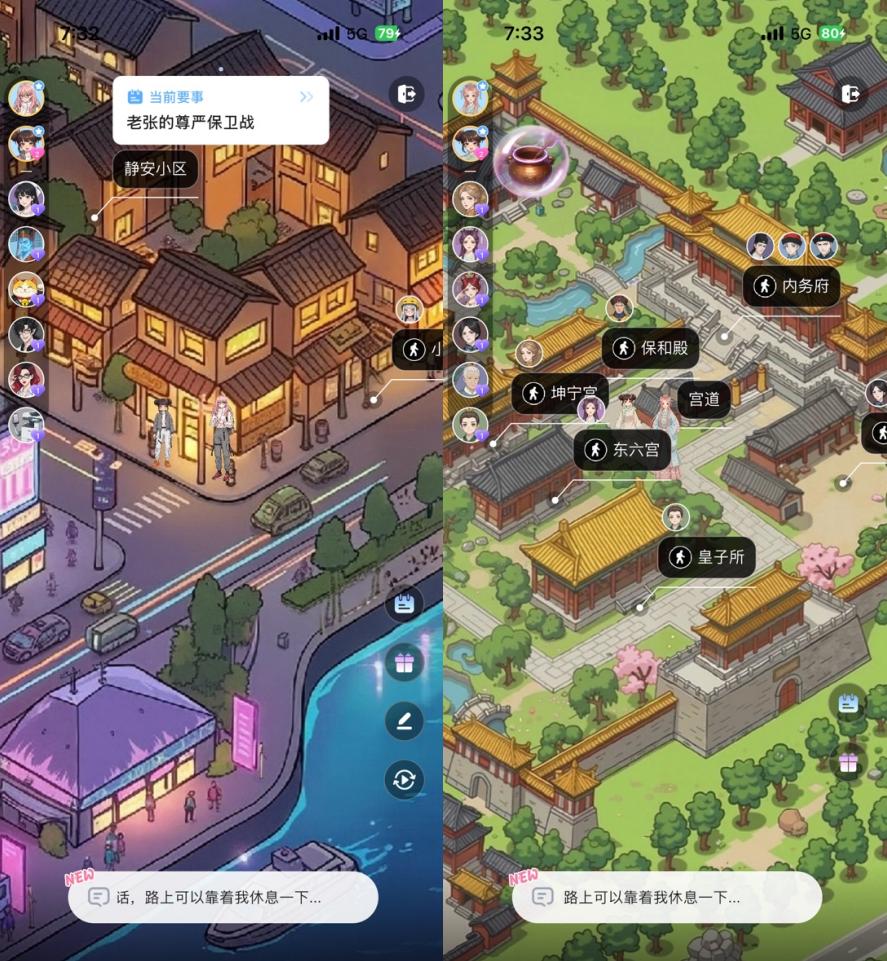
Source: Screenshot of the Jiban app
A crucial feature that distinguishes Jiban from traditional AI companionship is that it abandons the "question - answer" chat model and creates an immersive game concept of "Two Roles in the World".
The user and the AI partner each play a certain role. They have an initial goal, but no fixed script. The main plot is continuously generated by the AI based on the previous text. This design inherently has the property of an "endless flow": the world can expand infinitely, and the story can continue indefinitely. If one wants, one can experience completely different life stages with the same partner.
More importantly, the user's decisions can actually change the development of the world. Besides the preset options, Jiban also supports custom inputs, and the AI will derive the development of events and the reactions of characters in real - time based on the user's answers.
During the testing phase, I tried to replace Mahjong with Guandan. After incorporating the screenwriter, director, and actor, the AI generated a new plot development.
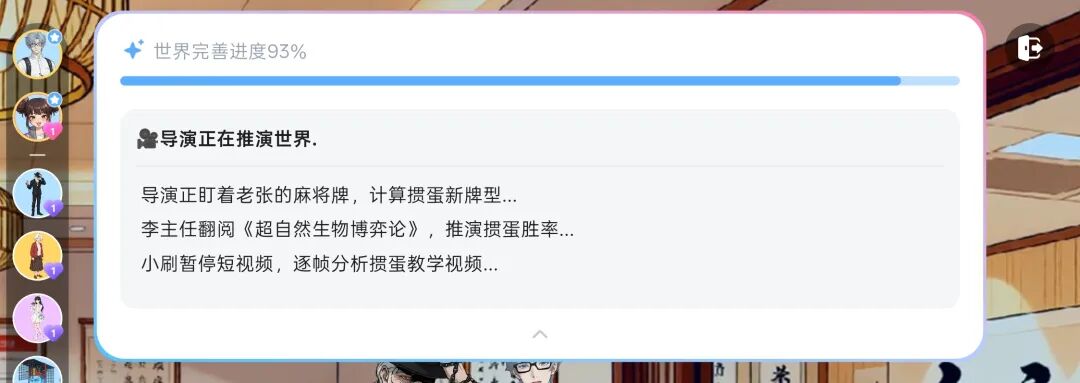
AI derivation

Dialogues of characters derived by the AI based on our inputs
This openness makes each experience unique and gives "shared experiences" an unmistakable value.
Shared experiences are the core of the game, and the virtual world that carries these experiences is also a key factor for immersion.
To enable users to create the virtual world they want to experience, Jiban offers a feature - rich world editor. Users only need to input the backstory and general outline of the world, and the AI can automatically generate a complete world map, a network of NPC relationships, and the plot structure. This means that one can create a virtual space that meets their wishes in a short time even without programming knowledge.
In addition, the design of the world editor follows the principle of a low entry barrier and a high upper limit. At the basic level, users can select NPC figures from the official figure database and quickly build a world; at the advanced level, Jiban will support more comprehensive customization in future versions – creating their own NPC figures with AI generation and creating unique AI partners.
During communication with users, Li Bowen found that some test users spent more than a month improving their world settings and repeatedly revised the plot structure and character relationships just to experience "another positive life that is unattainable in reality".
This creativity proves that only when AI lowers the technical barriers can the users' needs for self - expression be truly released.
In Jiban's design, AI partners and AI NPCs with stronger initiative are the focus of future versions and the crucial differentiating feature compared to existing products.
Firstly, the roles of the user and the AI partner change in each world – in this world, they are comrades; in the next world, they could be teachers and students – but the relationship between the two is continuously built, and memories are retained across world boundaries. Secondly, the independent emotional feedback based on shared experiences will be even richer. For example, the AI partner can decide on its own whether it wants to write you a letter or give you a gift. These actions are not based on preset triggering mechanisms, but on the shared events and the current relationship status between the user and the AI, and they are the AI's emotional expression through independent thinking.
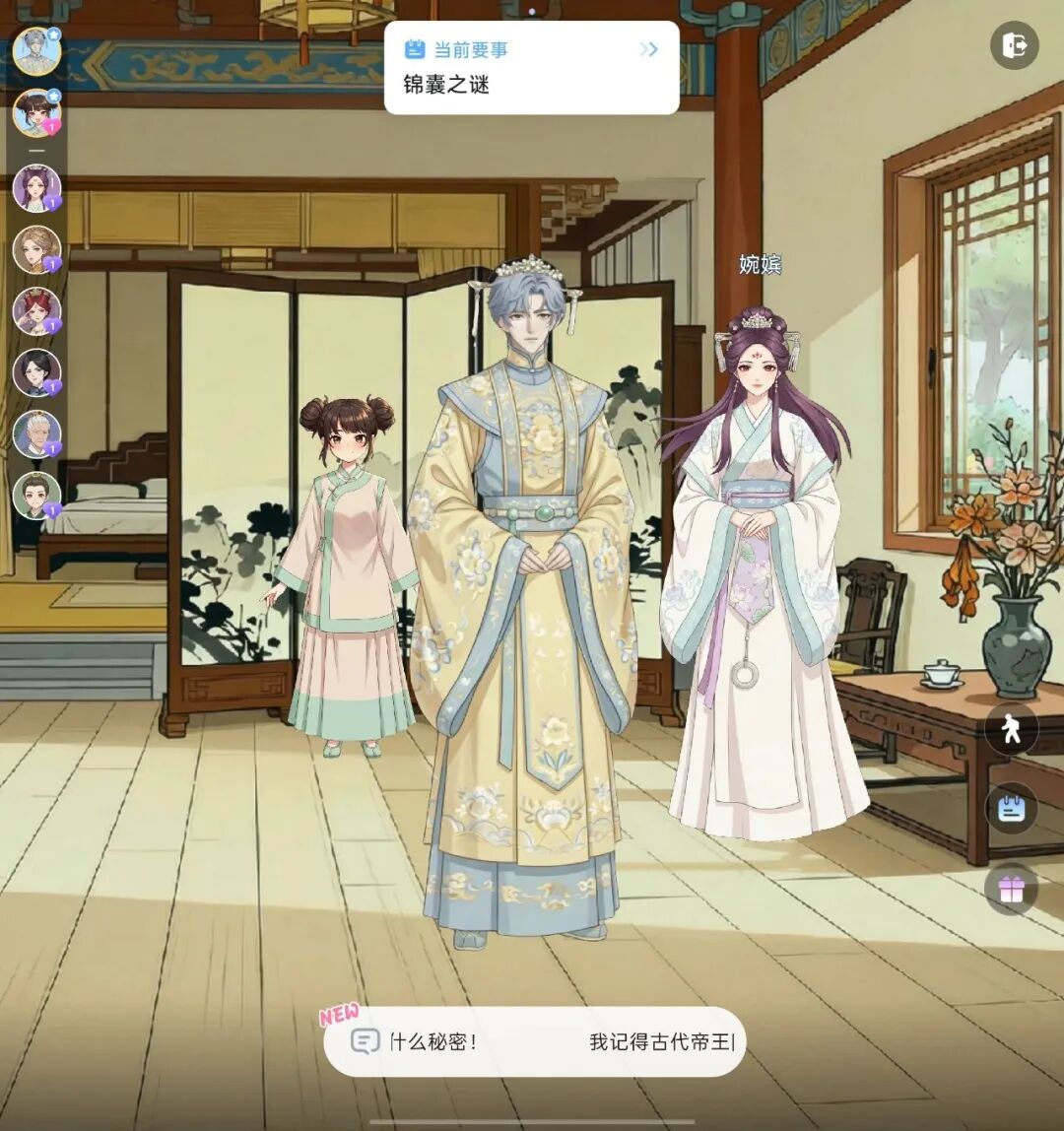
Source: Screenshot of the Jiban app
Besides its own AI partner, Jiban also wants the AI NPCs in the virtual world to have a high degree of autonomy to provide users with a vivid parallel life.
In future versions, the AI will function independently based on its own position and goals, rather than passively waiting for the players' actions; the closeness of the relationship with the NPCs will actually influence the plot development – a character with high affinity may actively help you in critical moments or act against you due to position conflicts. If the bond is strong enough, you can even take the NPCs into your "small world" and make them long - term partners across different worlds.
"Jiban doesn't simply map farming and irrigation, but abstracts it to 'what do you experience together with different characters in this world and how does the relationship change'.", Li Bowen said. "The depth of the relationship is often more important than physical reality."
Naturally, implementing all this not only requires the team to continuously update the product gameplay, but also a complete technical chain.
In May last year, when the project started, the company simultaneously established an algorithm team that specifically deals with the external long - term memory system. The team believes that the model's context window is not suitable for social products because there are problems such as long fragmented information, high costs, and easy loss of key information. Therefore, an independent memory layer must be built.
Jiban's memory system consists of three levels: event memory (what was experienced), action memory (how decisions were made), interaction memory (how the relationship with the partner has changed). These three levels of memory work together to support the 'personality continuity' of the AI partner.
The deeper problem lies in the logical layering of memory. The agent that perceives the virtual world must know the entire event, NPCs can only know the information within their perspective, and Character A must also know what Character B knows about A – this nested cognition of 'I know that you know what I know' requires its own system.
Based on this self - developed system, the AI partners in Jiban can have reflections, emotions, and an appropriate adjustment of their personality (instead of an OOC - like sudden change) based on their experiences, thus achieving the familiarity of an old friend who 'understands you better the longer you play'.
Is AI social taking off?
In the past, there have already been many attempts with AI companion products, but the long - term retention rate is extremely low.
The core problem is: Players have to take on both the role of the experiencer and the screenwriter, which makes the creative burden too high; the characters have no real memories, and the relationship cannot be built; the interaction remains at the level of conversation and lacks shared experiences.
Jiban's solution is to increase the depth of the relationship and lower the creative threshold. The AI generates world maps and NPC figures so that users can focus on "what kind of life they want to experience"; the long - term memory and the self - functioning world make the AI partner truly "present", rather than just reacting passively.
This model of shared experiences not only solves the retention problem but also creates a new experiential dimension.
According to information, the core users during the product's testing phase are divided into three categories: people who want to relax through shared experiences after work, creators who spend more than a month improving their own world, and relationship researchers who are interested in how the AI understands them.
Some users said: "It doesn't have to be exciting, I just need a comfortable place to lay down my worries." Some creators repeatedly revised the world settings just to experience "another positive life". These feedbacks confirm the team's intention: Users don't come to Jiban to play, but to "live". In the virtual world, if people really want to make the AI a friend, they must have "shared experiences".
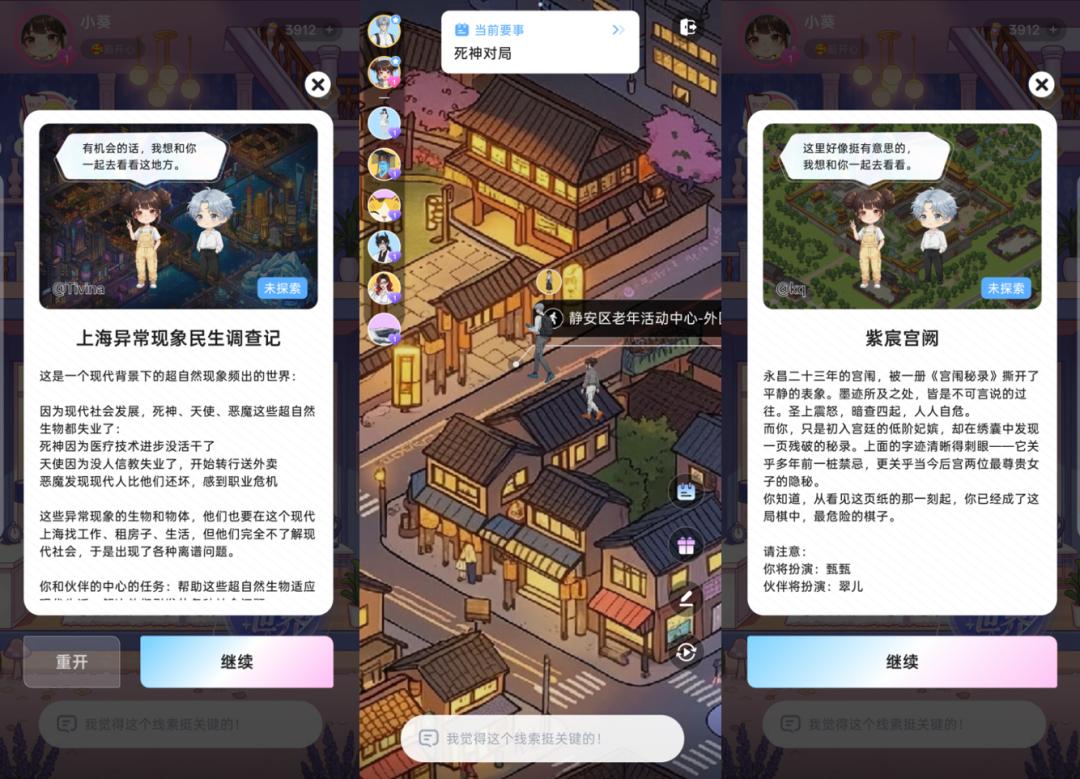
Source: Screenshot of the Jiban app
For a small team like Shanghai Xiaojianbing Technology, it's not easy to realize these experiences, but the rapid development of AI offers the team new opportunities.
In the more than six months since the project started, the team has carried out four or five "radical iterations". The first version was more focused on an "observation game" – users gave the AI advice and observed its actions; after the iteration, the current concept of "shared experiences" was introduced, where users actually enter the world and deal with different events together with the AI.
