Tencent: Superjäger für medizinische Börsengänge
In the past year, the medical IPO market has revived again, and more than 37 Chinese medical companies have completed their IPOs. Tencent's investments stand behind several medical IPOs.
In the last three months, Tencent has participated in the IPOs of three medical companies, namely the AI pharmaceutical company Insilico Medicine, the mid - to high - end medical service provider Livelihood Medical, and the surgical robot company MicroPort EndoTech. This has positioned Tencent in several emerging fields and achieved considerable book profits.
2026 is likely to be a profitable year for Tencent's medical IPOs. Among the medical companies that have already submitted IPO applications and are waiting for their IPOs, Tencent has invested in several companies, including Sinovac Biotech, Xynovio, Corvium, Libang Pharmaceutical, Bomei Medical, and WeDoctor. Tencent has the potential to become the most successful hunter of medical IPOs in 2026.
Enter before the IPO and act as a cornerstone investor: Secure profits from the revival of the innovative pharmaceutical industry
As early as ten years ago, Tencent began to invest in the medical field. In the early years, Tencent focused on the Internet - medical segment. In recent years, the focus of Tencent's investments has shifted to innovative pharmaceuticals.
Tencent's investments in innovative pharmaceuticals have now reached the profit - making period of medical IPOs. According to statistics from Arterial News, eight medical companies invested in by Tencent have submitted IPO applications, of which five are in the field of innovative pharmaceuticals. Most of these companies come from Tencent's investments in the last two years and were acquired in later rounds. This low - cost entry strategy after the revival of the segment has enabled Tencent to complete the cycle from investment to exit in a short time.
Tencent has also taken advantage of the fact that many medical investment funds have reached the end of their term and have strong selling needs. Tencent has invested in companies by acquiring the shares of old shareholders, such as in the investment in Bomei Medical.
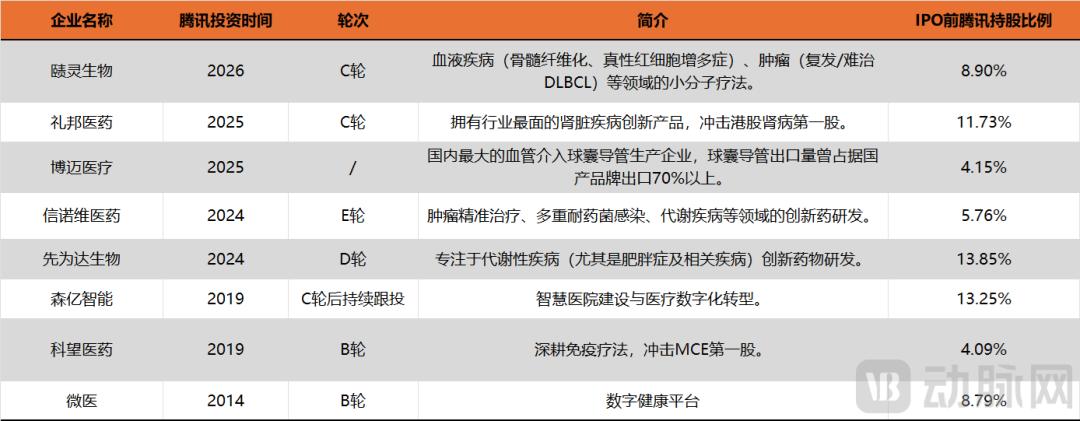
Tencent's medical investments: Distribution of companies that have submitted IPO applications
The IPO window period for innovative pharmaceuticals coincides with Tencent's investment rhythm. Tencent has boldly entered the late stages of investments in innovative pharmaceuticals and has fortunately caught the revival of IPOs for innovative pharmaceuticals. In 2024, when pharmaceutical investments were still in the adjustment phase, Tencent had already actively invested in innovative pharmaceuticals. After the industry clearly revived in 2025, Tencent further increased its investments in innovative pharmaceuticals.
In the innovative pharmaceutical industry, Tencent usually follows the strategy of a late, large - scale investment push. Most investments are concentrated in the last financing round before a company's IPO. Typical examples are Zeling Biotech, Libang Pharmaceutical, Xynovio, and Sinovac Biotech. Entering after the invested company has demonstrated clear business prospects and a mature technology platform is safer.
The future has confirmed Tencent's assessment: Many of the invested companies still show strong growth potential and have completed numerous BD transactions, indicating strong growth potential. For example, Xynovio has completed BD transactions with well - known pharmaceutical companies such as Astellas Pharma, Evoque Pharma, and China Antibody, and the total transaction amount (including upfront payments and milestone payments) has already exceeded 2 billion US dollars.
Corvium completed a global strategic partnership with Astellas Pharma in 2023 to promote the joint development of candidate drugs based on the BiME® platform. The total amount of the partnership exceeds 1.7 billion US dollars.
Sinovac Biotech has signed a cooperation agreement with Pfizer. Pfizer obtains the exclusive commercial right to the GLP - 1 - based weight - loss drug Xevonta in China. Sinovac Biotech has the right to receive a maximum payment of up to 495 million US dollars from Pfizer.
Cornerstone investments are also a major form for Tencent to participate in medical IPOs. In the second half of 2025, the demand for cornerstone investments on the Hong Kong Stock Exchange was high, and Tencent has achieved rich profits from its cornerstone investments. In the medical field, Tencent has participated in the cornerstone subscriptions of the IPOs of VelosBio, MicroPort EndoTech, Insilico Medicine, and Livelihood Medical. The cornerstone investments in medical IPOs have also rewarded Tencent's investments with considerable book profits.
Tencent's cornerstone investments in medical IPOs are characterized by two features: First, the valuations are relatively low; second, Tencent focuses on top - tier assets with high security.
Take MicroPort EndoTech and Insilico Medicine as examples. The pre - IPO valuations of the two companies were about 15 billion yuan and 9.5 billion yuan respectively. Although the absolute values are not low, they are more attractive compared to comparable companies. The pre - IPO valuation of MicroPort Robotics, a comparable company to MicroPort EndoTech, was about 25 billion yuan, and that of Jingtai Technology, a comparable company to Insilico Medicine, was about 14 billion yuan. A reasonable price is the key to motivating Tencent to make cornerstone investments.
Tencent does not only invest in "cheap" companies. The companies selected by Tencent are all among the top 3 in their industries. Tencent prefers to invest in leading companies with clear growth directions. Such companies usually achieve good results after their IPOs and bring considerable book profits to Tencent.
Tencent's investment preferences
The medical segment has changed from Tencent's second - priority investment to a core investment. In addition to investing in medical companies through pre - IPO and cornerstone investments, Tencent also strengthens its presence in the healthcare sector through early - stage investments. Tencent is increasingly investing in the medical field. In 2025, Tencent invested in the healthcare sector 10 times, and 7 times in 2024. In the last two years, Tencent has invested more in the medical field than in the artificial intelligence and gaming sectors.
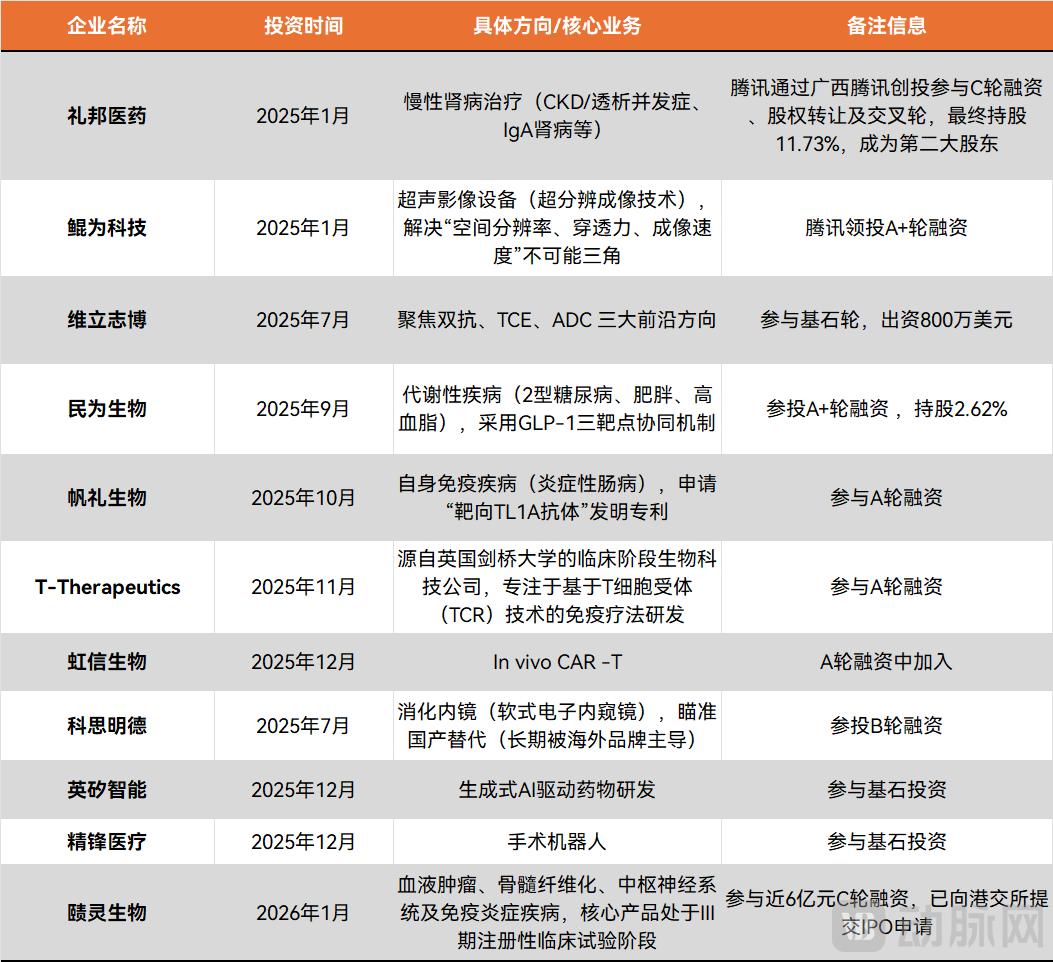
Medical companies in which Tencent has invested from 2025 to January 2026
Which healthcare industries does Tencent focus on?
In the innovative pharmaceutical industry, Tencent has made extensive investments. In 2025, Tencent invested in Hongxin Biotech, Fanli Biotech, T - Therapeutics, and Minwei Biotech and positioned itself in the segments of in vivo CAR - T, the autoimmune potential target TL1A, TCE immunotherapy, and obesity - metabolism.
In particular, in the obesity - metabolism industry, Tencent has invested in two companies, namely Sinovac Biotech and Minwei Biotech.
GLP - 1 drugs have quickly created a market of nearly 100 billion US dollars with a weight loss of 10% - 25% and have become the center of the pharmaceutical industry. Among many candidates, the companies invested in by Tencent are among the top companies in China: They are ahead in production progress, have impressive clinical data, and have also received support from MNCs through BD transactions.
The two GLP - 1 drugs invested in by Tencent also differ significantly and focus on different targets. Enoglutide of Sinovac Biotech is the world's first preferred GLP - 1 receptor agonist, which mainly acts through the cAMP signaling pathway instead of the usual β - arrestin signaling pathway. Enoglutide (Xevonta®) is already approved in China, and the clinical data of this product are significantly better than those of Semaglutide. Pfizer China has acquired the commercial right to this product in China for 495 million US dollars.
Minwei Biotech focused on the technological highlight of the three targets early on. Its GLP - 1/GIP/FGF21 receptor triple - agonist MWN105 has signed an overseas licensing agreement with a subsidiary of Novo Nordisk, and the product has already entered the second clinical phase in China.
The field of immunotherapy is also a preferred area for Tencent. Immunotherapy is a treatment method that activates or enhances the body's immune system to recognize and eliminate abnormal cells (such as cancer cells). After years of development, a pattern of cooperation among multiple technologies has emerged in immunotherapy. Among them, CAR - T and TCE (T - cell coupler) are the two most notable core areas, and there are also emerging directions such as TCR - T, TIL, and cancer vaccines.
Tencent has positioned itself in the segments of in vivo CAR - T, TCE, and TCR - T in immunotherapy, thus comprehensively developing immunotherapy.
In the highly competitive in vivo CAR - T industry, Tencent has invested in the leading company Hongxin Biotech. In vivo CAR - T has the potential to overcome the limitations of traditional CAR - T therapy, such as long treatment time and high costs, and achieve new breakthroughs in the treatment of cancer and autoimmune diseases. In 2025, this industry experienced a BD boom phase, and Hongxin Biotech is ahead in this area. The in vivo CAR - T of Hongxin Biotech's mRNA - LNP approach has entered the clinical research phase, and it has received the first clinical confirmation in humans, which is a milestone in the industry.
In the TCE field, Tencent participated in the cornerstone investment of VelosBio, the "first TCE company to go public". TCE therapy uses the body's own T cells to recognize and kill cancer cells. The design principle is that T cells are directed and activated towards tumor tissue by binding to the tumor - associated antigen (TAA) on tumor cells and the receptor on T cells to induce a targeted cytotoxic effect. TCE therapy "uses antibodies as a bridge to attack tumors with the existing T cells in the body" and does not require modification of T cells. In this area, BD transactions are active. The core product LBL - 034 of VelosBio, in which Tencent has invested, is the world's second - leading GPRC5D - directed TCE. The clinical data are comparable to CAR - T therapy, and the safety is even better. It was selected for an oral presentation at the ASH 2025.
In the TCR - T field, Tencent, together with Sanofi, invested in a foreign company, T - Therapeutics. TCR - T are genetically modified T cells that can recognize antigens in tumor cells by modifying the TCR (T - cell receptor) on the surface of T cells. TCR - T therapy gives T cells navigation so that they can find hidden tumor antigens and requires genetic modification of T cells. In this direction, Tencent participated in the Series A financing of the foreign company T - Therapeutics. The TCR platform OpTiMus® of T - Therapeutics can generate almost an infinite number of highly specific, fully human TCRs, making it possible to address intracellular targets that could not be treated medicinally before.
In the risky and diverse innovative pharmaceutical industry, Tencent follows the strategy of "casting a wide net", but it usually enters only after the concept and the activity of MNCs in BD transactions are confirmed to avoid the uncertainty risks in the early R & D stage.
In the medical device field, Tencent invested in Kunwei Technology, Bomei Medical, and Kesi Mingde in 2025, which specialize in the segments of ultrasound imaging, interventional balloons, and endoscopes. In the medical device field, Tencent prefers industries with mature commercialization. The industries of interventional balloons and endoscopes have a global market of over 10 billion yuan, the commercialization is well - proven, and the market is in a growth phase. At the same time, the companies invested in by Tencent usually have global commercialization capabilities and a high proportion of foreign revenues. For example, the export of interventional balloons of Bomei Medical accounts for more than 50% of the Chinese brand market, and foreign revenues contribute more than half of the turnover.
When investing in medical device companies, Tencent not only pays attention to innovative assets but also to manufacturing capabilities. The companies invested in by Tencent not only have the ability to obtain innovative Class - III certificates but also have extensive manufacturing capabilities that usually cannot be quickly replicated in a short time.
The selection of the right people is also an important factor in medical investments. From this perspective, many of the companies invested in by Tencent have founding teams composed of top investors and scientists. For example, Corvium was founded by Ji Xiaohui, a former partner of Lilly Asia Ventures, and Lu Hongtao, a well - known immunologist who has worked in top institutions in the United States in tumor immunology for many years. Qiang Jing, the founder of Xynovio, is an experienced investor.