The top-secret WeChat AI project has been exposed, but a former Tencent employee has already developed it in Silicon Valley.
At 2:06 a.m. on March 11, Pony Ma reposted an article on his WeChat Moments about Tencent's launch of the full - scale "Lobster" product matrix, with the caption: "A batch of products are coming one after another."
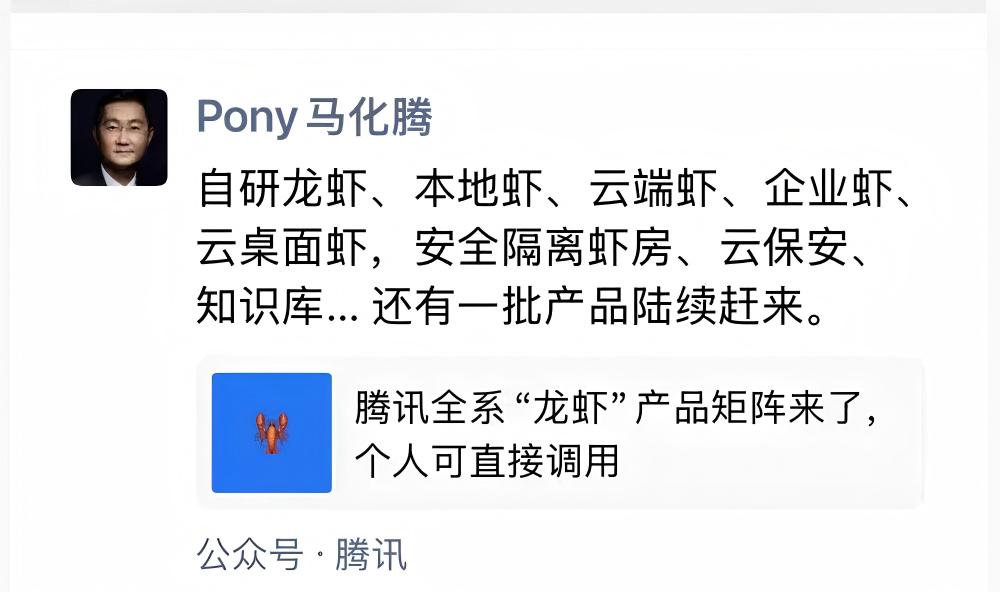
He posted late at night with a restrained tone.
But the signal is extremely strong - this is Tencent's highest - level positive response to the recent "shrimp - raising" craze that has swept the entire network.
Meanwhile, an even more significant piece of news is fermenting.
According to an exclusive report by The Information, Tencent is secretly developing a "top - secret" AI intelligent agent project for WeChat. It plans to start a gray - scale test in the middle of 2026 and launch it to all users in the third quarter.
People familiar with the matter revealed that the project has been classified as highly confidential within the company, and its start time can be traced back to at least the first half of last year.
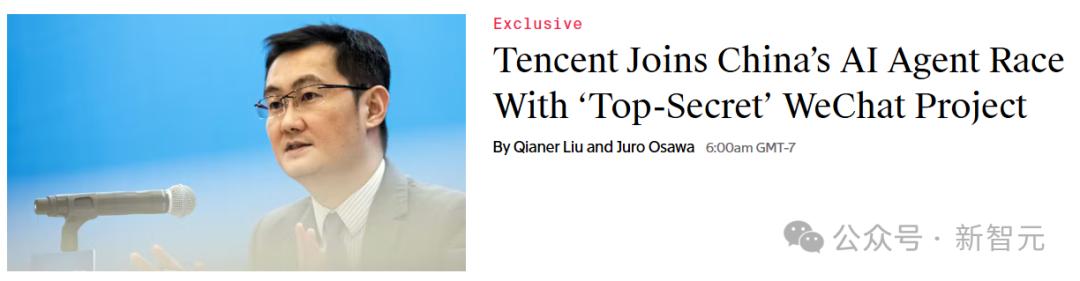
Once launched, this intelligent agent will connect millions of mini - programs on the WeChat platform, covering services such as car - hailing, food delivery, and ticket booking.
Users only need to say a word to the AI in WeChat, and the AI can automatically call the corresponding mini - program to complete the operation - evolving from a "social entrance" to an "intelligent task center".
The reason why this news is so explosive is that it reveals a cruel fact: the key to winning the AI competition has shifted from "whose model is stronger" to "who can get closer to users".
WeChat, with 1.4 billion monthly active users, is Tencent's biggest card.
However, what you may not expect is that what WeChat wants to do but hasn't achieved yet, a startup in Silicon Valley has already taken the lead and provided an answer, more than a year ahead of WeChat's top - secret plan.
It's called Teamily AI.
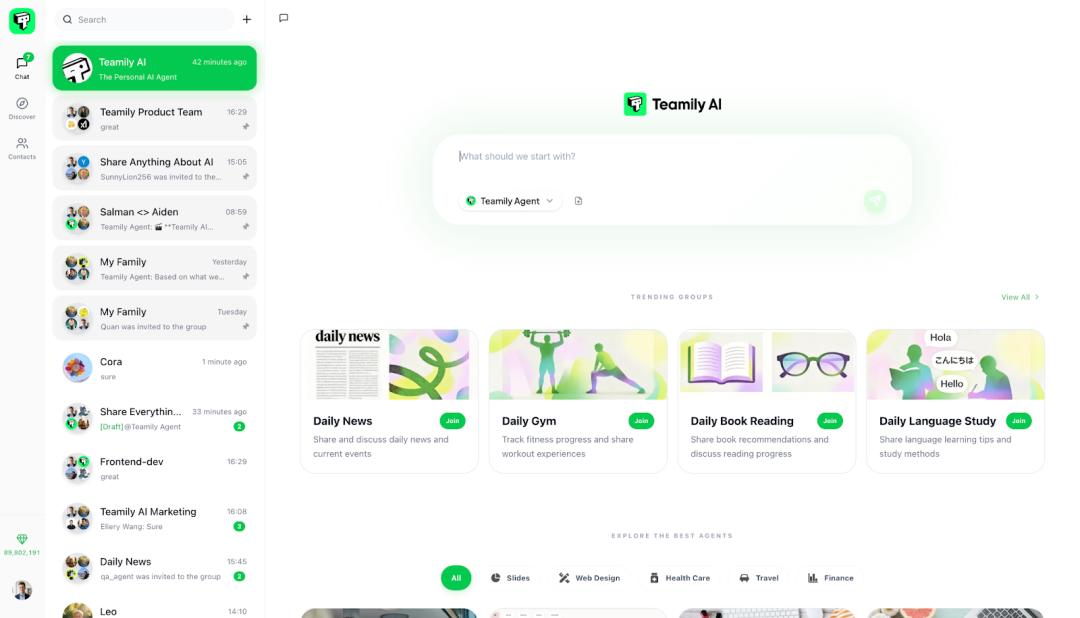
Teamily AI official website: https://teamily.ai/
From "revolving around one person" to "group - invading group chats"
Let's start with the background.
In the past two years, the evolution speed of AI can be described as exceeding expectations.
From ChatGPT to the popular OpenClaw, tasks such as writing code, developing applications, and generating solutions - many jobs that originally required the cooperation of multiple people have been compressed into "one person + one model".
You open a window, put forward requirements, and the AI responds. It is your assistant, your extra help, and your executive clone.
But the problem is: this single - person execution model starts to falter once it enters a multi - person collaboration scenario.
AI can indeed help you polish a passage, but it is difficult to continuously participate in an entire discussion; it can generate content, but it can't keep up with the division of labor changes, priority adjustments, and decision - making rhythms in a multi - person context.
To put it simply, current AI only solves the problem of "making individuals stronger", but hardly touches the proposition of "making groups smarter".
What Teamily AI does is precisely to break through this ceiling.
On this platform, AI Agents are no longer independent dialogue windows. Instead, they can be directly added to your friend groups, work groups, and industry groups, and participate in discussions, accept tasks, and execute operations like a real "group member".
More importantly, multiple Agents with different functions can collaborate in the group simultaneously, divide labor among themselves, and even actively promote tasks.
For example, the following video shows that by using a prompt "Create a security software", three Agents were automatically summoned to the group to work together: the Market Researcher was responsible for market and commercialization research, the Web Developer created the landing page of the product, and the Slide Assistant created a set of business plans for investors.
In the future, with the introduction of a Coding Agent, there is a chance to directly complete the development of software products. It can truly achieve a one - person company.
For the first time, carbon - based and silicon - based beings coexist, communicate, collaborate, and create in the same social network.
The seamless symbiotic scenario between humans and machines in science - fiction movies has really become a reality.
Full coverage of friend groups, work groups, and industry groups
How powerful is Teamily AI?
Let's experience it from three of the most common scenarios.
The "super fun - making partner" in friend groups
What's the atmosphere like in friend groups?
There are gossips, complaints, and flying emojis everywhere. Once the atmosphere gets going, no one can control it.
In Teamily AI, you can directly add an AI Agent to such a scenario.
For example, if you casually post a funny picture in a group of female friends, several friends in the group take turns asking the AI to have some fun. Some want to add elements, and some want more outrageous ideas - the AI can steadily understand the instructions of different people throughout the process, directly generate second - created pictures that meet the requirements, and even add its own creative inspiration actively.
In a friend's investment and stock - trading group, they created three Agents. One is a stock expert, with a certain friend's investment experience written into it; the second is an expert on the Middle East war situation, analyzing the impact of geopolitics on investment; and the third is an AI technology expert, specializing in exploring intelligent agents.
Friends asked the Agent team to remind him every three hours how to adjust his portfolio. He followed the advice, and the result was quite good. He earned a good return and also avoided a recent small - scale sharp decline.
The "AI collaboration engine" in work groups
Friend groups are just lively, but what really gives people a headache is work groups.
Office workers deeply understand that requirements are repeatedly changed, directions are adjusted temporarily, and everyone pulls back and forth in the group.
Each person can open an AI window to ask questions, but the context of each person is scattered in different dialog boxes, and the collaboration cost doesn't really decrease.
In Teamily AI, AI Agents can directly enter your workflow.
If you give it a market research report of thousands of words, the AI can sort out the structure and core logic in one or two minutes, and break down the research plan into a complete in - depth analysis report - from whether the data source is reliable, to whether the market analysis is complete, from whether the target users are fully characterized, to where the subsequent optimization space lies, each dimension is expanded item by item.
In response to the follow - up questions from colleagues in the group, it can even directly provide a business - level analysis report, presenting the competitive relationship in matrix and comparison charts in a visual way.
This is not a simple document assistant; it is a complete set of AI collaboration engines embedded in group chats.
The "thesis killer" in industry groups
What's the most headache in industry groups?
Long theses.
They are often dozens of pages long, with formulas page after page. You want to read them but don't have the patience to read them from beginning to end.
In Teamily AI, a 100 - page thesis can be summarized with the key points in five seconds, and even the limitations are separately marked to remind you.
When AI Agents can understand the context, remember the discussion context, and process pictures, videos, and long texts, many communication links are naturally compressed.
Moreover, in this process, the more people communicate with the Agents, the smarter the Agents become.
This is the "collective intelligence" emphasized by Teamily AI - a group of people can help a group of Agents become smarter together.
Zero deployment, build your Lobster Legion
Speaking of the hottest keyword in the tech circle in the past month - OpenClaw, netizens' discussions around it focus on: how to deploy it exactly? How to buy a Mac mini more cost - effectively? How to ensure privacy?
Tinkering with hardware, running the environment, and configuring the model have a relatively high threshold.
But in Teamily AI, this whole process is directly skipped.
You don't need to deploy it locally at all, nor do you need to prepare additional equipment. You just need to create a new Agent, and a dedicated OpenClaw for you will appear in the list.
You can chat with it, assign tasks to it, and let it execute. It can also connect to your Gmail, Slack, GitHub and other accounts, send emails for you, synchronize information, and handle affairs.
Compared with the model that requires you to build the environment yourself and bear the risks yourself, this form is much more user - friendly for ordinary users.
In addition to creating your own Agents, Teamily AI also has a large number of built - in Agent experts proficient in different fields: text polishing, market research, health advice, travel planning, stock analysis... All kinds of types are lined up and can be dispatched at any time.
Global memory: human - to - human communication makes AI more intelligent
Memory is an underlying proposition that cannot be bypassed in building a multi - agent society.
There are fundamental differences in the permission model, read - write protocol, and data structure between the memory of intelligent agents like Lobster and the storage of social IM. The former needs to understand semantics, distinguish roles, and schedule across groups, while the latter only needs to store and retrieve text according to the timeline.
It is almost impossible to patch and integrate the global memory of humans and AI on the old architecture in the short term.
Teamily AI is realizing real AI social memory: summarizing the interactions between humans and AI Agents, and between multiple people and multiple Agent groups. When recalling an event, it can restore the participation perspectives of different roles and even remember the formation process of the memory itself.
This reminds people of Minsky's concept in "The Society of Mind" in 1986 - memory is a distributed and hierarchical intelligent agent network, rather than a storage and retrieval system.
Forty years later, it has finally become a reality.
This is precisely the ability that the splicing scheme of "old - era IM + new - era Lobster" does not have.
A real new species must rebuild the IM base, self - develop the Agent execution layer, and design the whole link natively to achieve product - level high availability.
The three - layer architecture supports the underlying logic of human - machine symbiosis
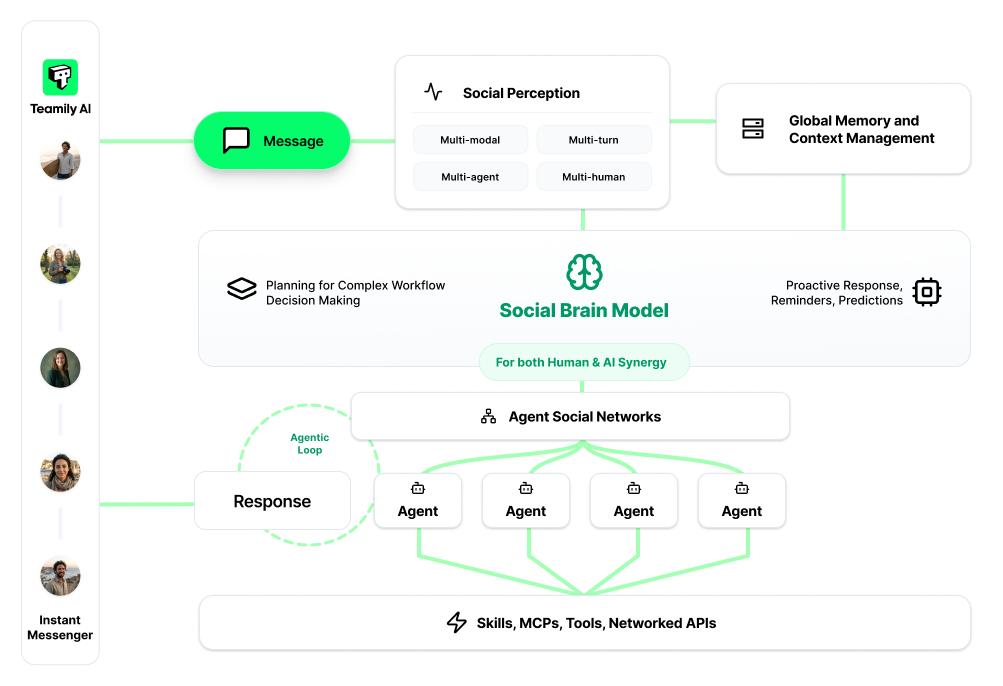
First layer: Global Memory & Context Management.
The system can continuously understand the complete context in group chats - including multi - modal content, multi - round conversations, and multi - role participation, making long - term collaboration continuous.
Traditional chatbots mostly have one - to - one interactions and are prone to hallucinations in group chats with mixed topics.
Teamily AI uniformly transforms and understands rich media content such as videos, music, pictures, and links, and uses multi - level search and compression technologies to ensure that the AI won't "forget while chatting".
Second layer: Social Brain Model.
This is the decision - making center of the system, responsible for understanding user intentions, breaking down complex goals into executable steps, and then distributing tasks to appropriate AI Agents or human members according to ability matching, while arranging the execution order and collaboration rhythm.
It can intelligently distinguish the urgency of events and independently decide whether to simply reply with a sentence or call complex background tools.
Third layer: Agent Social Network.
In this layer, the system performs real - time task allocation, progress coordination, and result integration, enabling multiple Agents and real members to closely cooperate and operate efficiently.
What's more worth mentioning is that Teamily AI's Agents also have the "adaptive response" ability - they can provide incremental information in a timely manner without being actively summoned.
For example, in a family group, it can actively remind "Don't forget, the child has a football game this afternoon."
The three - layer architecture progresses step by step. From memory as the foundation, to decision - making and scheduling, and then to collaboration implementation, it truly combines the carbon - based group and the silicon - based group into a mixed - team that can operate in the long term.
The most essential difference from traditional social products also lies in the database selection: WeChat and WhatsApp mostly use structured databases such as MySQL, with the core being text storage; while Teamily AI preferentially uses multi - modal vector databases, retaining embedding backups of all data, allowing the AI to truly "understand" rather than just "store" the data.
As the founder, Aiden Chaoyang He, said, the relationship between the two is like that between a fuel - powered car and an electric self - driving car - they look similar, but the product structure and imagination space are no longer in the same era.
From Tencent, USC Ph.D.s, Silicon Valley tech giants' scientists to the latest startup project
For such a set of underlying technologies to be truly implemented into a product, the background of the team behind it is naturally not shallow.
The founder, Aiden Chaoyang He, obtained a Ph.D. in the Department of Computer Science at the University of Southern California, with a research focus on distributed machine learning and the efficient training of large - scale foundation models.
Before starting his entrepreneurial journey, he served as an engineering manager and software engineer at Tencent, and also worked at Google, Meta (Facebook), and Baidu, with more than ten years of experience in AI and large - scale Internet product engineering.
Another founder, Salman Avestimehr, is an IEEE fellow and a Dean's Professor at the University of Southern California. He has more than 20 years of R & D leadership experience in the fields of machine learning, information theory, security, and privacy. He served as the first director of the USC - Amazon Center for Trustworthy Machine Learning and received the Presidential Award for his profound contributions in information technology.
His pioneering work in the fields of security, privacy, and distributed computing provides a solid theoretical and practical foundation for Teamily AI to build memory boundaries and data protection systems across groups.
The other members of the team graduated from well - known universities such as Stanford, Berkeley, MIT, and Tsinghua, and have been responsible for large - model or ToC product - related work at companies such as Apple, Amazon, Google, Tencent, and ByteDance.
The two founders have been collaborating for more than six years. One focuses on system construction and product evolution, and the other delves into frontier research and theoretical breakthroughs.
Teamily AI plans to start a new round of financing in March this year.
Forbes columnist Charlie Fink highly praised this product in a recent report, saying that it has "brought the Agent team into the human team".