Large companies are collectively promoting "lobster farming", and the anxiety syndrome in the era of "super individuals" has broken out.
In the spring breeze of 2026, it blew towards a "lobster", stirring up the entire Chinese technology circle.
From the long queues of thousands of people at the Tencent Building in Shenzhen and the Baidu Building in Beijing to the widespread craze of "raising lobsters nationwide" on Douyin, OpenClaw has, in a very short time, made people truly feel for the first time that AI is no longer just a "chatbot" in the dialog box, but a "digital employee" that can really do work for you and take over your computer.
What's even more noteworthy is that the big Internet companies have collectively entered the "lobster - raising" arena. Within just one month, more than a dozen technology giants such as Tencent, Alibaba, ByteDance, Baidu, and Xiaomi have successively entered the fray. Tencent launched three related products in one day. ByteDance launched ArkClaw, Alibaba introduced CoPaw and HiClaw, Baidu launched the mobile version of OpenClaw, and Xiaomi initiated a small - scale closed - beta test of Xiaomi miclaw.
Behind this "lobster - raising" craze is the competition among technology giants for a new entry point as the AI wave accelerates towards full - scale adoption by the public. It is also the proactive embrace of AI by ordinary people before they worry about their jobs being replaced by AI at any time. Moreover, it is their eager pursuit of the opportunity to reverse their personal fates when they see a new trend. Meanwhile, those who blindly follow the trend have also tasted the bitter fruit of the "money - burning" nature of OpenClaw, as the so - called "lobster - raising courses" and "OpenClaw installation services" are taking advantage of them.
Overall, people have already sensed that the trend of AI is irresistible. However, the technology for the vertical application scenarios of OpenClaw still needs continuous improvement. It will further penetrate all walks of life and even change the rules and patterns of some industries.
From "able to talk" to "able to do things": What makes OpenClaw a legend?
To understand why OpenClaw has become so popular, we first need to see the essential differences between it and traditional large models.
In the past two years, our way of using AI has been passive - we have to sit in front of the screen, open a web page or an app, enter instructions, wait for the generation, and then copy and paste. This "question - and - answer" mode is like a super - brain locked in a cage: it has a mouth but no hands and feet; it can talk but can't do work.
OpenClaw gives this super - brain "hands and feet". It is an automated intelligent agent framework with a headless architecture, and its core lies in "letting AI really do the work". Different from conversational AIs such as ChatGPT and Doubao, OpenClaw can run directly on your local device or server. Through browser automation, file operations, and API calls, it can handle specific tasks on your behalf. It is like an operating system that "equips the large model with a robotic arm", enabling AI to evolve from "able to talk" to "able to do things".
The core differences of this evolution are reflected in several aspects -
First is the interaction mode. Traditional AI is "passively responsive": you ask a question, it gives an answer, and then the interaction ends. OpenClaw, on the other hand, is "goal - driven": you set a goal, and it will break down the steps on its own, call the system on its own, and adjust the path according to the results. For example, if you tell it to "organize the desktop files, classify them by type, generate today's work summary, and remind me to attend a meeting at 9 am tomorrow", it can really finish all the work for you, and you can just leave work.
Second is the memory ability. The conversations of traditional AI are "one - time"; each new session starts from scratch. OpenClaw comes with "persistent memory" and can remember user preferences and operation history. The more you use it, the better it understands you. It can even define the identity, personality, and permission boundaries of the AI through a file called SOUL.md, making the AI assistant have a "soul" like a real person.
Third is the execution ability. This is the most core difference. OpenClaw can silently read local files, execute Shell scripts, control browser rendering, and even decide on its own to help you regularly fetch specified news and generate briefings at 3 am. It can connect to tools such as WeChat, Feishu, and DingTalk. Usually, wherever you chat, the AI will be on standby. A developer sighed: "OpenClaw enables the large model to grow hands and feet that can take over the computer's mouse and keyboard."
However, OpenClaw is not perfect. Its deployment threshold is extremely high. The complex environment configuration and the intimidating command - line interface make it difficult for ordinary office workers to operate. The whole process takes at least half an hour to an hour, and those with little technical knowledge basically give up as soon as they see the tutorial.
From an economic perspective, the significance of OpenClaw lies in creating a brand - new model consumption scenario. Different from traditional conversations, a single Agent task may consume hundreds of thousands or even millions of Tokens to complete closed - loop operations such as writing code, calling tools across applications, and reading files. Heavy users consume between 30 million and 100 million Tokens per day, which is dozens or even hundreds of times that of traditional chat users.
In short, the popularity of OpenClaw is not accidental, and its advantages and disadvantages are still being widely discussed.
In specific operations, currently, OpenClaw has found applications in multiple fields: article writers use it to automatically collect materials and generate first drafts; corporate legal counsels let it scan contracts and identify risk clauses; and some developers even try to connect it to medical databases to create a prototype of an "AI intelligent doctor".
Undoubtedly, one of the industries that has responded most quickly and applied OpenClaw most deeply is the e - commerce industry. From "able to talk" to "able to do things", the "lobster - raising craze" seems to be reshaping every aspect of the e - commerce industry.
The e - commerce people's "lobster - raising" record: From surprise to sobriety
The impact of OpenClaw on the e - commerce industry first occurred on the computers of front - line sellers.
Let's first look at the positive side. An Amazon seller connected OpenClaw to the four core aspects of daily operations. On the customer service side, it can automatically identify whether an email is a "request for an invoice" or a "logistics consultation", generate a draft reply and save it for sending, and the seller only needs to spend 10 minutes checking it every day. On the negative review warning side, it can regularly scan the review section of the Listing, and immediately push a notification via Telegram when it finds a 1 - 3 star review. It can even match the order information in the background according to the buyer's name. On the competitor monitoring side, it can check the prices of competitors every two hours and generate a trend table to alert the seller once the price drops by more than 10%. On the advertising report side, it automatically logs in to the background to download data at 9 am every day and uses AI to summarize that "the ACOS increased by 5% yesterday, mainly due to the decline in the conversion rate of SKU - B".
It is roughly estimated that if an OpenClaw functions fully, it can directly take over back - end positions such as order tracking, customer service, and supplier liaison.
Another seller of customized products has made a deeper attempt. His team's process highly depends on Feishu's multi - dimensional table. Graphic needs docking, order processing, and after - sales logistics follow - up are all carried out in Feishu. After connecting OpenClaw, three core functions have been achieved: logistics tracking - by using a Python script to connect Feishu and the logistics provider's API, it automatically updates the logistics status and notifies colleagues to follow up; multi - sub - table collaboration - after the tasks in Table A are completed, they are automatically copied to Table B, eliminating the monthly limit on the number of Feishu automation operations; competitor data collection and analysis - by giving tasks in plain language, it can output an analysis of advantages and disadvantages according to the required fields. He estimated that "if an OpenClaw functions fully, it can directly take over all the back - end work".
Taobao merchants have also benefited. A seller tried to use OpenClaw to test product listing. Through conversations, it can search for product categories and generate file templates, which has indeed improved efficiency. For e - commerce sellers who need to handle a large amount of repetitive work every day, this automation ability is undoubtedly attractive.
The boldest attempt comes from a Xianyu seller. During the Spring Festival, he thought about using OpenClaw to help him sell goods automatically. At that time, there was no relevant Skill for Xianyu, and he was afraid that OpenClaw would click randomly if it directly operated the web page, so he decided to develop a connection between OpenClaw and Xianyu himself. After a week of practice, he found that OpenClaw can indeed do some things - such as handling technology - related and content - generation tasks, Excel processing, and software development.
However, on the other side of the spotlight, there are many deficiencies and hidden dangers in OpenClaw.
First is the limitation of use cases. The Xianyu seller found that OpenClaw can only handle technology - related and content - generation tasks. Since Xianyu does not support file sending, how to send the completed work to customers after OpenClaw finishes its task requires connecting other functions. "At the beginning, I basically watched it the whole time, afraid that it would talk nonsense with customers." This "watching - the - whole - time" mentality precisely reveals the current embarrassment of OpenClaw - it still cannot truly achieve "fully automated operation".
Second is the problem of technical thresholds and stability. A Taobao seller hit a wall during the test - when uploading pictures, Taobao's anti - AI mechanism is too strong. "Many operations are easy for humans but difficult for AI." What's even more frustrating is that continuous errors suddenly occurred during the test, and changing several models didn't work. He said with a bitter smile: "It's like the gold - diggers didn't find gold, but the ones selling shovels made money."
The algorithm engineer Qiufeng pointed out that the technology of OpenClaw itself is not particularly amazing. The underlying Agent Loop architecture was a relatively common consensus in the industry by the end of 2025. As an open - source project, the framework is bloated due to excessive function stacking, and there are also problems with the execution mechanism: once a task is started, OpenClaw cannot receive feedback in real - time and correct errors like a human. "If you find that the instruction is wrong and want it to stop, it won't stop immediately. It has to finish the previous instruction completely before processing the next one."
The most worrying issue is the security risk. Technology experts remind that OpenClaw has AI hallucinations. Coupled with its ability to replace users to complete some operations, it will magnify the negative impact of these hallucinations - "OpenClaw may misinterpret user requirements, give wrong answers, and then automatically send them on behalf of the user."
Some users found that the "lobster" suddenly started deleting emails in batches, and they couldn't stop it. A technology expert installed OpenClaw on an independent computer instead of the commonly used one. "Since the 'lobster' needs to read your email, contacts, and files, who can be sure that there is no active or passive leakage when it reads this information?" There have even been leaked OpenClaw instances on the Internet, with the default ports all open. "All the information is leaked, and it even has the highest system privileges."
Cost is also an issue that cannot be ignored. A product manager pays hundreds of dollars in Token fees every month and jokes that he is "working on loan". Before the emergence of large models, he hardly had the habit of paying for products. The operating costs of OpenClaw include API call fees, storage costs, electricity costs, etc., which are a significant expense for individual users and small sellers.
What's even more worthy of vigilance is that if ordinary people easily let AI take over their computers and even need third - parties on e - commerce platforms to participate in the deployment, the hidden risks are obvious. Currently, the biggest use of OpenClaw is to handle some low - level, cumbersome, and repetitive tasks for humans. This is very useful for enterprises that need to face a large amount of such work every day, but there is really no need for ordinary people to follow the trend blindly. Because after installation, they may find that they don't have that many tasks for AI to do.
Its far - reaching impact on the e - commerce and other industrial patterns - when AI really starts to do work, every aspect of e - commerce operations, from product selection, customer service to inventory management, may be redefined.
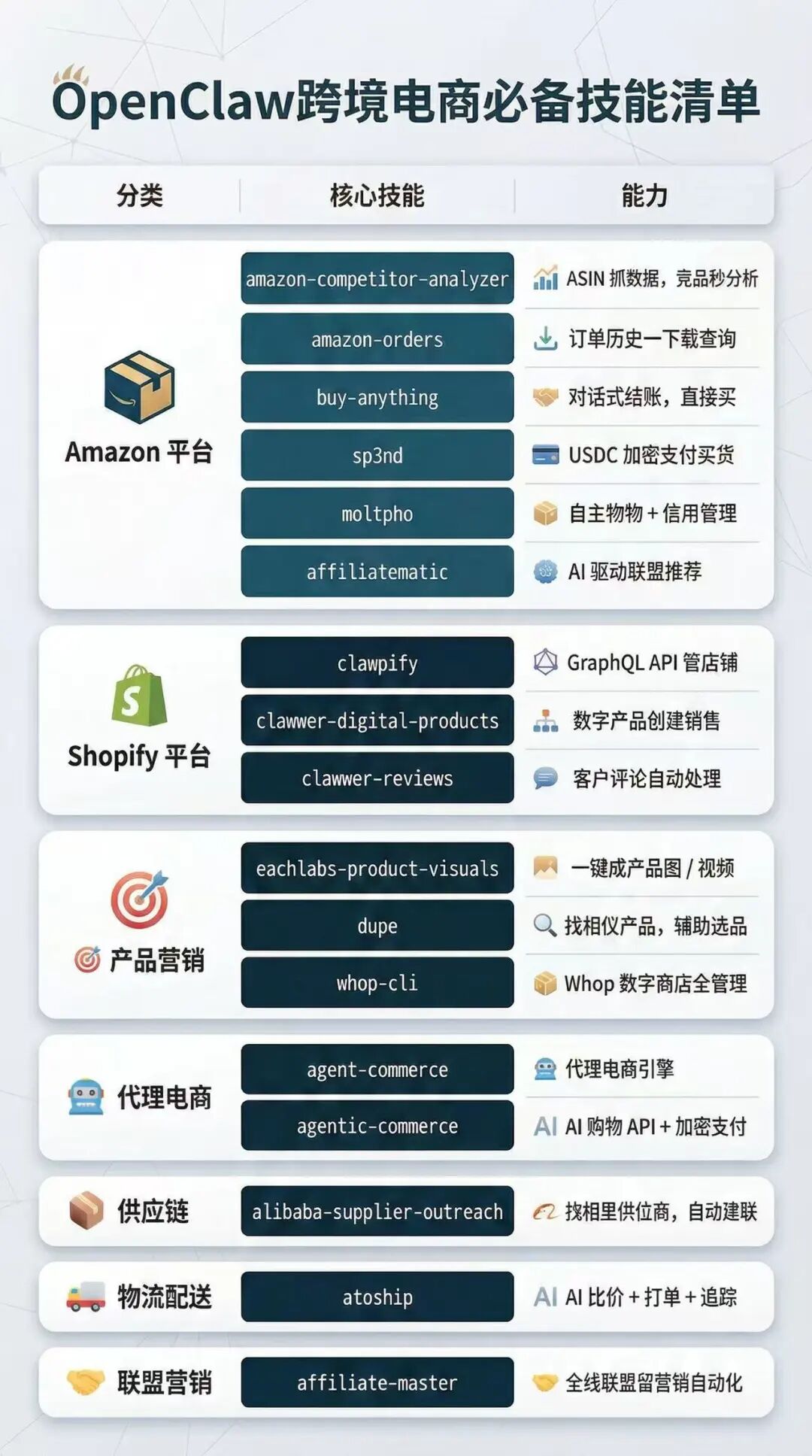
(Picture from the Internet)
Overall, the upper limit of OpenClaw's capabilities depends on the capabilities of the large model it calls. Connecting to a model with poor capabilities is like hiring an enthusiastic but error - prone intern.
However, it is precisely this "insecurity" and "immaturity" that have contributed to the popularity of OpenClaw. Its open - source nature allows it to be arbitrarily modified, deployed, and connected to various social platforms, which has led to its rapid spread on the Internet. And the big companies with a keen sense of smell have seen greater opportunities in this wave.
The AI "new entry point" war of big companies
The big companies are more aware than anyone else of the popularity of OpenClaw.
The cloud providers were the first to take action. In late January, Alibaba Cloud launched a one - click deployment service for OpenClaw, pre - installing the operating environment and integrating the Tongyi Qianwen model. On January 28, Volcengine announced support for rapid deployment and integrated Feishu applications. On January 30, Tencent Cloud launched a Lighthouse application template. On February 2, Baidu Smart Cloud also joined the battle.
But the real battle started on March 9. Tencent launched three products in one day: QClaw, launched by Tencent Computer Manager, supports both Mac and Windows platforms and features zero - configuration connection with WeChat; the OpenClaw intelligent robot for Enterprise WeChat is for enterprise collaboration; and WorkBuddy is the complete form of Tencent's "little lobster", which can seamlessly connect to QQ, Feishu, and DingTalk.
On the same day, ByteDance's Volcengine launched ArkClaw - a ready - to - use cloud - based SaaS version that is deeply compatible with Feishu plugins. The Tongyi Laboratory of Alibaba Cloud introduced CoPaw, which features a unified "local + cloud" experience, allowing users to add custom Skills on their own.
Baidu chose e - commerce as its entry point. On February 13, Baidu's official e - commerce Skill for Baidu Youxuan was officially launched on ClawHub, becoming the first official - level e - commerce capability plugin in the OpenClaw ecosystem. It packages Baidu's product knowledge graph and CPS supply - chain capabilities into standardized tools, opening up capabilities such as CPS product library search, SPU cross - platform price comparison, multi - product parameter comparison, and word - of - mouth summary. This means that the intelligent agent can now complete the entire process of e - commerce tasks from product search to decision - making and ordering in one stop.
On the surface, this battle is about whose "lobster" is more useful and easier to install, and who can keep up with the trend faster. But in essence, OpenClaw has hit several areas that have worried the big Internet companies in the past two years -
The first layer of anxiety is "idle computing power". In the past two years, the three giants, ByteDance, Alibaba, and Tencent, have invested an estimated over $60 billion in computing power infrastructure, with thousands of accelerator cards running day and night. However, if users don't make calls, the computing power becomes idle assets that burn money every day. What's more embarrassing is that the Token consumption in the C - end user conversation mode is too low - writing an occasional email or drawing a picture, this level of call volume can't fill the huge computing power cluster at all. The big companies urgently need a "Token black hole" that can continuously and automatically consume computing power.
The second layer of anxiety is "data depletion". The high - quality public text data on the Internet has been almost "eaten up