A post-2000 Yale doctor raises 300 million in financing: The robots he builds can hold eggs.
Recently, a post - 2000 Yale doctor's team has raised 300 million yuan in financing. The company is called Youliqi, and its core business is humanoid robots.
Suppose you are asked to spend 88,000 yuan to buy a robot that can hold an egg and fold clothes and take it home. Do you think it's cost - effective? If you think it is, you may be more interested in this company.
Youliqi can currently deliver about 100 products per month, and it has about 1,000 orders on hand, indicating that users have a certain level of interest and the demand is budding.
At least the capital is very interested. The company has only been established for 2 years, but its valuation has reached 1.8 billion yuan.
Through this article, you can see a trend: Capital is betting real money. Those robots that used to exist only in laboratories are entering hotels, restaurants, and families in batches and getting closer to us.
Starting from the Yale Laboratory
Yang Fengyu, the founder of Youliqi, is a post - 2000 and a Yale University doctor. He graduated from the University of Michigan in the United States with a major in computer science and once worked at Google DeepMind.
During his research overseas, he mainly focused on embodied intelligence and participated in the research and development of multimodal models. He is one of the main authors of the UniTouch large - scale model, which is the world's first model that integrates tactile sense. He is also the core author of the TouchandGo dataset, which is currently the world's largest visual - tactile dataset.
During his research, he found that most of today's humanoid robots are still in laboratories. Either their movements are too simple, or they rely on expensive sensors to perform fine operations. Therefore, it is difficult for them to be truly applied in real - world scenarios.
In 2024, Yang Fengyu returned to China and founded Youliqi in the Suzhou Industrial Park. The company's headquarters is located in Shanghai, and R & D centers are also set up in multiple locations.
In the early stage of entrepreneurship, the team continued to improve the technology while looking for suitable product directions for implementation. The company quickly determined its strategy: The robot should first be usable in real - world scenarios before considering large - scale production. The business focus is on the B - end commercial scenarios, while also taking into account the needs of families, scientific research, and education.
Following this direction, the team focused its R & D on two key issues: tactile perception and fine operation.
Youliqi invited robot experts such as Wang Hesheng to join the team, and he serves as the chief scientist. The team spent more than a year refining the UniTouch tactile large - scale model.
The concept of this model is very simple: Let the robot judge "what it touches" by "looking". This can reduce the use of expensive sensors, improve training efficiency, and reduce hardware costs.
With this set of capabilities, the robot can perform fine actions such as picking up tofu, holding an egg, and folding clothes, and can also execute continuous tasks such as cleaning, greeting guests, and delivering items.
As the technology matures, Youliqi has started to move from the research stage to the product stage.
In terms of route selection, the company pursues full - stack self - research. From algorithms, large - scale models, to core components such as joint modules and reducers, and then to adaptation solutions for different scenarios, most of them are completed by the internal team. The core members come from universities such as MIT and Peking University, as well as enterprises such as Huawei, DJI, and Ecovacs. Most of the key links from R & D, design to production are also in the hands of the company.
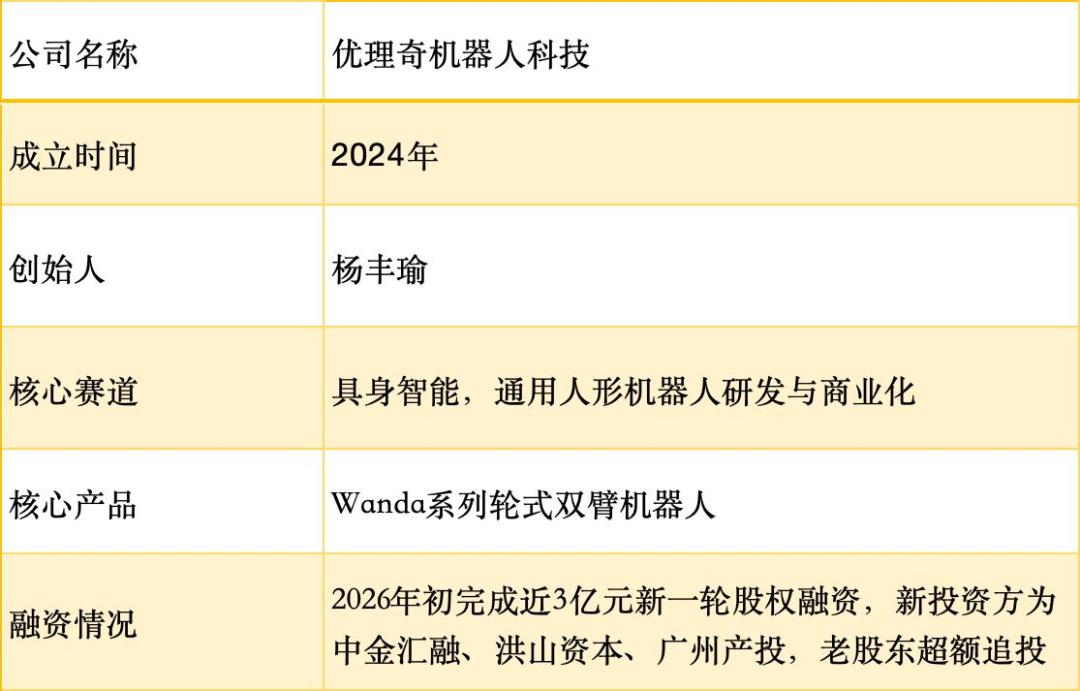
After settling in Suzhou, the company's financing pace has also significantly accelerated. In early 2026, Youliqi completed a new round of financing of nearly 300 million yuan. The new investors include Zhongjin Huirong, Hongshan Capital, and Guangzhou Industrial Investment, and the old shareholders continued to increase their investment. The funds are mainly used to expand the R & D team and build production capacity.
Currently, the company has launched the Wanda series of wheeled dual - arm robots and the Panther series of products. The monthly delivery volume exceeds 100 units, and the number of orders on hand exceeds 1,000. The products have been put into use in scenarios such as hotels, security, and retail catering. The entire team has gradually moved from the initial technology R & D stage to the product delivery and large - scale application stage.
Current Situation: Expansion of the Service Robot Scale
The rapid rise of Youliqi is related to seizing the development window period of embodied intelligent robots.
The year 2026 is regarded by many institutions as a year of accelerated mass production of robots. In the past few years, the industry mainly focused on technology R & D, and now it has entered the stage of delivery and large - scale production.
According to the information from the China Commercial Industry Research Institute, in terms of market scale, the global intelligent robot market scale is expected to reach 451.2 billion yuan in 2026, with a compound annual growth rate of 28.7% from 2021 to 2026. In the domestic market, the scale of service robots is expected to exceed 102 billion yuan for the first time, exceeding the scale of industrial robots.
The delivery volume of humanoid robots is also increasing. It is expected to deliver 60,000 - 80,000 units throughout 2026. In the second half of the year, the weekly production capacity of the industry is expected to reach 1,000 - 2,000 units. The application scenarios are expanding from scientific research and education to hotels, health care, security, and household services.
Technological progress is one of the key reasons for promoting the development of the industry. In the past, the biggest problems of humanoid robots were poor vision, inaccurate grasping, and high costs.
In recent years, technologies such as multimodal models, the combination of vision and touch, and imitation learning have gradually been implemented. Robots can now walk on complex terrains, perform fine grasping, and even execute continuous tasks such as cleaning rooms.
In terms of hardware, some enterprises have started to self - research core components and promote mass production, resulting in a decrease in costs. Taking Youliqi as an example, the starting price of its Martian series of household service robots is 88,000 yuan, which is lower than that of some similar products.
The demand side is also changing.
Against the background of an aging population, the demand for health care and escort robots continues to grow, with an annual growth rate of more than 30%. Industries such as hotels, retail, and security are more interested in service robots due to the rising labor costs. The procurement of embodied intelligent experimental equipment by universities and scientific research institutions is also expanding.
The International Federation of Robotics predicts that the global robot market scale will reach 350 billion US dollars in the future, with a compound annual growth rate of more than 15%. The Chinese market is expected to account for more than 30%.
However, the industry still faces common problems. Most robots are prone to errors when performing continuous tasks in real - world environments. Battery consumption and sensor drift can lead to shutdowns or repeated adjustments.
The cost of core components such as servo motors and precision joints is high, and the hardware often accounts for more than 60%, making mass production difficult. These factors limit the large - scale application of robots in scenarios such as catering, hotels, and health care.
Trend: Financing Values Mass - Production Capacity More
During the Spring Festival, many robot enterprises appeared on the Spring Festival Gala stage. After the Spring Festival, many enterprises disclosed their financing progress. The focus of industry discussions has also shifted from technological concepts to product delivery.
Not only Youliqi has received funding. Since 2026, Qiongche Intelligence has completed hundreds of millions of yuan in Series A financing, Xinghaitu has completed nearly 1 billion yuan in Series B financing, Wujie Power has completed more than 200 million yuan in Angel + round financing, and Zhipingfang has completed more than 1 billion yuan in Series B financing.
Different from the early stage when investors focused on technical parameters, now investors are more concerned about two things: whether the product can be mass - produced and whether it can be delivered in real - world scenarios. Whether an enterprise has stable delivery capabilities has become an important reference indicator. One reason why Youliqi has received multiple rounds of financing is that it has achieved a monthly delivery of more than 100 units. In the field of humanoid robots, the number of enterprises that can achieve "three - digit monthly delivery" is not large.
The way of industry competition is also changing.
In the early stage, most enterprises focused on a single link. Some did algorithms, some did hardware, and some focused on a specific application scenario. Now, more companies are starting to layout a complete system of "algorithm + hardware + scenario". Youliqi has launched the UniTouch tactile model and self - developed mechanical arms and mass - production product lines. Companies such as Ubtech and Unitree are also strengthening the construction of full - chain capabilities.
In addition, the number of mass - production enterprises has increased.
In 2025, the domestic humanoid robot enterprises that achieved large - scale mass production were mainly a few leading enterprises such as Unitree and Zhiyuan. By 2026, with the release of production capacity of enterprises such as Youliqi and Ubtech, the number of enterprises that have achieved mass - production and delivery has increased to more than 4. The industry has gradually shifted from a few enterprises' trials to multiple enterprises' parallel development.
Finally, the application scenarios are also expanding. Youliqi's Wanda 2.0 robot has been used in scenarios such as hotel cleaning, security patrol, and retail reception, and the new - generation Panther series has started delivery. Galaxy General's logistics robots are used for product shelving and replenishment. The household cleaning robots of Ecovacs and Roborock together account for more than 60% of the global market share.
Overall, the embodied intelligence industry is moving from the R & D stage to the delivery stage. The differences between enterprises are no longer only reflected in laboratory results, but in production capacity, cost, and scenario adaptation capabilities.
This article does not constitute any investment advice.
This article is from the WeChat official account "Pencil News" (ID: pencilnews), author: Song Ge. It is published by 36Kr with authorization.