Google "schneidet die Verluste ein" und reformiert: Dritte Zahlungsmethoden werden zugelassen, und die Provision von Google Play wird auf 20% gesenkt.
Google's parent company, Alphabet, has recently announced a fundamental reform of the Google Play Store system. The standard service fee for in-app purchases (IAP) will be reduced from the 30% that has been in effect for nearly 20 years to 20%, and the subscription service fee to 10%. In addition, the third - party payment system and third - party app stores will be fully opened. This is a radical reshaping of the business model of the Google Play App Store since its establishment.
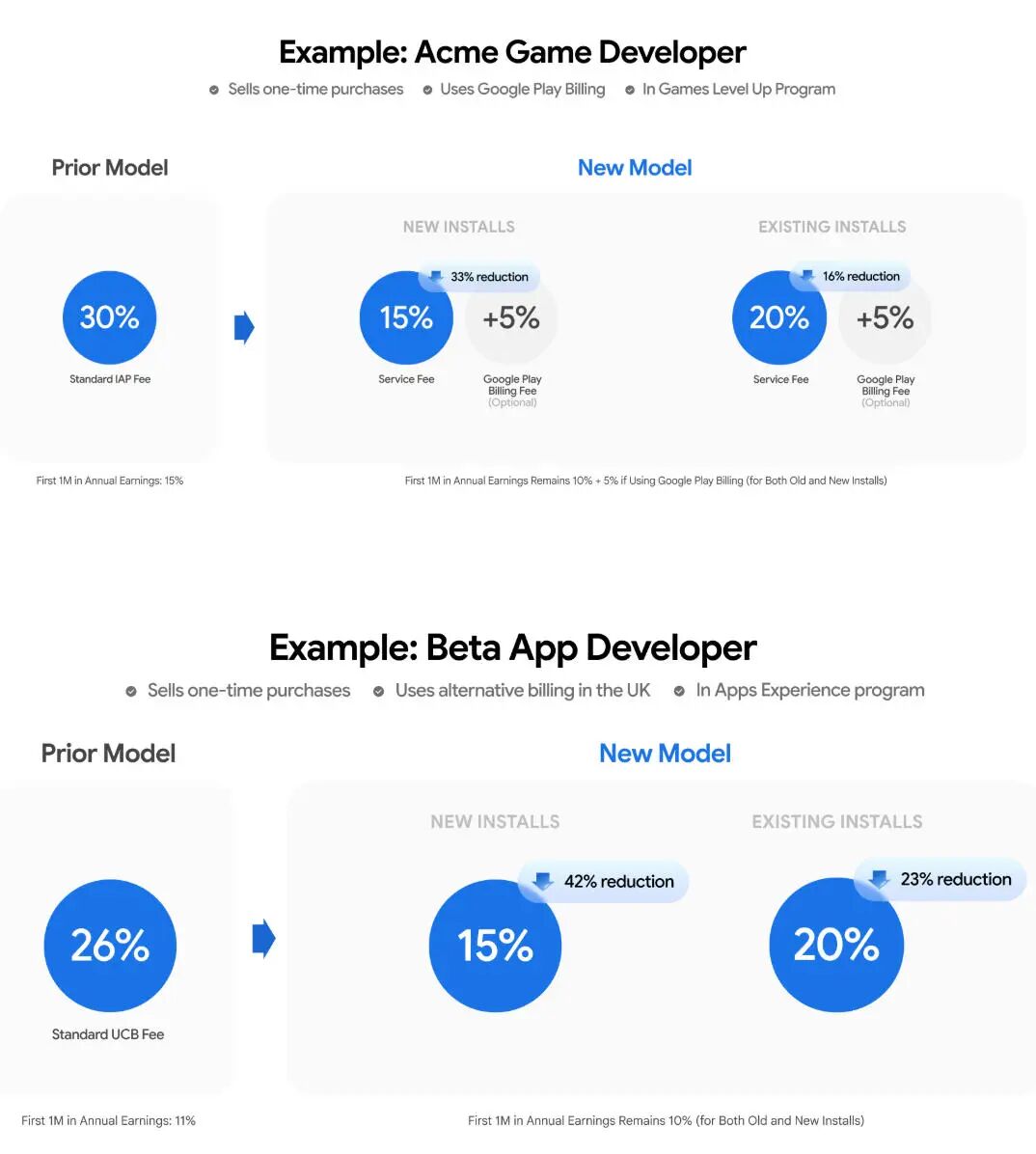
According to Google's official announcement, this fee reform is not a simple "one - size - fits - all" price cut. First, Google divides the previously combined 30% fees into a "basic service fee" and a "payment processing fee". For the basic service fee, the service fee for standard in - app purchases is reduced from 30% to 20%. For developers participating in the newly introduced "Apps Experience Program" or the improved "Games Level Up Program", the service fee for in - app purchases from new installation users of their apps can be further reduced to 15%, while the transactions of existing users remain at 20%. The commission for subscription services is uniformly reduced to 10%.
Regarding the payment processing fee, developers who still use Google's official Google Play Billing payment system must additionally pay 5% in the markets of the United States, the United Kingdom, and the European Economic Area (EEA). If developers use their own payment system or instruct users to complete the payment on an external website, they do not have to pay this fee. This means that for developers who choose to set up their own payment channels, the total cost can be reduced to a minimum of 15%, which is a halving compared to the previous 30%.
In addition to the fee adjustment, Google has also announced two "opening" policies. First, the "anti - steering" restriction has been completely lifted, which allows developers to clearly inform users in the app that external payment options are cheaper and directly provide links for redirection. Second, the "Registered App Stores" program is introduced, which enables third - party app stores that have been security - checked by Google to be more easily installed and run on Android devices, significantly simplifying the process of sideloading apps for users.
These new rules will be introduced globally in phases. The United States, the United Kingdom, and the European Economic Area will implement them first by June 30, 2026; Australia by September 30; South Korea and Japan by December 31; and the rest of the world is expected to fully implement them by September 30, 2027.
The direct trigger for Google's "sacrificial" reform was the long - drawn - out legal battle with Epic Games. In 2020, the game "Fortnite" was removed from the Google Play Store because Epic had introduced a direct payment option that bypassed Google's payment system. Subsequently, Epic filed an antitrust lawsuit against Google, accusing it of abusing the dominant position of the Android system in the app distribution and payment market.
After nearly five years of struggle, the two parties reached a comprehensive agreement under judicial supervision in November 2025. As part of the settlement agreement, Google has committed to making the above - mentioned fundamental adjustments to its business model. In February 2026, "Fortnite", which had been removed from the Google Play Store for nearly five years, returned. Tim Sweeney, the CEO of Epic Games, responded that the new program "is a better option for all developers".
In recent years, the scrutiny of the monopoly behavior of app stores in countries around the world has been steadily increasing. The EU's "Digital Markets Act" (DMA) explicitly requires the opening of third - party payment systems. The UK Competition Court has determined that the 30% commission of app stores represents an unfairly high price and that the appropriate range should be between 10% and 17.5%. The US court has also supported the demand for opening third - party payment systems in the Epic Games v. Apple lawsuit.
Currently, Samsung has already reduced the commission of the Galaxy Store from 30% to 20% in May 2025, and the Microsoft Xbox Store has even reduced the commission to 12%. The industry is gradually moving away from the "30% commission convention". As another major player in the industry, although the Apple App Store has opened third - party payment systems in the EU to comply with the "Digital Markets Act" and reduced the commission to 10% - 20%, it has not promoted this globally. Especially in the Chinese market, strict restrictions are maintained. The use of third - party payment channels and third - party app download channels is prohibited, and the commission can still be up to 30%.
This article is from the WeChat account "Jiemian News", author: Li Kefeng, published by 36Kr with permission.