After the national subsidy, the iPhone 17e costs 3,999 yuan. Is it going to "slaughter" the mid-range market?
At the beginning of 2026, several structural adjustments took place in the mobile phone industry.
Meizu announced the suspension of its mobile phone business, and Shen Wei, the founder of vivo, stepped down from the position of president.
Meanwhile, Apple released the iPhone 17e, with a starting price of 4,499 yuan. The 256GB version is expected to be priced at 3,999 yuan after the national subsidy is applied.
This pricing strategy has brought the iPhone into the traditional price range of domestic mid - range flagship phones.
At the beginning of 2026, the price of the memory market fluctuated, which affected the cost structure of the mobile phone industry.
The iPhone 17e entered the market with a starting storage of 256GB and a starting price of 4,499 yuan. Against the backdrop of some domestic mid - range models adjusting their pricing strategies during the same period, a specific market competition situation has been formed.
History always rhymes.
In 2013, Apple tried to expand its user base among price - sensitive consumers through products like the iPhone 5c, and the market response was complex.
In 2026, this strategic adjustment of the iPhone 17e reflects Apple's new round of exploration in the mid - range market.
From a market positioning analysis, the release of the iPhone 17e reflects Apple's strategic adjustment for the Chinese market. The business logic behind this strategy is to leverage the advantages of the supply chain scale to maintain product competitiveness during the cost - rising cycle.
Obviously, Apple is well - prepared, but will the domestic market buy it?
01
From "High - end Belief" to "Inclusive Harvesting"
The pricing strategy of the iPhone 17e marks a significant adjustment by Apple in the Chinese market.
With a starting price of 4,499 yuan and after the national subsidy, the actual purchase price enters the 4,000 - yuan range, which overlaps with the prices of domestic mid - range flagships such as the Redmi K series, realme GT series, and iQOO Neo series.
From the market data, there is a background for this adjustment.
According to Counterpoint data, in January 2026, the sales volume of smartphones in China decreased by 23% year - on - year. All major domestic brands experienced double - digit declines, while Apple maintained an 8% growth. Previously, the national subsidy policy had a significant stimulating effect on domestic mid - range phones, but it may also have led to the early release of some demand. The iPhone 17e's active adaptation to the national subsidy policy can be regarded as a rational response to the policy dividend.
Changes in the cost side are also crucial.
Around March 2026, the memory price increased significantly, and the average industry cost rose by 15% - 25%. Domestic mid - range phones generally faced price - increase pressure, and most products in the original 3,000 - yuan range have moved up to the 4,000 - yuan range. The iPhone 17e is priced at 4,499 yuan, and after the subsidy, it is positioned in the 3,000 - yuan range, objectively filling the market gap.
This strategy reflects Apple's dual considerations for the Chinese market: the growth space in the high - end market is limited, and moving down to the 4,000 - yuan range helps to expand the user base. At the same time, the relatively long replacement cycle of Android users, about 40 months (Counterpoint data in 2025), provides an opportunity to attract the conversion of existing users.
The target user group of the iPhone 17e includes some price - sensitive consumers, which is different from its previous product positioning.
It means that every user who switches from the Android camp may become a loyal user of Apple's future ecological consumption.
02
The Game between Inner Sincerity and Outer Restraint
Apple's product philosophy has always been "you have to give up something to gain something."
1. Inner Sincerity
The most surprising thing is the upgrade of the storage capacity, which is the most powerful weapon. The starting storage is 256GB, the same as the iPhone 17, and the price remains unchanged.
In March 2026, when the memory price increase wave swept across the entire industry, and domestic manufacturers were forced to cancel low - capacity versions or even cut entire product lines due to a 100% increase in DRAM prices, and the Chinese mobile phone industry was about to face a full - scale price increase.
Thanks to its strong bargaining power in the supply chain and inventory management, Apple achieved the anti - cycle operation of "increasing the quantity without increasing the price."
The introduction of the A19 processor is also meaningful.
Although this chip is not the top - of - the - line model, it is sufficient to support smooth use for the next three to four years, precisely meeting the core demand of mid - range users for "durability."
The upgrade of the 48 - megapixel main camera, combined with the 2x optical - quality telephoto lens, enables the iPhone 17e to "outperform" Android models in the same price range in terms of imaging capabilities.
The iPhone 17e is also equipped with fast charging. It can charge to 50% in 30 minutes with wired fast charging, and with 15W MagSafe wireless charging, it fills the last gap in iPhone's charging experience. The addition of the second - generation ultra - ceramic crystal panel further strengthens the core selling point of "durability."
For budget - sensitive users, "using it for a longer time" is more attractive than "using it better."
2. Outer Restraint
However, the outer "restraint" is also obvious.
This is exactly the core drawback of the iPhone 17e.
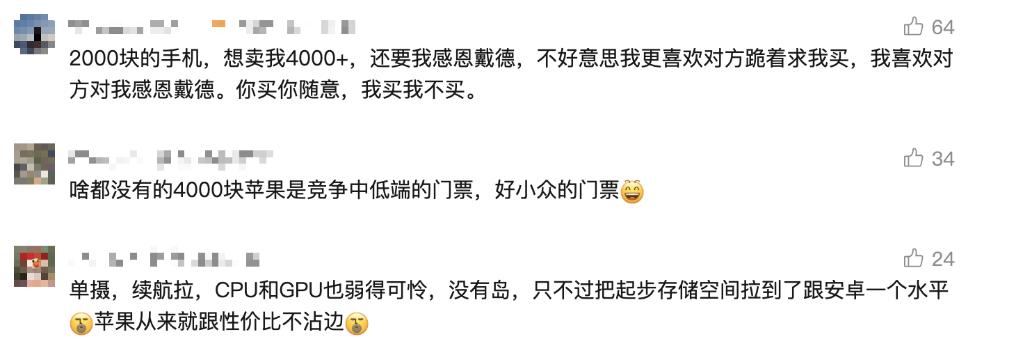
Image source: WeChat official account comment section
Not only does it not have the Dynamic Island, but the notch screen design looks out of place in 2026, and the 60Hz refresh rate is in sharp contrast to the 120Hz commonly used in the Android camp.
For Apple, these "cut - backs" are not only to save costs but also to create differentiation.
The Dynamic Island and ProMotion are the moats of the iPhone 17 series. If they are introduced to the e series, it will directly shake the premium foundation of high - end products.
This strategy of "loading on the inside and being stingy on the outside" is actually Apple's accurate portrait of the mid - range market.
Compared with the elegance of the Dynamic Island's animation, these users care more about whether WeChat lags, whether the photos are clear, and whether the battery is durable. In this way, Apple meets the most core needs with the lowest cost while maintaining the distinction of high - end products.
03
From "Stock Game" to "Clearing and Harvesting"
The release of the iPhone 17e coincides with the "full - scale price increase in the Chinese mobile phone industry."
Meizu's decline is just the beginning, and the chain reaction caused by the memory price increase is accelerating the reshuffle of the industry.
It is understood that some brands have issued price - adjustment notices to channel partners and distributors:
"The price adjustment of previously launched models is relatively moderate, but for new products launched after March, the price increase will be significantly larger. The minimum increase will not be less than 1,000 yuan, and the increase for mid - to high - end flagship models may reach 2,000 - 3,000 yuan."
According to industry insiders, some manufacturers are cutting the planning of mid - and low - end models:
"When storage was cheap from 2023 to 2024, a lot of replacement demand had been released. In 2026, manufacturers lack confidence in the mid - range market, and many planned models have been cancelled."
1. The "Killing Line" of Small and Medium - sized Brands Moves Down
In the past, the 4,000 - yuan range was the "safe zone" for domestic mid - range phones and the main battlefield for Redmi, realme, iQOO, etc.
They built a seemingly solid defense line in this price range by relying on extreme cost - effectiveness and rapid iteration.
However, the collective price increase after March 2026 will completely change the rules of the game. When these models are forced to move up to the 4,000 - yuan range, they will directly face the frontal impact of the iPhone 17e.
On one side are domestic mid - range phones with limited brand premium ability and increasing cost pressure, and on the other side is the iPhone 17e with the iOS ecosystem and the A19 chip at the same price after the subsidy.
For young users who are price - sensitive but have awakened brand awareness, the answer to this choice is not difficult.
Meizu's dilemma is a warning.
Its sales volume in 2025 was less than 1 million units, a year - on - year decrease of more than 40%. The Note series, which relied on the market below 600 yuan, could no longer survive due to the storage price increase.
When the iPhone 17e brings the battle to the 4,000 - yuan range, the survival space of third - tier manufacturers will be further compressed, and the collective clearance of the "Others" camp may only be a matter of time.
2. The "Leverage Effect" of the National Subsidy
The national subsidy aims to stimulate consumption and benefit the public, and the policy does not exclude foreign - funded brands.
It is worth noting that the iPhone 17e participates in the national subsidy while the iPhone 17 is not included in the subsidy scope. This difference is due to the product pricing threshold. The starting price of the iPhone 17 is 5,999 yuan, which exceeds the subsidy limit, while the iPhone 17e is priced at 4,499 yuan, meeting the subsidy conditions. After the national subsidy, the expected price of the iPhone 17e is 3,999 yuan, forming a price gradient of about 2,000 yuan with the iPhone 17.
This price difference has led to a clear differentiation of product lines:
The iPhone 17 maintains its high - end positioning.
The iPhone 17e enters the mid - range market.
From the market effect, the price competitiveness of the iPhone 17e has been significantly improved after receiving the subsidy, which reflects the interaction between policy conditions and corporate pricing strategies. Enterprises with scale advantages and price adjustment space are indeed more likely to adapt to policy rules and turn them into market opportunities. In the stage of stock market competition, this trend of resource concentration towards leading enterprises is quite common.
3. The "Defensive War" of the Android Camp is Forced to be Upgraded
Facing the downgrade attack of the iPhone 17e, domestic manufacturers have limited room for response.
Following the price cut means zero or even negative profit, while insisting on price increase means losing market share.
The only way out is to accelerate differentiation, either achieve breakthroughs in single - point experiences such as imaging and fast charging, or accelerate the construction of the ecosystem to enhance user stickiness.
The change of leadership and strategic shift of vivo are quite representative.
After Hu Baishan took over as president, vivo clearly expanded into the XR and robot fields, trying to get rid of the label of a "pure mobile phone company."
This idea of "changing tracks to survive" is actually a prediction of the peak of the mobile phone business growth. When the hardware profit is compressed by Apple's price war, the premium of the ecosystem and technological attributes will become a new way out.
04
From "Parameter Worship" to "Rational Experience"
If the iPhone 17e can succeed, it will verify a changing consumer psychology. Mid - range users are shifting from "parameter worship" to "rational experience."
In the past three years, the Android camp has been caught in a "parameter race" in the mid - range market:
200 - megapixel camera
120W fast charging
16GB of memory
The hardware stacking has continuously broken the ceiling, but the improvement of user experience has been diminishing.
When models like the iPhone 13 and Xiaomi 12 from three years ago still run smoothly and are recognized by users as backup phones.
Consumers have begun to realize that parameters do not equal experience, and configuration does not equal value.
The iPhone 17e taps into this awakening of "rational experience."
It doesn't have a 200 - megapixel camera, but the 48 - megapixel camera combined with Apple's imaging algorithm may result in a higher photo - taking success rate; it doesn't have 120W fast charging, but charging to 50% in 30 minutes combined with iOS's power - saving optimization can provide a more durable user experience; it doesn't have 16GB of memory, but iOS's background management mechanism may ensure a more long - lasting smoothness.
This product philosophy of "less is more" is more convincing in the context of consumption downgrade.
When users no longer pay for redundant parameters and "sufficient and durable" becomes the core demand, the "stripped - down" version of the iPhone 17e may become its greatest advantage.
The most surprising thing is the support for dual - SIM cards with eSIM + physical SIM.
This is Apple's first dual - mode model and is also regarded as a preview for the future popularization of eSIM in China.
Once the eSIM policy is relaxed, the iPhone 17e will be among the first beneficiaries, and its product life cycle will be further extended.
05
Conclusion
During the historical window period when the memory price increase has caused the industry - wide cost to get out of control and small and medium - sized manufacturers are falling one after another, Apple has chosen to sink into the market against the trend. With the simple strategy of "increasing the quantity without increasing the price," it has brought the battle to the home base of domestic mid - range phones.
By "clearing" the stock market, it uses its brand influence, supply chain advantages, and ecological stickiness to attract a large number of price - sensitive users who still pursue quality.
For the industry, the iPhone 17e is a wake - up call.
It announces the official upgrade of the "stock - killing" stage in the mobile phone industry, evolving from brand confrontation in the high - end market to ecological crushing across all price ranges.
When Apple lowers its stance to participate in the mid - and low - end competition, how long can the "cost - effectiveness moat" that domestic manufacturers rely on last?
The time window for competitors is narrowing.
For consumers, this may be the best of times.
An iPhone in the 4,000 - yuan range means that more people can enter the iOS ecosystem at a lower threshold and enjoy the benefits of cross - device collaboration, privacy protection, and long - term software updates.
But it also means the homogenization of choices. When the most cost - effective option comes from Apple, will the innovation motivation of the Android camp be further frustrated?
The market will give an answer, but the answer may not be optimistic.
Reference Sources
36Kr, "The Cheapest iPhone is Here, Priced at 3,999 Yuan After the National Subsidy"
Sohu Technology, "Priced at 3,999 Yuan After the National Subsidy! The iPhone 17e is Released, and Domestic Mid - Range Phones Face Severe Challenges"