"Rivals" turn into "teammates", and the cities on the verge of reaching a GDP of 2 trillion are joining forces.
Two cities on the verge of reaching the 2 - trillion - yuan GDP mark are now shaking hands and seeking cooperation.
On February 28, Wang Cheng, Secretary of the Ningbo Municipal Party Committee, led a delegation from Ningbo to Nanjing, Jiangsu Province for a study and inspection. Zhou Hongbo, Secretary of the Nanjing Municipal Party Committee, and Li Zhongjun, Mayor of Nanjing, met with Wang Cheng and his entourage.
Exchanges and visits between cities are not uncommon. However, after reviewing public information, it is found that Nanjing and Ningbo, which have long been "competitors" to each other, have rarely had such high - level interactions before.
For a long time, due to their similar economic scales, the two cities have often been compared by the outside world. Especially in recent years, the competition between Nanjing and Ningbo for a place in the top ten GDP - ranking cities has become increasingly fierce.
However, a careful analysis reveals obvious differences in the development endowments of the two cities: one has rich scientific and educational resources and excels in the software industry; the other is known for its vibrant private economy and strong manufacturing strength. What kind of sparks will fly when the "Software - famous City" meets the "Manufacturing - powerful City"?
Under the common opportunity of building the Shanghai (Yangtze River Delta) International Science and Technology Innovation Center, how will Nanjing and Ningbo achieve win - win results through cooperation?
01
Consensus
In the race among China's major economic cities, Nanjing and Ningbo are a pair of "twin stars" that are frequently mentioned.
In 2025, as the "gatekeeper" of the top ten GDP - ranking cities, Nanjing's GDP reached 1942.878 billion yuan, a year - on - year increase of 5.2%. During the same period, Ningbo's GDP was 1871.6 billion yuan, a year - on - year increase of 4.9%. Nanjing thus retained its place in the top ten, and the GDP gap between the two cities further widened.
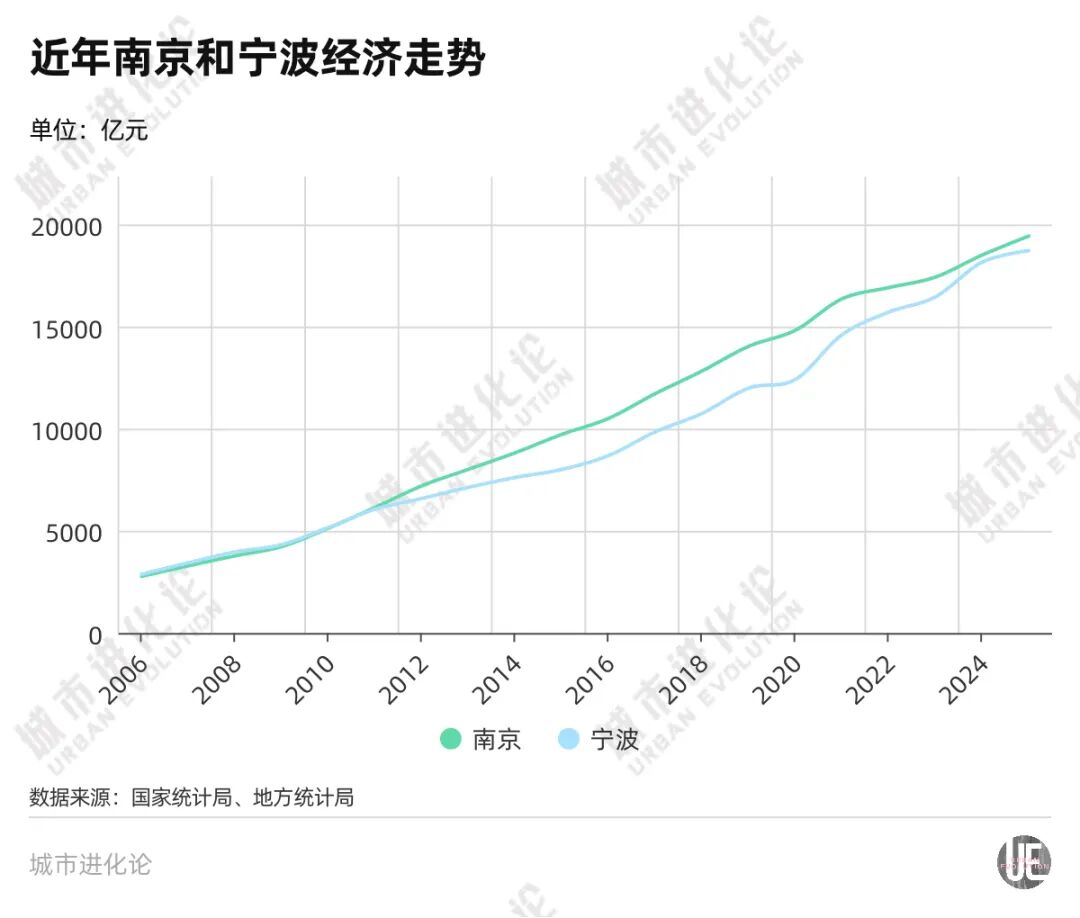
However, putting aside the ranking competition, the two cities are both at a critical juncture of striving to reach the 2 - trillion - yuan GDP mark and are facing similar development situations.
Zeng Gang, Dean of the Urban Development Research Institute of East China Normal University, analyzed to Urban Evolution Theory that in the two economic powerhouses of Jiangsu and Zhejiang, Suzhou and Hangzhou are the unshakable "leaders" in their respective provinces, while Nanjing and Ningbo are slightly inferior and have long held the second - place position in the provincial economy.
Specifically, in 2025, Nanjing's economic primacy still ranked at the bottom among the 27 provincial capitals (autonomous region capitals) in the country, and the development pressure under the label of a "weak provincial capital" is greater.
The economic gap between Ningbo and Hangzhou has also widened from about 40 billion yuan in 2004 to about 430 billion yuan in 2025, making it almost impossible to catch up in the short term.
The similar development bottlenecks have led the two cities to reach a consensus on the desire for "new driving forces".
Driven by the common need to break through the bottleneck, the two cities have rarely initiated high - level exchanges and interactions, trying to seek more possibilities and space for cooperation.
Wang Cheng said bluntly that Nanjing and Ningbo are both in the Yangtze River Delta region, and their industries are highly complementary. He hopes that the two sides will work together to explore key technology research and development and the development of key industries.
Zhou Hongbo also said that Ningbo is worthy of Nanjing's learning in terms of being a strong manufacturing city and an open hub. He hopes that the two cities will give full play to their respective comparative advantages and make new contributions to regional coordinated development and the overall national development situation.
In Zeng Gang's view, Ningbo and Nanjing have a good foundation for cooperation.
As the "City of Single - champion Enterprises", Ningbo has a strong industrial manufacturing strength, with the private economy and export - oriented economy at its core. Nanjing is the first "China Software - famous City" in the country, with software business revenue exceeding one trillion yuan and outstanding R & D capabilities, and it has obvious characteristics of the state - owned economy and domestic - oriented economy.
The differences in industrial structure and ownership structure between the two sides just form a complementary relationship of "R & D + application" and "software + scenarios". There is less competition and more cooperation space, and it is expected that through collaboration, new driving forces can be found for each city to enter the "2 - trillion - yuan Club".
02
Complementarity
During this research trip, the Ningbo delegation visited several places, including the Jiangsu Industrial Technology Research Institute, the Nanjing Software Industry Expo Hall, and Yihui Information Technology Co., Ltd. The software industry was one of the important focuses.

Image source: Nanjing Software Valley, China
Wang Cheng emphasized that in the field of artificial intelligence, Ningbo's advantage lies in manufacturing and the hardware end, which can provide rich application scenarios for the development of the software industry. He hopes that the two places will actively promote exchanges and cooperation between platforms such as Nanjing Software Valley and Ningbo Software Park.
In Zeng Gang's view, the underlying logic of the industrial cooperation between Nanjing and Ningbo is that Ningbo has the market and Nanjing has the technology.
During the "14th Five - Year Plan" period, Ningbo's industrial added value rose from the ninth to the fifth in the country, and the number of national - level single - champion manufacturing enterprises has ranked first among Chinese cities for eight consecutive years, demonstrating Ningbo's strong industrial strength.
Currently, Ningbo, a major manufacturing city, is entering a critical period of using "artificial intelligence" to empower the upgrading of traditional advantageous industries.
According to the "Ningbo Action Plan for the Innovative Development of Artificial Intelligence (2025 - 2030)", by 2027, the scale of the city's core artificial intelligence industry is expected to reach 120 billion yuan, and it aims to create a national - level artificial intelligence innovation and application pilot zone (base). It clearly mentions that it is necessary to deepen the integration of "artificial intelligence + manufacturing", focus on industrial clusters such as green petrochemicals and new energy vehicles, and accelerate the application of artificial intelligence in the core links of the manufacturing industry.
And Nanjing can just be the key "partner" for Ningbo's intelligent manufacturing upgrading.
Nanjing is the first "China Software - famous City" in the country. In 2021, its software and information service industry was selected as a national - level advanced manufacturing cluster, and in 2025, the scale of software business revenue exceeded one trillion yuan.
Especially in the field of industrial software, Yihui Information, the enterprise visited during this research trip, is a leading domestic enterprise in industrial operating systems, and its performance and functions in real - time industrial operating systems have reached the international advanced level. Currently, Nanjing has cultivated more than 160 key enterprises such as Yihui Information, Guorui Xinwei, and Jinheng Technology, and has set the goal of achieving an industrial software revenue scale of over 50 billion yuan by 2028.
In fact, the industrial cooperation between Nanjing and Ningbo does not start from scratch, and the foreshadowing for cooperation has been laid long ago.
In 2023, Nanjing Software Valley specially went to Ningbo for investment promotion and docking, visited key enterprises in the fields of industrial software and digital - real integration, laying a preliminary foundation for the interconnection of industrial resources and enterprise linkage between the two places.
Zeng Gang said that on one hand, there are trillions of manufacturing scenarios in need of intelligent upgrading, and on the other hand, there is an industrial software industry cluster with core technologies. Nanjing and Ningbo are a perfect match in the combination of "industrial software + advanced manufacturing". The two - way pursuit of technology implementation and scenario empowerment constitutes a core approach for the industrial cooperation between the two places.
Zeng Gang further suggested that in the future, the two sides can give full play to the flexible advantages of Ningbo's private economy and the resource advantages of Nanjing backed by Jiangsu Province to promote the practical implementation of industrial cooperation.
03
Innovation
The cooperation between Ningbo and Nanjing is not limited to industrial complementarity. When the Ningbo delegation was on an inspection and study trip in Nanjing, the "Shanghai (Yangtze River Delta) International Science and Technology Innovation Center" was mentioned again.
The Central Economic Work Conference held in December 2025 proposed to "build international science and technology innovation centers in Beijing (Beijing - Tianjin - Hebei), Shanghai (Yangtze River Delta), and the Guangdong - Hong Kong - Macao Greater Bay Area". Among them, the Shanghai (Yangtze River Delta) International Science and Technology Innovation Center takes Shanghai as the leader, mobilizes the scientific and technological strategic forces of the Yangtze River Delta region on a larger scale, adheres to innovation and front - line research, and explores future front - line scientific and technological directions.
Both cities have made deployments in line with this national strategy.

Image source: Photographic Network_501204922
According to the "Ningbo Daily", during his visit to the Jiangsu Industrial Technology Research Institute, Wang Cheng emphasized: "Taking the construction of a key fulcrum of the Shanghai (Yangtze River Delta) International Science and Technology Innovation Center as a starting point, further promote the open sharing of scientific research platforms and laboratories and the orderly flow of high - level talents."
When meeting the Ningbo delegation, Zhou Hongbo also said that he hopes that the two cities will give full play to their respective comparative advantages, strengthen the precise docking of development strategies, jointly integrate into and serve the integrated development of the Yangtze River Delta, and work together for the construction of the Yangtze River Delta Science and Technology Innovation Community.
Under the strategic framework of the Yangtze River Delta integration, how can the two places work together to integrate into the Yangtze River Delta Science and Technology Innovation Community and become two key fulcrums for promoting the common prosperity of industries in the Yangtze River Delta?
"A key fulcrum means taking on greater responsibilities, which requires each place to break through its own development and give full play to its comparative advantages in combination with the top - level deployment." Zeng Gang said that the construction of the Shanghai (Yangtze River Delta) International Science and Technology Innovation Center focuses on achieving more original breakthroughs from "0 to 1" and promoting applied research on the in - depth integration of the industrial chain and the innovation chain.
In short, it emphasizes "major breakthroughs in applied technology". Nanjing and Ningbo can jointly strive for major national science and technology projects or joint research projects in the Yangtze River Delta around this direction.
In terms of endowments, Ningbo's economic foundation is the private economy. Enterprises in Ningbo have a strong desire for new technologies and a keen sense of grasping industrial trends. Nanjing has high - level R & D platforms such as the Purple Mountain Laboratory and the Jiangsu Industrial Technology Research Institute, with a concentration of universities and research institutions and outstanding R & D capabilities.
However, for Nanjing, although it has rich scientific research results, it has long faced the bottleneck of low efficiency in result transformation.
According to Zeng Gang's observation, taking the Jiangsu Industrial Technology Research Institute as an example, "professors and academicians play too dominant a role, and the role of entrepreneurs is not enough", resulting in a large number of scientific and technological achievements, but not many have been transformed into profits and industrial competitiveness.
In contrast, Ningbo is sensitive to technological needs but lacks R & D resources.
Zeng Gang said that the complementarity between the two places has formed a foundation for cooperation. Ningbo's mature private economic environment provides an efficient transformation scenario for Nanjing's scientific research results, accelerating the transformation of technology into industrial competitiveness. Nanjing's scientific research strength and technological reserves provide the "source of innovation" for Ningbo's enterprises.
Zeng Gang suggested that relevant research institutions in the two places can strengthen cooperation and adopt a model of "led by entrepreneurs and participated by scholars", making the market the guide for technology transformation and jointly contributing to the scientific and technological cooperation between Nanjing and Ningbo and the construction of the Shanghai (Yangtze River Delta) International Science and Technology Innovation Center.
This article is from the WeChat official account "Urban Evolution Theory", author: Liu Xuqiang, published by 36Kr with authorization.