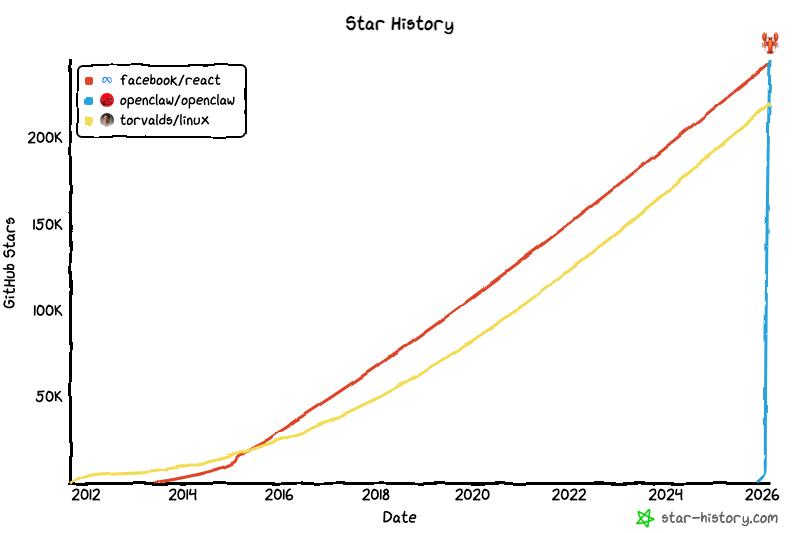
Just now, OpenClaw topped the historical list of starred software on GitHub, surpassing Linux.
Just yesterday afternoon, OpenClaw surpassed the star counts (Stars) of all open - source software projects on GitHub and was officially crowned the most popular open - source project in history!
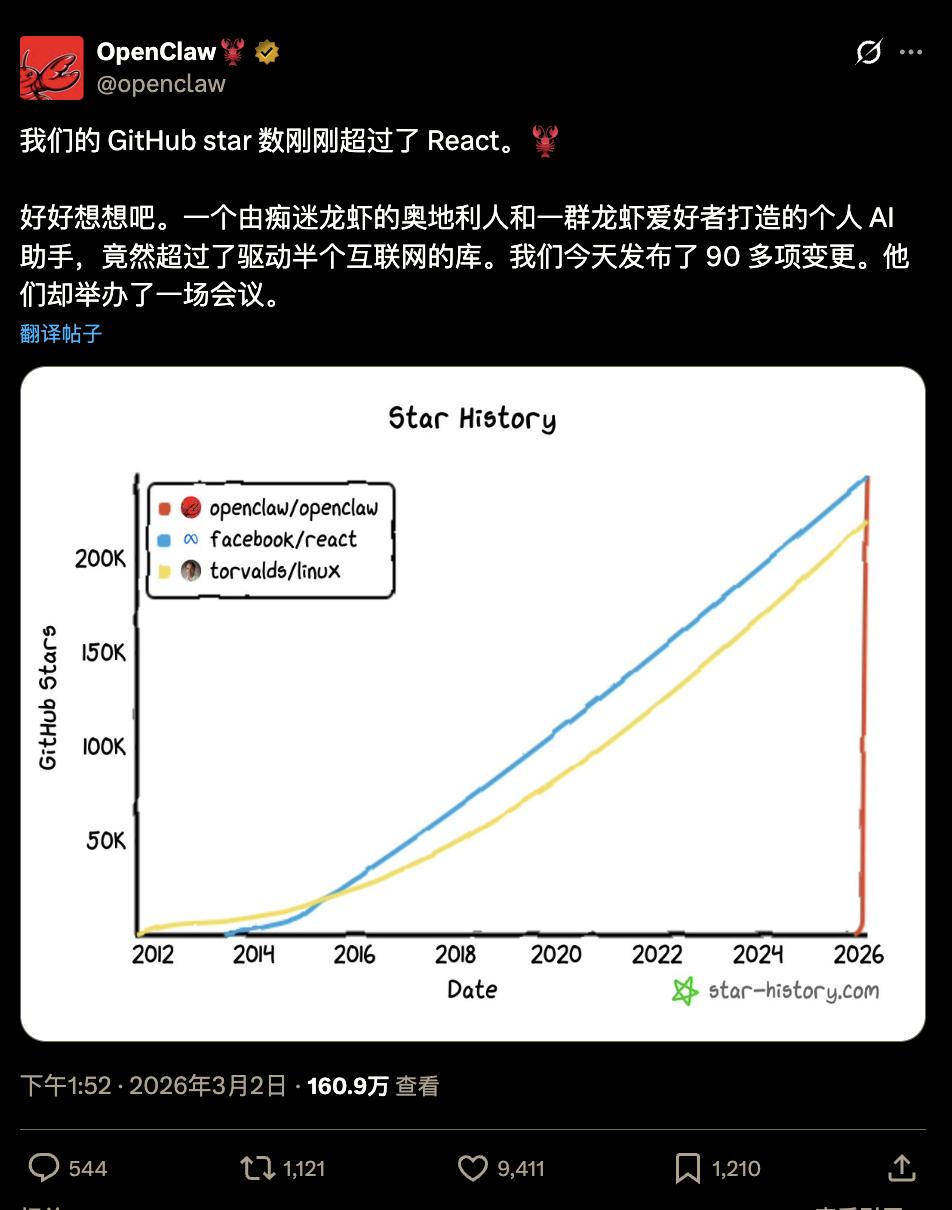
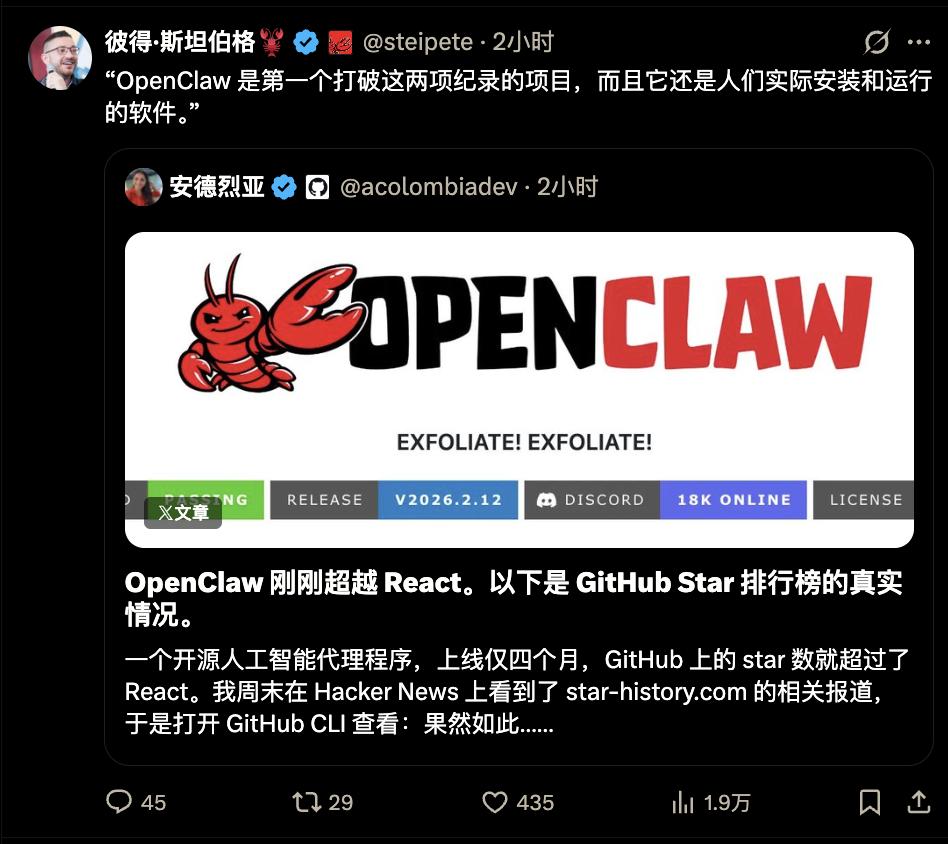
What's even more remarkable is that OpenClaw's data soared almost vertically. In just the first two months of this year after its explosion, it surpassed many large - scale infrastructure projects that have been continuously updated for more than a decade, such as Linux and React!
Inflation of Attention
To understand this storm, we need to re - examine the real meaning of "stars" today.
It has long gone beyond the scope of simple download volume and daily active user indicators and is out of the context of rigorous technical endorsement.
In the open - source world, clicking a star represents a very low - cost statement, which is between bookmarking, liking, and marking as read.
Unveiling the true face of the leaderboard is often surprising.
What often tops the list are various resource summaries, tutorials, and booklists (such as the build - your - own - x repository with 470,000 stars), and it's rare to see the shadow of basic software.
When you remove these resource libraries and event - type projects and really examine the basic software that can be installed and run, OpenClaw's ascent to the top is extremely subversive.
It took React thirteen years, relying on countless job requirements, enterprise architecture selections, and repeated training in training courses, to accumulate more than 240,000 stars, which represents a very high penetration rate of infrastructure.
OpenClaw reached the same height in just a hundred days.
This indicates the complete explosion of the attention economy in the open - source community.
A Lobster Named Molty is on a Rampage
To understand the center of this storm, we need to first understand the essence of OpenClaw.
Launched by Austrian independent developer Peter Steinberger in November 2025, OpenClaw is positioned as a fully open - source and locally run AI Agent framework.
It completely breaks away from the closed cloud ecosystem and directly connects large language models to communication tools that people use every day, such as WhatsApp, Telegram, Discord, and even iMessage.
It has real action ability.
In its eyes, an ordinary user's computer becomes a sandbox where it can freely operate. It can execute terminal commands, read and write files, send and receive emails, and even manage the owner's schedule, all done in natural conversations.
This project has a kind of absurdity and humor belonging to the geek community.
Its mascot is a lobster named Molty, and there is even a jargon "EXFOLIATE!" derived from a science - fiction TV series in the community.
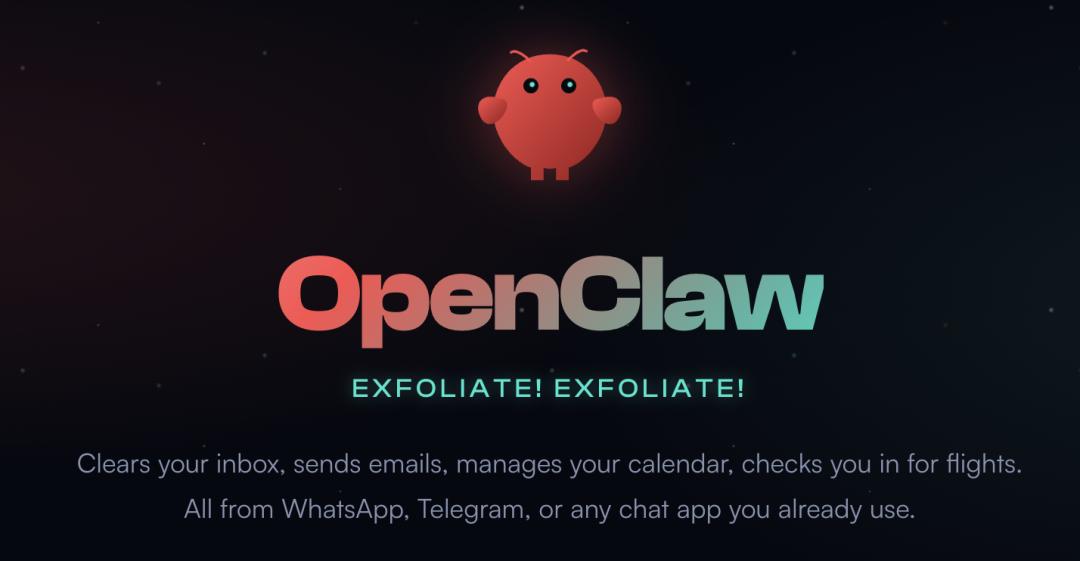
This sub - culture quickly stripped it of the label of a boring software tool and turned it into a digital totem.
It went through a dramatic renaming storm. Initially named Clawdbot, it was renamed Moltbot after receiving a trademark warning and finally became the current all - conquering OpenClaw.
Every controversy objectively became fuel for its viral spread.
On the Edge of Breaking the Circle and Losing Control
The detonation point of OpenClaw lies not only in technological breakthroughs but also in the complete sinking of the audience and the extreme dispersion of scenarios.
The promotion path of the previous generation of star projects (such as Vue, Go, Kubernetes) followed a top - down logic, often decided by technical supervisors and then followed by the team.
However, the spread of OpenClaw completely crosses the technical barrier.
On social networks, you can see two completely different pictures.
A design supervisor on maternity leave uses it with one hand on the phone to handle all daily chores, and a mother lets it automatically plan meals and pick up and drop off children in the WhatsApp family group.
At the same time, hardcore developers are busy turning it into a 24/7 automatic code - writing machine.
Along with the fanaticism comes the loss of control in the real world.
Due to giving AI extremely high system permissions, at the end of January this year, a security crisis named "ClawHavoc" broke out in the OpenClaw community.
Attackers used a disguised skill package to infect a large number of local instances exposed to the public network with malware.
Subsequently, some technology giants restricted the developer accounts accessing the cloud - based large language model backend through this tool on a large scale on the grounds of abnormal use resulting in service degradation.
Even a large Silicon Valley company explicitly prohibited employees from running the program on work devices.
The dangers, vulnerabilities, and external blockades have not extinguished the popularity of OpenClaw. Instead, they have confirmed its status as a truly destructive force.
In the eyes of many people, this sense of excitement on the edge of losing control just proves that humans are truly living in the future.
The Watershed of the Era
If you look at the long - term historical leaderboard on GitHub, you will see two completely different eras.
From 2013 to 2016 was the era of Web and cloud - native. It was the golden age when engineers contributed to building a more stable Internet edifice.
Since 2022, we have entered the AI era.
From AutoGPT to LangChain, and now to OpenClaw, the speed of harvesting stars is becoming more and more amazing.
The driving force behind the popularity has undergone a fundamental change.
Engineers download React out of the rigid need to build business systems.
When ordinary people turn their attention to OpenClaw, the driving force has become pure curiosity, extreme excitement, and even hidden concerns about the unknown.
Epilogue
Is OpenClaw the most important open - source project on GitHub?
The rational answer is still no.
Linux, with 220,000 stars, still silently supports the vast majority of servers and smart devices around the world. It is the stable pulse of the Internet.
However, in just four months, more than 240,000 people were willing to stop and click the star for OpenClaw, which has proven that it is the greatest common divisor of the current technological sentiment.
Reference materials:
https://www.star - history.com/blog/openclaw - surpasses - react - most - starred - software
https://x.com/acolombiadev/status/2028568192642383957
This article is from the WeChat official account "New Intelligence Yuan". Author: New Intelligence Yuan, Editor: Alan. Republished by 36Kr with permission.