Wie lebhaft war die Künstliche Intelligenz während des Frühlingsfestes! Was haben wir daraus gewonnen?
This year was highly influenced by AI.
Chinese tech giants have brought AI into the Spring Festival holidays of hundreds of millions of people with an unprecedented red envelope campaign, in which they have invested a large amount of money. On the stage of the Spring Festival Gala, the humanoid robots were no longer just choreographed dancers, but could even compete with students from the Shaolin Temple in fighting and jumping.
AI is making a lot of noise. What have we gained from it?
Those who return to work are worried: It's difficult for them to get out of the holiday mood, but the KPIs are waiting. Can AI help us in this regard?
Fortunately, the so - called "Hummer" (OpenClaw) offered an approach at the beginning of the year. Instead of passively waiting for AI responses, we can also actively let AI work for us. All those tedious emails, annoying travel arrangements, and even the cumbersome conversations with customer service staff might be delegated to this digital double.
We should also think about how to understand AI at this time. How can carbon - based beings and silicon - based beings coexist? Should we believe that Embodied AI will change the world, or should we agree with Dr. Wu Jun's harsh assessment - "Embodied AI is a pseudo - problem"?
01. The "AI Introduction" at Everyone's Fingertips
Let's first talk about the AI red envelope campaign during the Spring Festival. Many see it as another "involution" of capitalists, a resource war between tech giants to capture access points.
Baidu ERNIE was the first to launch a red envelope campaign. It has deeply integrated its AI capabilities into the Baidu app with 700 million monthly active users. With 500 million yuan in red envelopes and nearly a hundred AI games (such as AI New Year greetings, AI photos), it has made users accustomed to equating "asking Baidu" with "asking AI" to revitalize the search tool in the AI era.
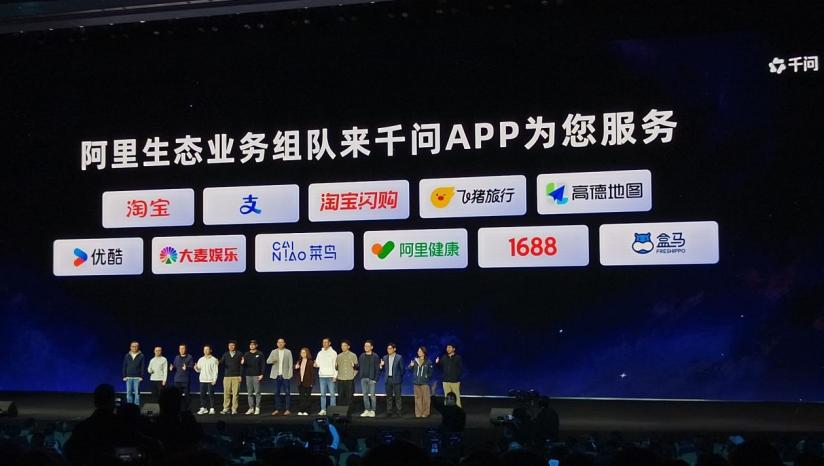
Alibaba Tongyi Qianwen has adopted a more pragmatic and "closed - loop" strategy. Through 3 billion yuan in subsidies, it has made users order tea and book flight tickets with Tongyi Qianwen. Behind this are the service delivery systems of Ele.me, the payment systems of Alipay, and the discount systems of Taobao. It tries to make AI the starting point of transaction decisions and firmly bind users to Alibaba's huge e - commerce ecosystem.
Tencent Yuanbao has adopted the "most social" strategy. Through the deep interface of the WeChat ecosystem (for example, sending "Yuanbao" triggers lucky money packets) and the AI group chat function of the "Yuanbao Club", it tries to introduce an AI assistant as a "club member" into traditional social relationships. In this way, users gradually get used to accepting AI as part of their social relationships while collecting red envelopes and chatting.
The tech giants have brought AI to the fingertips of all ordinary users in the most direct way.
Source: Photo from DoNews
However, this is not a simple "money - burning game". In contrast to the fragmented US app market (Social Media = Meta, Search = Google), Tencent and Alibaba in China have their own super - apps. AI cannot appear as an independent new access point but must be integrated into the existing ecosystems.
This also shows a trend: The access point of AI is merging from independent apps into the most well - known super - apps. The battle for the AI access point is essentially a battle for the "next form" of super - apps. The red envelope campaign is just the beginning. The real competition is how to retain hundreds of millions of new users.
But if we look beyond the commercial competition, this campaign seems more like an "AI introduction" for billions of Chinese people.
The numbers don't lie: ByteDance has invested over 1 billion yuan. Doubao was intensively involved in the interaction of the CCTV Spring Festival Gala. On New Year's Eve, the total number of AI interactions was 1.9 billion times. Alibaba has spent 3 billion yuan as the title sponsor of four regional Spring Festival Galas. The Tongyi Qianwen app has made nearly 200 million users "order with one sentence" to order tea and book flight tickets. The daily active users of Tencent Yuanbao have exceeded 50 million, and the monthly active users have reached 114 million.
This means that hundreds of millions of Chinese people, regardless of age, region, and educational background, had their "first close contact" with AI, either passively or actively, during this Spring Festival. The noise will pass, but the habits will remain. The significance is much deeper than we think.
02. The "Hummer" Frees the "Tools"
If the red envelope campaign solves the problem of "getting more people to use AI", then the emerging OpenClaw at the beginning of 2026 addresses the next question: What happens when we use AI?
OpenClaw has caused a sensation because it has redefined the cooperation between humans and AI.
It can be regarded as a "self - deployable" AI assistant. The core idea is simple: It is not just a chatbot but a truly work - capable central system, a digital colleague that is online 24/7, remembers things, and can also actively approach you.
In the architecture of OpenClaw, there is something called the "Gateway". On the one hand, it connects WhatsApp, Telegram, iMessage, and on the other hand, it connects the most powerful AI brains like Claude, ChatGPT, DeepSeek. In between, there are countless small tools.
This means that you no longer have to jump back and forth between different apps. Do you want the AI to sort your emails? OpenClaw can do it directly. Do you want it to negotiate the price of a car with a dealer? A netizen actually did it, and OpenClaw saved him $4,200 - it searched the websites on its own, sent emails about the price, and negotiated with negotiation strategies without the owner having to worry about it.
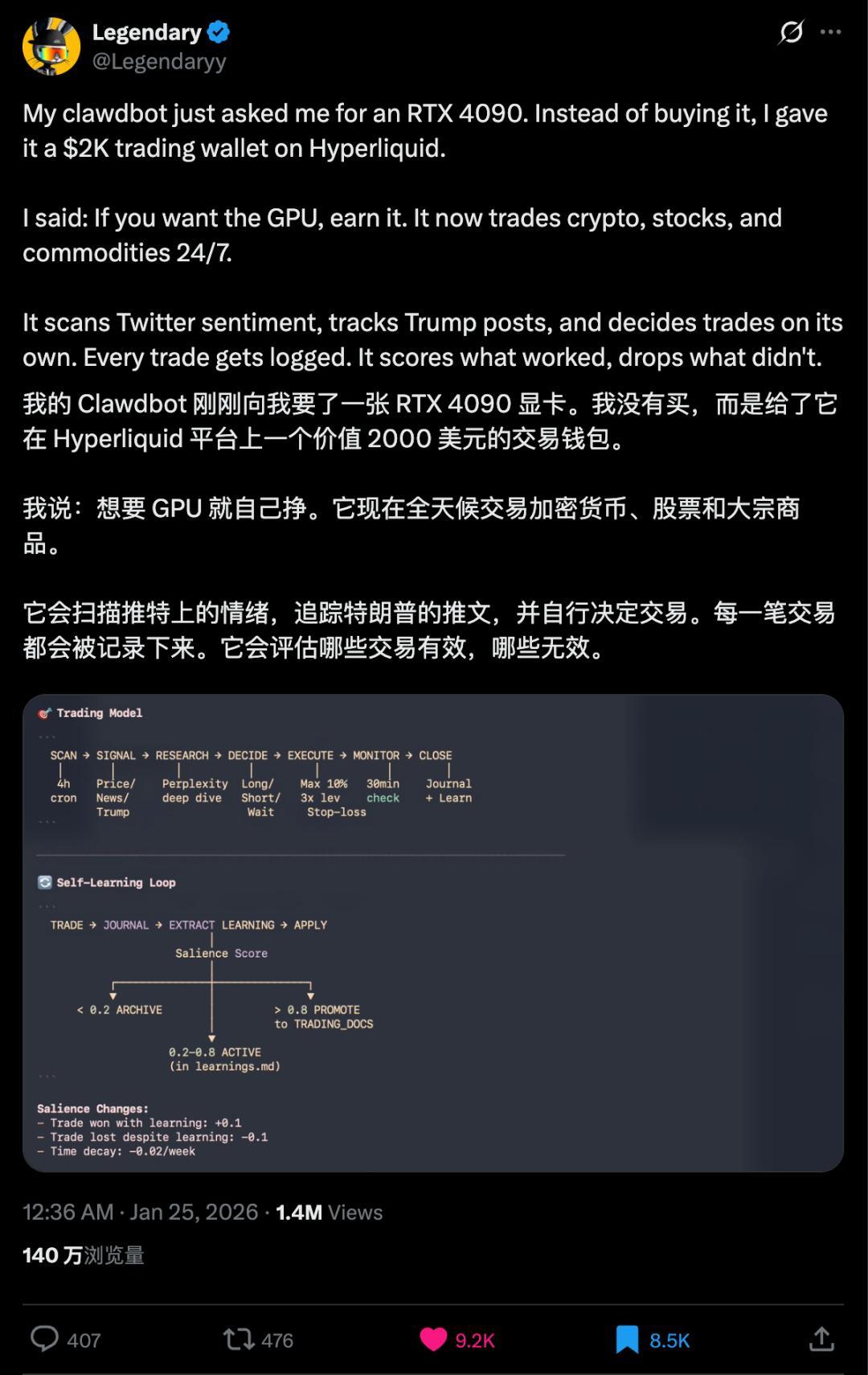
Even more extreme: Someone gave OpenClaw a trading account with $2,000 and instructed it to analyze the market every four hours, adjust positions, and trade. Another person asked it to manage a tea company, handle customer requests, monitor inventory, and generate reports.
Source: X
The social network is full of discussions: Some study the configuration lists, others share deployment tutorials, and some even buy in bulk... This "technical consensus" spontaneously formed by netizens is more convincing than any carefully planned press conference.
People have realized that OpenClaw can handle a lot of annoying, repetitive, and strenuous work and free them from the "tool - person" situation, so that they can focus their value more on the ability to set goals, make decisions, and bear the consequences.
03. "Is Embodied AI a Pseudo - Problem?"
While the red envelope campaign is making inroads in the consumer field and OpenClaw is freeing people with its "hands" in the digital world, the robots on the stage of the Spring Festival Gala represent the awakening of the "subjectivity" of AI in the physical world.
Four types of robots from Unitree Robotics, Songyan Dynamics, Magic Atom, and Galaxy Universal appeared on this year's Spring Festival Gala. They are cool and exciting and have practiced the motto "I want to be on the Spring Festival Gala".
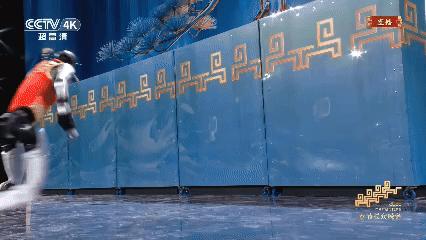
In 2025, the Unitree robots only danced Yangko, twirled handkerchiefs, and stood still. Their movements were based on preset paths and were essentially "mechanical executions" with high precision. In 2026, the Unitree robots could already compete with human actors in drunken boxing and staff fighting and even jump 3 meters high and do somersaults.
Source: Screenshot of the Spring Festival Gala
The martial arts performance shows a magnificent scenario of human - robot cooperation. The sketch "What Grandma Likes Best" brings another challenge - to achieve a warm - hearted emotional expression in a limited space. The biomimetic robot from Songyan Dynamics has written history by being the first humanoid robot to enter a language sketch. They have developed a humanoid robot that is almost identical to the actress Cai Ming in appearance and facial expression. It can not only cooperate with the actors but also precisely represent micro - expressions such as raising eyebrows, pressing lips, and smile lines.
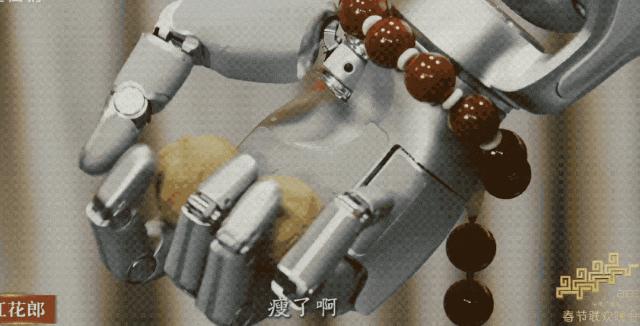
The GalBot G1 robot from Galaxy Universal appeared in the short film "My Unforgettable New Year's Eve". The camera has rarely focused on a robot's hands for so long - cracking nuts, skewering sausages, precise grasping, and fine manipulation - because it is no longer dependent on preset programs but is equipped with the self - developed "Galaxy Star Brain" Embodied Large Model, which enables end - to - end autonomous perception, decision - making, and execution.
Source: Screenshot of the Spring Festival Gala
Behind these advancements is the "brain upgrade" through the multimodal large model. Previous robots were more like "machines" that executed fixed programs and could only make preset movements. Now, the robots have evolved into "Embodied Intelligent Agents" that have multimodal perception, real - time decision - making, and dynamic adaptability. They no longer passively execute commands but can perceive the environment, understand the scene, make autonomous decisions, and react in real - time.
People are celebrating Embodied AI again, but an observer has a completely different opinion.
"Dancing only proves that the robot's joints can move flexibly and not stumble. It has no practical meaning." This was said by Dr. Wu Jun - the former Google Intelligent Search scientist, Silicon Valley venture capitalist, and author of "Top of the Wave".
In an exclusive interview with NetEase Tech "Attitude AGI", Wu Jun directly said that Embodied AI is a pseudo - problem: "Humans are too narcissistic and always try to model robots in their own image. But in fact, human senses and physical performance are far behind those of other living beings. Robots don't necessarily have to take on the human form."
His opinion is based on a basic commercial logic: The cost of a robot dog is easily 200,000 yuan, and that of a humanoid robot is even 400,000 to 500,000 yuan. In scenarios such as serving food in a hotel, a simple rolling device with a cost of less than 10,000 yuan can meet the requirements. "The core of robot application is to adapt to the scene. For example, specialized robots can patrol in a park 24 hours a day or clean narrow areas in a tourist destination. They can do things that humans can't without deliberately imitating humans."
These two perspectives are on different levels and form a wonderful contrast. It's not about right or wrong. We need to clarify that the real value lies not in "being human" but in "being useful". Just like in the era of the Internet bubble, many companies went bankrupt, but the remaining infrastructures have reshaped the whole world.
Conclusion
Wu Jun predicted that the AI bubble might burst in 2028. But he also emphasized that this is not scary. "Every technological development has bubbles. This is a historical rule."
This cyclical perspective helps us correct our assessment of the current AI boom.
The concept of the "Sovereign Agent" represented by OpenClaw is the direction of the future, but it also faces the reality of security loopholes. The 200 million new users gained through the red envelope campaign are a milestone for the spread of AI, but it could also just be a market prematurely ripened by capital. The impressive performance of the robots on the Spring Festival Gala shows the progress of the Chinese industrial chain, but it could also just be a temporary success.
We come back to the initial question: AI is making a lot of noise. What have we gained from it? Everyone will surely have their own...