To catch up with Apple, Samsung has placed a risky bet on innovation.
Once a dominant force in China, Samsung has now become the most obscure international giant.
On February 25th, in a truly unnoticed corner, Samsung globally launched its flagship mobile phones for 2026: the Samsung S26 series, which includes three models: the standard S26, S26 Plus, and S26 Ultra.
There was no trending on social media, nor was there any overwhelming promotion. Many people wouldn't even know about this press conference if they hadn't seen the articles from core media outlets.
This result isn't actually surprising.
Many self - media bloggers who have long focused on Samsung have straightforwardly stated that the S26 series is the "most conservatively upgraded generation" in the past three years.
Except for the regular iterative upgrade of the processor, the upgrades of Samsung's new phones in terms of exterior design, screen size, and imaging parameters can only be described as "lackluster". Even regarding the long - criticized issue of "insufficient battery life", only the battery capacity of the standard S26 model has increased by 300mAh, while the other two models remain unchanged.
Moreover, the new phones are also affected by the "AI cost burden". Due to the rising storage prices and the cost pressure brought by AI component stacking, the overall price of the new phones has increased, with an average increase of several hundred yuan for each model.
Judging from these aspects alone, the S26 really isn't worth paying attention to.
However, this "steadily iterative" flagship has introduced a new feature that all mobile phone competitors envy and are eager to follow: Privacy Display, the native privacy - protecting screen.
According to the revelation of the authoritative digital blogger @Digital Chat Station, domestic manufacturers are already testing the "privacy - protecting screen", and it is expected to appear in the flagship new phone wave in September this year.
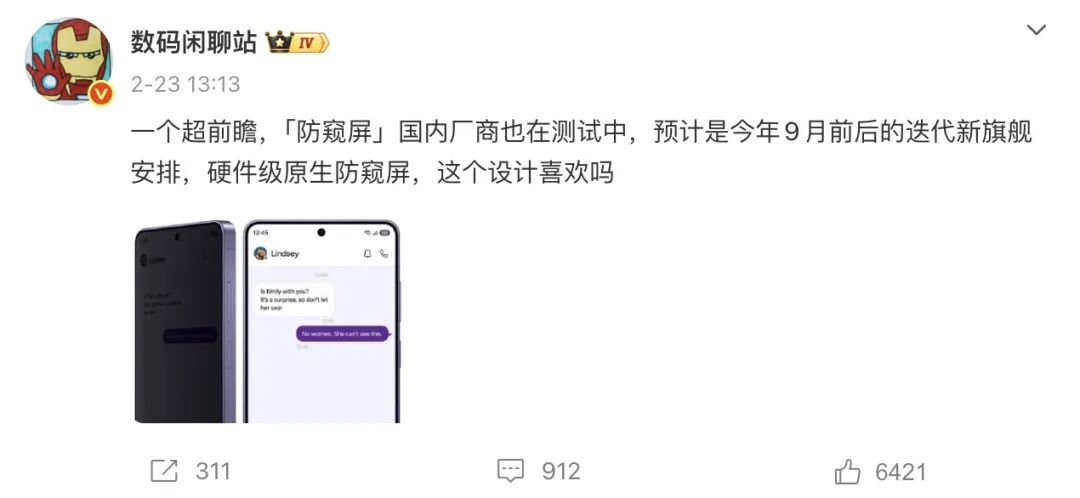
Overseas media such as Android Central and TechAdvisor generally believe that the Xiaomi 18, OPPO Find X10, and vivo X500 series will all follow this technology. PhoneArena even boldly predicts that Apple may also embrace this "transformative privacy innovation" as soon as possible through its cooperation with Samsung.
But here comes the question.
The difference between the "privacy - protecting screen" and the "privacy - protecting film" is just one character.
It has been widely discussed by the media, pursued by users, and is about to be followed by competitors. Is this an approval of innovation or a precisely - crafted promotional narrative?
"The Real Subway Essential"
Almost everyone has seen privacy - protecting films.
The effect is simple: the screen is clear when viewed from the front, but turns black when viewed from the side.
Because people are so familiar with privacy - protecting films, the same question always appears under every piece of content introducing Samsung's privacy - protecting screen: "What's the use?"
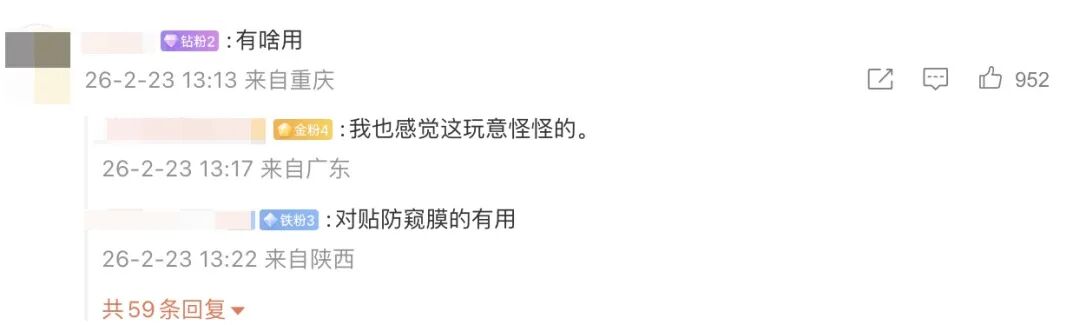
The subtext is very clear: A privacy - protecting screen exclusive to a flagship phone costing tens of thousands of yuan can be replaced by a privacy - protecting film that costs just a dozen yuan.
But to be honest, the technical logics of the two are not on the same level.
Although Samsung's privacy - protecting screen has been "pre - heated" through revelations for some time, the actual effect of the real phone is still more amazing than expected:
Firstly, there is the regular full - screen privacy - protecting mode. Just like traditional privacy - protecting films, once it is turned on, as long as the viewing angle deviates from the front by about 25° - 30°, the screen will quickly turn black, and the content will become unreadable.
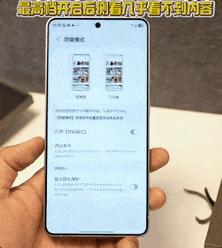
Source: Bilibili @Xu Junma
But this is just an appetizer. The real killer feature lies in "on - demand allocation". Samsung offers a high degree of customization freedom. Users can decide which apps will trigger the privacy - protecting effect according to their personal needs.
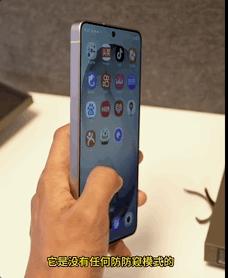
Source: Bilibili @Xu Junma
This means that even if you open a stock - trading app on the subway, you don't have to worry about others seeing your losing stocks.
Even more impressively, this level of control can be as precise as the UI component level.
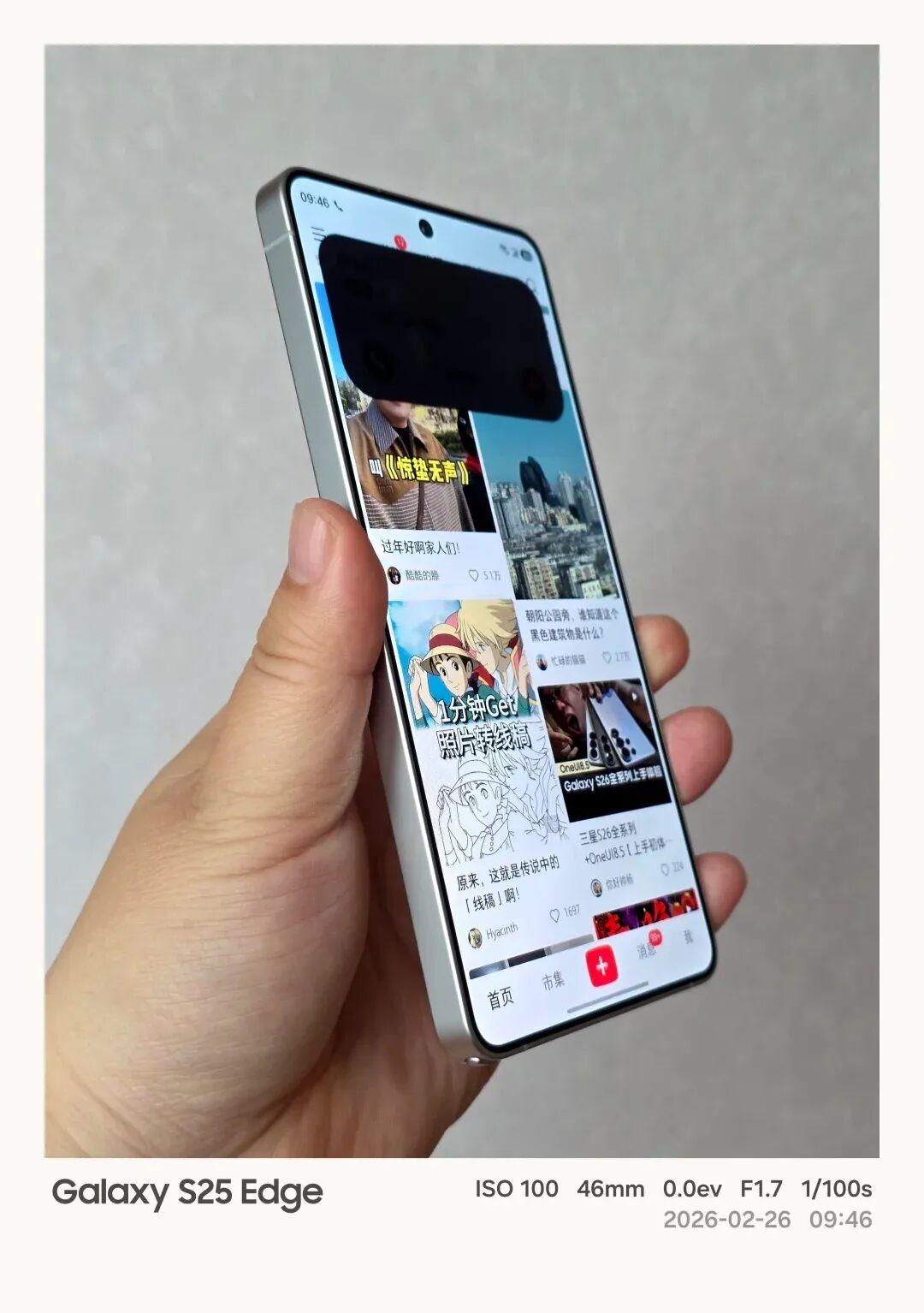
Source: Weibo @i Bingyuzhou
It can make the pop - up verification code SMS and the virtual keyboard for entering passwords "invisible to the side view", while the rest of the display area remains clearly visible.
This "targeted" dynamic strategy is the essential difference between it and the privacy - protecting films sold on the street.
Ultimately, traditional privacy - protecting films are essentially based on a micro - louvre structure, simply adding a micron - level barrier on the screen surface, allowing light to pass through only in a straight line and being physically blocked from the side.
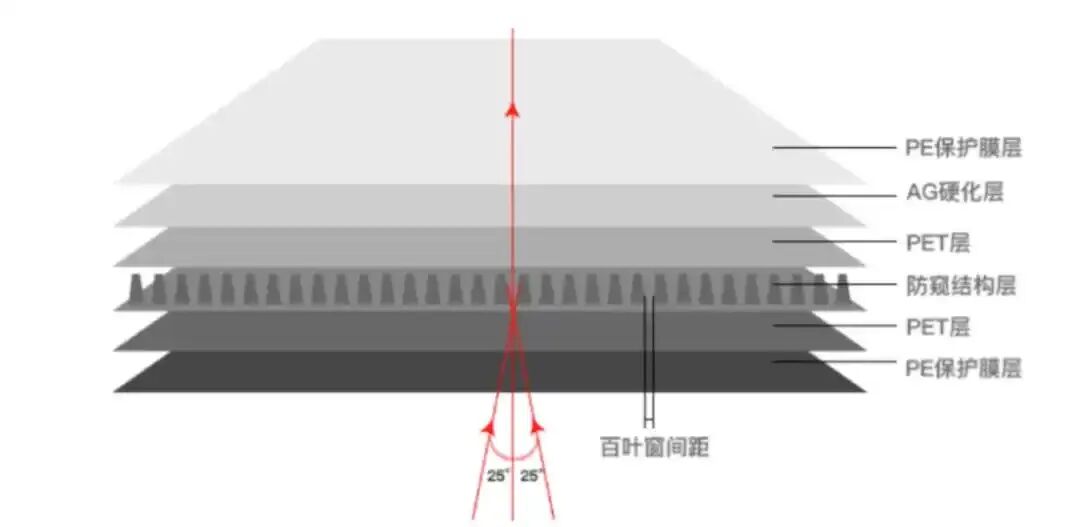
The cost is quite direct: The brightness decreases, the contrast is impaired, the color deviation is obvious, the screen turns gray and dark, and there may even be rainbow patterns and a decline in fingerprint recognition accuracy.
However, Samsung's native privacy - protecting screen system doesn't modify the outside of the screen but rather the source of pixel illumination.
If we use a more intuitive analogy to explain:
Ordinary OLED pixels are like light bulbs without lampshades, and the light is diffusely reflected, making them visible from all directions.
On the S26 Ultra, each pixel has an internal directional optical structure. It's like installing a mini - spotlight on some bulbs, allowing the light to be more concentratedly emitted towards the front.
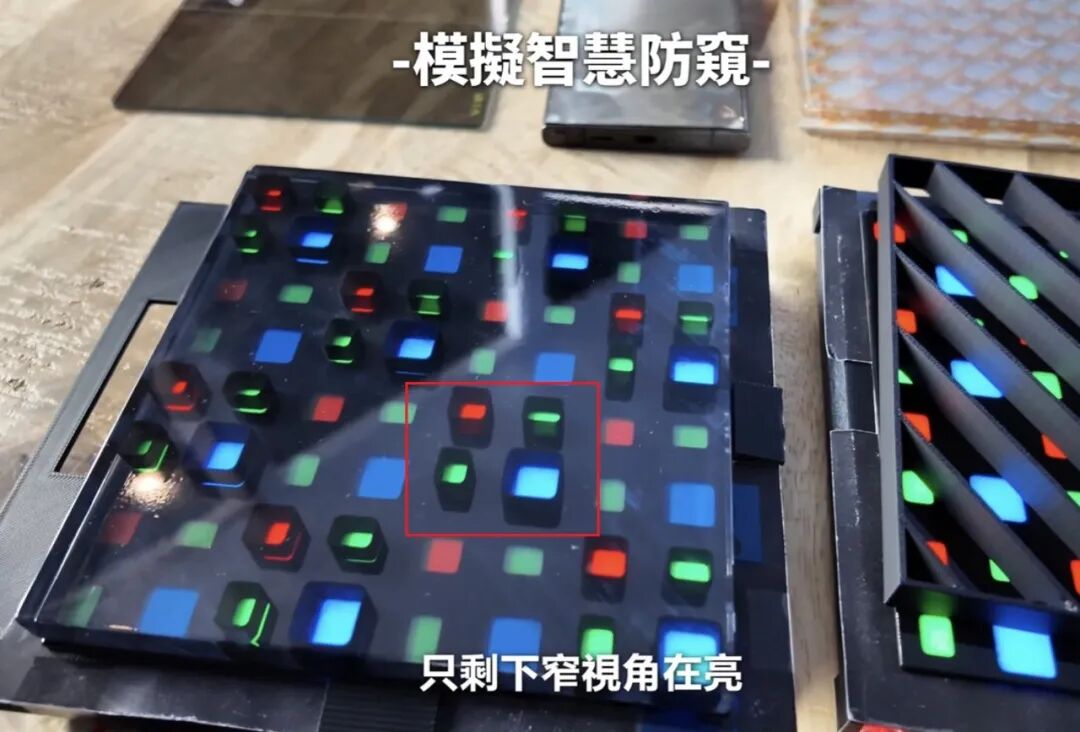
When the privacy - protecting mode is turned on, the driver IC will adjust the current distribution of sub - pixels, activating only those pixels with "shields", so that the light only travels towards the front of the screen, ultimately achieving the privacy - protecting effect.
It's not easy to achieve such an effect.
On an OLED panel with a 2K+ resolution and 500+ PPI, the size of a single sub - pixel is only a few tens of microns. Introducing a physical structure that affects the light path at such a scale while trying to control the loss of color gamut, luminous efficiency, and lifespan is itself a very challenging process engineering task.
This is why, although the S26 itself has received a lukewarm response, the privacy - protecting screen technology has attracted far more attention than the entire phone.
In addition, the emergence of this feature perfectly meets the rigid consumption needs of a large group of people:
Subways, airports, and open workstations in office buildings - high - density social scenarios have become part of daily life. Mobile phones carry high - sensitivity information such as payments, finance, identity verification, and private communications. Privacy - protecting films have thus become the "last line of defense" for protecting privacy.
The mobile phone screen privacy - protecting market is a rapidly growing segment in the smartphone accessories market.
Data shows that the global market size of privacy - protecting films in 2025 was approximately $1.39 billion (about 9.5 billion yuan). Calculated at a unit price of $5 - 10, the annual shipment volume is in the hundreds of millions.
In other words, hundreds of millions of users actively accept the decline in screen viewing experience every year just to gain a sense of privacy security.
This set of data can directly respond to the question "What's the use?". This is not a false demand.
This is why overseas media generally believe that Xiaomi, OPPO, and even Apple in the future will follow this technology:
From the perspective of demand logic, this is not a concept created out of thin air by manufacturers but a real pain point verified by the market. Once the panel technology matures, supply - chain players like BOE and Huaxing Optoelectronics will surely launch similar solutions.
From an industry perspective, this is a technological direction with the potential for widespread adoption.
It doesn't focus on parameters, algorithms, or marketing narratives. It solves a real pain point that has been verified by hundreds of millions of purchase decisions.
From this perspective, this can truly be called a "hard - core innovation" that the mobile phone industry hasn't seen in a long time.
However - if you ask me whether I'll buy it?
The answer is: No.
The Cost of Privacy Protection
As we all know - even if you didn't care much before, you should realize it now - Most privacy - protecting films are very harmful to the eyes.
The American Academy of Ophthalmology has pointed out that long - term exposure to a screen environment with insufficient brightness and reduced contrast will increase the burden of visual adjustment, thereby increasing the risk of visual fatigue. Tracking studies by some optometry institutions have also found that users who use electronic devices for a long time in a low - transmittance screen environment are at a higher risk of dry eyes.
User feedback on social platforms also confirms this: Many people have clearly felt that their eyes are more prone to soreness and fatigue after long - term use of privacy - protecting films.
For this reason, many people have high expectations for Samsung's "native privacy - protecting screen". Since it's not an external film but a system - level and structural - level solution, can it achieve both "privacy protection" and "comfort"?
Unfortunately, the answer isn't that ideal.
It does avoid some problems of traditional privacy - protecting films, but it can't completely bypass the laws of physics.
For example, after turning on the privacy - protecting mode, phenomena such as a decrease in brightness and screen sharpness will still occur.
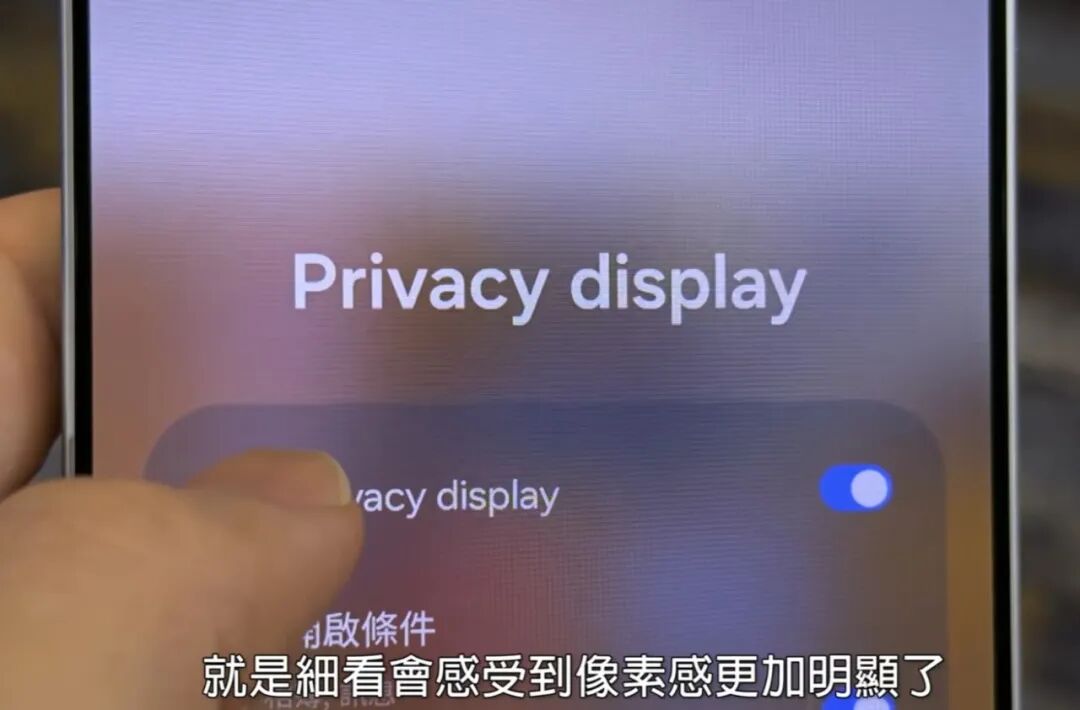
Source: Bilibili @Linzin A Zhe
This is not difficult to understand: In the privacy - protecting mode, the number of pixels participating in light emission will be reduced, and combined with the limitation of the light - emitting angle by the directional structure, the overall brightness and sharpness will inevitably be affected.
But the really embarrassing thing is another problem: Even when the privacy - protecting mode is turned off, some bloggers have reported that there are slight differences in screen sharpness and peak brightness compared with the previous - generation S25 Ultra.
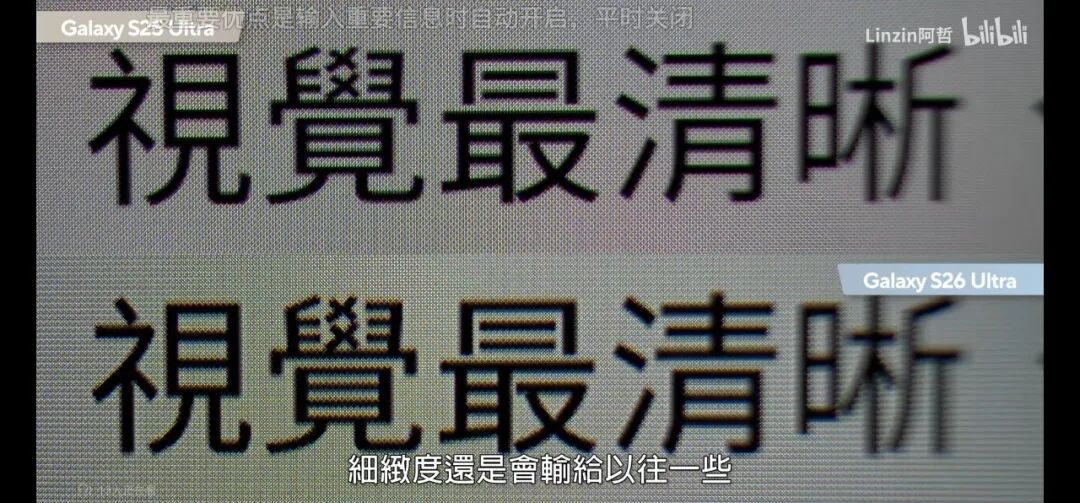
Source: Bilibili @Linzin A Zhe
This is actually what the outside world was worried about before Samsung officially launched the privacy - protecting technology.
As mentioned before, the core logic of Samsung's native privacy - protecting screen is still directional light - emitting control. Whether it's called a "light collimation layer" or a "directional light - emitting structure", the essence is to change the propagation direction of light through a physical structure.
Once the structure exists, it won't disappear just because the function is turned off.
Samsung can optimize the brightness performance through dynamic compensation of the driver IC and re - allocation of current; the micro - structure is indeed much finer than traditional privacy - protecting films...
But the lost light is gone for good.
Moreover, in addition to the discussion about "display regression", people are also worried about another thing: Samsung's flagship phones have never been in the first echelon in the topic of "eye - protection". Will the introduction of the privacy - protecting screen function further magnify the problem of "poor eye - protection"?
Privacy is of course important, but the priority of visual health is also high.
If users have to bear a higher visual burden for a long time in the name of privacy security, then Samsung's native privacy - protecting screen may fall into a logical dilemma similar to that of traditional privacy - protecting films.
Of course, there is currently no conclusive medical evidence to show that Samsung's privacy - protecting screen will directly lead to visual impairment, and the so - called "regression of screen quality" is also negligible without professional instrument testing.
Some claim that the screen quality has regressed, while others insist that the screen of the S26 Ultra still maintains the top - level standard of Samsung's flagship phones.
Therefore, unless you are as meticulous as "Leeuwenhoek" or as sensitive to photoelectric parameters as the "Sharingan", in daily social and reading scenarios, these subtle physical losses are probably difficult to detect with the naked eye.
However,