Huawei, ByteDance, and Meta compete on the same stage. AI glasses are bound to remember the year 2026.
As soon as 2026 began, the AI glasses market kicked off the year's competition with what seemed like a "saturation attack."
Just over a month into the year, manufacturers such as XGIMI, Thunderbird Innovation, Rokid, and MLVision have already launched new products in quick succession. Meanwhile, the product roadmaps for the year of global giants like Meta, Google, Apple, Samsung, Huawei, and ByteDance have also come to light one by one.
From the "inception year" to an all - out "battle," the smart glasses market in 2026 is no longer just a toy for geeks or a narrative for capital. It's a real - life confrontation about technology implementation, scenario occupation, and ecosystem building.
01 All - star lineup enters the arena: From "lightweight trials" to "breakthrough as independent terminals"
The AI glasses market this year has shown a very different and bustling scene from previous years. It is no longer a one - man show for startups but an "all - star game" where internet giants, major mobile phone manufacturers, traditional eyewear distributors, and AR new forces compete on the same stage.
The most obvious feeling in the industry this year is that the pace of new product launches has significantly accelerated, and the technical paths have become clearly differentiated. Among them, CES 2026 in January became the best stage for manufacturers to showcase their capabilities.
XGIMI Technology high - profilely launched a new AI hardware sub - brand, "MemoMind," officially entering the smart glasses market. Thunderbird Innovation demonstrated the world's first binocular full - color AR glasses with eSIM independent networking, the "Thunderbird X3 Pro Project eSIM," truly achieving independent communication and multi - modal AI dialogue without relying on a mobile phone, which is a crucial step in getting rid of the "accessory" attribute of the phone.
Rokid adopted a two - line strategy. On the one hand, it launched the ultra - light AI glasses, Rokid AI Glasses Style, weighing only 38.5 grams, overseas, focusing on audio interaction with a "senseless wearing" experience. On the other hand, its core product, Rokid Glasses, has integrated translation, navigation, payment, and multi - modal AI large - model calling capabilities, with its weight controlled at 49 grams.
In addition, MLVision launched the rare modular AR glasses, M6, in the industry, trying to solve consumers' anxiety about the value preservation of electronic products due to rapid iteration through a "sustainable hardware upgrade" model.
If the new products at the beginning of the year were the "appetizer," then the annual plans disclosed by the giants are the real "main course," which has further intensified the market competition.
As the current dominant player in the market, Meta captured 84% of the global AI glasses market share in 2025 with Ray - Ban Meta (according to SAG data). Its moves in 2026 are undoubtedly the industry's vane. According to Cailian Press citing sources familiar with the matter, Meta is planning to increase the annual production capacity to over 20 million pairs with EssilorLuxottica to meet the explosive demand and seize the market opportunity. The new - generation Ray - Ban Meta is expected to be comprehensively upgraded in terms of optical comfort, battery life, and AI interaction.
After the dormancy of Google Glass, Google returned to the battlefield with a "three - step" strategy: In early 2026, it launched audio smart glasses with a camera and microphone, focusing on voice translation and environmental understanding; at the end of the year, it will introduce a monocular micro - display product; and Project Aura, jointly developed with XREAL, will also be launched this year, deeply integrating the Gemini large - model with the Android XR platform.
Apple is finally taking real action. According to Bloomberg, it plans to release Apple Glasses at the end of 2026. The first - generation product may abandon the AR display function and be positioned as an iPhone accessory similar to the Apple Watch, focusing on Siri and AI smart experiences, aiming for an "invisible AI assistant" experience with all - day wearing through extreme lightweight design.
Domestic manufacturers are also going all out. Huawei's AI glasses are scheduled to be launched in the first half of the year, which will achieve seamless cross - device collaboration based on the HarmonyOS system.
ByteDance has two products in the pipeline: an AI glasses without a display will be launched in the first quarter, focusing on all - day photography; a version with a display will be introduced in the fourth quarter.
Samsung, Alibaba Quark, Baidu Xiaodu, Li Auto, etc., have also announced plans to deeply integrate large AI models into their glasses products.
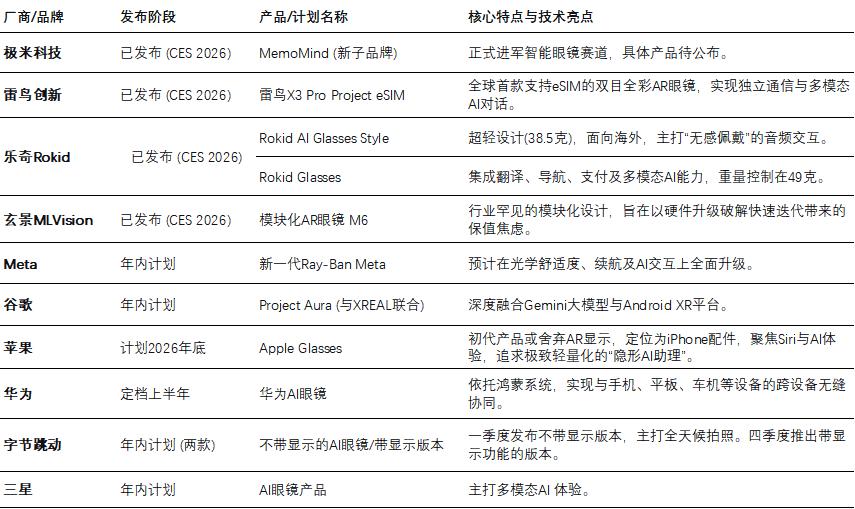
Overview of the release and planning of some new products in the AI glasses industry in 2026
Looking at these new products, the industry shows two core trends.
Firstly, "lightweight" and "independence" go hand in hand. Manufacturers no longer simply pile up display functions but prioritize wearing comfort. For example, Rokid's 38.5 - gram glasses and Apple's non - display strategy. At the same time, through configurations such as eSIM and independent chips, glasses are gradually getting rid of the rigid dependence on mobile phones.
Secondly, "AI capabilities" have become the core selling point. They have evolved from simple voice assistants to AI Agents with multi - modal perception, environmental understanding, and active service capabilities. The deep integration of large models and glasses hardware has become the standard.
02 Behind the explosion: The combined force of cost, technology, and demand
Why did AI glasses experience a concentrated explosion in 2026? This is not accidental but an inevitable result of the resonance among the maturity of the industrial chain, technological inflection points, and market demand. A research report by China Merchants Securities pointed out that behind this "hundred - glasses battle," there are three driving forces: the accelerating cost reduction of the industrial chain, AI interaction helping glasses transform from "toys" into productivity tools, and scenario adaptation providing killer applications.
Firstly, the rapid cost reduction in the supply chain and domestic substitution have laid the commercial foundation for the "hundred - glasses battle."
From the cost structure of the industrial chain, in AI shooting and audio glasses, the cost of chips accounts for more than one - third; in AI glasses with displays, the cost of micro - displays and optical modules accounts for more than half.
In the past two years, with the accelerated localization of chips, breakthroughs in waveguide technology, and the gradual maturity of Micro LED micro - display technology, the cost of core components has dropped significantly. According to industry data, Chinese manufacturers have occupied more than 80% of the global AI glasses market share thanks to their complete industrial chain advantages.
In the chip field, companies such as BES Technology and Allwinner Technology have developed AI - specific chips, raising the computing power - to - power consumption ratio to the leading level in the industry. In terms of optical display, companies such as Crystal Optech and Lante Optics have solved the mass - production problem of resin waveguide lenses, reducing the weight of full - color AR glasses from 90 grams to 49 grams, approaching the wearing experience of ordinary glasses.
The cost reduction has been directly reflected in the terminal price. Currently, mainstream AI glasses products are priced in the range of 2,000 - 3,000 yuan, which is acceptable to the general public, clearing the key obstacle for market expansion.
Secondly, the implementation of edge - side AI and breakthroughs in interaction technology have solved the "usability" problem of products.
Previously, smart glasses were long trapped in the "impossible triangle" of "weight, battery life, and computing power." Now, the launch of dedicated chips such as the Qualcomm AR1 series has made it possible to run complex AI algorithms with extremely low power consumption. Take the Rubis AR glasses demonstrated by Goertek at CES 2026 as an example. It uses a three - core heterogeneous system of MCU + ISP + NPU, and through heterogeneous communication, it connects the processing links from the camera, ISP, NPU to the display, allowing the glasses to run a lightweight object detection model on the NPU with extremely low power consumption.
At the same time, the evolution of optical solutions from BirdBath to geometric/diffractive waveguides and the iteration of display technology from LCoS to Micro OLED/Micro LED have enabled products to have all - day display effects while maintaining a lightweight design. The eSIM function of Thunderbird X3 Pro and the multi - modal AI recognition of Rokid Glasses are direct manifestations of these technological breakthroughs.
Notably, Rokid has carried out in - depth cooperation with leading domestic large - model companies to specially develop a dedicated edge - side multi - modal model. Its next - generation AI glasses will be driven by generative AI and AI Agents as the core, creating a new operating system and interaction interface.
The innovation in interaction methods is also reflected in the breakthrough of multi - modal perception capabilities. The in - vehicle AI glasses jointly developed by Rokid and GAC can remotely control vehicle unlocking, locking, and air - conditioning switching through voice commands, and even achieve automatic parking. The "Hongyan AIOS" system of MLVision can automatically switch service modes according to the user's scenario. The implementation of these technologies marks that glasses are evolving from "toys" to "productivity tools."
Thirdly, clear policy dividends and market expectations have injected a boost into the industry's explosion.
In 2026, smart glasses were included in the national consumer subsidy category for the first time. The National Development and Reform Commission and the Ministry of Finance jointly issued a new policy, allowing individual consumers to enjoy a 15% subsidy on the sales price of four types of digital products, including smart glasses, with a maximum subsidy of 500 yuan per item. This policy is regarded by the industry as an important signal of listing smart glasses as a "strategic popularization terminal," promoting their transformation from "niche novelty products" to "nationally popularized terminals."
With policy dividends and technological maturity, market expectations are extremely high. IDC predicts that driven by the new product launch rhythm of manufacturers and the new national subsidy policy, the shipment volume of the Chinese smart glasses market will reach 4.51 million units in 2026, a year - on - year increase of 78%. The global shipment volume is expected to exceed 23 million units, among which the AI glasses category will exceed 10 million units for the first time.
The huge expected market growth, in turn, has attracted more players to enter the market. Thunderbird Innovation completed a Series C+ financing of over 1 billion yuan, led by China Mobile Chain - leader Fund and CITIC Jingshi. Sharge Technology received nearly 100 million yuan in investment. The net buying amount of 17 AI glasses concept stocks in a single quarter exceeded 200 million yuan.
The combined force of policy and capital has formed a positive cycle of "supply creating demand and demand driving supply," providing the strongest footnote for the concentrated explosion in 2026.
03 The future battle: From "hardware involution" to "ecosystem definition"
With Meta planning a production capacity of over 20 million units, Google reconstructing the operating system ecosystem, and Apple testing the waters with lightweight devices, the focus of competition in 2026 has quietly changed. The industry is shifting from the early hardware parameter competition to a deeper - level competition in user experience, technology integration, and ecosystem building.
Firstly, user experience takes precedence over technological show - off and has become the core of product competitiveness.
Facing concerns about the high return rate of some products and doubts about their "useless functions," manufacturers must find reasons for users to wear glasses every day. On social platforms, consumers are most concerned not about high parameters but about "whether it will be tiring to wear for a long time."
Rokid's data confirms this. The daily wearing time of its Rokid Glasses products reaches 8 hours on average, and users have truly integrated them into their daily lives instead of leaving them as unused "toys."
In 2026, manufacturers' evolution direction has shifted from piling up functions to in - depth scenario exploration. Rokid cooperated with GAC to integrate AI glasses into the in - vehicle full - scenario interaction, realizing remote vehicle control and navigation information projection. NanoBox launched the world's first AI learning glasses with a built - in educational large - model, which can generate classroom notes in real - time and intelligently plan word review, making learning efficiency and concentration the core values.
Ye Qingqing, an analyst at IDC China, believes that 2026 is a crucial year for the implementation of smart glasses in vertical scenarios. Only by deeply integrating AI capabilities in high - frequency and essential fields can the leap from "novelty" to "regular use" be achieved.
Secondly, technology integration is better than single - point breakthroughs, and system - level innovation determines the height of products.
Previously, smart glasses were long trapped in the "impossible triangle" of "weight, battery life, and computing power." Now, the upgrade of a single component is no longer sufficient to build a competitive barrier. The real breakthrough comes from the collaborative optimization at the system level.
The Rubis AR glasses demonstrated by Goertek at CES 2026 use a three - core heterogeneous architecture of MCU + ISP + NPU. Through efficient collaboration, it connects the processing links from the camera, NPU to the display, enabling the operation of a lightweight object detection model with extremely low power consumption. This "heterogeneous computing" integration idea enables glasses to shift from passive response to active perception.
At the same time, the integration of interaction methods is also accelerating. Rokid cooperated with Wearable Devices to connect the neural wristband Mudra Link to AI glasses, allowing users to achieve precise control through subtle finger movements, making interaction "a second nature."
This evolution from "single - point breakthrough" to "system integration" marks that the industry is moving towards true maturity.
Finally, ecosystem building determines long - term value, and a single piece of hardware cannot win the war.
An analyst at Huafu Securities pointed out that the threshold for making glasses hardware in China is relatively low, and the products are highly homogeneous. When the supply chain tends to be unified and the product appearance falls into a stereotype, the real barrier lies in the software ecosystem and AI capabilities.
Google's joint launch of Project Aura with XREAL is not just about selling a pair of glasses. Its ambition is to promote the Android XR system and replicate its "ecosystem platform" path in the mobile phone era.
Domestic manufacturers are also accelerating their layout. Huawei achieves seamless collaboration between mobile phones, tablets, in - vehicle systems, and glasses based on HarmonyOS. Rokid has been launched in 115 countries globally, with over 100,000 active users, and has connected with ecological partners such as AutoNavi Maps, Alipay, and JD Technology.
The future competition is not between glasses but between ecosystems. Whoever can truly integrate large - model capabilities, application services, and user data into glasses will take the initiative in the next - generation human - computer interaction competition.
This article is from the WeChat official account "Insight New Research Institute" (ID: DJXYS - 0309). Author: Someone concerned about smart glasses. Republished by 36Kr with authorization.