The capital behind four industry leaders joins hands to spawn a unicorn worth tens of billions in the field of embodied AI.
In the Year of the Horse, another unicorn in the embodied intelligence field with a valuation of over 10 billion yuan has emerged.
On February 24th, following the official announcement by Zhipingfang yesterday of a Series B financing round exceeding 1 billion yuan and a valuation of over 10 billion yuan, Spirit AI, a Hangzhou-based developer of embodied intelligence and general humanoid robot technologies, officially announced the successful completion of two consecutive financing rounds totaling nearly 2 billion yuan.
Similar to Zhipingfang, which attracted a lineup of prestigious investors such as CRRC Capital and Baidu Strategic Investment, Spirit AI's financing this time features a gathering of industry capital heavyweights: Yunfeng Capital, Sequoia China, TCL Capital, 360 Capital, and others have all joined the fray.
Notably, behind Shunwei Capital, the seed-round investor, stands Lei Jun; behind JD.com, the Pre - A+ round investor, stands Liu Qiangdong. With this latest financing, including Jack Ma behind Yunfeng Capital and Zhou Hongyi behind 360 Capital, Spirit AI has managed to attract four internet industry titans.
With the successful completion of this financing round, Spirit AI's valuation has soared past the 10 - billion - yuan mark, officially joining the core ranks of the "10 - Billion Club" in the embodied intelligence sector.
As of now, there are six members in the "10 - Billion Club" of the embodied intelligence sector: In addition to the newly minted unicorns, Spirit AI and Zhipingfang, ZHIYUAN ROBOTICS had an early valuation of 15 billion yuan; Unitree Robotics, which has appeared on the Spring Festival Gala for two consecutive years and captured national attention, has a valuation of 12 billion yuan after its latest financing round; Galaxy General has a current valuation of approximately 21 billion yuan; and Xinghaitu is the fourth Chinese embodied intelligence unicorn with a valuation of over 10 billion yuan.
It's worth mentioning that Hangzhou, as an important hub for China's embodied intelligence industry, is the birthplace of both Spirit AI and Unitree Robotics. The "Six Rising Stars of Hangzhou" are about to expand.
Over 3.3 billion yuan in 6 financing rounds in 2 years, with Lei Jun, Liu Qiangdong, Jack Ma, and Zhou Hongyi in the background
Public information shows that Han Fengtao studied under academician Ding Han, a leading figure in robotics academia. In 2015, he co - founded Luoshi Robotics as the CTO. During his tenure, he assembled a world - class R & D team for motion control and algorithms, leading the team to successfully develop and deliver nearly 100 models of industrial and collaborative robots, with a total production of nearly 20,000 units.
As the wave of large - scale models accelerates the arrival of the AI 2.0 era, seizing the opportunity, Han Fengtao joined forces with Gao Yang, an assistant professor at the Institute for Interdisciplinary Information Sciences of Tsinghua University, the director of the Tsinghua Vision and Embodied Intelligence Laboratory, and a doctoral supervisor (with ten years of research experience in embodied intelligence, machine vision, and machine learning). In January 2024, they established Spirit AI (Hangzhou) Technology Co., Ltd.
In addition to these two prominent figures, Spirit AI boasts a team known as the "irreplaceable AI dream team." Most of its members graduated from top - tier institutions such as UC Berkeley, Tsinghua University, and Peking University, with an average age of under 30. They have profound academic and engineering backgrounds in core areas of embodied models, including multi - modal large models, robotics, reinforcement learning, and imitation learning. They not only continuously contribute core achievements to international open - source communities but also have the full - chain ability to integrate "models - algorithms - hardware."
An investor once commented, "The team at Spirit AI is on par with the level of Pi and Google DeepMind."
With a doctoral - led and second - time entrepreneurial venture and a strong team, either factor alone would be enough to attract active investment from the primary market. Indeed, in August 2024, Spirit AI officially announced the completion of nearly 200 million yuan in seed and angel rounds of financing. The seed - round investors were Shunwei Capital and Oasis Capital (which also participated in the angel round). The angel - round financing was led by Honghui Fund, with participation from Fortune Capital and Qiancheng Capital. In November of the same year, Spirit AI received exclusive investment from Bairui Capital in the angel + round.
In March 2025, in Spirit AI's Pre - A round financing of 528 million yuan, Prosperity7 Ventures (P7) under Aramco Ventures took the lead, with deep participation from multiple capitals such as China Merchants Capital, GF Xinde Investment, Jingya Capital, Orient Fortune Capital, and Huakong Fund.
The climax occurred on July 21, 2025. On this day, "Led by JD.com" appeared three times. The embodied intelligence companies receiving investment included Spirit AI, which raised nearly 600 million yuan in the Pre - A+ round, along with Zhujidongli and Zhongqing Robotics.
To date, including the recently announced nearly 2 billion yuan in financing, Spirit AI has completed six consecutive financing rounds in less than two years, with a total financing amount of approximately 3.328 billion yuan.
Notably, in the layout of industrial capital, Spirit AI is the only embodied intelligence startup that has attracted multiple industrial capitals to invest simultaneously, creating a unique "full - scenario ecosystem" in the embodied intelligence sector. From industrial manufacturing giants like CATL, Inovance Technology, and TCL, to logistics, retail, and financial infrastructure represented by JD.com and China Merchants Capital, and then to the two consumer electronics giants, Huawei and Xiaomi - the industrial shareholders have achieved cross - border coverage of the core sectors of the real economy.
Regarding the entry of large companies like Xiaomi, Tencent, and XPeng into the field of embodied intelligence, Han Fengtao said in an interview with LatePost AI, "I often say internally that our real future competitors are these large companies. Enterprises like Huawei, Xiaomi, and Li Auto, which are involved in both hardware and software, are more likely to succeed. (In this financing round) Spirit AI has attracted many industrial investors, such as Huawei, Xiaomi, and JD.com. These large companies have application scenarios and their own embodied intelligence departments, but they lack models. In the future, we can provide them with a 'standard robot + model + data management platform,' allowing customers to fine - tune the system according to downstream tasks and develop their own robot agents."
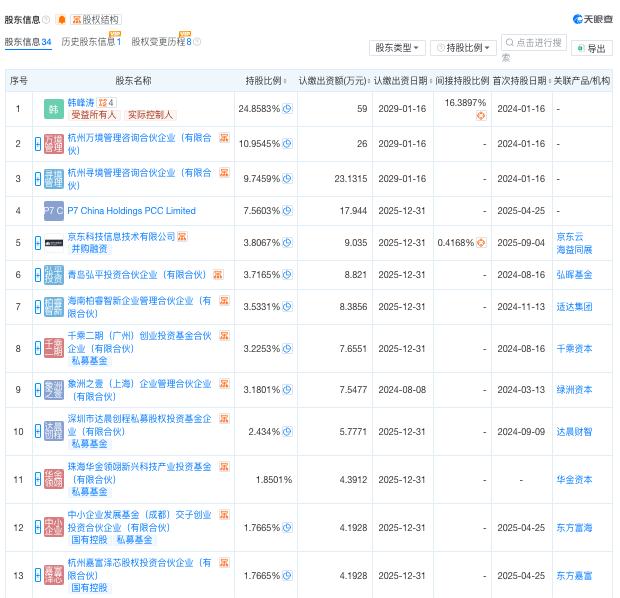
Information from Tianyancha App shows that currently, Han Fengtao, as the actual controller, directly holds 24.8583% of Spirit AI's shares and indirectly holds 16.3897%. P7 holds 7.5603%, making it the largest external institutional shareholder.
Source: Tianyancha
In addition, Shunwei Capital holds a total of 4.4048% of Spirit AI's shares; JD.com holds 3.8067%; and Hubble Investment under Huawei holds 1.1777%. The shareholding details of the newly joined Yunfeng Capital and 360 Capital are not yet clear.
Building dual barriers of models and data, collaborating with CATL and JD.com to explore commercialization
After large - scale models reshaped the digital world, the wave of "embodiment" in which artificial intelligence penetrates the physical world has become the core narrative of the global technology industry. Data from the China Academy of Information and Communications Technology shows that in 2025, the total financing in the domestic embodied intelligence field reached 73.543 billion yuan, with over 740 investment events, indicating a continuously rising popularity of the sector.
While capital is pouring in, the market is also rapidly differentiating. From concept hype to value realization, companies with real technological moats and industrial - scenario penetration capabilities are becoming scarce targets for capital competition. Spirit AI is a prime example.
As one of the few domestic embodied intelligence companies with full - stack AI + robotics production - level capabilities, Spirit AI is committed to creating world - class general humanoid robots and next - generation embodied large models and learning algorithms, aiming to bring general robot companions into every household and drive the world into the era of intelligent robots.
In June 2025, Spirit AI officially launched the Moz1, a full - force controlled humanoid robot equipped with its self - developed VLA model. It has 26 degrees of freedom throughout the body, is equipped with the world's highest - power - density integrated force - controlled joints, and features China's top - notch high - precision and high - speed WBC algorithm, with a load - to - self - weight ratio of 1:1. Moreover, the robot can achieve zero - latency full - body teleoperation. Paired with its self - developed multi - dimensional data collection device, it can efficiently collect data to support hourly model iterations.
In the field of embodied models, Spirit AI's self - developed VLA model, Spirit v1, is continuously being iterated and upgraded. It can accurately perform office tasks such as tidying desks, throwing away trash, and returning chairs, continuously enhancing the model's applicability in multiple scenarios. In January 2026, Spirit AI's open - source Spirit v1.5 model became the first Chinese open - source model to outperform Pi0.5 in terms of performance. This model has strong zero - shot generalization ability, capable of completing complex tasks such as wiping objects, operating hinges, and handling flexible objects without the need for new sample training, demonstrating efficient cross - scenario execution capabilities.
According to Gao Yang, "We adhere to the 'data pyramid' training concept. In the pre - training stage, we didn't follow the traditional 'world model' approach of predicting each frame, which consumes a large amount of computing power and is inefficient. Instead, we chose to pre - train based on a vast amount of human Internet videos, achieving better results with fewer parameters and significantly reducing computing costs."
Regarding data collection, Gao Yang added, "We have reduced data collection costs by 90% through our self - developed equipment, enabling the large - scale collection of real - world data. It is the combination of these technological capabilities that has made Spirit v1.5 the world's first open - source foundational embodied model to outperform Pi0.5 in terms of performance."
Spirit AI is firmly advancing its Scaling strategy with "diversity" at its core. As of now, it has accumulated over 200,000 hours of multi - type real - interaction data, covering dimensions such as Internet videos, teleoperation, and wearable data collection. It is expected that the total amount will exceed 1 million hours in 2026. The self - developed wearable data collection device has been upgraded to the fifth generation, reducing data costs to one - tenth of traditional methods and removing obstacles to large - scale data collection.
Notably, through training on diverse "imperfect data," the team has discovered a steeper Scaling curve - the diversity of data is far more valuable than its "cleanliness."
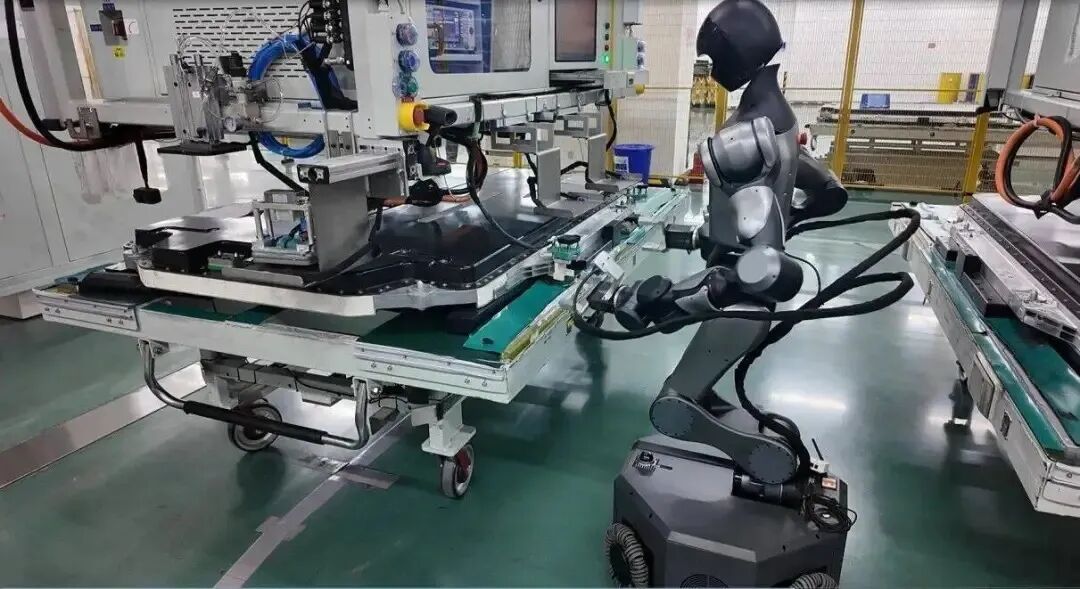
Relying on these advantages, Spirit AI has continuously achieved breakthroughs in commercialization: The world's first humanoid embodied intelligence production line has been put into operation at CATL's Zhongzhou Base. The Xiaomo robot has become the core equipment of the production line, achieving zero - fault mass production of nearly a thousand batteries. Its operation rhythm is comparable to, or even faster than, that of skilled workers, demonstrating millisecond - level rapid adaptation to production uncertainties and flexible operation capabilities that surpass humans.
Relying on its 100% self - developed full - stack technology moat and a large amount of process data accumulation, Spirit AI has not only established industry barriers but also maximized its "capability output." It has shifted from simply selling hardware to providing full - stack capabilities in perception, decision - making, and execution, enabling rapid customization to adapt to different production lines and global large - scale replication. In the future, it will cover various battery types and process links, completely reshaping the business boundaries of new - energy manufacturing.
Source: Spirit AI
Meanwhile, the cooperation with JD.com has further expanded these boundaries. The Mozi robot replaces humans for interactive product demonstrations in JD.com's retail scenarios. The two parties are jointly exploring the potential of JD Cloud and the Joyinside large model in large - scale retail networks, achieving two - way empowerment between technology R & D and application scenarios.
Regarding the speed of commercialization, Han Fengtao said in an interview with LatePost AI, "From 2028 to 2029, more large Chinese companies will regard embodied intelligence as an important strategy and invest massive resources. Start - ups need to prove the existence of this market first, and some medium - sized start - ups have indeed emerged. So we always say internally that speed is our only advantage. When starting a business in China, we must become a medium - sized company (selling at least 100,000 robots a year and achieving profitability) before large companies enter the market. Spirit AI plans to become a medium - sized company by 2030."
In the future, Spirit AI will continue to increase its investment in embodied foundation models and real - data systems and deepen the co - construction of the industrial ecosystem. From task - level intelligence to general embodied models, from simulation to real - world driving, embodied intelligence is entering a critical stage of technological industrialization.
This article is from the WeChat official account "Lieyun Selection", author: Wang Fei. Republished by 36Kr with permission.