During this Spring Festival, the car rental business "boomed".
"By the 28th day of the twelfth lunar month, all twenty to thirty vehicles in the store had been rented out. Even by the fourth day of the first lunar month, the store still had no cars available for rent." Du Lei (a pseudonym), the owner of a car rental company in Fuyang, Anhui Province, told DoNews about the booming business at his store during the Spring Festival.
The popularity of Du Lei's store is a microcosm of the booming car rental market across the country during this year's "longest Spring Festival holiday ever."
Data from CAR Inc. shows that this year's Spring Festival car rental bookings were 20% higher than the same period in previous years. The inflection point of the demand increase came a week earlier than in previous years. Among them, the proportion of orders with a rental period of 9 days or more reached a record high. Specifically, inter - city travel orders increased by more than 70%, and the bookings for new energy vehicles surged six - fold year - on - year.
Data from Hello Car Rental shows that Spring Festival orders increased by more than 80% compared to the same period in 2025, and the growth of self - drive car rental orders in the week before the festival was even more rapid. A relevant person in charge of Ctrip also said that during the Spring Festival, the number of car rental orders across the country increased by nearly 20% year - on - year, and the average vehicle usage duration was extended to about 5 days, a 30% increase compared to last year.
If the "increase in bookings" is just a direct reflection of the market's popularity, then "the early inflection point, the extended rental period, and the shortage of cars in the lower - tier markets" are more like a structural signal reflecting industry changes: car consumption is shifting from "owning a car" to "using a car on demand."
In the typical "tidal - style travel" scenario of the Spring Festival return - home rush, families' travel demands are more concentrated and clear, but the necessity of buying a car is constantly being diluted. Compared with tying up hundreds of thousands of yuan in a one - time purchase and the long - term cost of car maintenance, short - term car rental can provide a higher degree of travel freedom with lower and more certain expenses.
Therefore, cars are no longer just simple durable goods but more like a socially - operated transportation capacity that is finely managed: in the peak season, it's a competition of supply and turnover; in the off - season, it's a competition of efficiency and cost.
The explosion of car rental demand has also brought new changes in traffic congestion to the lower - tier markets. During the Spring Festival return - home rush, rented cars and privately - owned cars flooded into county towns and rural areas, quickly filling the previously uncongested roads with "short - term incremental transportation capacity."
On the first day of the first lunar month, when DoNews visited Jieshou City, Anhui Province, it was found that many main roads in the local county town were congested, and traffic police were on the scene to direct traffic. Even on rural roads, congestion occurred frequently. This confirms from another perspective that car rental is completing the transformation from a "supplementary option" to a "rigid demand supply" in the lower - tier markets.
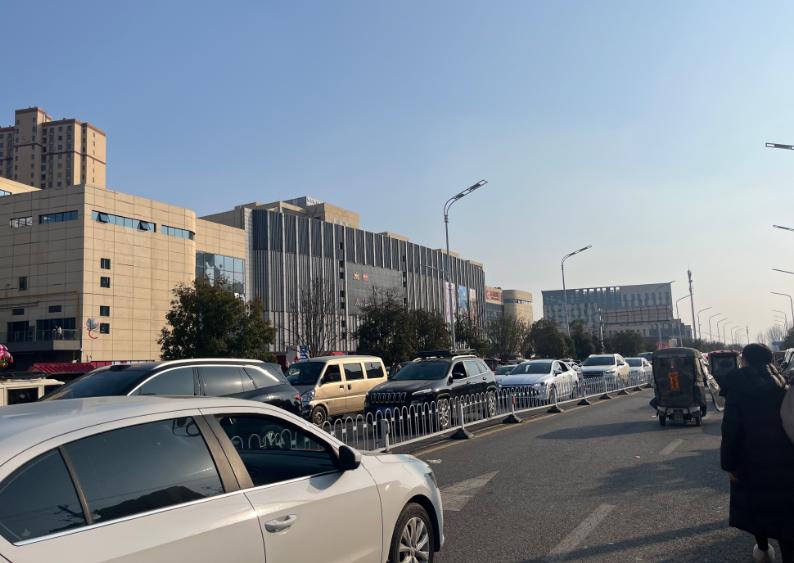
Source: DoNews
Compared with previous years, the car rental market during the 2026 Spring Festival also showed three major new changes: First, consumer attitudes have become more rational. Car rental is no longer a "face - saving consumption" but has returned to the essence of practical travel needs. Second, the main consumer group has become younger. Young people in the lower - tier markets have become the core group of car renters, and their preference for new energy vehicles has increased significantly. Third, AI technology has continued to penetrate all aspects of the car rental industry, from risk control, pricing to scheduling and customer service. It is gradually solving the long - standing efficiency and trust issues in the industry and injecting new impetus into the high - quality development of the industry.
01. From Face - Saving to Rigid Demand: The Logic of Car Rental Consumption is Changing
Facing the concentrated explosion of car rental demand during the Spring Festival, what the industry first exposed was not the "popularity" but the rigidity of supply. As heavy - asset items, cars are difficult to expand in large quantities in a short period, while the demand is simultaneously increasing in scenarios such as returning home, self - driving, and blind dates. Once the gap between supply and demand widens, "car shortage" and "price increase" become the common phenomena in the market. Under this definite contradiction, platforms and car dealers began to "grab transportation capacity" in their own ways.
On the one hand, leading car rental platforms accelerated their preparations. For example, CAR Inc. launched and put 100,000 new cars into the market before the Spring Festival, trying to meet the surging orders with large - scale supply. On the other hand, sensitive second - hand car dealers quickly extended their business boundaries to "rental." Zhang Yang (a pseudonym), a second - hand car dealer in Zhoukou, Henan Province, admitted that during the Spring Festival, he rented out some second - hand cars in good condition from his store. The rental prices and procedures were all in line with the local car rental market standards.
This is not a temporary idea but a more "asset - operation" choice: the second - hand car and car rental industries are naturally compatible because they both focus on "the full - life - cycle value of vehicles." Car rental splits the usage time of a car and rents it out to earn continuous cash flow; second - hand cars are sold at an appropriate time to realize profits, and the key to profitability lies in residual value management and circulation efficiency.
More importantly, rented cars usually have a concentrated model range, complete maintenance records, and transparent vehicle conditions, which can continuously provide standardized car sources. In turn, this reduces the uncertainty in second - hand car pricing and sales. After the connection between the two, a closed - loop of "purchase → rental operation → withdrawal at the end of the lease → realization of second - hand car value → repurchase" is formed. This can not only stabilize the vehicle utilization rate but also lock in the exit channels, making the depreciation cost more controllable and the capital turnover faster.
Even though platforms and car dealers have added more cars, the imbalance between supply and demand still makes "price increase" the keyword in the Spring Festival car rental market. Social media is full of discussions about the increase in car rental fees during the Spring Festival: "The car rental price increased by more than 10 times during the Spring Festival, and it cost 5,500 yuan to rent a car for 11 days." "It cost three or four thousand yuan to rent a car for 11 days, and it cost 10,000 yuan (including insurance) to rent an Ideal L6 for 10 days." Many car rental platforms clearly stated that the minimum rental period during the Spring Festival is 6 days, and some stores even require a minimum rental period of 7 days.
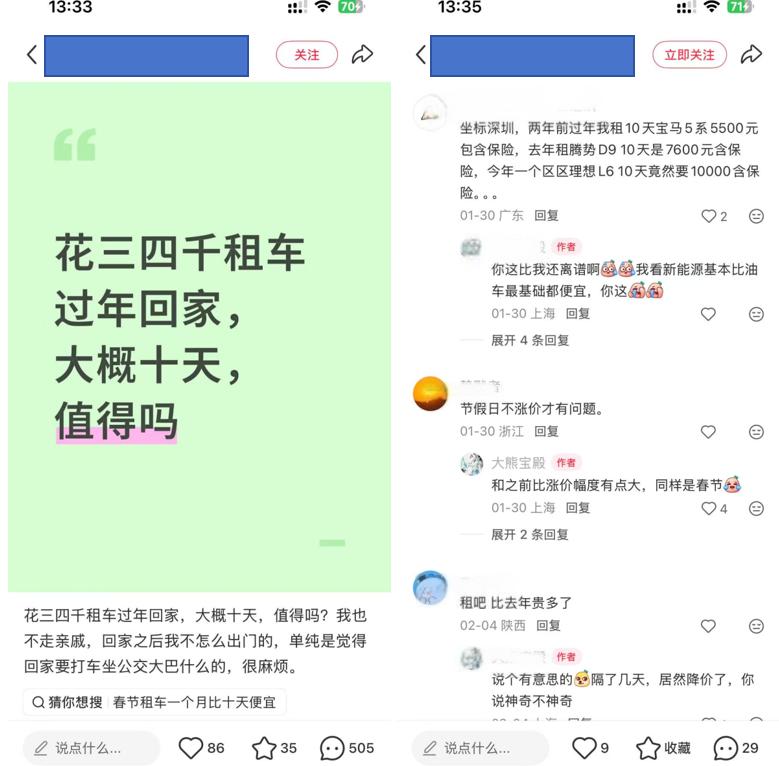
Source: Xiaohongshu
The rising car rental prices have not significantly suppressed the demand. Behind this is the change in the logic of car rental consumption: car rental is shifting from the past "face - saving consumption" of driving a luxury car to return home in style to a more rigid and rational travel choice, especially among those who think "buying a car is not cost - effective/using a car is more convenient."
Cao Yang (a pseudonym), who has worked in Shenzhen for many years, said that his colleagues planned a self - driving tour during the holiday more than a month before the Spring Festival. For them, in a city like Shenzhen with a highly developed transportation system, although it is not difficult to buy a car, the parking cost, vehicle usage frequency, and daily commuting structure make many people more dependent on public transportation. Once they encounter a concentrated travel period like the Spring Festival, it is difficult to get tickets, and the travel plan is passive. In this case, car rental becomes a more cost - effective choice.
This kind of "tourism - type car rental" is not an isolated case. Data from CAR Inc. shows that in addition to traditional hub cities such as Beijing, Guangzhou, Kunming, Shenzhen, and Haikou remaining in the top five in terms of booking volume, the demand for both ice - snow and cold - avoiding theme tours has increased simultaneously. The demand for traveling north to ice - snow destinations such as Altay and Kashgar and south to cold - avoiding destinations such as Sanya, Haikou, and Xishuangbanna has also strengthened significantly.
Data from Hello Car Rental shows that in January this year, the browsing and searching volume of car rentals on the App in Xinjiang and Tibet increased by more than 200% year - on - year, and the order volume increased by more than 300%. The self - drive car rental orders in provinces (autonomous regions) such as Gansu, Inner Mongolia, and Qinghai also increased by about 100%.
Different from his colleagues who choose to rent a car for a self - driving tour, Cao Yang's decision to rent a car is more like a compound rigid demand. His hometown is in a rural area in Hunan. Even if he manages to get a ticket, he still needs to transfer multiple times from the high - speed railway station to his home, and the round - trip cost is high. In previous years, he had to rely on relatives' cars to go home, which was rather embarrassing. During the Spring Festival, he also has to face the real requirements of blind dates and social activities. In addition, he can't return home with his pet without a car. Due to these multiple factors, he finally chose to rent a car instead of buying one.
As more and more people like Cao Yang regard car rental as a comprehensive solution to meet their needs for returning home, traveling, socializing, and family, car rental is no longer just an "alternative solution" but is becoming a "normal option" in more cities and lower - tier areas.
As car rental gradually becomes a rigid and common demand, the market's supply mode, vehicle model structure, and service chain will be reshaped accordingly. This is the key signal released during this year's Spring Festival.
02. The Younger Generation Becomes the Main Force in Car Rental, and New Energy Vehicles Gain Popularity
As Spring Festival car rental shifts from "face - saving consumption" to a more frequent and practical rigid - demand choice, users' decision - making models have also been re - arranged: They no longer only focus on the brand logo but care more about space, comfort, and overall cost. Under this new standard, new energy vehicles have taken the center stage in this year's car rental market.
Data from CAR Inc. confirms this shift in preference. During the Spring Festival, the number of users who want to experience personalized vehicle models has doubled compared to previous years, and the bookings for new energy vehicles have increased six - fold compared to previous years. Domestic new energy vehicles with intelligent cockpits and large spaces have become the "new favorites for the Spring Festival."
Data from Hello Car Rental shows that people returning home for the Spring Festival pay more attention to the cost - effectiveness of car rental, the number of passengers the car can carry, and the size of the trunk. Tourists, on the other hand, value comfort more and regard "test - driving a new car" as an additional benefit of car rental.
This change is not limited to high - tier cities but is also accelerating in lower - tier markets. Du Lei said that his store only keeps a small number of "functional vehicle models" of fuel - powered cars, such as BMW 530, Volkswagen Golf, Buick GL8, Toyota Sienna, Mercedes - Benz E300, and Audi Q5. Among them, the GL8 mainly meets the business reception needs of people coming from other places, while the BBA models are more popular among men over 40 in the county who have a preference for "face - saving attributes."
The main vehicles in his store are popular new energy models such as Tesla Model Y/X, XPeng P7/MONA, AITO M9/M5, and Ideal L8/L9. "It's not that I don't want to buy more fuel - powered cars. It's just that the current main car renters are younger, and they prefer these new energy models," Du Lei said.
The vehicle fleet structure of Du Lei's store reflects a deeper logic: The popularity of new energy vehicles in the lower - tier car rental market is not just the result of "technological progress" but also the result of "re - evaluation of consumer mentality."
In the past, in county towns and rural areas, cars were relatively scarce, and brand symbols were more prominent. Driving a Mercedes - Benz E - Class, BMW 5 - Series, or Audi A6 - Series was more likely to be regarded as a sign of "success" and had obvious social advantages in scenarios such as blind dates, New Year greetings, and class reunions.
However, as the car ownership rate has increased and cars have gradually become a family staple, young people's perception of cars has begun to return to their "tool - like nature." Instead of using cars to save face, they care more about whether the car is hassle - free, comfortable, and whether they are spending their money in a more worthwhile way.
At the same time, the "evaluation system" in the acquaintance - based society of county towns is also loosening. On the one hand, more and more single men in county towns are choosing to "lie flat." On the other hand, New Year greetings to relatives have become more efficient, and it has become common to visit five or six families in a day. "Rather than wasting time dealing with relatives, it's better to earn more money and live a more comfortable life," Du Lei said self - deprecatingly.
As the social narrative weakens and the efficiency narrative strengthens, new energy vehicles with large space, high intelligence, and a more "worthwhile" driving experience are becoming the choice of more young people.
Data from CAR Inc. shows that inter - city travel orders during the Spring Festival increased by more than 70%, and the bookings from post - 2000 users were 63% higher than in previous years, far exceeding the growth rate of other age groups. Data from Fliggy shows that during the 2026 Spring Festival travel rush, the number of car rental orders increased by more than 40% year - on - year, and post - 90s and post - 2000s accounted for about 60%, becoming the core group of car rental consumers.
However, when rented cars and private cars "flood into county towns" during the Spring Festival, new contradictions have begun to emerge: The demand side has completed the transformation to new energy and intelligence, but the system supply in county towns (infrastructure, traffic management, and usage habits) is still catching up.
On the one hand, in the short term, the car ownership in county towns is still mainly fuel - powered cars, and the structural contradiction of charging resources being "excessive in off - peak hours and in short supply during peak hours" has been magnified. When DoNews visited Jieshou City, Anhui Province, it was found that some charging piles were occupied by fuel - powered cars, while others were idle during non - peak hours. The unstable utilization rate directly affects the return on investment, making it difficult for the charging network to expand rapidly in the short term. The peak demand during the Spring Festival is undoubtedly a stress test for the charging system in county towns.
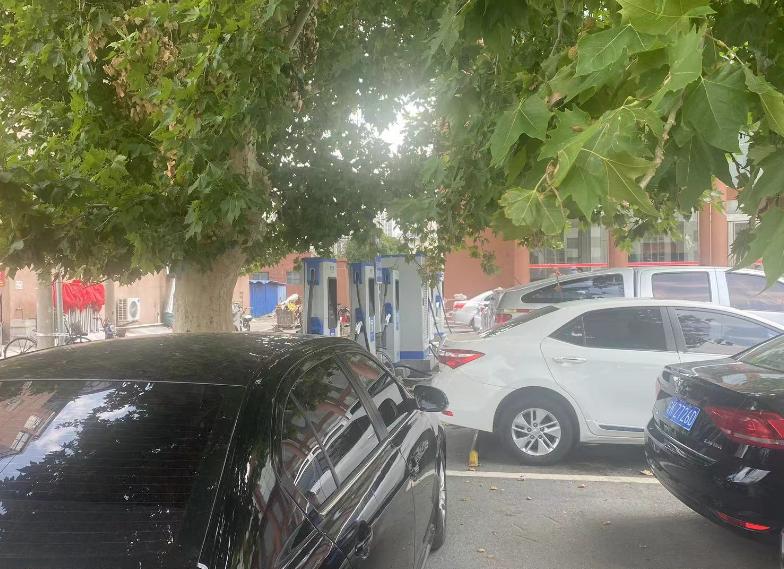
Source: DoNews
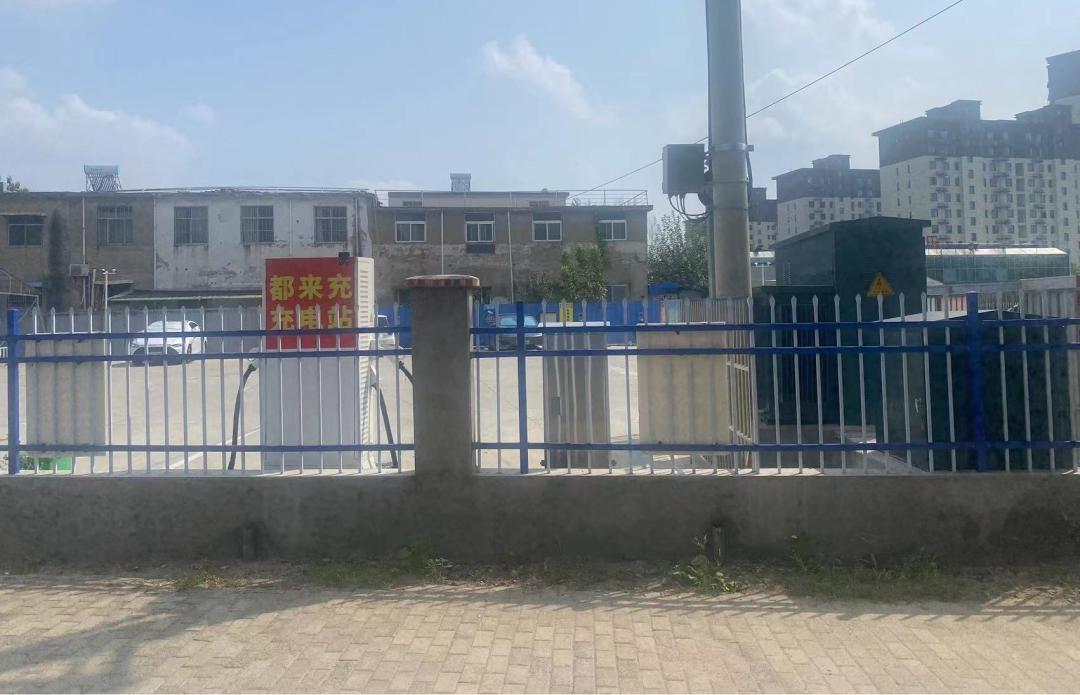
Source: DoNews
On the other hand, platforms are accelerating the process of intelligentization on the supply side. Among the 100,000 new cars deployed by CAR Inc. before the Spring Festival, more than 30% are new energy vehicles with L2+ -