Spring Festival mobile phone battle: Some offer a direct discount of 4,000 yuan, while others hold back.
Price wars during the Spring Festival have always been a regular event in the mobile phone industry. However, during the Spring Festival in 2026, the situation changed: some manufacturers waved their hands and cut prices by 4,000 yuan, while others held back and only relied on national subsidies.
Walking into any popular shopping mall, you may see a strikingly contrasting scene.
In Huawei's stores, sales staff are enthusiastically helping customers calculate the "Spring Festival discounts": for a folding-screen mobile phone with an original price of nearly 14,000 yuan, the official price is first reduced by 2,000 yuan, and then a local subsidy of 500 yuan on Douyin is added. If the customer has a store coupon in their account, they can get an additional 200 yuan off. After a series of complex combinations, the total discount can reach 2,700 yuan. This is not the maximum reduction; some models can even have a reduction of 4,000 yuan.
At the counters of Xiaomi, vivo, OPPO, and Honor, in response to the question "Is there a price cut for mobile phones during the Spring Festival?", the sales staff all replied, "No, there is only the national subsidy."
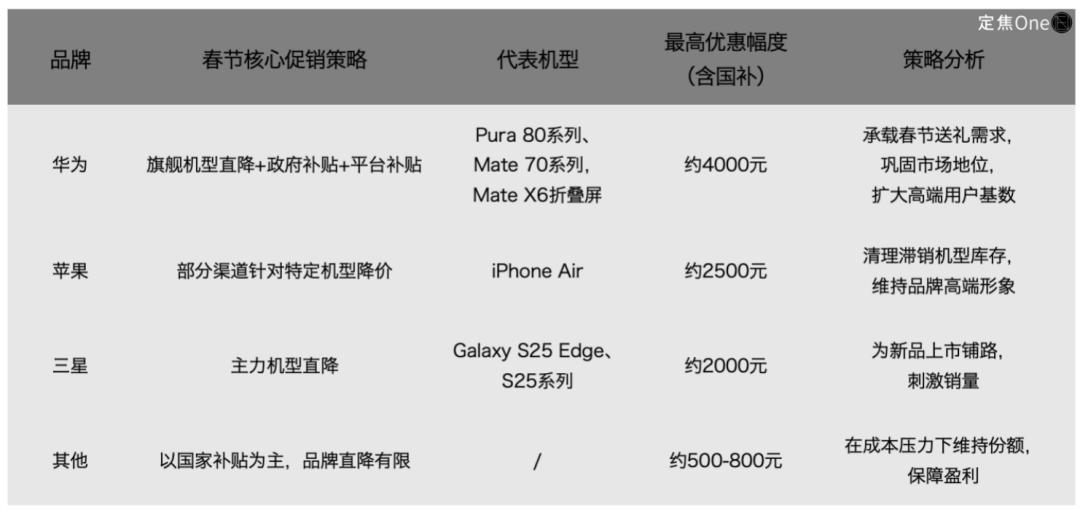
On one side, there are all kinds of complex "math problems," while on the other side, there is a straightforward "one-size-fits-all" approach. Behind this, it is no longer just a promotion based on who can offer the biggest price cut. Huawei is calculating the "gift-giving bonus," Apple is "clearing inventory but has an image to maintain," Samsung is "paving the way for new products," and other manufacturers are not responding. Behind each choice, there are their own cost and brand accounts.
However, no matter what each manufacturer is planning, they all cannot avoid the same reality: in January 2026, the overall sales volume of the Chinese smartphone market declined by 23% year-on-year. In such a "late spring cold" market, the gap between manufacturers will not disappear after this Spring Festival.
Price cuts by Huawei, Apple, and Samsung:
Clearing inventory, stimulating sales, and consolidating the high-end market
This year's Spring Festival price war has presented all manufacturers with a choice between "seeking market share or seeking profit."
Leading the charge is Huawei. On January 29, Yu Chengdong announced the launch of a major Spring Festival promotion, covering all product categories, which will last until February 28.
According to the understanding of "Focus One" at Huawei stores in first-tier cities, the discount is indeed significant. A staff member at a Huawei store calculated that for the Pura 80 Pro (12GB + 512GB version) released in mid-2025, with an original price of 6,499 yuan, the official price is first directly reduced by 1,500 yuan. After the price cut, it can exactly enjoy a 500-yuan national subsidy, and the final price is 4,499 yuan, 2,000 yuan lower than the original price.
The more popular model in the store is the Mate70 Pro+, with an original price of 8,499 yuan and a maximum reduction of 2,700 yuan. For the more expensive folding-screen Mate X6 series, after stacking various discounts, the maximum reduction can reach 4,000 yuan.
However, this salesperson also admitted: Currently, the models with relatively large discounts are all old models, such as the Pura 80, Mate 70, and Mate X6. New models basically only have the national subsidy and no other additional discounts.
The judgment of Zhang Xin, a mobile phone industry practitioner, also verifies this point: Huawei's significant price cuts are essentially using the inventory of the previous generation of models to boost sales volume, and the price system of new products has not loosened.
Price cuts during the "Spring Festival season" are a regular practice for Huawei mobile phones. Song Jia, a channel insider, added that the reason is not complicated: among all mobile phone brands, Huawei is probably the one that can benefit the most from the "Spring Festival gift-giving" bonus. This implicit demand gives Huawei enough motivation to invest heavily at this time.
Apple and Samsung have also joined this "limited" price war, but they have more shrewd plans.
Apple's price cut only applies to the iPhone Air model, which was released in October 2025 and has relatively mediocre sales. During the Spring Festival, the price is reduced by 2,000 yuan, and after stacking the national subsidy, the reduction can reach 2,500 - 2,900 yuan, with a final price of 5,499 yuan (original price 7,999 yuan). However, the price cut channels are mainly Tmall's official flagship store, JD.com's self-operated store, and offline authorized stores, excluding Apple's official website and offline direct-sale stores.
This level of price cut is understandable because the Air didn't sell well before. In order to pursue extreme thinness and lightness, this phone made significant sacrifices in terms of battery life and camera performance. The activation volume after its launch only accounted for about 1% of the new iPhones in the same period, and Apple even cut its production plan in half a few weeks after the release.
The effect of the price cut was immediate. The person in charge of an Apple offline authorized store said that the iPhone Air was very popular during the Spring Festival. "Two units that just arrived at the store this morning were sold out by noon. Currently, you can register your demand first, but the specific delivery time is uncertain."
Apple's approach can be understood from its situation in the Chinese market - the recent situation is good, but there have always been hidden concerns. In January 2026, Apple's sales volume increased by 8% against the trend, and its market share rose to 19%, tying with Huawei at the top, reaching the highest level in January in the past five years; in Q4 2025, its single-quarter share rebounded to 22%, returning to the first place. However, the data for the whole of last year was not good. Its shipment volume was 46.2 million units, almost the same as that of vivo (46.1 million units), and both were behind Huawei (46.7 million units), which was the first in the whole year, with a difference of less than one million units among the three.
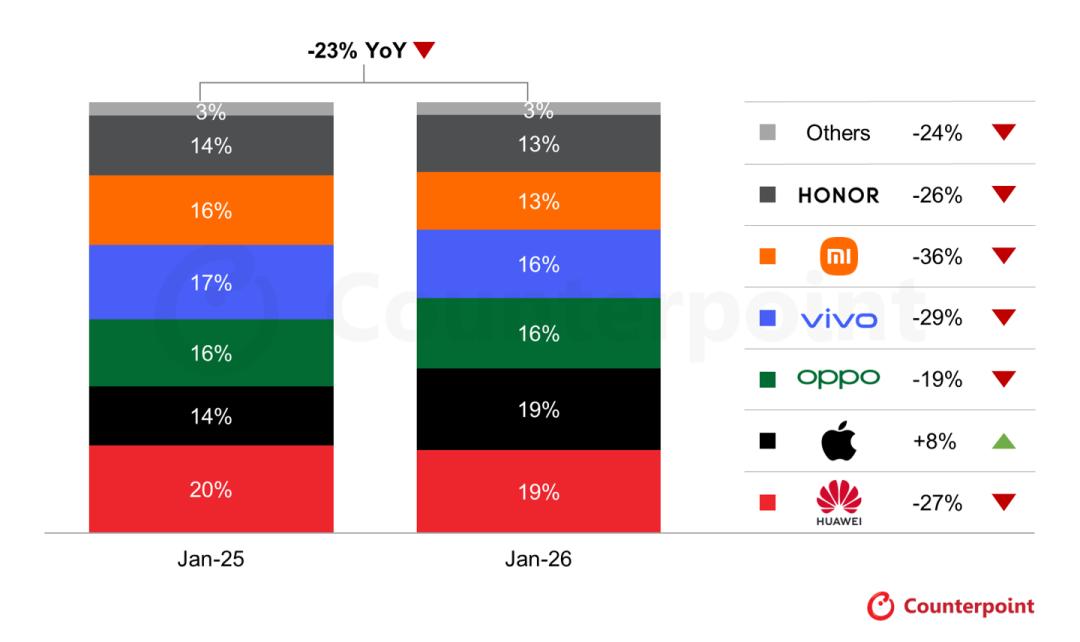
Sales volume of domestic smartphones in January 2026
In this situation, using specific channels to offer discounts to clear inventory while maintaining the price system on the official website has become Apple's common approach to deal with competition. In the second quarter of 2025, Apple offered a channel discount of about 31% on the iPhone 16 Pro, with the same purpose of making the price meet the national subsidy threshold and stimulating sales - the Spring Festival price cut of the iPhone Air this time follows the same logic.
Samsung's price cut is more direct. Models such as the S25 Edge have a price cut of more than 2,000 yuan, and after stacking the national subsidy, it can reach 2,500 yuan. In addition, the entire S25 series of Samsung has a price cut of 900 - 1,500 yuan. To put it simply, it is to clear the channel inventory and make room for the upcoming S26 series of new products.
However, there is another consideration for Samsung's price cut this time.
Samsung's market share in China is relatively limited, which actually gives it more room for maneuver - this price cut can be regarded as a strategic test. Song Jia analyzed that the price cut during the Spring Festival peak season seems to be to gain market volume and sales and increase its presence; the deeper purpose is to test the "price elasticity" of the Chinese market for high-priced products such as folding screens (such as the S25 Edge).
The three manufacturers have their own strategies, but they all choose to cut prices.
Xiaomi, OV hold back:
Hampered by memory costs, adjusting mid - and low - end models
On the other hand, brands such as Xiaomi, vivo, OPPO, and Honor have not yet followed up with significant price cuts. For a few models, such as some models in the Xiaomi 17 series and the vivo X300 series, there were additional discounts of 100 - 300 yuan at the end of January, but they disappeared by late February. Currently, the promotions are mainly the universal national subsidy, and a few models can stack small - scale platform or store discounts.
Why is this the case?
"The flagship models of Huawei, Apple, and Samsung have high gross profit margins and have room to cut prices to gain market share. But for the other manufacturers, the situation is different," Zhang Xin said.
The difference lies in the cost, and the root cause is on the supply side. Since 2025, the demand for AI servers has exploded, causing original manufacturers such as Samsung and SK Hynix to shift a large amount of production capacity to more profitable HBM (high - bandwidth memory) - the supply of consumer - grade storage for mobile phones has shrunk accordingly. As a result, the prices of DRAM and NAND Flash have continued to soar.
Counterpoint Research predicts that the storage price will increase by 40% - 50% quarter - on - quarter in Q1 2026 and another 20% in Q2; a research report from Kepler also points out that the DRAM price may more than double from the second half of 2025 to the first half of 2026.
Moreover, this is not a short - term fluctuation. "This structural supply gap is expected to last until 2027," Zhang Xin added.
The impact of the rising storage prices on mobile phones in different price segments is not on the same level.
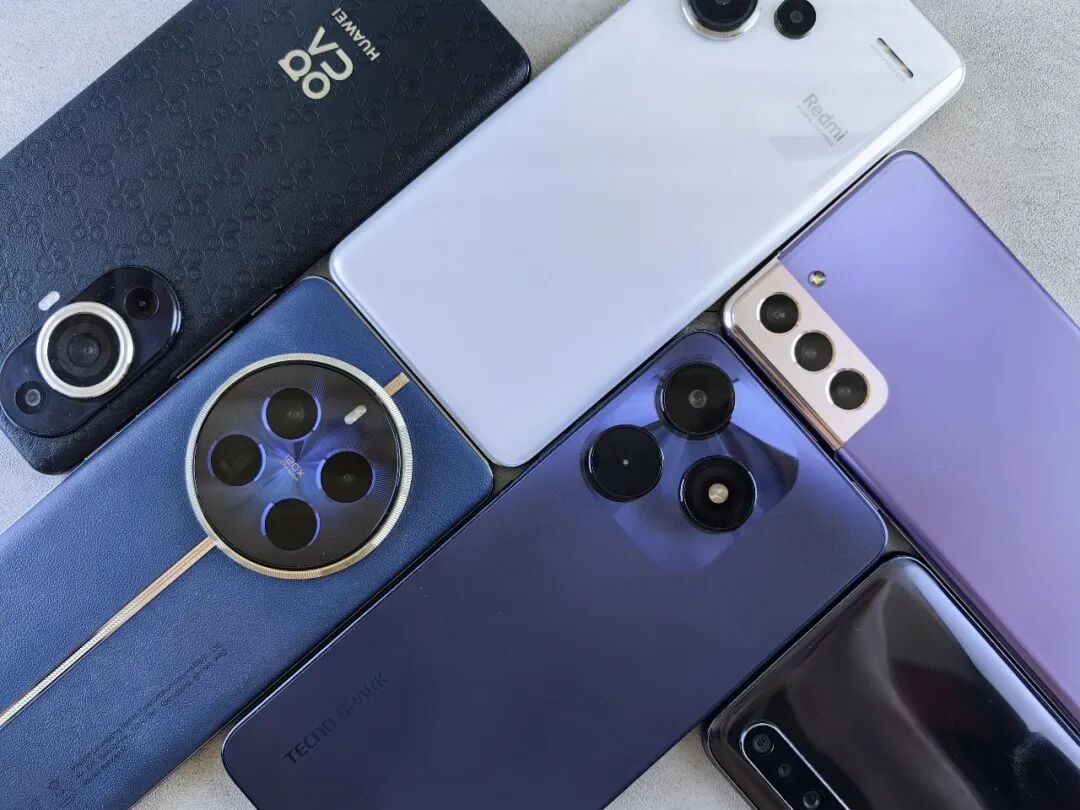
Image source / pexels
A Kepler research report points out that memory costs usually account for 15 - 20% of the BOM of mid - end smartphones and 10 - 15% of high - end devices. For a flagship phone priced at 6,000 yuan, the proportion of storage cost in the BOM is already low, and the cost may only increase by more than 100 yuan, which can be covered by the brand premium. However, it's different for a mass - market phone priced at 1,500 yuan - UBS predicts that in 2026, the memory cost of low - end mobile phones will account for 40% - 45% of the BOM, much higher than the 20% - 30% in 2025. The cost directly increases by more than 100 yuan, almost squeezing out the profit margin.
This is the real reason why Apple, Huawei, and Samsung dare to cut prices, while Xiaomi, vivo, and OPPO dare not.
And this has been reflected in the actual actions of the manufacturers. In mid - January, many media reported that brands such as Xiaomi, OPPO, vivo, and Transsion have all reduced their overall machine orders for 2026 by 10% - 20% to varying degrees, mainly cutting mid - and low - end models and overseas products. Some manufacturers have also quietly "reduced the configuration" on the product side, using the previous generation of chips or imaging modules on some models to control the overall machine cost.
This "holding back" during the Spring Festival is a forced strategic contraction, sacrificing scale to gain profit margins.
Three major trends:
User management, AI, and moving upmarket
Whether it's cutting prices or holding back, all manufacturers are facing a more fundamental problem: in 2026, the era of driving phone replacements through simple hardware and function iterations has basically ended.
Currently, the average replacement cycle of Chinese smartphones has approached four years. This is of course due to the increasing rationality of consumers, but the deeper reason is that technology itself has reached a ceiling - it is becoming increasingly difficult for ordinary users to perceive the performance improvement of each generation of flagship phones. The difference in photos taken by the previous generation of flagship phones and the current generation is almost indistinguishable to the naked eye, and the pixel competition of cameras has reached the physical limit.
The actions of manufacturers during this Spring Festival actually foreshadow three major new trends in the mobile phone industry in 2026.
First, marketing has returned to rationality, from selling a single phone to managing a user.
Most notably, "Chinese zodiac limited - edition" phones have almost disappeared. Manufacturers have realized that this kind of design for short - term marketing has a short life cycle and becomes unsalable after the festival.
Instead, there are more universal seasonal color schemes and accessory sets. For example, the "Lucky Red" of the vivo X300 and the "Cherry Red" of the Redmi Note 15 Pro. OPPO has launched a "Lucky Year of the Horse" accessory set, including a red phone case and a magnetic power bank, with a price of only about 100 yuan; vivo has launched a Spring Festival - limited dynamic watch face for the iWatch, paired with a red watch strap, packaged as a gift option for the elderly.
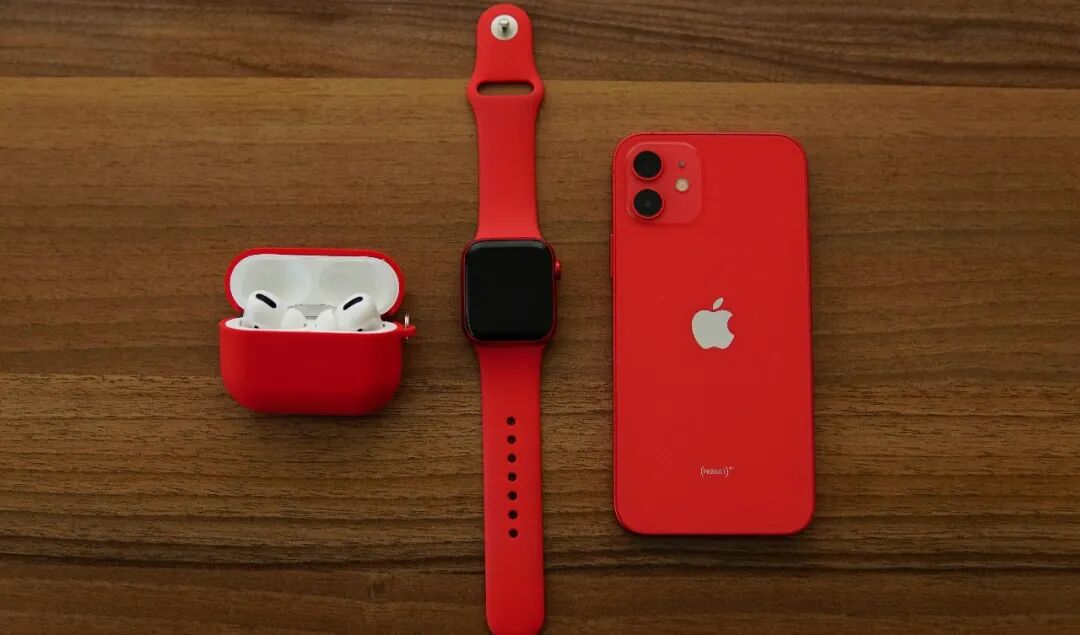
Image source / pexels
The calculation behind this is clear: since users are not willing to spend thousands of yuan to replace their phones, then provide them with some low - cost peripheral options to maintain user activity and brand loyalty with low - decision - making costs.
Second, AI has changed from a marketing gimmick to a costly "entrance battle."
The phone is the entrance, and accessories, watches, and software services are the reasons for users to stay. And when this logic is extended to the extreme, it is AI.
During the Spring Festival, AI applications such as Alibaba's Qianwen, Tencent's Yuanbao, Baidu's Wenxin, and ByteDance's Doubao have invested more than 4.5 billion yuan in total, using the most direct way of "throwing money" to compete for the "super entrance" in the AI era. Mobile phone manufacturers are also well aware of this and have integrated AI functions into their own systems one after another - AI is both a reason for consumers to replace their phones and a core tool for them to build an ecological moat and compete for the next - generation interaction entrance.
Judging from the data, AI seems to be becoming a real reason for phone replacement. Canalys predicts that the penetration rate of AI phones will reach 34% in 2025, and the upgrade of end - side models and chip computing power is also promoting the penetration of AI functions into mid - end models.
However, front - line practitioners are not optimistic about this. Zhang Xin said, "Most of the so - called AI functions are not strongly perceived by users. They are more like icing on the cake and far from being a must - have reason for replacement. Before the emergence of a real killer application, AI is still mostly a marketing gimmick."
Finally, and most importantly: "Moving upmarket" is no longer just a slogan but the only way to survive in 2026.
In the process