The whole internet is discouraging people from traveling to Chaoshan. Can we "outsiders" still go there?
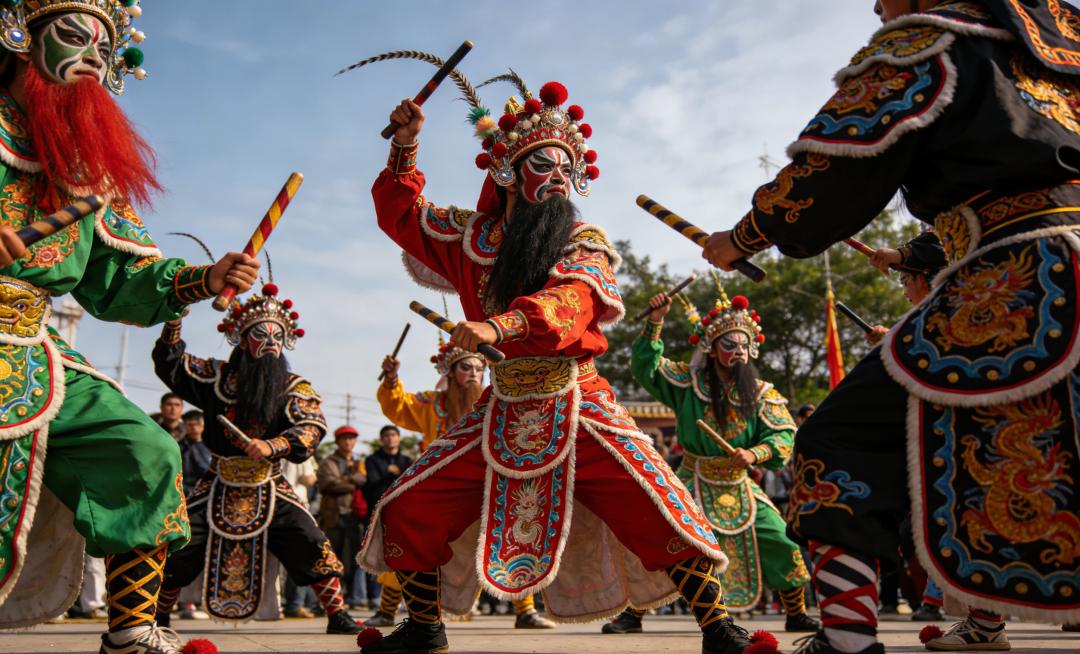
Why has Chaoshan become so popular?
Author | Luo Lixuan, Wang Xiaoling
Ms. Xie, a native of Chaoshan, found that the return ticket to her hometown in the countryside of Shantou this year was extremely expensive. She noticed that the airfare from Beijing to Jieyang (Chaozhou, Shantou, and Jieyang share an airport) had doubled compared to previous years, and she almost couldn't buy an affordable ticket back to Beijing.
"I thought I made money by buying gold, but I didn't expect life here to ambush me," she said.
In fact, the significant increase in hotel prices in Chaoshan this year has become a hot topic. The Atour Hotel near the popular Longyan South Road in the city center of Shantou costs over 2,000 yuan per night during the Spring Festival (usually around 500 yuan), and some room types cost over 4,000 yuan.
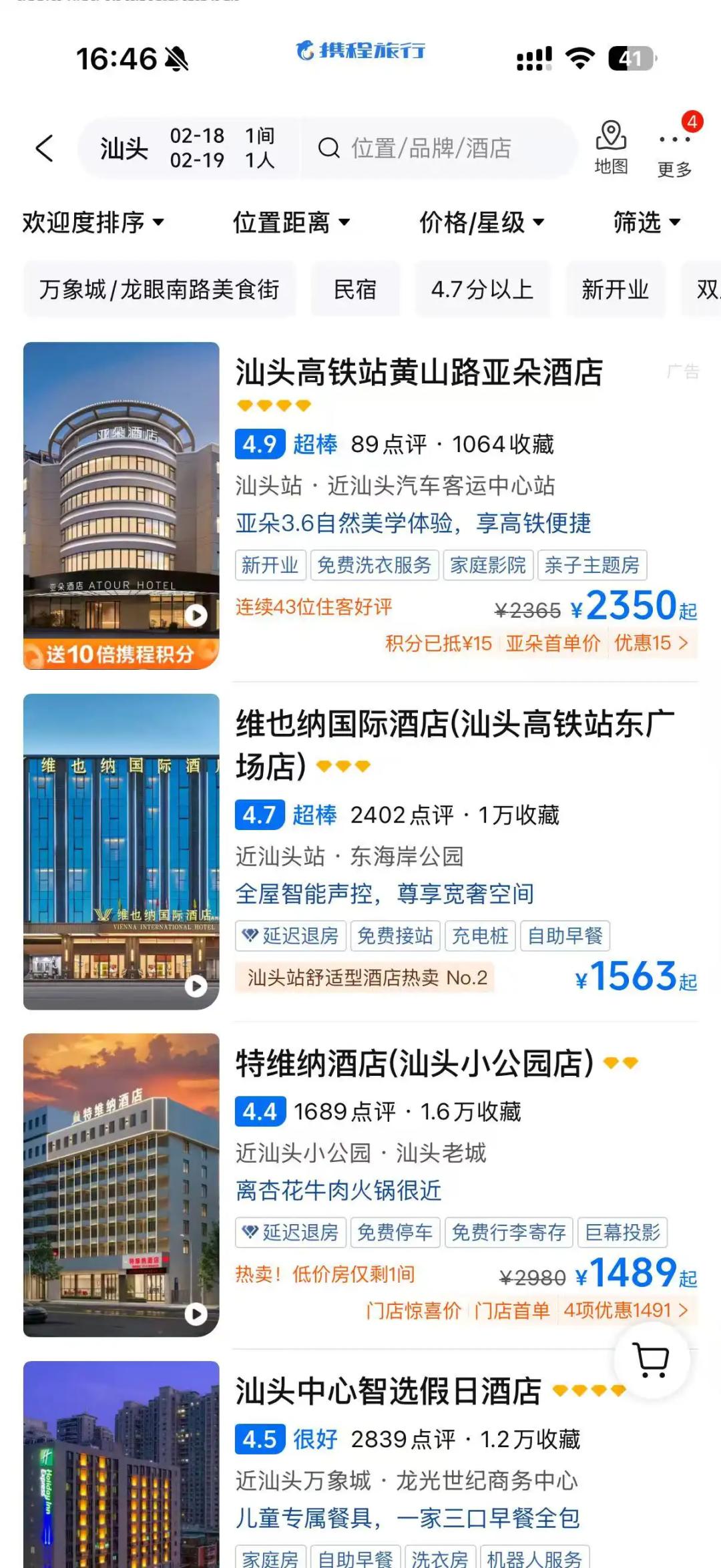
Hotel prices in Chaoshan on platforms
As early as January 28th, Shantou issued a price reminder and warning letter, calling on hotel operators to set reasonable prices and regulate their business behavior.

Hotel prices in Chaoshan on platforms
On social platforms such as Xiaohongshu, there are also joking notes: Plan A for the Spring Festival is New York/Paris/Sydney, and Plan B is Chaoshan. Which city do you think is better? The comments say: It is recommended that those without the financial ability not choose Chaoshan.
In response, Uncle Luo from Dongguan said in surprise: "It's a place that we Cantonese people go on a self-driving trip to because we're so bored during the Spring Festival. How come it has become so unattainable?"
Why has Chaoshan become so popular?
People's awareness of the uniqueness of the Spring Festival customs in Chaoshan dates back to 2023.
After the first lunar month, the god-pilgrimage activities in Chaoshan suddenly became popular on short-video platforms. People found that these activities could be modern and wild. In some villages, they even play EDM and use neon lights while inviting the gods out for a parade in the coolest way, creating a "cyber god-pilgrimage."
Travel bloggers are the most sensitive to traffic. Since the god-pilgrimage activities in Chaoshan reach their peak on the 15th day of the first lunar month, many bloggers who noticed the trend during the Spring Festival holiday flocked to Chaoshan and also to the Fuzhou area, which was also trending at the same time. This laid the real foundation for the climax of the cultural and tourism theme of the Spring Festival in Chaoshan after 2024.
The uniqueness lies in that Chaoshan has a complete, vivid, and community-wide Spring Festival custom system, rather than just individual dragon and lion dance activities. This has hit the deep-seated longing of contemporary people who regret that "the Spring Festival atmosphere is fading" for tradition, reunion, and a sense of ritual.
For Chaoshan people, the Spring Festival is roughly divided into "eating" and "worshipping." Ancestor worship and god-pilgrimage are the key activities, and Chaoshan people attach great importance to them. No matter how busy they are at work, they will make time to participate in these two things.
Chaoshan people have a strong belief in gods. In addition to the gods of Buddhism and Taoism, there are also many historical heroes (such as Lord Guan), who are respected as "Lao Ye." "Ying Lao Ye" means praying for the gods to bless peace and good weather in the new year.
The god-pilgrimage activities are divided into "civil parade" and "military parade." In the civil parade, there is the most famous Yingge Dance (its form comes from nuo opera and yangge), as well as flag teams, flower basket teams, eight-treasure teams, and honor guard teams. The forms are basically stable-paced teams, accompanied by singing and dancing, parading through the village.
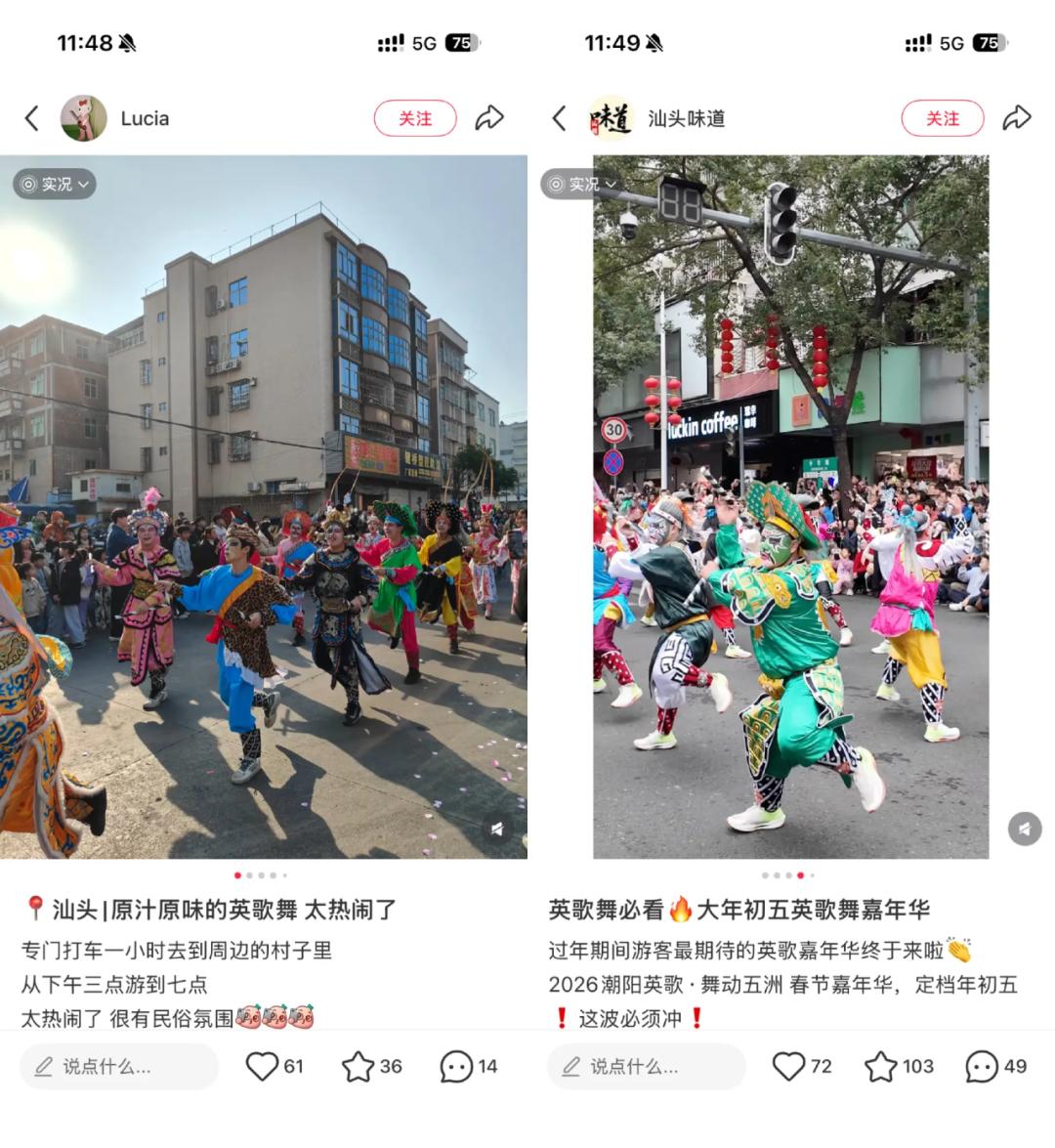
Yingge Dance
The military parade adds more obstacles and thrilling elements to the ordinary parade, making it more exciting. For example, in Puning, people need to carry the gods and quickly jump over the fire pit. In Chenghai, there is an activity called "Ai Long Shen," which is probably running around a wooden stake quickly. People carry the gods and take turns to join, while people outside set off firecrackers. The scene is thrilling.
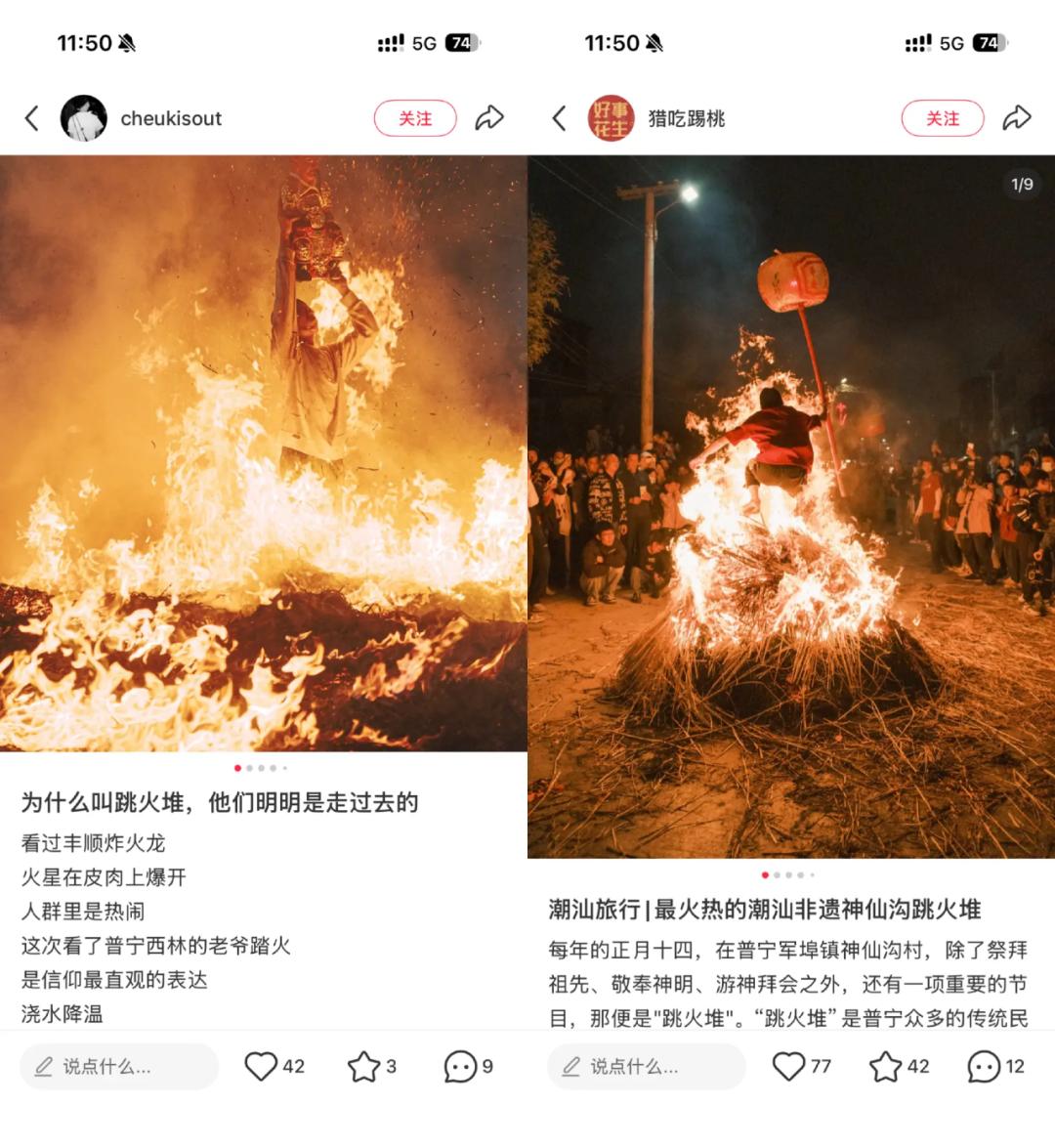
Jumping over the fire pit
The most exciting one may be the god-pilgrimage in Yanhong, Chenghai. During the parade, one team is responsible for carrying the gods, and the other team is responsible for "besieging" the gods and pulling down the sedan chair. The two sides confront each other.
From the perspective of tourists, these well-preserved and rich rituals have become amazing landscapes that vary from village to village, which are particularly ornamental today.
Moreover, Chaoshan has two major attractions - a warm climate and delicious food everywhere. Located on the eastern coast of Guangdong, it goes without saying that its cuisine has also reached a historical peak in popularity in recent years. First of all, in top-rated food shows such as A Bite of China, Flavorful World, and A Single Meal to Conquer the Gods, Chaoshan cuisine is highly recommended.
Secondly, the Chaoshan beef hot pot, which is popular in big cities such as Beijing, Shanghai, Guangzhou, and Shenzhen, has implanted the "stereotype" of Chaoshan people's pursuit of ultimate freshness in the minds of food lovers across the country.
In addition, the raw marinated seafood originating from Chaoshan has also become popular in recent years and has become a favorite in the pre-made food track of mid - to high - end supermarkets such as Hema and Sam's Club. Fruits such as Phyllanthus emblica, guava, and lemon, which have gained popularity in chain tea shops, were first developed by Chaoshan people into various products.
It can be said that in terms of tourist destinations, Chaoshan is definitely a well - rounded place where people can have a good time and enjoy delicious food.
All "Avoidance Tips"?
However, if you are getting excited and planning a Spring Festival trip to Chaoshan after reading this, you may need to calm down.
The search results associated with the high - priced hotels in Chaoshan during the Spring Festival also include overcrowding. Don't forget that the cultural and tourism resources in Shantou, Chaozhou, and Jieyang have not been deeply developed. Their manufacturing and trading characteristics are far more prominent than their tourism characteristics, and their reception capacity is relatively limited.
Just do a simple search on social platforms, and you will find that tourists traveling in Chaoshan during the Spring Festival are complaining, "Why are there so many people?"
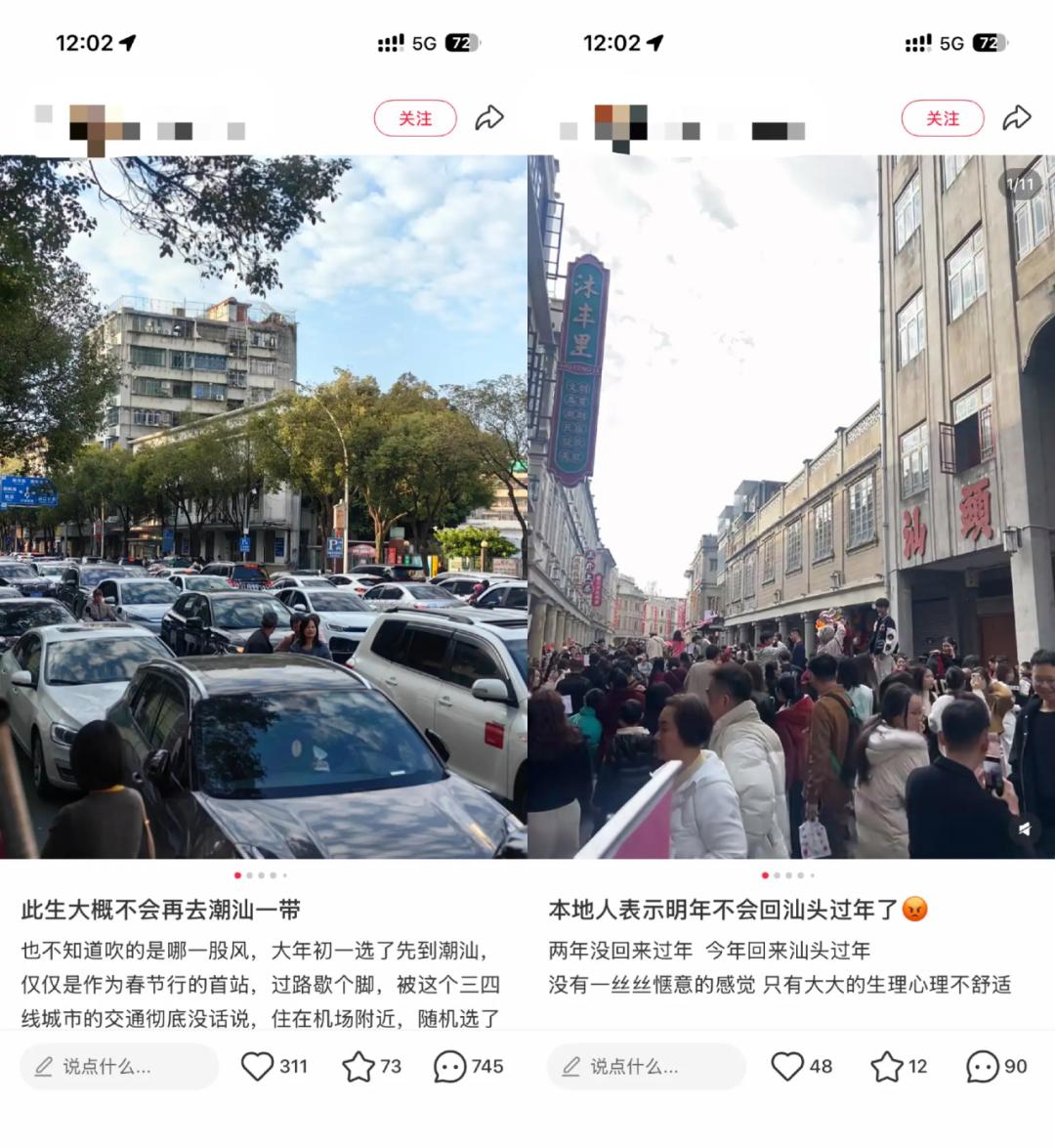
Complaints on social media
On Longyan South Road, the most popular route for a city walk in the city center of Shantou, not only is it crowded, but you may also have to wait three to five hours to get a table at a restaurant. Even worse, after taking a taxi to the city center in the morning, you may not be able to find a taxi back to the hotel at night and have to walk back on your own. "I originally wanted to take the bus, but later found that some bus routes didn't even operate."
Some people went to the ancient city of Chaozhou and found that traffic control had been implemented due to the large number of people. "I had to get off the vehicle and walk in when I was still 3 kilometers away from the ancient city."
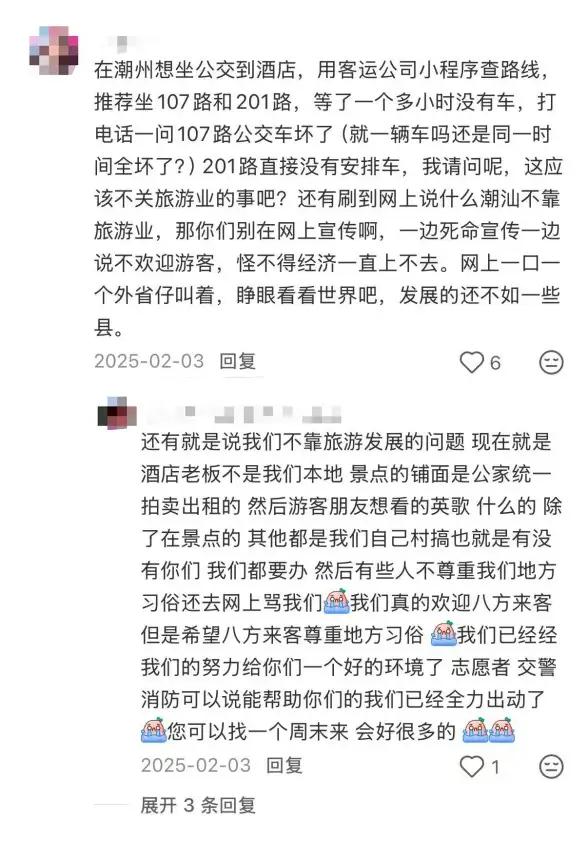
Complaints on social media
Some people wanted to go to Nan'ao Island, 30 kilometers away from Shantou urban area, to watch the sea view, but found that the roads in and out of the island were congested. "It took 3 hours to get on the island, and another 3 hours to get off."
Why is it so congested? An important reason is that there is no subway in Chaoshan. The public transportation mainly consists of buses, taxis, and ferries, covering the central city and its surroundings. When the roads are paralyzed, it is basically equivalent to a transportation paralysis.
More importantly, why is it so expensive? Hotels are expensive, and the cost of meals is also 30% - 40% higher than usual. This is simply a matter of supply and demand.
The growth of the Spring Festival tourism scale in Chaoshan far exceeds the growth rate of local supply.
According to South China Morning Post, during the Spring Festival in 2024, both Chaozhou and Shantou received over 5 million tourists. In 2025, the three cities in Chaoshan received over 15 million tourists during the Spring Festival, with Shantou receiving 6.33 million and Chaozhou slightly decreasing to 4.3 million.
In 2025, the Jieyang Chaoshan Airport (the only airport in the Chaoshan area) received over 10 million passengers, ranking 43rd in the country. In 2019, the annual passenger throughput of the Jieyang Chaoshan Airport was 7.35 million.
According to an incomplete statistics by South China Morning Post, by 2025, the total number of mid - to high - end hotels in the local area is limited. The three cities have a total of about 120 - 150 hotels, with about 18,000 - 22,000 rooms, far lower than the supply scale of first - tier cities such as Guangzhou. Considering that triple pay is required during the Spring Festival and various service fees are rising, the cost is further increased.
Of course, many tourists are returning home, taking a day trip, or a short - distance trip, but we still cannot ignore the huge gap between 15,000 hotel rooms and 15 million tourists.
Many tourists, due to limited time, can only go to the main scenic spots and watch relatively commercial activities. In fact, many villages start their activities on the fifth or sixth day of the first lunar month and reach the climax on the 15th day, which is exactly staggered from the public holidays, so they don't see the excitement they saw in the videos.
Can't you really go to Chaoshan?
When any place suddenly becomes a popular national tourist destination, it will definitely be overcrowded. That's why popular scenic spots such as the Forbidden City require advance reservations (in fact, most scenic spots in the urban area of Chaoshan also require reservations now).
However, the carrying capacity of an area is actually flexible. That is, tourists can be diverted to surrounding towns and even villages.
The degree of flexibility varies from area to area. Some areas have high flexibility. For example, in Fujian and Zhejiang, the degree of urban - rural integration is very high. It is convenient to stay anywhere, and there are many places worth visiting in counties and towns.
Some areas have low flexibility. Either there is only one popular scenic spot and there is nothing to do in the surrounding areas, or the accommodation and catering conditions in the surrounding areas are completely inadequate.
The flexibility of Chaoshan can be said to be extremely high or extremely low.
First of all, the Chaoshan area includes three cities: Chaozhou, Shantou, and Jieyang. Locals will recommend that you take a self - driving tour of these three cities.
All three places are really worth visiting. Many locals proudly recommend that the Yangmei Torch Festival in Jieyang is as worth watching as the "Ying Lao Ye" activity. People from Puning say that when the Yingge Dance was not popular before, it was called Puning Yingge, and they are the most famous.
On the map, the three cities form a very compact triangle. It is more than 40 kilometers from Chaozhou to Shantou, more than 50 kilometers from Shantou to Jieyang, and only 30 kilometers from Jieyang to Chaozhou. The total mileage is less than 150 kilometers. You can drive around several times in a day without getting off the car.
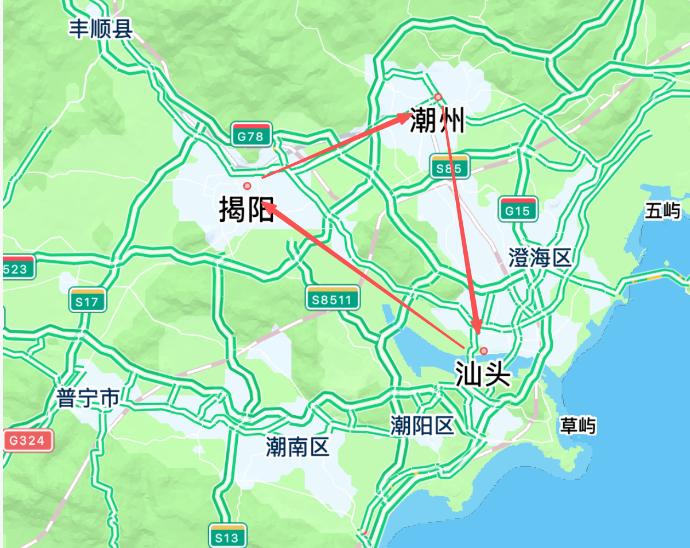
Chaoshan
However, if you want to follow this route during the Spring Festival and limit your itinerary to the three urban areas, you may still encounter problems with tight accommodation and catering. Although the Chaoshan culture is well - known, its area is actually not very large.
The total area of the three cities in the Chaoshan area is about more than 10,000 square kilometers, with a permanent population of more than 10 million. The total area is about two - thirds of that of Beijing, and the permanent population is only half of that of Beijing. Compared with Guangzhou, it may be more intuitive. The total area of Guangzhou is more than 7,000 square kilometers, with a permanent population