In 2026, when both the costs of automakers and the tax burdens of users are rising, how can consumers make smart car purchases?
In 2026, the Chinese new energy vehicle market kicked off with an expected yet exceptionally frigid "cold snap".
For most automakers, a 20% month - on - month decline in January sales was the "norm". The sales of LeDao and Denza even plummeted by 62% and 67% respectively compared to the previous month.
As the leading enterprise in the new energy vehicle industry, BYD's sales in January decreased by about 30% year - on - year and 50% month - on - month. There were even rumors that a BYD dealership group was facing operational problems, with many stores incurring losses and owing employees' salaries.
The slump in the auto market extended from January to February. Recently, the Xiaomi Home located at Changying Tiantian Street in Chaoyang, Beijing, was rather deserted, and there were very few consumers coming to look at cars. It wasn't just Xiaomi; in many brand stores, there were more sales staff than customers.
The combination of multiple factors such as the reduction of purchase tax incentives, the pre - exhaustion of demand, and the rising cost pressure has declared the end of the era of easy growth in the new energy vehicle industry. A new era of cut - throat competition in a shrinking market has fully arrived.
To survive, automakers naturally have to engage in a close - quarter battle on the front lines of technology, cost, and channels. Consumers caught in the middle are faced with more complex car - buying decisions. How can they see through the fog of the market cycle and make wise and cost - effective decisions during the pain of transformation?
1. The Tough Start of the Auto Market in 2026
In fact, most consumers have already given their answer with their actions. Now is not a good time to buy a car.
According to the latest data from the Passenger Car Market Information Joint Committee of the China Automobile Dealers Association, in January, the retail sales of passenger cars nationwide reached 1.544 million units, a year - on - year decline of 13.9%.
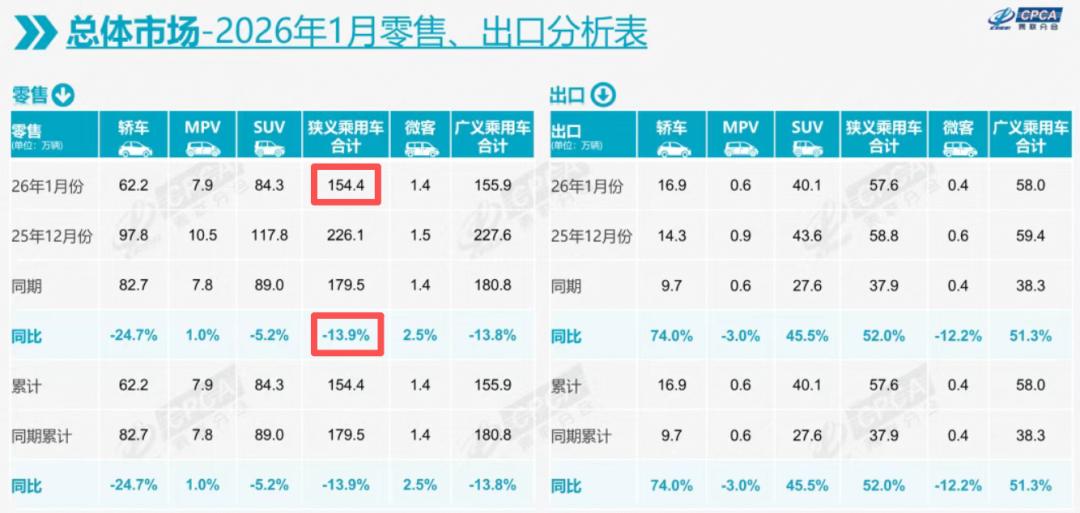
Chart/Analysis of Retail and Export in January 2026 Source/Screenshot of New Energy Outlook from the Passenger Car Market Information Joint Committee
During the off - season of new energy vehicle sales, even the top - selling brands in 2025 such as Leapmotor, Xiaomi, XPeng, and NIO were not spared.
Leapmotor delivered 32,059 vehicles in January 2026. Although it increased by 27% year - on - year, it still dropped by about 47% compared to the 60,423 vehicles delivered in December 2025. Xiaomi Auto delivered over 39,000 vehicles in January, a month - on - month decline of about 22% compared to the over 50,000 vehicles delivered in December 2025. XPeng Motors delivered 20,011 vehicles in January 2026, a month - on - month decline of 47%. NIO's total brand delivered 27,182 vehicles in January, a month - on - month decline of 43%, and the declines of LeDao and Firefly were both over 60%.
It is worth mentioning that BYD, the leading enterprise, sold 210,051 vehicles in January 2026, of which 100,009 were overseas sales. The number of BYD's domestic passenger cars may be less than 110,000, and its domestic passenger car sales in December 2025 were about 287,000, a month - on - month decline of about 62%.
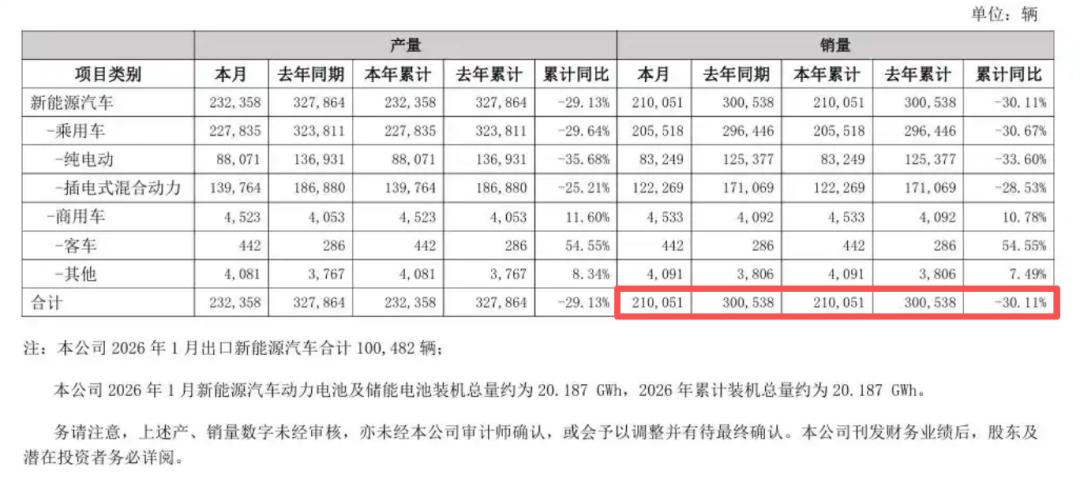
Chart/BYD Sales Report in January 2026 Source/Screenshot of New Energy Outlook from the Internet
Behind the sharp drop in sales is the direct manifestation of the concentrated release of market demand before the policy switch and the subsequent weakness.
Since January 1, 2026, the new energy vehicle purchase tax "exemption" policy, which had been in place for many years, has officially ended, replaced by a "50% reduction" policy with a maximum reduction limit of 15,000 yuan. At the same time, the pure - electric range threshold for plug - in hybrid models eligible for tax incentives has been raised from 43 kilometers to 100 kilometers.
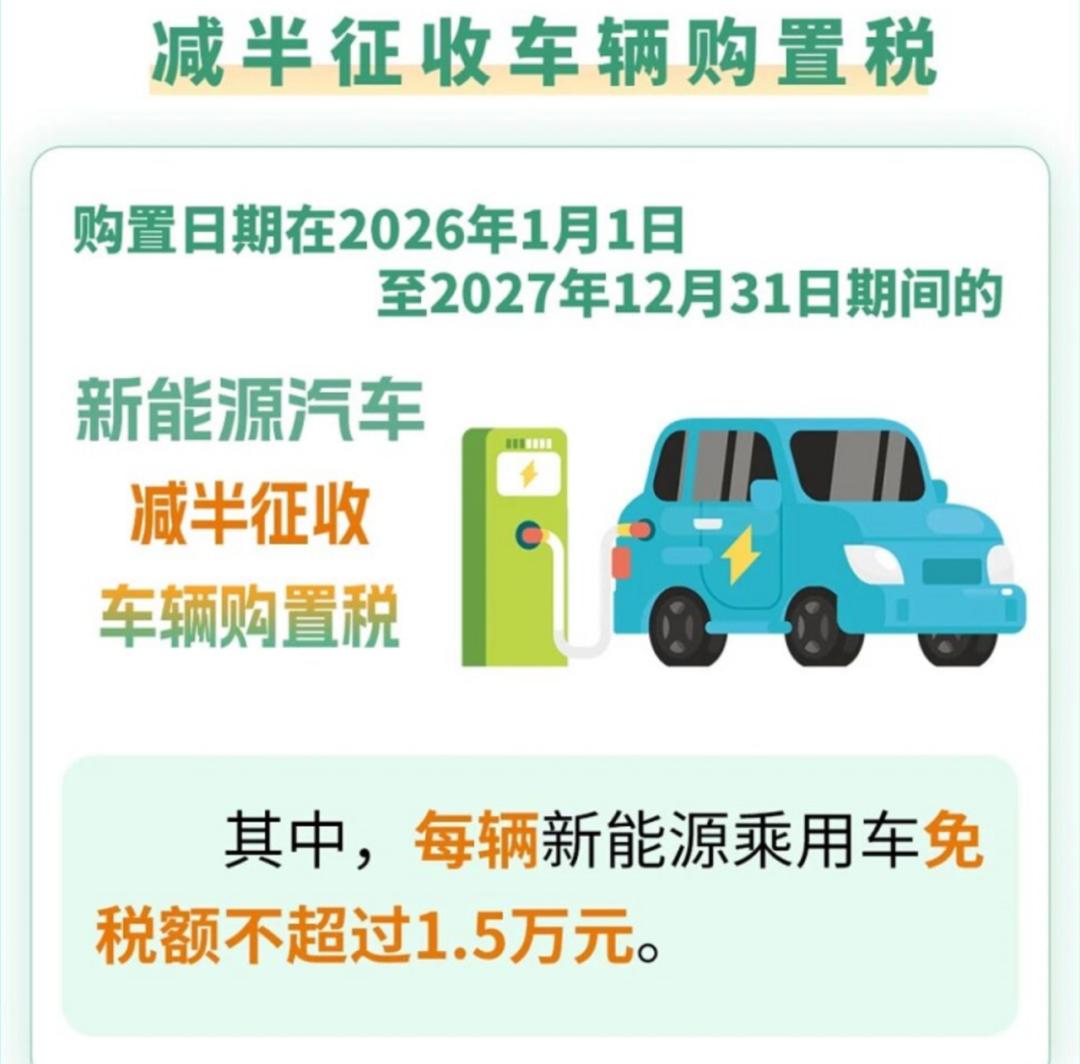
Chart/2026 Purchase Tax Policy Source/Screenshot of New Energy Outlook from the Internet
This adjustment has led to a large amount of car - buying demand being pre - exhausted at the end of 2025, resulting in a "vacuum period" in the market at the beginning of 2026.
We interviewed several consumers who bought cars at the end of December 2025. After comparing multiple brands, they found that December had the greatest purchase discounts. Take Tesla for example. It offered a 5 - year zero - interest or 7 - year ultra - low - interest loan plan. Existing customers who referred new orders could get an 8,000 - yuan paint selection gift card, and there was also an 8,000 - yuan limited - time insurance subsidy for buying a Model 3. Combined with the purchase tax exemption policy, they decided to make their purchases.
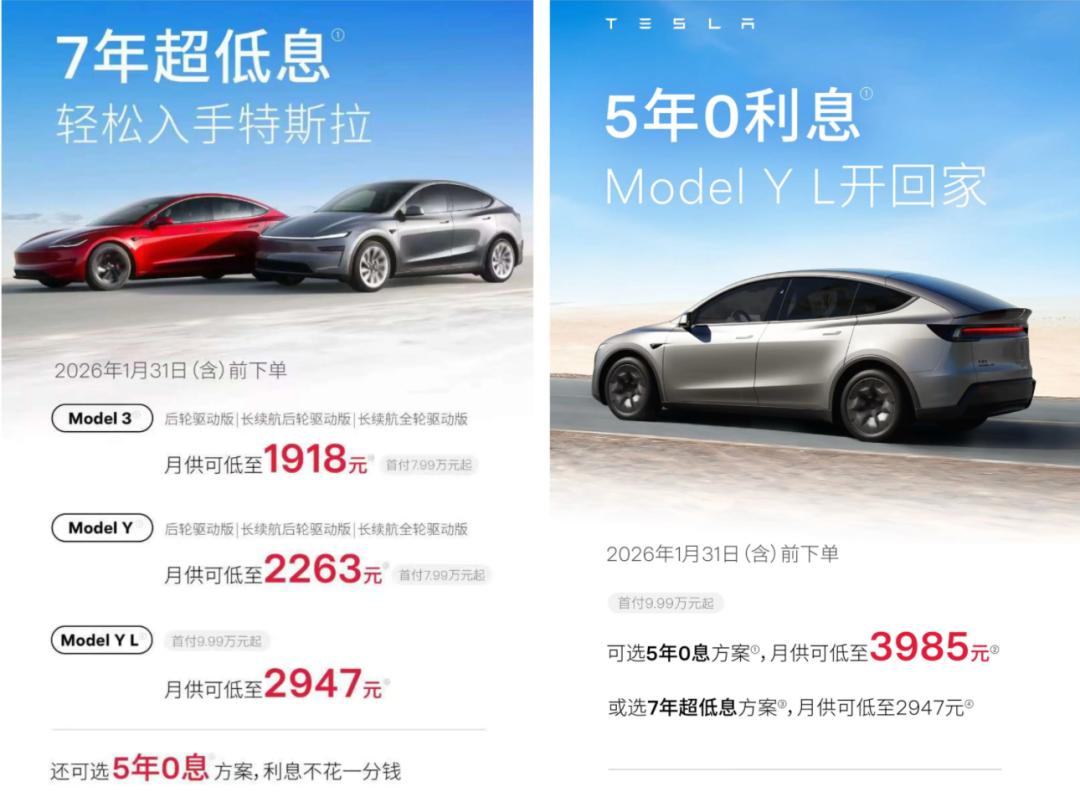
Chart/Tesla Promotion Activities Source/Screenshot of New Energy Outlook from the Internet
If you bought a car in January 2026, even for a 100,000 - yuan car, you would have to pay several thousand yuan in purchase tax. For a 300,000 - yuan car that was exempt from purchase tax in 2025, you would have to pay over 10,000 yuan in 2026.
At the beginning of the current policy switch, consumers are highly cautious, and the situation of a temporary decrease in terminal orders continues.
2. Automakers Must Engage in Cut - Throat Competition to Survive
As the market enters the brutal stage of "competing for a shrinking market" from "sharing the growing market", cut - throat competition has become the survival rule for all automakers. This battle revolves around three core dimensions: technology, cost, and efficiency. The reshuffle of the industry is accelerating, and the pattern reshaping is inevitable.
For leading enterprises, in addition to the economies of scale, technological leadership is their first sharp weapon to outcompete their rivals.
BYD's success as a benchmark in the new energy vehicle industry is due to its technological reserves. However, in the past year, BYD's sales growth has slowed down and its sales volume has declined. BYD Chairman Wang Chuanfu attributes this to "the lack of previous technological leadership".
This reveals the cruel reality of the industry: continuous huge R & D investment and maintaining the iteration speed are the only ways to maintain a leading position.
Cost control is the "lifeline" that determines the survival of automakers. According to the research report of UBS Investment Bank, affected by the triple challenges of the withdrawal of stimulus measures at the beginning of 2026, the resumption of purchase tax, and the rising cost of commodities, the cost of an ordinary medium - sized intelligent electric vehicle is expected to increase by 4,000 to 7,000 yuan.
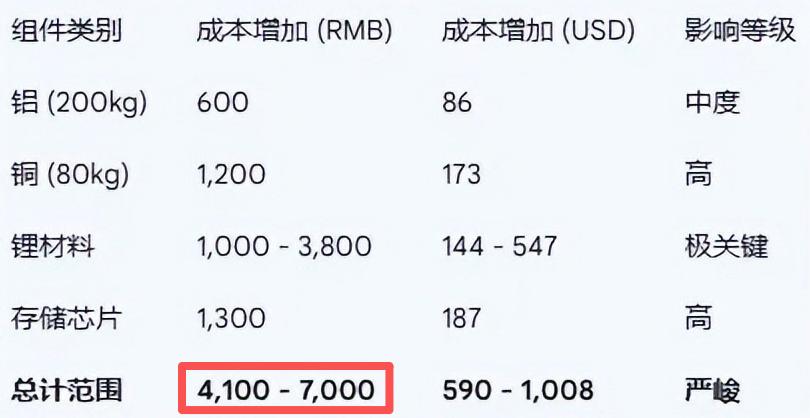
Chart/UBS Data on Electric Vehicle Costs Source/Screenshot of New Energy Outlook from the Internet
Facing the dual pressures of price fluctuations of metal raw materials and lithium carbonate and the terminal price war, automakers are making internal adjustments and implementing extreme reforms to reduce costs and increase efficiency.
The "streamlining" of sales channels is also in progress. For example, Li Auto plans to close several underperforming retail stores in the first half of 2026. XPeng Motors is promoting the "Jupiter Plan", shrinking its direct - sales system and shifting to a lighter - asset authorized dealer model. NIO is piloting "user - cooperative stores" in third - and fourth - tier cities, where partners will bear the delivery and after - sales costs.
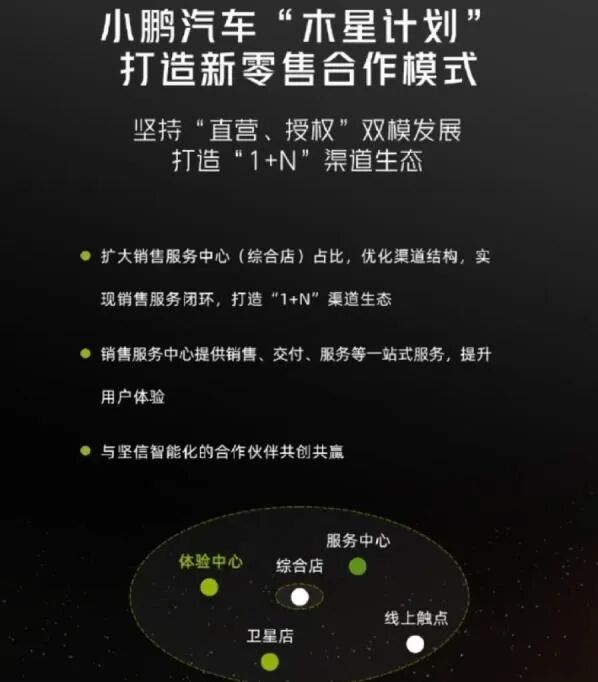
Chart/The Jupiter Plan Source/Screenshot of New Energy Outlook from the Internet
Accelerating overseas expansion has become a "must - do" for automakers in 2026. For example, XPeng Motors recently announced its official entry into New Zealand and opened its first service centers in Auckland and other places. NIO plans to launch a new Firefly series in 2026 as its global pioneer model. Li Auto's L9, L7, L6 and other models have entered markets such as Egypt, Kazakhstan, and Azerbaijan, completing a preliminary layout across Central Asia, the Caucasus, and Africa.

Chart/Li Auto's Overseas Stores Source/Screenshot of New Energy Outlook from the Internet
Against this background, the differentiation in the industry is predictable: A few leading automakers will dominate the market with their technological and scale advantages. Some mid - tier enterprises will face the choice of "being acquired or transforming and expanding overseas". A large number of tail - end brands lacking core competitiveness will quietly exit the market in the harsh winter.
3. When Is It More Cost - Effective for Consumers to Buy a Car in 2026?
For ordinary consumers, in 2026, a year of drastic industry transformation, buying a car not only presents more complex choices but also may bring more cost - effective opportunities. To decide when to make a purchase, multiple factors such as policies, the market, and technology need to be comprehensively considered.
The change in policy windows is the primary consideration. The new purchase tax policy implemented since 2026 has affected the car - buying cost. At present, consumers need to pay attention to the detailed rules of the 2026 car trade - in subsidy in their local areas. For example, Beijing, Shanghai, Hubei, and Tibet have issued specific implementation plans, and the subsidy application has officially started recently.
In addition, we also need to pay attention to the application deadline in the detailed rules and the fact that the funds may be distributed on a "first - come, first - served" basis and will stop once they are used up. We can't miss any price differences.
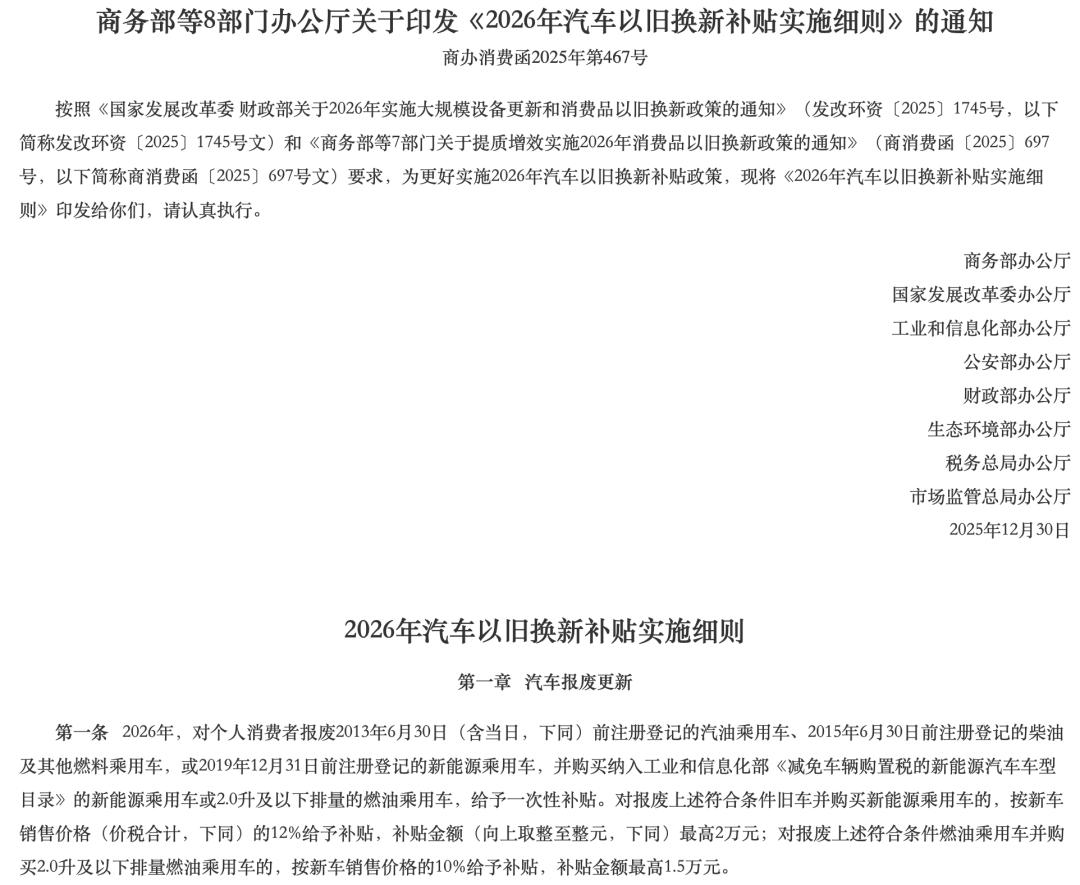
Chart/Partial Content of the "Detailed Rules for the Implementation of the 2026 Car Trade - in Subsidy" Source/Screenshot of New Energy Outlook from the Internet
Secondly, the seasonal fluctuations in the market and the competitive pressure bring price opportunities. In the first quarter of 2026, due to the pre - exhaustion of demand, dealers are facing huge inventory and sales target pressures. To recover funds and meet the assessment, manufacturers and dealers often introduce significant temporary promotional policies.
Especially for brands or models with a significant decline in sales, the possibility of price cuts is higher. Consumers can closely monitor the monthly sales data of their target models (such as the list released by the Passenger Car Market Information Joint Committee) and the terminal inventory information, and negotiate prices during the period when the competition is the fiercest and the merchants are the most anxious.
Moreover, the rhythm of technological iteration is worth attention. In 2026, new technologies such as semi - solid batteries, 800V high - voltage platforms, and high - level urban intelligent driving will accelerate their commercialization. The transition period between old and new technologies is often a fork in the road for the decision of "buying the old model at a discount" or "buying the new model for a new experience".
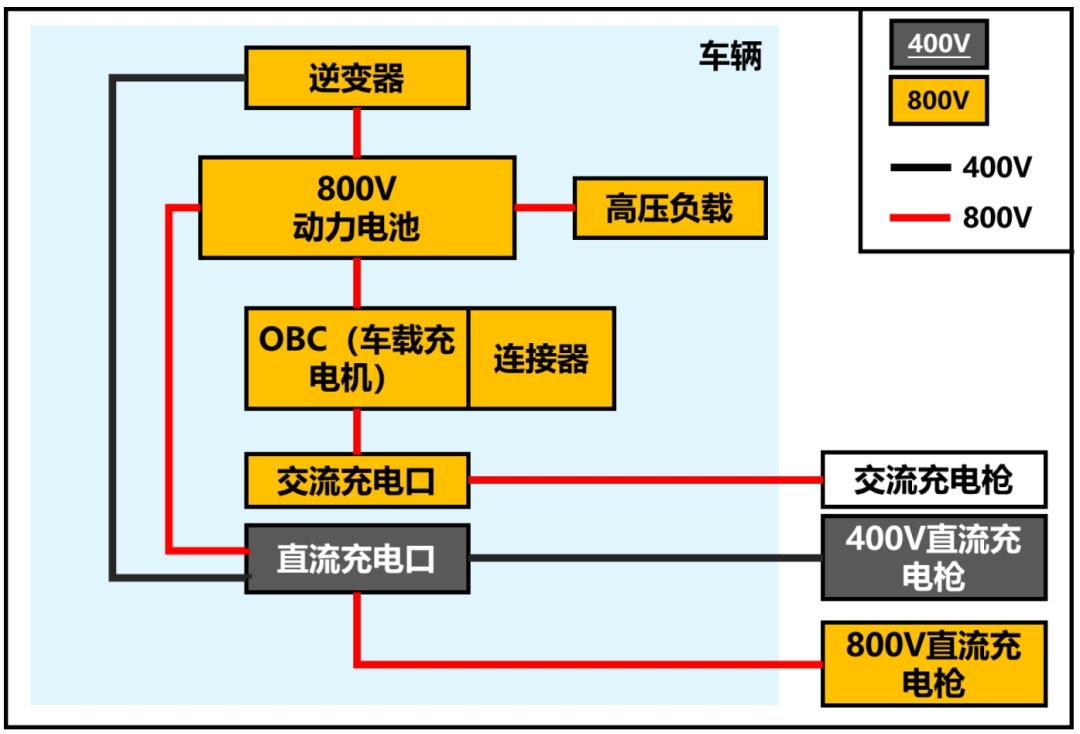
Chart/Technical Principle of the 800V High - Voltage Platform Source/Screenshot of New Energy Outlook from the Internet
Usually, models equipped with the previous generation of technology will have considerable inventory - clearing discounts at the end of their life cycle. New models have firm prices but can offer a more cutting - edge experience. Consumers need to make a choice based on their own sensitivity to technology and budget.
Overall, there may not be an "absolutely best" time to buy a car in 2026, but there is a "relatively better" decision - making logic. Consumers who pursue the ultimate cost - effectiveness can focus on the second and third quarters of 2026. By then