The highly popular OpenClaw is repricing all AI startup tracks.
Just now, OpenClaw has reached 190,000 stars on GitHub. Almost all of these stars came in the past half - month, and it has become the fastest - growing open - source AI project in GitHub's history.
190,000 stars mean that it is becoming a new "de facto standard". In comparison, Kubernetes, one of the most important basic software in the past decade, currently has 120,000 stars on GitHub, while the Linux kernel has 195,000 stars after years of accumulation.
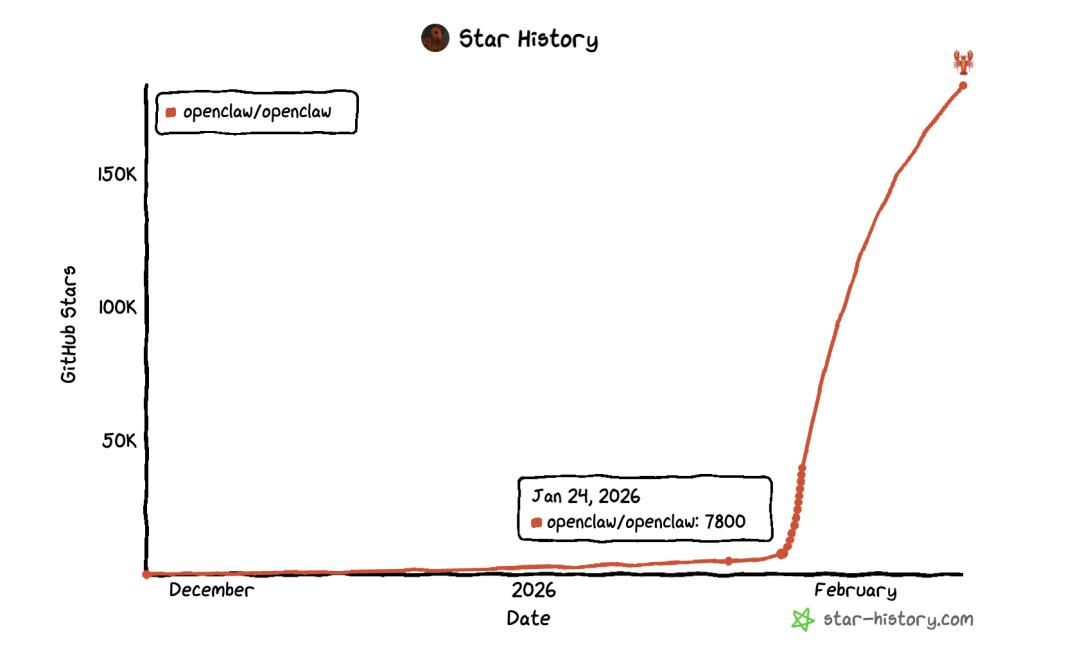
The steep growth of OpenClaw | Image source: GitHub
Undoubtedly, the birth of OpenClaw is a milestone event in the development history of Agents.
Different from Manus, which became extremely popular last year, Manus triggered a large number of imitations after its birth, while OpenClaw has triggered "co - construction". A large number of developers have flocked in, and a growing business ecosystem has quickly formed around it, including secure versions, skill markets, workflow plugins, secondary development, and so on.
It has ignited a lot of entrepreneurial enthusiasm for Agents.
Some entrepreneurs said that OpenClaw is like Linux in the AI era and is the operating system for Agents. They even considered shifting their company's business to develop around the OpenClaw ecosystem.
In addition, on February 7th, Wang Huiwen posted that he was paying attention to entrepreneurship in the OpenClaw direction and invited relevant entrepreneurs to contact him. The last time he showed such enthusiasm was during the large - model entrepreneurship wave in 2023.
Colleagues in the GeekPark editorial department have noticed that the flow of capital in the industry is changing rapidly. For projects related to OpenClaw, after it became popular, their valuations have soared rapidly. Some projects that were once ignored have now become the targets that investors compete for.
OpenClaw has made many things popular, such as Mac Mini and Kimi's K2.5 model. It has also overturned many consensuses formed around AI in the past two years, such as "the model is the Agent, and the model is everything".
Various AI entrepreneurship tracks are being re - evaluated and priced.
So, what kind of changes is OpenClaw triggering? Who will appreciate in value, and who will depreciate? We have simply made some sorting and deductions.
01 The "emotional value" beyond ChatGPT and Doubao, an irreversible change in the interaction paradigm
Compared with super AI assistants like ChatGPT and Doubao, OpenClaw has a qualitative leap in the interaction experience. It can be said that the human - computer interaction change led by OpenClaw may be irreversible.
Traditional AI assistants exist in an app, while OpenClaw does the opposite. It embeds the entrance in existing communication tools, and the logic becomes "wherever people are, the AI follows", rather than you opening a specific app to find the AI.
As a result, OpenClaw has become more like an operating - system - level existence: it can be distributed in different social software and communication tools, and can collaborate across platforms and call different tools. In the past, many entrepreneurs wanted to subvert the GUI - dominated interaction paradigm. This time, the GUI really no longer exists. Many tasks executed by OpenClaw and the software capabilities it calls are carried out silently in the background.
It smoothly integrates into life, social, and workplace workflows. With its initiative and long - term memory, it provides users with extremely high emotional value during use. Many people who have experienced OpenClaw will sigh, "I felt for the first time that AI is alive." AI has truly changed from a one - time tool to a long - term partner.
In addition, it redefines 'who the AI belongs to'.
If we roughly divide today's AI world into two categories, one is: super AIs that are cloud - based, platform - oriented, and closed; the other is: personal AIs that are personal, controllable, and combinable.
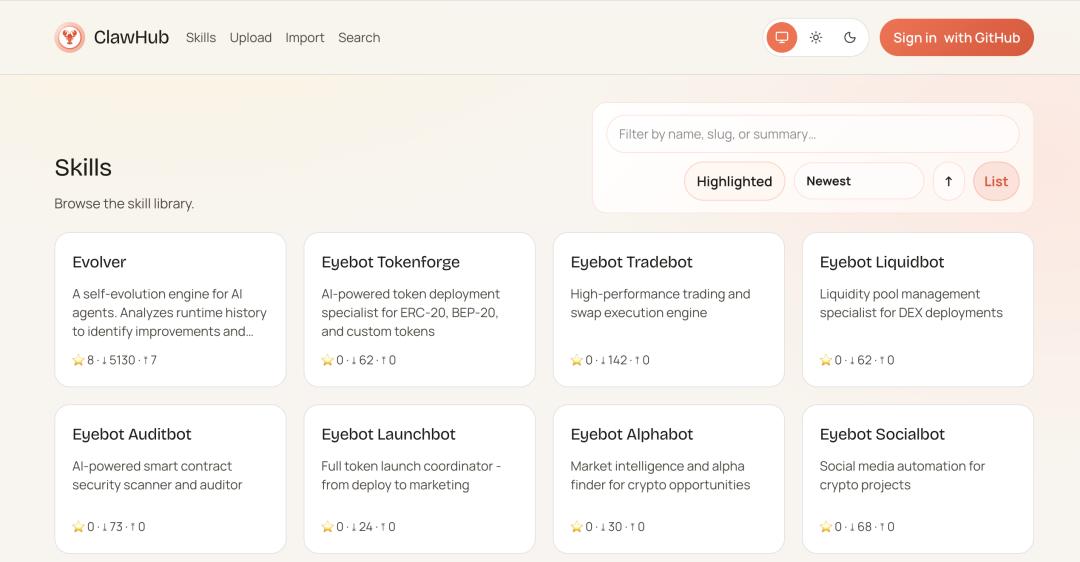
A large number of developers and users contribute skills in the OpenClaw ecosystem | Image source: ClawHub homepage
Then, OpenClaw clearly stands on the second side. It turns AI from a service provided by the platform into a 'digital individual' that users can own, deploy, transform, and collaborate with in the long term - everything is centered around the user, rather than the platform. This is completely opposite to the monopoly logic of Internet giants.
In the past, our data was on the platform, the computing power was in the cloud, and the permissions were in the hands of manufacturers. Now, the data control right returns to the individual, the computing power selection right returns to the individual, and the permission management returns to the individual.
This will gradually lead to a major psychological change for more people: AI is no longer just a service provided by the platform, but your digital asset. Therefore, once there is an option for a 'personal AI', no one wants to go back to the 'centralized AI'.
The 'personal AI' brings a great sense of control and satisfaction, as well as changes in the business model. For example, the ordinary versions of AI assistants like ChatGPT and Doubao can be used for free, while deploying OpenClaw requires paying for tokens from the beginning. It's like 'raising' an AI. It needs to run continuously, and its birth marks the start of payment. Its business model is very clear.
In the future, everyone may face a choice of whether to spend money to 'raise' an AI. When we cultivate an AI like we cultivate a person, more new consumption habits will surely emerge.
02 Re - pricing: centered around the individual, rather than the big manufacturers
One of the extremely important historical significances of OpenClaw is that Agents can be separated from the platform and become a system that individuals can own and expand.
This means that the values of models and Agents will be re - evaluated.
In the past two years, large - model companies (OpenAI, Anthropic, DeepSeek, Qianwan, Doubao, etc.) have stood at the top of the industry's contempt chain. A narrative that has gradually become an industry consensus is that the model is the Agent, the Agent is the model, and the model is almost the only barrier. As long as the model is powerful enough, it is everything.
Therefore, the values of companies doing AI applications and Agents have not been fully valued. Even the extremely popular Manus has been mired in the controversy of being a "shell".
OpenClaw has broken this narrative.
The slogan of OpenClaw is "Your assistant. Your machine. Your rules". Simply put, OpenClaw positions itself as an "execution center + tool ecosystem + permission system". It only provides users with an open - source framework for a "personal Agent". You can choose your own model and pay for your own API Key. Local models can also be connected.
People can freely combine models, tools, and plugins, and choose cloud platforms or local computing power without being locked in by big manufacturers. It breaks the platform's monopoly on expansion capabilities, and power flows from the platform to developers and users.
This also means that the large model is just a replaceable part.
More importantly, it also gives legitimacy to the stories of infrastructure for the "Agent runtime" and the "desktop execution layer". A direct result is that personal Agents and desktop Agents are beginning to be regarded as independent tracks, and related companies are beginning to be valued as infrastructure, rather than as ordinary toC tools or plugins.
Meanwhile, the model layer is also being re - evaluated.
A large number of users on Reddit mentioned that they thought open - source meant free, but then they saw a token consumption bill that reached hundreds of dollars. Later, OpenClaw introduced several Chinese open - source or cost - effective models (such as Kimi K2.5 and MiniMax) to relieve this cost pressure. The token unit price of these models is about 1/8 - 1/9 of that of top - tier closed - source models in Europe and the United States. The call volume of Kimi once reached the top of the large - model aggregation service platform OpenRouter.
This means that having a powerful model is not enough. Low cost also needs to be ensured. There may still be opportunities for small manufacturers in the competition pattern of large models.
03 What 'digital life' needs may be the new entrepreneurial frontier
It is an existing fact that AI is better at "using a computer" than humans.
Last week, at a closed - door event organized by the founder park, a startup community under GeekPark, an entrepreneur shared his experience of using OpenClaw: "As long as you give these Agents enough permissions, they will become very smart. They can call tools on the computer in a more fundamental way and even more proficiently than humans. Their work has no boundaries, just like the emergence of intelligence when large models were first born."
Since AI can already master computers, it can actually master other hardware. For example, I recently saw on Xiaohongshu that a netizen bought a robotic dog assembled with open - source hardware. After deploying OpenClaw on the robot and saying "stand up", OpenClaw automatically learned the robot's hardware firmware and then developed software on its own to make the robot stand up, completely eliminating the process for humans to learn hardware development. It was very shocking.
Also last week, OpenAI's GPT - 5.3 - Codex and Anthropic's Claude Opus 4.6 were released on the same day. Both companies unexpectedly announced a shocking news: AI can design the next version of itself.
We are witnessing one of the most important turning points in the history of AI development: from humans designing AI, to AI assisting in designing AI, and then to AI leading the design of AI. It can already evolve by itself.
Don't just regard AI as a tool. Treat it as a "person" and a "digital life". This is what the industry has been discussing heatedly recently, that is, to develop software for Agents instead of for humans.
Therefore, after regarding the "personal Agent" as a digital life, the things it depends on for survival, such as food (energy, computing power), social platforms (information transmission), schools (skill platforms), immune systems (security and compliance), wallets (credit and ledgers), etc., may all become independent tracks.
For example, here are some tracks that have recently become "hot topics":
The "security / immune system" track
After the viral growth of OpenClaw, security risks have also emerged. According to data from VirusTotal, they have automatically analyzed more than 3000 OpenClaw skills, hundreds of which have malicious features. They also found that a single account uploaded more than 300 malicious skills within 72 hours, and the attack payloads were mainly focused on cryptocurrency theft, credential stealing, etc.
So, it's not difficult to understand that the premium of the "security and immune system" track is increasing. The story of security software can also shift from the past ordinary PC/mobile phone security tools to the "basic firewall in the Agent era".
The AI NAS track
The default form of OpenClaw is not to open a cloud website, but to reside permanently on your home Mac mini, NAS, small host, or a rented cloud server. As a result, AI NAS, home computing power boxes, and small - scale edge servers are no longer toys for niche enthusiasts, but the infrastructure that every digital life needs.
The independent Agent Memory track
OpenClaw's permanent cross - platform memory attribute has pushed the Agent Memory track, which has been explored for a long time but has not yet reached a consensus in the industry, to the forefront of AI entrepreneurship.
The maintenance and update of user profiles, the maintenance of cross - conversation and cross - task memory, and more proactive and user - understanding Agents all put forward higher requirements for the Memory ability of AI products. "Memory" has become one of the key factors affecting AI Agents.
......
In addition, many new entrepreneurial directions have quickly emerged around OpenClaw, such as helping AI hire humans, creating a credit system for Agents, an Agent - specific community, an Agent - specific job - hunting market, etc., which are all kinds of different.
The general logic is: Whatever Agents need, developers will create and supplement. Treat Agents as "people" and think about how to make this "person" stronger and have an easier life.
The "next - generation Agent" boom set off by OpenClaw is just the beginning. This article is just a thought - provoking piece, hoping to stimulate more discussions.
Editor's note:
If your project related to "OpenClaw" is seeking coverage or looking for more like - minded people, welcome to communicate with us. You can add the author's WeChat at the end of the article to amplify the real signals in a noisy environment.
*The source of the cover image: OpenClaw official website
This article is from the WeChat official account “GeekPark” (ID: geekpark). The author is Su Zihua. It is published by 36Kr with authorization.